A deep toothache can turn an ordinary evening into a search for “root canal near me” within minutes. A professional on Manhattan's Upper East Side might notice a faint twinge during dinner, then wake at 11 PM with a throbbing ache in a lower right molar. Hot coffee becomes unbearable, facial pressure builds, and ibuprofen barely dulls the pain.
That pattern deserves prompt dental attention. A root canal may be the right way to preserve the tooth, but only an examination, dental X-rays, and sometimes three-dimensional imaging can confirm the diagnosis. For patients comparing an emergency dentist, endodontist, or dentist in Manhattan, the practical priority is a provider who can manage pain, identify the cause, and coordinate the final restoration without unnecessary delays.
Table of Contents
- When a Throbbing Tooth Becomes an Emergency
- What a Root Canal Actually Treats
- Symptoms That Mean You Should Call Today
- What Happens at the Appointment
- Why the Crown After the Root Canal Matters
- Real Costs and What Insurance Covers
- How to Choose the Right Endodontist
- Next Steps and Common Questions
When a Throbbing Tooth Becomes an Emergency
A toothache doesn't always begin dramatically. Early decay, a cracked filling, or trauma may cause occasional sensitivity during a meal. As inflammation reaches the pulp, however, pain can become spontaneous, deep, and difficult to localize. A patient may feel pressure in the jaw, tenderness when biting, or pain that continues long after hot or cold food is gone.
That change matters because the tissue inside the tooth can become infected or irreversibly inflamed. Waiting may allow the problem to extend into the surrounding bone and gums. A dental abscess can sometimes be treated with root canal therapy, which gives the dentist an opportunity to drain infection while preserving the natural tooth, as explained by the NHS guidance on dental abscess treatment.
Practical rule: Severe pain that escalates quickly, especially with swelling or fever, should be treated as a same-day dental call rather than a problem to monitor overnight.
A local multi-specialty practice such as Prosth & Co. can triage acute endodontic concerns, arrange diagnostic imaging, and determine whether the patient needs urgent root canal treatment, drainage, tooth extraction, or another intervention. The advantage of coordinated care is not merely speed. It also reduces the risk that a painful tooth receives temporary relief without a plan for definitive treatment.
Emergency evaluation becomes essential when a dental abscess causes trouble breathing, difficulty swallowing, severe facial swelling, swelling around the eyes, or a fever of 38°C/100.4°F or higher. These red flags require emergency medical evaluation, not home treatment, according to clinical guidance on dental abscess warning signs. Prompt assessment protects the tooth when it can be saved and protects the surrounding tissue when infection has begun to spread.
What a Root Canal Actually Treats
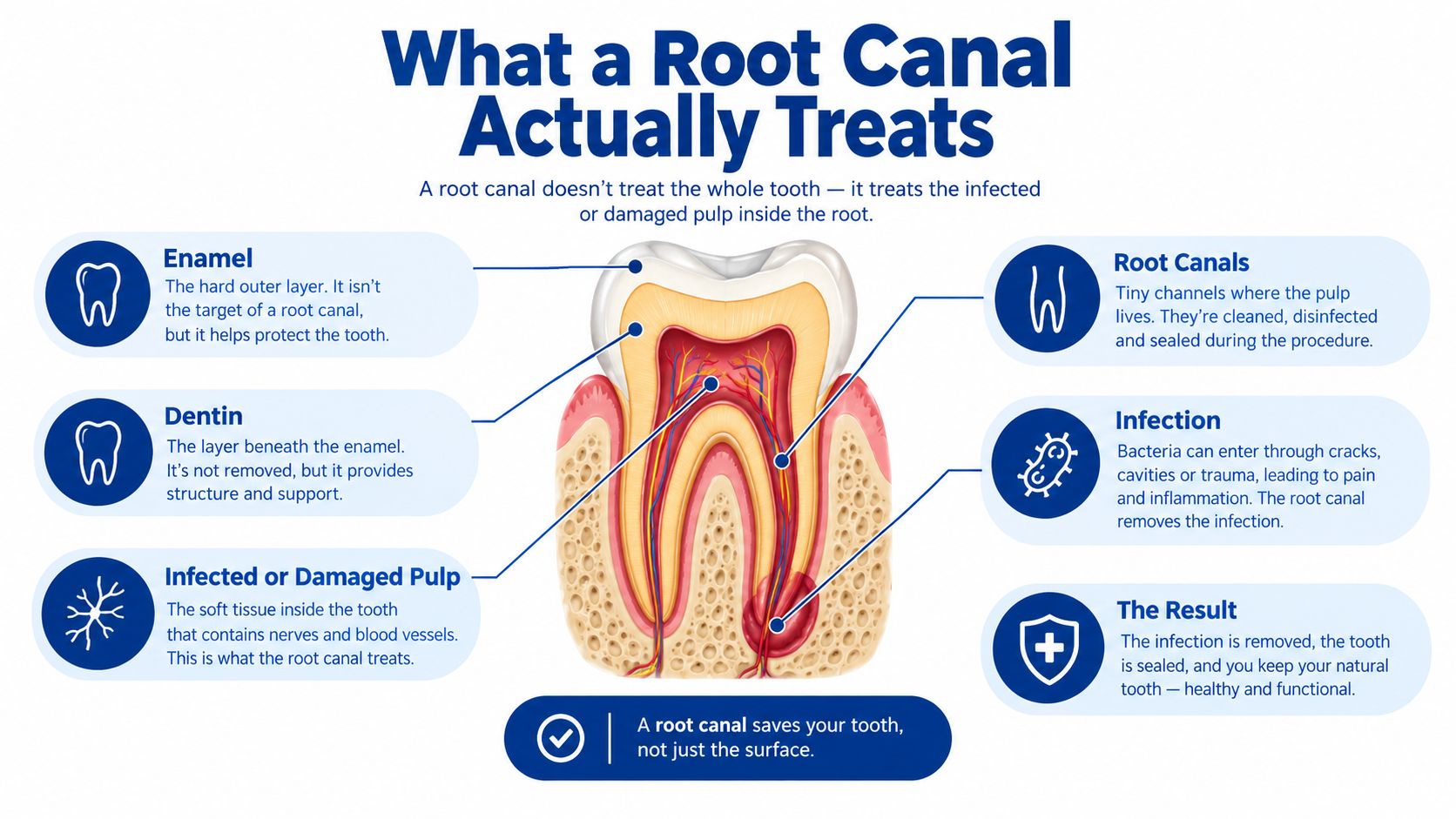
A root canal treats the soft tissue inside a tooth, called the pulp. The pulp contains nerves, blood vessels, and connective tissue. It helps the tooth develop, but a fully formed adult tooth can survive without it because the surrounding tissues continue to support the tooth.
Decay, repeated dental procedures, or a crack can create a pathway for bacteria to reach the pulp. The tissue may become irritated, inflamed, or infected. When the pulp dies, the infection can move through the small canals inside the roots and into the surrounding jawbone.
Reversible and irreversible inflammation
Not every sensitivity requires endodontic treatment. Reversible pulpitis often causes a brief response to cold or sweets that stops when the irritant is removed. A filling, adjustment, or other conservative treatment may resolve the problem.
Irreversible pulpitis is different. Pain may occur without a trigger, linger after temperature exposure, worsen when lying down, or interfere with sleep. In that situation, the damaged pulp cannot reliably recover. Root canal therapy or extraction may be necessary, depending on whether the tooth remains restorable.
The procedure removes the diseased pulp, cleans and shapes the internal canals, disinfects the space, and seals it. The objective isn't just to make pain disappear. It is to eliminate infection, preserve the natural tooth, and reduce the risk of bacteria reaching the surrounding bone and gum tissue.
Root canal treatment is part of routine modern endodontic care worldwide. A systematic review found that 8.2% of all teeth had been endodontically treated and 55.7% of people globally had at least one root canal-treated tooth, with substantial regional variation, according to this systematic review of root canal treatment prevalence. The history of the procedure also extends back centuries, from early pulp-removal efforts described by Pierre Fauchard to an approach credited to Robert Woofendale in 1766, as outlined in this history of root canal treatment.
Symptoms That Mean You Should Call Today
The most useful distinction is whether the tooth settles quickly or continues to signal that the pulp is under stress. Brief sensitivity can have several causes, while lingering or spontaneous pain deserves a professional diagnosis.
A patient should contact a dentist or endodontist promptly when pain wakes them from sleep, appears without an obvious trigger, or becomes sharp when biting and chewing. Swelling, a small pimple-like bump on the gum, a foul taste, or temperature sensitivity that continues after the hot or cold stimulus is removed also warrants an appointment.
| Symptom | Urgency level | Recommended action |
|---|---|---|
| Brief sensitivity that stops quickly | Prompt but not always an emergency | Arrange an exam if it returns or worsens |
| Lingering hot or cold sensitivity, spontaneous throbbing, or pain when chewing | Same-day or next-day dental call | Request an examination and diagnostic imaging |
| Gum bump, facial swelling, foul taste, or increasing pressure | Urgent endodontic evaluation | Contact an emergency dentist or endodontist |
| Trouble breathing, difficulty swallowing, severe facial swelling, swelling near the eyes, or fever of 38°C/100.4°F or higher | Immediate emergency evaluation | Seek emergency medical care rather than waiting for a routine appointment |
Short-term discomfort after treatment is also possible. In a prospective study, postoperative pain incidence ranged from 34.6% to 63.8% depending on pulp condition, as reported in this study of pain after root canal treatment. That finding doesn't mean treatment has failed. It means the diagnosis and the condition of the pulp influence the recovery experience.
Root canal outcomes are generally favorable, but success depends on how it is measured and on the condition of the tooth before treatment. A systematic review found pooled primary-treatment success of 92.6% under loose criteria and 82.0% under strict criteria, with survival often remaining above 87% at 8 to 10 years, according to this review of endodontic treatment outcomes. The sensible response to early symptoms is not panic. It is to make the call before swelling, bone involvement, or a fracture narrows the available options.
What Happens at the Appointment
The first call usually begins with triage. The dental team asks when the pain started, whether it is triggered by temperature or chewing, whether swelling is present, and whether the patient has fever or difficulty swallowing. Those answers help determine whether the visit can be scheduled as an urgent dental appointment or requires immediate medical escalation.
Diagnosis before treatment
At the appointment, the dentist examines the tooth, surrounding gums, bite, and neighboring teeth. Dental X-rays show the roots and surrounding bone. When the anatomy is complex, a CBCT scan can provide three-dimensional information about curved canals, hidden infection, fractures, or nearby structures.
The dentist then explains the findings and discusses the available choices. A tooth may need root canal treatment and a crown, a temporary stabilizing measure followed by definitive care, or extraction if the structure cannot be predictably restored. Clear diagnosis prevents a patient from committing to a procedure that cannot solve the underlying problem.
A controlled, carefully isolated procedure
Local anesthetic numbs the tooth and surrounding area. A rubber dam keeps the tooth dry and helps prevent saliva and bacteria from entering the treatment field. The dentist creates a small access opening, removes diseased pulp, cleans the canals, and shapes them so the filling material can seal the internal space.
A bioceramic sealer may be used with the canal filling material to close irregularities and reduce pathways for reinfection. Some straightforward teeth can be completed in one visit, while molars or teeth with complex anatomy may require staged treatment. The exact schedule depends on the tooth, the infection, and the restoration required afterward.
A prosthodontist-endodontist collaboration can make the next step clearer. At Prosth & Co., an in-house laboratory and coordinated restorative planning allow the team to consider the build-up and crown while the root canal is being planned. Patients can leave the initial visit with a stable temporary restoration and a defined path toward definitive care, rather than an unclear referral chain.
Why the Crown After the Root Canal Matters
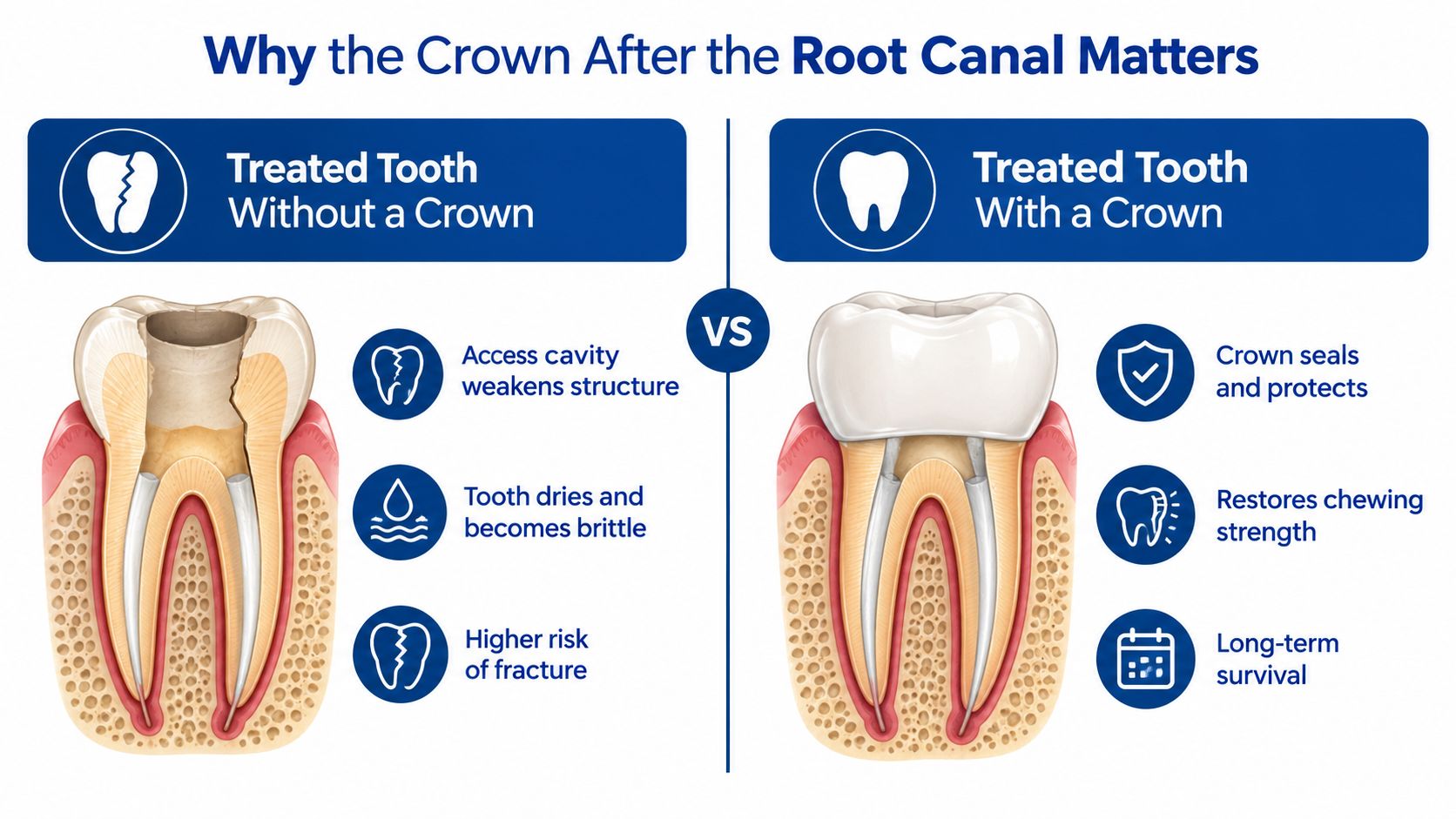
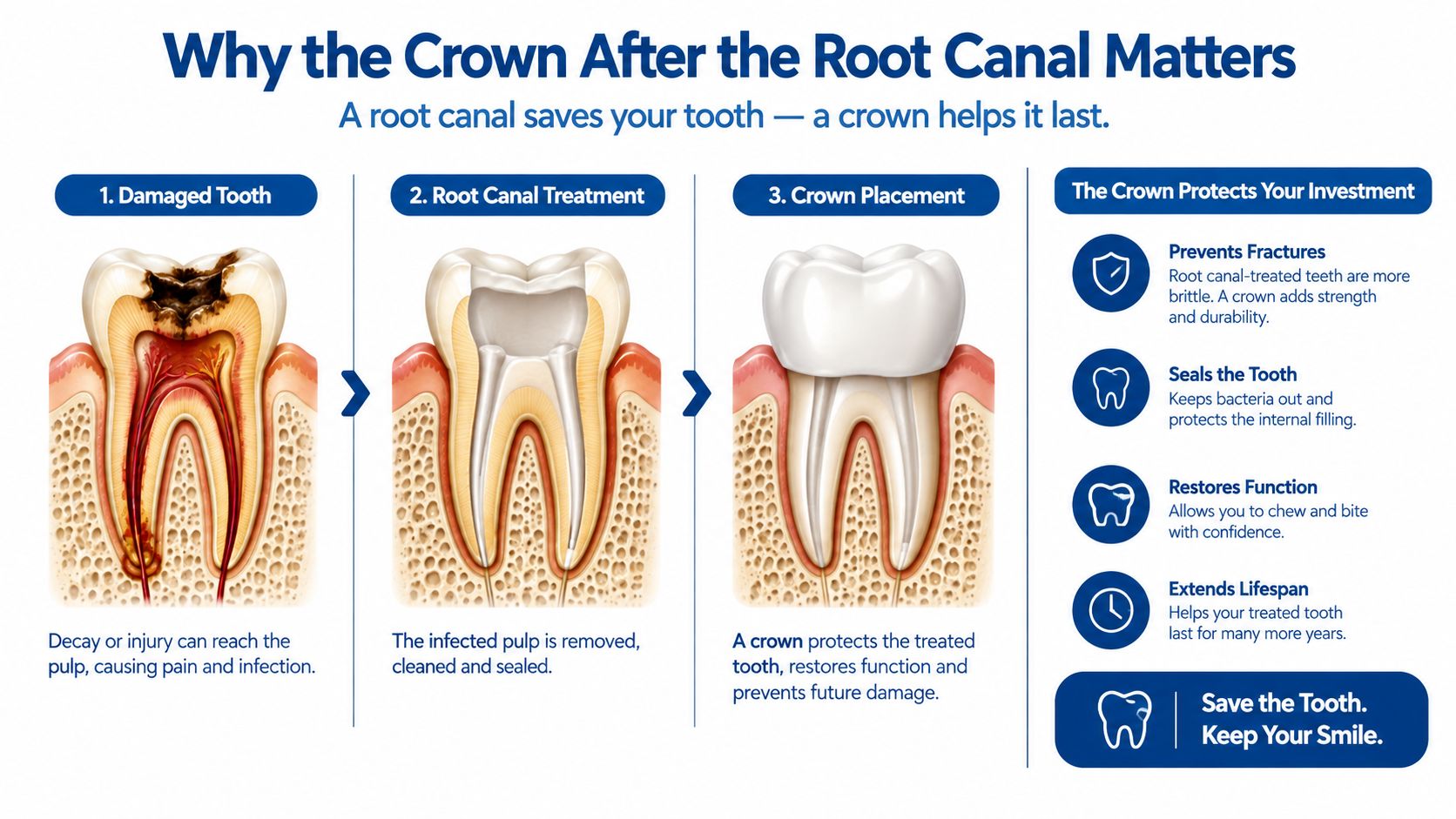
Root canal treatment removes infection, but it doesn't automatically restore the tooth's full structural strength. The access opening removes part of the tooth, and a tooth weakened by decay, cracks, or previous restorations may be less able to withstand chewing forces.
That is why the final restoration matters as much as the canal treatment. A root canal without a suitable restoration can leave the tooth vulnerable to leakage, fracture, or further loss of structure. The restorative plan should be discussed before treatment begins, not after the patient has already left with a temporary filling.
The restoration sequence
The dentist may rebuild missing structure with a core build-up. A post can be considered when additional retention is needed, although a post doesn't strengthen every tooth and isn't automatically appropriate. The final crown covers and protects the remaining tooth, restores its shape, and returns it to functional contact with neighboring teeth.
Molars and premolars commonly need full-coverage protection because they absorb substantial chewing forces. A front tooth may sometimes be restored with a bonded filling or another conservative option when enough healthy structure remains and the functional demands are different. The decision depends on remaining enamel, cracks, the size of the access opening, bite forces, and appearance.
A prosthodontist-led practice with an in-house laboratory can coordinate impressions, digital design, shade selection, and fabrication in one treatment plan. That arrangement can reduce disconnected appointments and gives the restorative dentist direct oversight of the crown's fit, bite, contacts, and appearance.
Extraction remains appropriate when a tooth is split below the gum, has insufficient healthy structure, or cannot be sealed predictably. In that situation, a tooth extraction may be followed by a dental implant and implant-supported crown. Patients searching for dental implants near me should compare that replacement pathway with the possibility of saving the natural tooth, but the decision must follow a restorability assessment rather than cost or fear alone.
Real Costs and What Insurance Covers
The cost of a root canal should be discussed as a complete episode of care, not as a single procedure. The total may include the examination, dental X-rays or CBCT imaging, endodontic treatment, a core build-up, and the final crown. Tooth location, anatomy, infection, restoration complexity, and the practice's fees all affect the estimate.
Independent U.S. cost guidance places root canal treatment at roughly $679 to $1,733 overall, while a crown may add approximately $800 to $2,500, according to this root canal cost guide. These figures are broad reference ranges, not a Manhattan quote. A practice should provide a patient-specific estimate after examining the tooth.
| Treatment component | Root canal path | Extraction and implant path |
|---|---|---|
| Diagnosis and imaging | Examination, X-rays, and possible CBCT | Examination, X-rays, and possible CBCT |
| Tooth treatment | Root canal therapy | Tooth extraction |
| Structural restoration | Core build-up when needed | Implant placement and healing stages |
| Definitive restoration | Crown when the tooth requires coverage | Implant-supported crown |
| Main trade-off | Preserves the natural tooth when it is restorable | Replaces a tooth that cannot be predictably saved |
Insurance coverage depends on the plan, deductible, annual maximum, waiting rules, and whether the dentist is in network. A written pretreatment estimate can show how the plan applies to endodontic treatment, the build-up, and the crown separately. Patients should also ask whether imaging, emergency visits, sedation, and laboratory charges are handled under different benefit categories.
The lowest initial fee isn't always the lowest overall cost. Extraction can remove the immediate source of pain, but replacing the tooth may require additional surgery, an implant, a crown, or a bridge. The better financial comparison is the full restorative pathway against the full tooth-saving pathway, not the root canal fee against the extraction fee alone.
How to Choose the Right Endodontist
Choosing an endodontist can begin with a short phone call. Patients don't need to understand every technical detail, but they should receive direct answers about diagnosis, timing, treatment, and restoration.
Questions worth asking
- In-house treatment: Does the practice perform root canals on-site, or does it routinely refer patients elsewhere?
- Imaging: Can the team use digital X-rays and CBCT when the anatomy or diagnosis calls for three-dimensional imaging?
- Urgent access: Are same-week emergency evaluations available for acute pain, swelling, or a suspected abscess?
- Restorative ownership: Who plans the build-up and crown after the canal treatment?
- Laboratory coordination: Will the final crown require a separate laboratory visit, or can an in-house ceramist and dentist coordinate the restoration?
A prosthodontist-led multi-specialty office can connect endodontic treatment with the final crown, implant planning, bite management, and cosmetic considerations. That matters when a tooth has significant structural damage or when neighboring teeth also need attention. It also helps families who want adult care, an endodontist, a pediatric dentist, or a kids dentist within the same coordinated setting.
For patients evaluating endodontic care in Manhattan, Prosth & Co. is located at 47 E 77th St #207 on the Upper East Side, near the 77th Street 6 train. The practice lists an in-house laboratory, digital treatment planning, and a collaborative team that includes endodontic, prosthodontic, and pediatric dental services. Those are practical factors to verify when a patient wants the root canal and definitive restoration planned together.
Next Steps and Common Questions
A patient in pain should call the office and describe the symptoms plainly. Mention whether the pain is spontaneous, whether hot or cold triggers it, whether biting hurts, and whether swelling or fever is present. The team can arrange urgent triage, determine whether a CBCT scan is appropriate, and discuss whether the build-up and crown can be coordinated with the root canal plan.
Until the appointment, patients should avoid chewing on the painful side and shouldn't place aspirin directly on the gum. Over-the-counter pain medication may provide temporary relief when used according to the product label and a patient's medical guidance, but it won't remove an infection. Rapidly worsening pain, facial swelling, difficulty swallowing, breathing problems, or significant fever require urgent escalation.
Common questions
How quickly does pain resolve after a root canal?
Pain often begins to settle after the source of inflammation has been treated, but recovery varies with the diagnosis and the condition of the surrounding tissues. Increasing pain, new swelling, or severe biting tenderness after treatment should prompt an endodontic re-evaluation. A 2026 systematic review found an overall severe flare-up incidence of 2.83%, and described flare-ups within hours or days of treatment as requiring emergency management, according to this review of severe post-treatment flare-ups.
Can a patient drive home afterward?
Patients can generally drive after a straightforward root canal performed with local anesthetic, provided they feel alert and comfortable. Sedation changes that advice, so anyone receiving sedation should arrange transportation according to the practice's instructions.
Can children receive treatment on-site?
Children can be evaluated by a pediatric dentist when a primary or permanent tooth develops pain, swelling, or trauma. Pediatric care may include behavior guidance, age-appropriate imaging, treatment coordination, and follow-up. A 2024 emergency endodontic study reported root canal treatment in 60% of treated teeth and a 95% successful one-year outcome among evaluated teeth, with 2% uncertain outcomes and 3% failures, as reported in this study of emergency endodontic treatment.
Patients searching for a root canal near me can contact Prosth & Co. for urgent triage, endodontic diagnosis, and coordinated restorative care on Manhattan's Upper East Side. The practice can help determine whether the tooth is best treated with root canal therapy, a crown, tooth extraction, or a dental implant, then schedule the next step with a clear treatment plan.

Founder and lead prosthodontist of Prosth & Co. on Manhattan's Upper East Side. DDS, Columbia University; Prosthodontics certificate and MMSc in Oral Biology, Harvard School of Dental Medicine; Implantology fellowship, Columbia University.
Meet Victoria →