
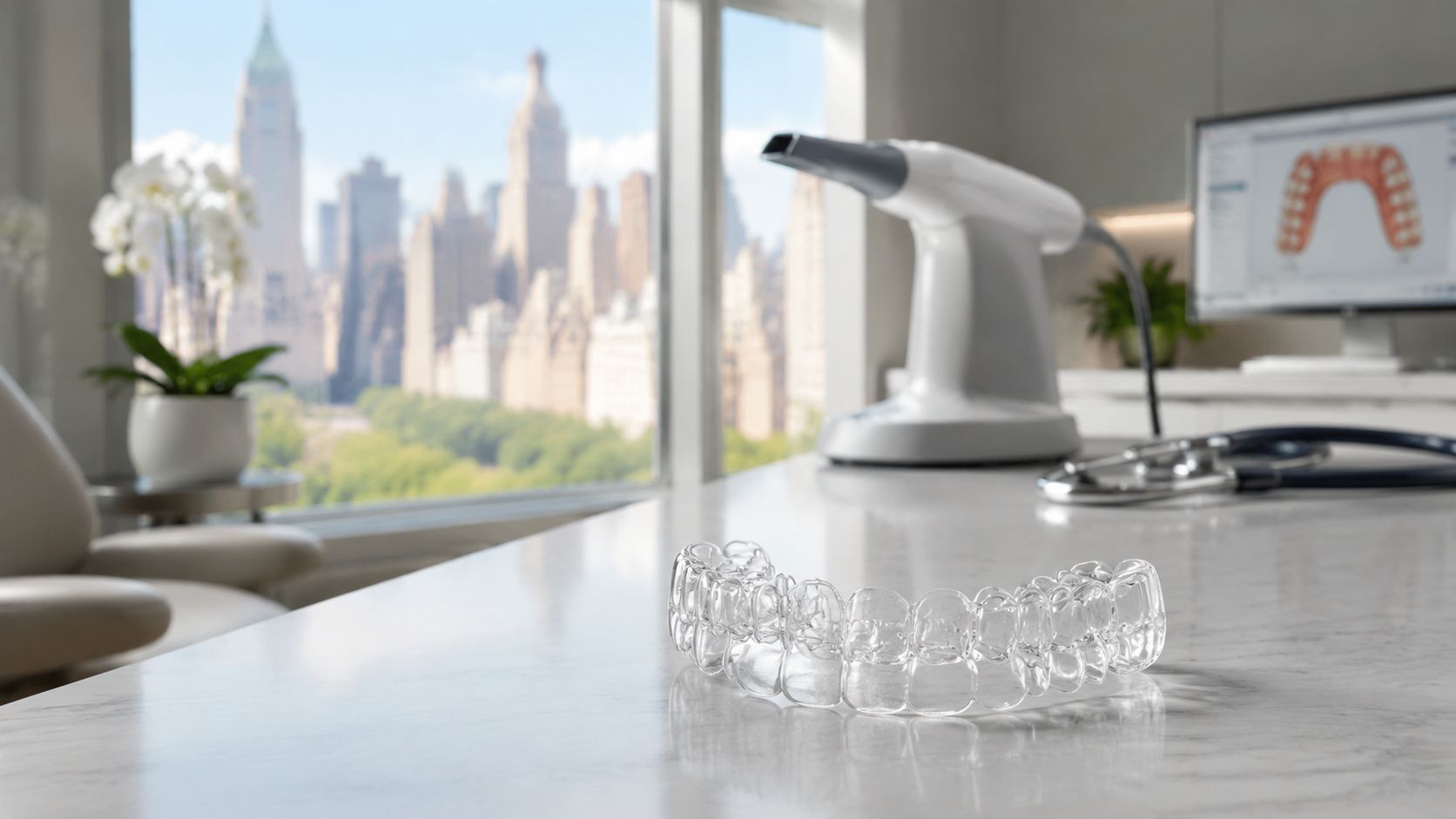
A lot of Upper East Side patients start the same way. They wake up with a tight jaw, a dull temple headache, or teeth that suddenly feel more sensitive than they used to. They assume it's stress, poor sleep, a long workweek, or age. Sometimes it is. Often, it's also bruxism, the habit of grinding or clenching the teeth, usually during sleep.
That matters even more for patients who've invested in their smiles. A person with porcelain veneers, implant crowns, ceramic restorations, or carefully rebuilt bite surfaces has more at stake than just morning soreness. Repeated nighttime pressure can shorten the life of dental work that was designed to restore comfort, function, and appearance. A properly selected night guard for bruxism helps protect those teeth and restorations from avoidable wear and fracture.
Table of Contents
- Your Trusted Dentist on the Upper East Side for Jaw Pain and Headaches
- Understanding Bruxism and Its Impact on Your Smile
- Comparing Night Guard Options Custom vs Over-the-Counter
- The Benefits of a Professional Custom Night Guard
- Your Night Guard Consultation and Fitting at Prosth & Co.
- Cost Maintenance and Insurance for Your Night Guard
- Schedule Your Bruxism Consultation on the Upper East Side Today
- Frequently Asked Questions About Night Guards
Your Trusted Dentist on the Upper East Side for Jaw Pain and Headaches
A common Upper East Side pattern looks like this. A patient books a visit for sensitive teeth, a chipped edge, or a headache that shows up most mornings. During the exam, the teeth show flattening, tiny fracture lines, or sore jaw muscles. The problem isn't always visible to the patient, but the bite often tells the story clearly.
Jaw pain and headaches can overlap with many issues, which is why diagnosis matters. Some people clench during sleep. Some hold tension in the face and neck during the day. For patients trying to sort out overlapping symptoms, it can also help to review outside guidance on addressing headaches caused by neck issues, especially when neck tension and jaw tension seem to feed each other.
When morning symptoms keep repeating
Bruxism rarely announces itself in a dramatic way at first. It usually shows up as repetition. Morning tightness. Soreness while chewing. Tenderness near the jaw joints. A partner hearing grinding sounds at night. A crown that starts to feel like it's taking more force than it should.
For busy Manhattan patients, the frustrating part is that the habit often happens during sleep, when there's no chance to consciously stop it. That's why many people don't connect the symptoms until a dental exam ties the pattern together.
A night guard shouldn't be chosen only because a patient grinds. It should be chosen because the bite, symptoms, and existing dental work all need the right kind of protection.
Why a local prosthodontic evaluation matters
Patients searching for a dentist near me or a dentist in New York, NY for jaw pain often need more than a quick look at the teeth. They need someone who can evaluate how force is moving through the bite and where restorations may be vulnerable.
That's especially true on the Upper East Side, where many adults already have crowns, veneers, implant restorations, or prior cosmetic dentistry. In those cases, the question isn't just whether a guard is needed. The question is whether the appliance will protect the entire system without creating new pressure points or making the jaw feel worse.
Understanding Bruxism and Its Impact on Your Smile
A patient may sleep through bruxism for years and only notice it after something expensive starts to fail. A veneer chips at the edge. A crown begins to feel sore when biting. An implant crown looks intact, but the surrounding bite starts carrying force unevenly. That is often how grinding first becomes real.

Why many patients don't know they grind
Sleep bruxism happens outside conscious control, so the first clues are usually physical signs, not awareness of the habit. I often see flattened enamel, small chips near the edges of front teeth, stress lines in restorations, or muscle tenderness that patients assumed was just poor sleep or tension.
Once those signs are present, waiting rarely helps. Grinding can continue night after night, and the force adds up. A night guard does not stop the brain from clenching or grinding. It creates a protective barrier between the teeth and helps distribute force more safely. Patients who want a clearer overview can read more about how night guards work for bruxism.
Why restorative work needs special protection
Bruxism is serious enough for patients with only natural teeth. The stakes rise for patients with crowns, veneers, implants, bridgework, or full-mouth restorative treatment because those teeth and restorations must function as one coordinated bite.
That distinction matters in prosthodontic care. Restorative materials are strong, but they are not indestructible, and different restorations handle force in different ways. Natural teeth have some ligament support. Implants do not. Veneers can look beautiful for years, but edge-to-edge grinding can chip them. A crown may remain intact while the opposing tooth wears down. In a complex case, the problem is rarely one tooth alone. The whole bite starts to drift under repeated overload.
- Natural teeth can lose enamel and become more sensitive as wear continues.
- Crowns and veneers can chip, loosen, or fracture under repeated heavy contact.
- Implant restorations need careful force control because implants lack the shock absorption of natural teeth.
- Full-mouth rehabilitation needs ongoing protection to preserve the bite relationships that treatment was designed to create.
Clinical point: A night guard for bruxism protects chewing surfaces and restorations from repeated force. It does not retrain the brain to stop grinding.
Patients often assume bruxism is mainly a comfort issue because it causes soreness, tension, or headaches. In many cases, the larger concern is preservation. Untreated grinding can shorten the life of dental work you have already invested in, and repairing that damage is usually more involved than preventing it.
Comparing Night Guard Options Custom vs Over-the-Counter
A patient with veneers, an implant crown, or several ceramic restorations usually needs more than a generic guard from the pharmacy. The main question is not which option is cheaper tonight. It is which appliance protects the bite you have already invested in over time.
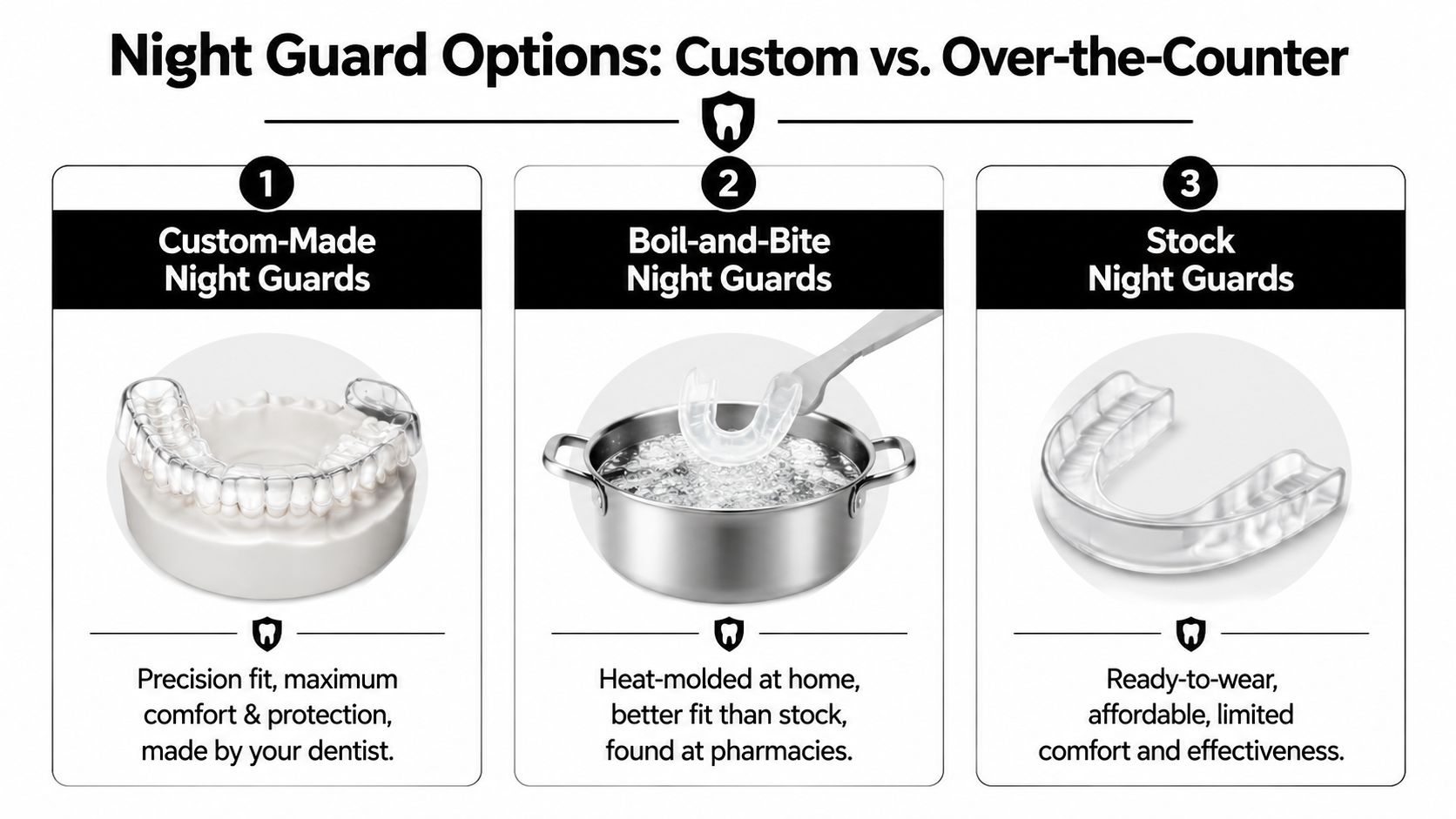
Patients generally look at three categories. Stock guards bought off the shelf. Boil-and-bite guards shaped at home. Professionally made custom appliances fabricated from records of the patient's actual bite.
How the main categories differ
A stock guard is the fastest option, but it is also the least precise. It is made to fit almost everyone, so it rarely fits anyone particularly well. That often means bulkiness, poor retention, and uneven contact across the bite.
A boil-and-bite guard offers more adaptation because the material is softened and molded at home. Some patients use one as a short-term stopgap. The limitation is accuracy. Home molding cannot capture the same detail as professional impressions or scans, and it cannot account for the force patterns I watch for in patients with crowns, veneers, or implant restorations.
A custom guard is made for the details that matter clinically. The fit is specific to the teeth. The bite contacts can be adjusted. The material and thickness can be chosen based on how a patient clenches, where wear is showing, and whether existing dental work needs extra protection. Patients who want a clearer overview of how night guards work and why design matters can review that in more detail.
Night Guard Comparison
| Feature | Custom-Fit (Prosth & Co.) | Boil-and-Bite | Stock (One-Size-Fits-All) |
|---|---|---|---|
| Fit | Made to the patient's teeth and bite | Molded at home with limited precision | Generic fit |
| Comfort | Usually easier to tolerate once adjusted | Variable | Often bulky |
| Protection for crowns veneers and implants | Better suited for complex restorative cases | Less predictable | Limited |
| Durability | Material can be selected for wear pattern | Moderate | Often lower |
| Ability to refine bite contact | Yes, professionally adjusted | No meaningful refinement | No |
| Best use | Ongoing protection and more complex needs | Temporary or budget-conscious trial | Very limited situations |
Material choice changes the result
Soft guards made from EVA are often used for lighter grinding patterns because they are easier for some patients to tolerate. Harder appliances are commonly chosen for heavier clenching because they hold their shape better under stronger force.
Material selection also affects how the appliance behaves against restorations. A patient with natural teeth and minor wear may do well with one design. A patient with porcelain veneers, implant crowns, or full-mouth restorative work may need a different approach so the guard protects the restorations without introducing unstable contacts.
Dual-laminate and hard acrylic appliances are common choices for moderate to heavier bruxism. Thickness is also adjusted for the case. In practice, the trade-off is straightforward. Softer appliances may feel easier at first. Harder appliances usually provide better durability and more controlled bite management when force levels are high.
That distinction matters more in prosthodontic care than many patients realize. If the goal is to protect a substantial investment in dental work, the best option is usually the one that fits accurately, wears predictably, and can be adjusted professionally as the bite changes.
The Benefits of a Professional Custom Night Guard
A patient spends years building a healthy, polished smile. Then one season of heavy clenching leaves a veneer chipped, a crown sore to bite on, or an implant crown taking more force than it should. That is the point where a custom night guard stops feeling optional.
A professional appliance protects more than teeth. It helps protect dental work that is costly, technique-sensitive, and meant to last. For many Upper East Side patients, that includes porcelain veneers, ceramic crowns, implant restorations, and full-mouth rehabilitation that deserves better than a one-size-fits-all guard.
Protection has to be precise
A night guard does not eliminate the grinding habit during sleep. Its job is to control how that force reaches the teeth and restorations. Precision matters here. If the fit is off or the bite contacts are uneven, the appliance can become one more surface that directs pressure poorly.
That concern is even more important in prosthodontic care. Natural enamel can wear. Restorations can chip, loosen, or fail under repeated overload. An implant does not have the same cushioning response as a natural tooth, so force management needs more attention, not less.
I tell patients the same thing every week. Protecting the bite is far easier than repairing a fractured veneer or replacing a damaged implant crown.
The benefit is not just comfort
Comfort matters because patients are more likely to wear an appliance that fits well. The larger benefit is control. A professionally made guard can be adjusted to the bite, the muscle pattern, and the existing dental work so force is distributed more evenly during sleep.
That gives a custom appliance several practical advantages:
- More accurate protection for restorations because the appliance is made around the actual tooth positions and bite relationship
- Better force control for patients with heavy clenching, worn teeth, or symptoms in the jaw muscles
- A more stable fit that is less likely to shift, feel bulky, or create pressure points
- Room for professional adjustment if the bite changes or certain teeth and restorations need lighter contact
- Support for long-term restorative planning in patients who already have significant dental treatment or are trying to avoid more of it
Those details are easy to overlook until a patient has complex dentistry in the mouth. Then they become the whole point.
A store-bought guard may create a barrier between the arches. A professional custom guard is designed to protect the specific bite it is covering. For patients with crowns, veneers, implants, or a history of fracture and wear, that difference is practical, not cosmetic.
The goal is simple. Keep expensive dentistry intact, keep the bite stable, and reduce the chance that night-time force turns into another repair.
Your Night Guard Consultation and Fitting at Prosth & Co.
A lot of patients delay treatment because they expect a complicated process. The actual visit is usually more straightforward than they expect.

What happens at the first visit
At the consultation, the dentist evaluates the teeth, existing restorations, jaw muscles, and bite pattern. The exam looks for signs such as wear facets, chipped edges, muscle tenderness, and stress on crowns or implant restorations. If a patient is also looking for a cosmetic dentist near me, dental implants near me, or help with worn or broken teeth, that bite analysis becomes even more useful because it helps guide long-term restorative planning.
The office at 47 E 77th St, Suite 207, New York, NY 10075 uses modern records to make the process more comfortable and precise. That can include digital scanning rather than traditional impression material, which many patients prefer.
How the fitting works
Once the records are taken, the appliance is fabricated to match the patient's bite. When it's delivered, the guard is checked for fit, retention, comfort, and contact. Small adjustments can make a significant difference in how naturally it seats and how well a patient tolerates it through the night.
A properly fitted appliance should feel intentional, not improvised. It should stay in place, avoid obvious high spots, and protect without creating a sensation that the bite is being pushed in the wrong direction.
For patients who want to see a general overview of oral appliance wear and what a custom solution looks like in practice, this short video is helpful.
Some patients need only a protective appliance. Others need a guard plus a broader plan for worn teeth, failing restorations, or changes in the bite.
That difference is why a consultation matters. The appliance is one part of care. The diagnosis is the part that keeps treatment on the right track.
Cost Maintenance and Insurance for Your Night Guard
A night guard is usually far less costly than replacing the work it protects. For patients with veneers, crowns, implant restorations, or multiple bonded teeth, that comparison matters. Nighttime clenching can chip porcelain, loosen bite harmony, and shorten the life of dentistry that was meant to last for years.
What the price difference really buys
Pricing reviews show a wide range between store-bought guards, mail-order options, and professionally made appliances. The difference is not just the material. It includes how accurately the guard fits, how it distributes force, how well it holds up, and whether it is designed around your actual bite instead of an average shape.
That distinction matters more in a mouth with restorative work. A guard that is slightly off may still feel usable, but it can place uneven pressure on a veneer edge, a crown margin, or an implant crown that does not have the same shock absorption as a natural tooth. In practice, I am less concerned with the upfront price than with whether the appliance protects expensive dentistry without creating new problems.
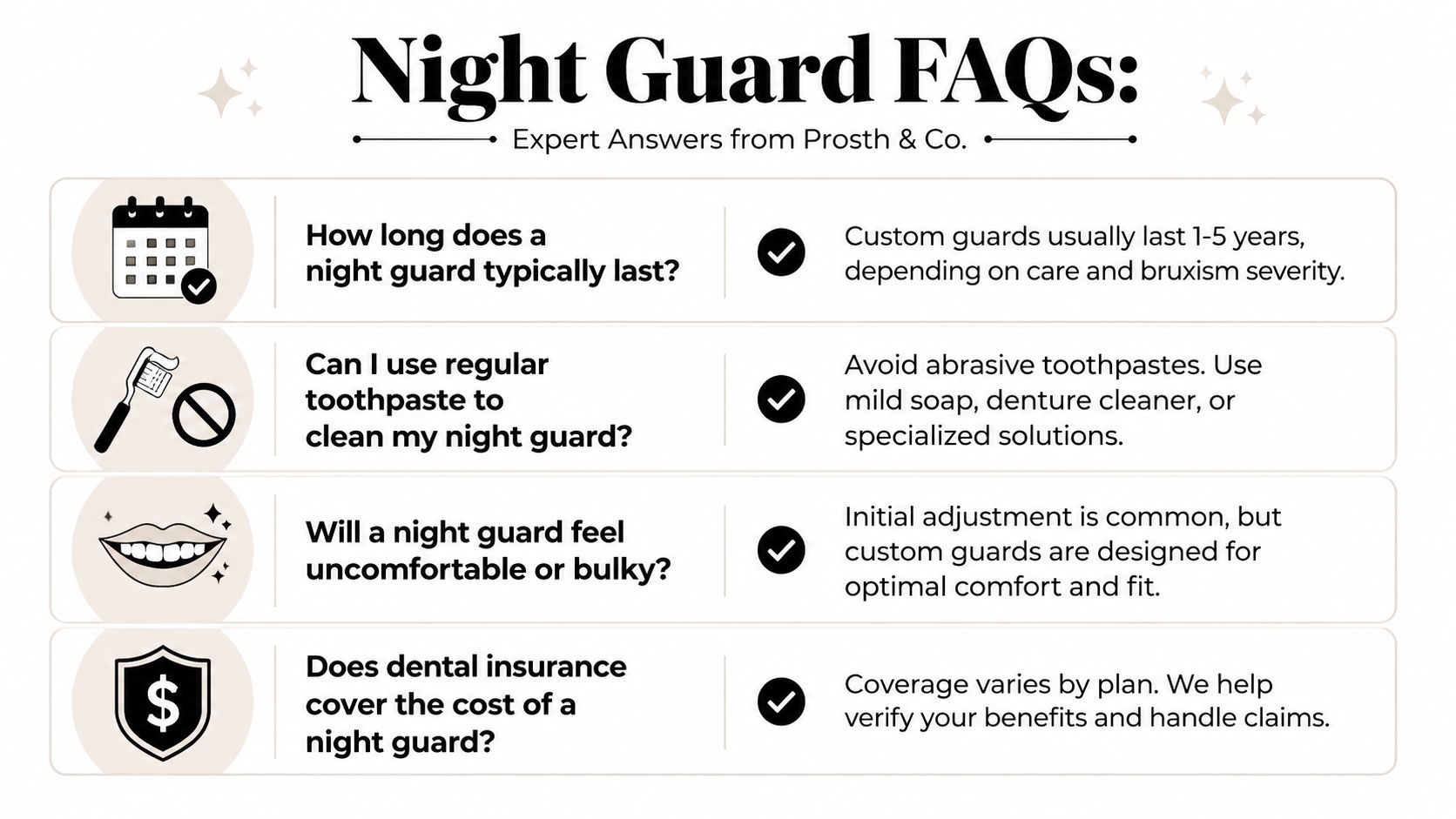
Insurance coverage varies by plan. Some plans contribute toward a medically or dentally necessary appliance, while others do not. The office team can help review benefits before treatment begins. For readers comparing broader benefit options, local guidance for family health coverage may also be useful.
How to care for the appliance
Good maintenance helps the appliance last and keeps it comfortable to wear.
- Rinse it after use to remove saliva and debris.
- Clean it gently with a non-abrasive cleanser.
- Store it in its case in a clean, dry place.
- Bring it to recall visits so wear, fit, and bite contacts can be checked.
Patients who want a more detailed home routine can review how to clean a night guard naturally.
Another practical point is fit changes. If the guard starts feeling loose, develops a rough edge, or no longer seats the same way, it deserves a prompt evaluation. Small changes in an appliance can be the first sign of heavy grinding, tooth movement, or stress on existing restorations.
Schedule Your Bruxism Consultation on the Upper East Side Today
Jaw pain, tension headaches, worn teeth, and repeated chipping aren't problems that patients should live with. When bruxism is caught early, a well-designed guard can help protect both comfort and long-term dental work before the damage becomes more complicated.
That matters whether a patient needs preventive care, help maintaining veneers or implant crowns, repair for worn teeth, or guidance from an emergency dentist after a crack or fracture. It also matters for people trying to avoid bigger procedures later, including extensive restorative care, root canal treatment, or even tooth extraction when damage has gone too far.
Patients looking for a dentist near me on the Upper East Side can take the next step by contacting the office for a bruxism evaluation. Scheduling is available through the online booking page at Prosth & Co., and patients can also call the office directly or visit 47 E 77th St, Suite 207, New York, NY 10075 to arrange a consultation.
Frequently Asked Questions About Night Guards
Some of the most important night guard questions come up after patients already know they grind. The next concern is whether the guard will help their specific situation.
Can the wrong guard make symptoms worse
Yes, it can. An ill-fitting appliance may feel bulky, seat unevenly, or create unwanted pressure on certain teeth or areas of the jaw. That doesn't mean night guards are harmful by nature. It means design and fit matter.
A common point of confusion is whether a night guard treats bruxism. The answer is that it primarily protects teeth from damage and may reduce symptoms, but it doesn't stop the grinding reflex itself. That's why diagnosis is important when there may be contributing issues such as stress, TMJ disorder, snoring, or sleep apnea, as explained in this overview of occlusal mouth guards.
How do night guards work with veneers implants and emergency symptoms
They can work very well with veneers, crowns, and implants when the appliance is designed with those restorations in mind. In fact, patients with existing dental work often benefit the most from bite-specific protection, because the goal is to preserve both the restoration and the surrounding structures.
Other oral appliances can look similar but serve a different purpose. Some are meant for snoring or sleep apnea. Others are used for specific jaw-joint conditions. That's one reason patients shouldn't assume any appliance worn at night is interchangeable.
A patient should seek prompt care if jaw pain is severe, a tooth fractures, a restoration breaks, swelling appears, or the bite suddenly changes. In those moments, the issue may go beyond routine bruxism management and require urgent dental attention.
Patients on the Upper East Side who are dealing with jaw pain, worn teeth, chipped restorations, or suspected nighttime grinding can schedule a consultation with Prosth & Co. to find out whether a custom night guard and a more complete bite evaluation are appropriate.
Related topic: Learn more about Bruxism And Night Guards.

Founder and lead prosthodontist of Prosth & Co. on Manhattan's Upper East Side. DDS, Columbia University; Prosthodontics certificate and MMSc in Oral Biology, Harvard School of Dental Medicine; Implantology fellowship, Columbia University.
Meet Victoria →