If a missing tooth has changed the way someone eats, smiles, or speaks, the problem rarely stays cosmetic for long. Many Manhattan patients begin by chewing on one side, avoiding certain foods, or covering their mouth in photos. Then the search starts for a dentist near me, dental implants near me, or a restorative dentist in New York City who can give a clear answer instead of a vague promise.
That's where the implant placement procedure matters. A dental implant isn't just a replacement tooth. It's a carefully planned surgical and restorative process designed to rebuild support where a natural root used to be. For patients on the Upper East Side, the right treatment starts with understanding the timeline, the technology, and the decisions that affect long-term comfort and stability.
Table of Contents
- Your Smile's Future Starts on the Upper East Side
- Your Personalized Implant Plan with Dr. Park
- The Implant Placement Procedure Step by Step
- Healing Osseointegration and Your New Tooth
- Advanced Solutions for Complex Dental Implant Cases
- The Prosth & Co Difference for Dental Implants in NYC
- Schedule Your Dental Implant Consultation in Manhattan
Your Smile's Future Starts on the Upper East Side
A single missing tooth can create problems that feel out of proportion to its size. Biting into a sandwich becomes awkward. Speech may feel different. Some patients start postponing social plans because they're tired of thinking about the gap every time they laugh.
Many people looking for a dentist in New York, NY or an emergency dentist after a broken tooth or failed restoration want one thing first. They want to know whether the situation can be fixed in a way that looks natural and feels dependable.
On the Upper East Side, implant care should feel calm, organized, and specific to the person in the chair. The implant placement procedure isn't a one-size-fits-all service. It depends on bone shape, gum health, bite forces, the position of nearby teeth, and whether the site needs preparation before surgery.
Why patients often start with uncertainty
Some patients arrive assuming an implant can be placed in a single visit and finished right away. Others have been told they may need a tooth extraction, a bone graft, or a staged restorative plan and aren't sure what that means.
What usually helps is a practical explanation:
- A missing tooth affects more than appearance. Chewing balance, bite comfort, and cleaning patterns can all change.
- Implant treatment is planned backward from the final tooth. The goal isn't just to place metal in bone. The goal is to create a tooth that can be restored, cleaned, and used comfortably.
- The timeline is biological, not arbitrary. Healing has to match what the bone and gum tissue can support.
A good implant result should make daily life easier, not create a restoration that looks acceptable in a photo but feels difficult to bite on or maintain.
Patients searching for a cosmetic dentist near me often discover that the most attractive result comes from strong restorative planning. A crown only looks right when the implant underneath it is in the right position. That's why the early decisions matter so much.
For New Yorkers balancing work, family, and a full calendar, clarity matters almost as much as treatment itself. When the process is explained well, patients usually feel less anxious and more confident about moving forward.
Your Personalized Implant Plan with Dr. Park
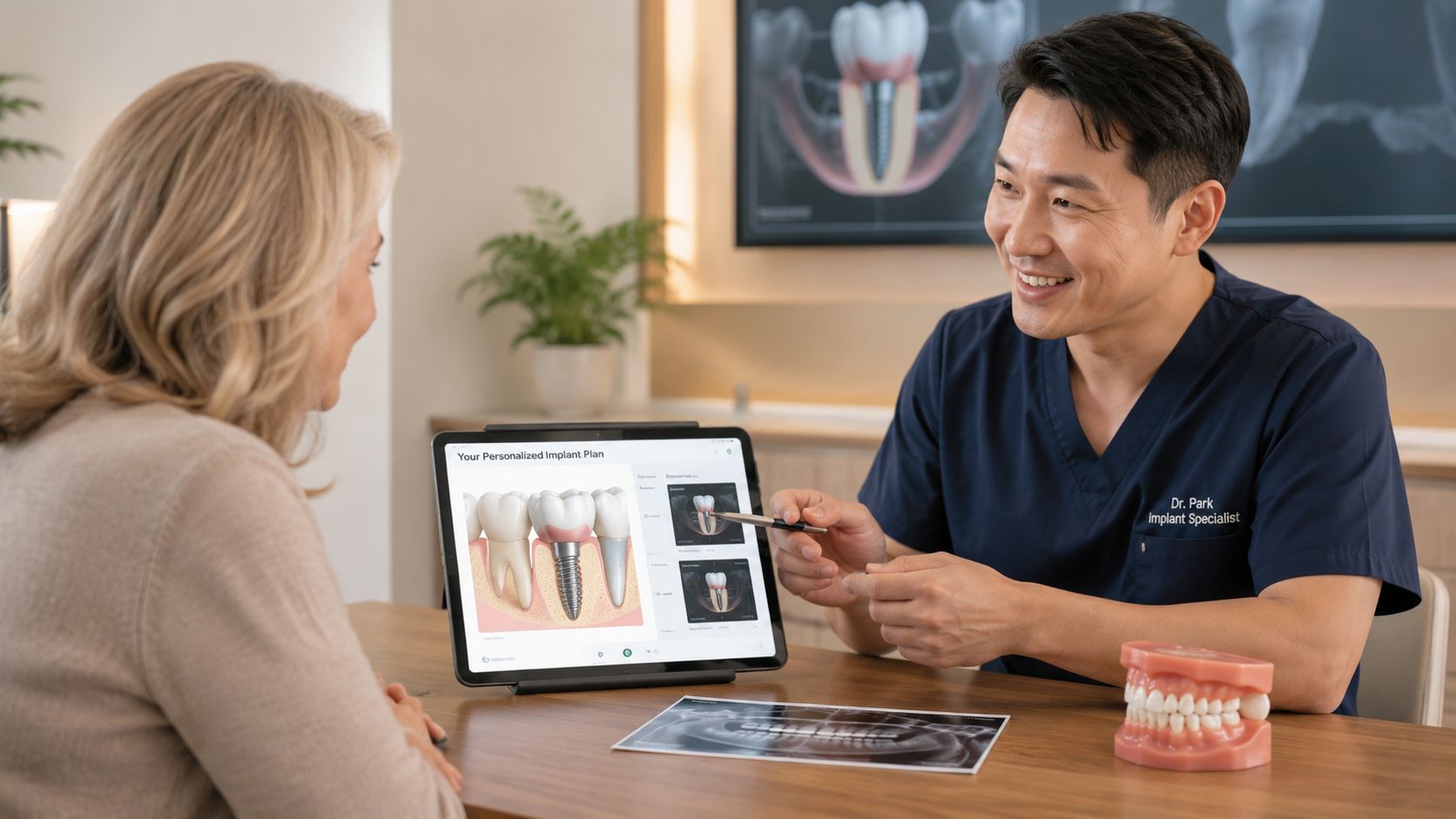
A predictable implant result starts long before surgery. The first appointment is where the entire treatment path begins to take shape.
What happens at the first visit
During a new patient exam, the focus isn't limited to the empty space. The evaluation includes the surrounding teeth, the bite, the gums, and the volume and contour of available bone. If a patient is also dealing with worn teeth, an old bridge, or a failing tooth that may need removal, those details affect the implant plan immediately.
Modern implant dentistry depends heavily on CBCT-based 3D planning and surgical guides to reduce positioning errors, with clinicians comparing the final implant position against the original plan to confirm placement relative to nerves, sinuses, and adjacent teeth, as outlined in this discussion of 3D implant planning and placement accuracy. That planning step matters because a few small positional changes can affect the final crown far more than most patients realize.
A careful consultation usually answers questions such as:
- Is there enough bone for an implant now? If not, grafting may be considered.
- Will the implant support a crown in a clean, functional position? That includes looking at bite forces and access for home care.
- Is the gum architecture favorable? Esthetics depend on more than the implant itself.
Why angle and depth matter
Placement is not merely about fitting an implant into available bone. The angle and depth influence stress on the surrounding structures and the shape of the future restoration. Biomechanical research found that implants placed perpendicular to the bone crest produced the lowest peri-implant bone stress under both axial and oblique loading, which helps explain why even small deviations can matter over time, as described in this biomechanical review of implant angulation and bone stress.
That research lines up with what experienced restorative teams already know in practice. A crown is easier to make beautifully and functionally when the implant is positioned with the final result in mind.
Clinical priority: The implant has to work for the restoration that comes later. If the implant is placed where the anatomy allows but the crown ends up bulky, hard to clean, or poorly loaded, the plan wasn't truly finished.
That's one reason prosthodontic planning changes the patient experience. The conversation starts with the end result, not just the surgery.
A short overview can help patients visualize what that planning process supports:
For patients seeking dental implants near me in Manhattan, this planning visit often becomes the turning point. Anxiety tends to drop once the process is mapped clearly, the imaging is reviewed together, and the treatment sequence makes sense.
The Implant Placement Procedure Step by Step
Surgery day is usually much more controlled and methodical than patients expect. By the time the procedure begins, the key decisions should already be made. The appointment is then focused on executing the plan precisely.
What happens on surgery day
Local anesthesia is used so the area can be treated comfortably. Once the site is prepared and exposed, the implant osteotomy is created in a carefully controlled sequence. In standard workflow descriptions, clinicians begin with a pilot drill to establish the proper three-dimensional path, then place the fixture at very low rotational speed, about 30 to 40 rpm, to avoid overheating and preserve primary stability, with final prosthetic tightening commonly around 30 to 35 Ncm and radiographic verification used to confirm complete seating, as described in this step-by-step implant treatment protocol.
That level of control matters. Bone responds poorly to excess trauma or heat, and implant placement works best when the surgical site is handled gently and intentionally.
Immediate placement or delayed placement
Not every implant follows the same schedule. If a tooth needs extraction, the team has to decide whether placement should happen immediately or after a healing interval.
A simple comparison helps:
| Approach | When it may make sense | Main trade-off |
|---|---|---|
| Immediate placement | The site anatomy and tissue condition support stable, well-positioned placement after extraction | Faster sequence, but only when position and stability can still be controlled |
| Delayed placement | The site needs healing, infection control, or tissue development before surgery | Longer timeline, but often more flexibility for precise reconstruction |
Immediate treatment isn't automatically better. Delayed treatment isn't a setback. The right choice is the one that protects the final restorative outcome.
Some of the strongest decisions in implant care are the ones that slow the process down just enough to avoid forcing a compromised position.
How placement is checked for accuracy
A surgical guide helps transfer the digital plan to the mouth. That guide can improve consistency, especially when nearby anatomy limits margin for error. Even so, surgery still requires judgment. Bone density, access, and visibility can all influence how the plan is carried out in real time.
Patients who speak a language other than English also deserve instructions they can understand clearly before and after surgery. Miscommunication in healthcare can create avoidable risk, which is why broader discussions about patient safety and translation errors are relevant to any surgical setting, including dental care.
For many patients, the most reassuring part of the implant placement procedure is realizing how much verification happens before the appointment ends. The implant isn't placed by guesswork. It's placed through a process built around position, stability, and the future restoration.
Healing Osseointegration and Your New Tooth
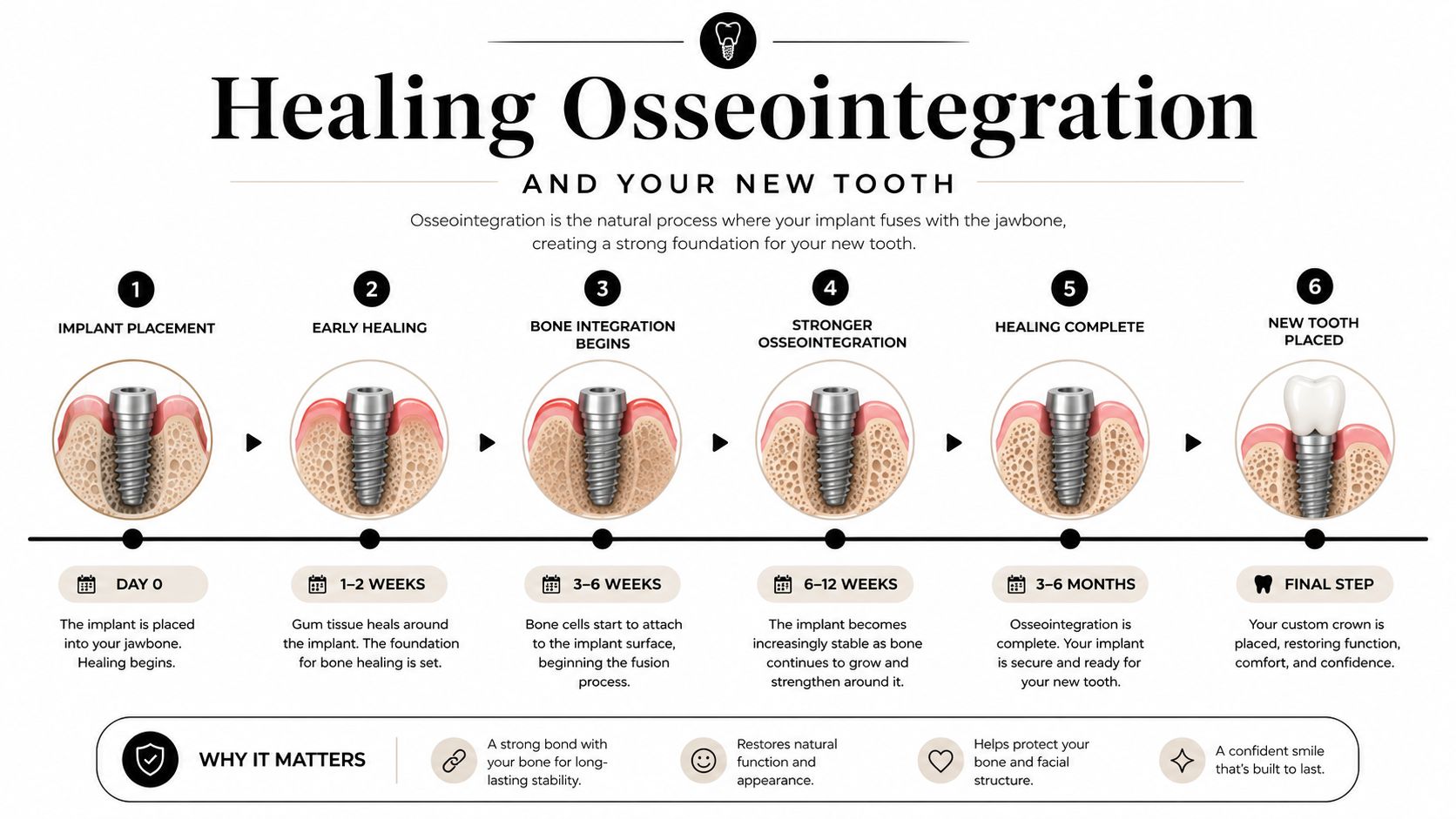
The healing phase is where biology does the quiet work that makes an implant durable. This part of treatment doesn't look dramatic from the outside, but it's the foundation for everything that follows.
What osseointegration actually means
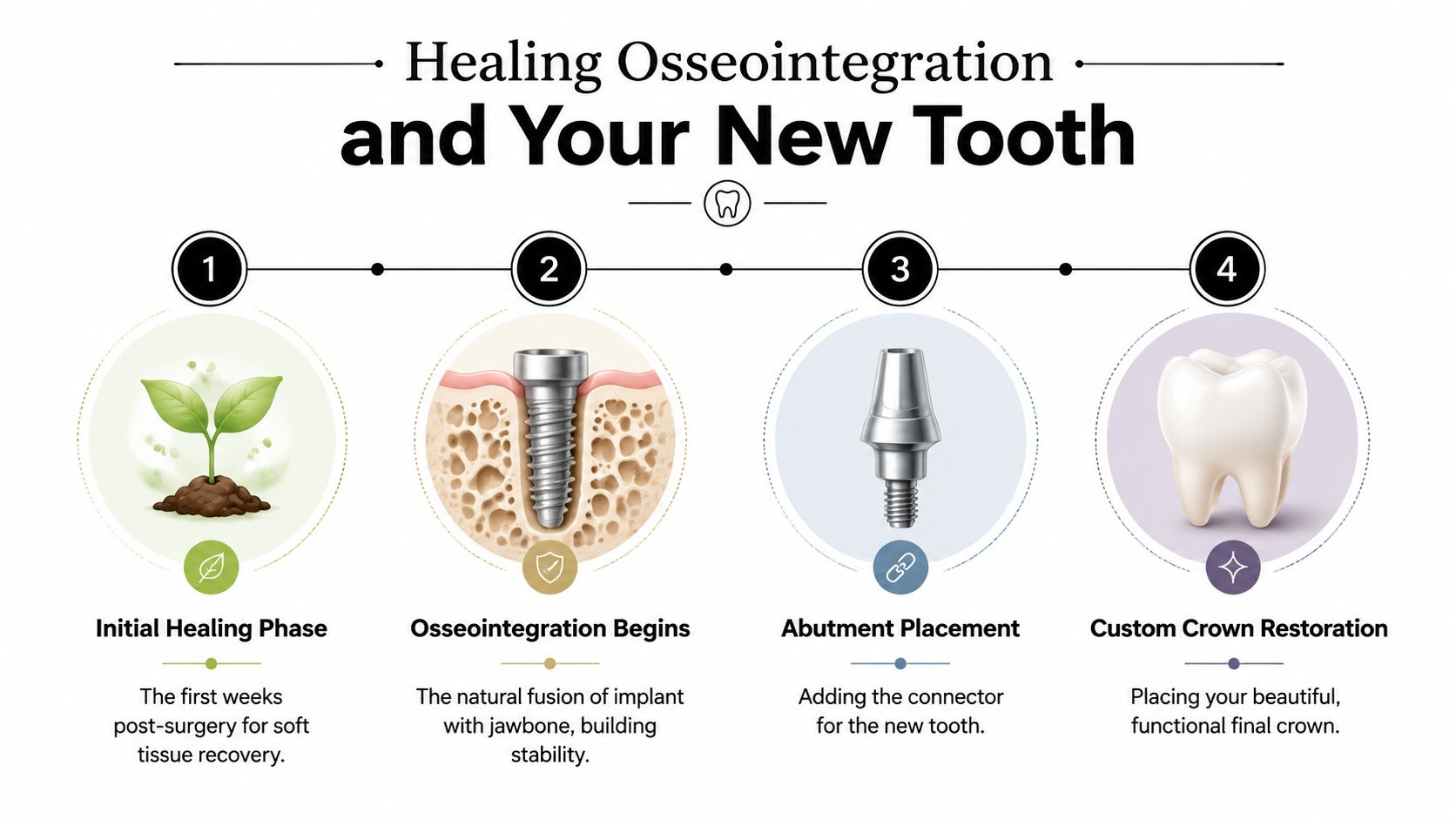
Osseointegration is the process in which the jawbone grows into and joins the implant surface, creating a stable base for the future tooth. The overall implant sequence is usually staged rather than completed in one visit. Mayo Clinic explains that treatment may include tooth removal, grafting when needed, implant placement, healing for bone growth, abutment placement, and then the artificial tooth over many months, with the key healing phase commonly taking 2 to 3 months in the mandible and 3 to 6 months in the maxilla, and the gums typically needing at least two weeks to heal after abutment placement before the final restoration is attached, as outlined in Mayo Clinic's overview of dental implant surgery and healing stages.
That timing is one reason unrealistic expectations can cause unnecessary stress. Patients sometimes feel well long before the site is biologically ready for full restorative loading. Feeling normal and being biologically ready aren't always the same thing.
When the abutment and crown are added
Once the implant has integrated properly, the next step is connecting the abutment and moving toward the final restoration. At this stage, function and appearance come together. The crown has to fit the bite, support the gum contour, and feel natural when the patient speaks and chews.
For patients researching the restorative side of treatment, the practice's page on implant crowns in New York gives a useful look at how the visible tooth is designed after the implant has healed.
A few practical realities help patients prepare:
- Healing isn't identical in every part of the mouth. Upper and lower jaw timing can differ.
- Temporary phases may be part of the plan. In some cases, a patient wears a provisional solution while tissues mature.
- Final fit matters as much as final appearance. A crown that looks good but traps food or feels heavy in the bite isn't a finished result.
Patients usually do best when they think of implant treatment as a sequence of checkpoints, not a single event.
That mindset makes the process easier to follow and easier to trust.
Advanced Solutions for Complex Dental Implant Cases
Some patients are ready for implant placement quickly. Others need site development first. That isn't bad news. It's often the most responsible path to a stable result.
When bone support needs to be rebuilt
If bone volume is limited, the implant may not have the support it needs in the ideal position. In those cases, grafting can rebuild the foundation before or during treatment, depending on the anatomy and the restorative goal. In the upper jaw, proximity to the sinus can also shape the plan, and sinus augmentation may be considered when vertical space is limited.
A concise way to think about these procedures is this:
- Bone grafting creates support. It helps build a site that can hold an implant in a more favorable position.
- Sinus augmentation creates room. It addresses upper-jaw anatomy when the sinus limits available height.
- Staging protects the final result. Preparing the site first can prevent a compromised implant angle or shallow placement later.
Patients who want to understand one of these preparatory procedures in more detail can review the practice's information on bone grafting in New York.
Why complex cases need restorative planning first
Complicated implant cases often fail conceptually before they fail surgically. The problem usually starts when surgery is treated as the whole treatment rather than one phase of a larger restorative plan.
A prosthodontic approach changes that. The team first determines where the future tooth should emerge, how the bite should function, and how the patient will keep the area clean. Then the surgical steps are built around that endpoint.
That distinction matters in cases involving:
- prior tooth loss with shrinkage of the ridge
- older restorations that changed the bite
- esthetic zones where gum contour is highly visible
- multiple missing teeth that need coordinated support
A patient isn't a poor implant candidate simply because the case is more involved. The question is whether the site can be prepared properly and restored intelligently.
That's why advanced procedures should be viewed as solutions, not obstacles. They often create the conditions that make a long-term implant result possible.
The Prosth & Co Difference for Dental Implants in NYC
Choosing a provider for implant treatment in Manhattan isn't only about finding a convenient office. It's about finding a process that connects diagnosis, surgery, and final restoration without losing precision along the way.
Why specialist planning changes the result
Dental implants have become one of the most established restorative procedures in dentistry. Clinical studies report success rates above 97% over 10 years, making implants a predictable and durable option when treatment is performed correctly, according to StatPearls' review of dental implant success and long-term outcomes.
Those outcomes don't happen because implants are simple. They happen because the case selection, positioning, healing, and restoration are handled carefully.
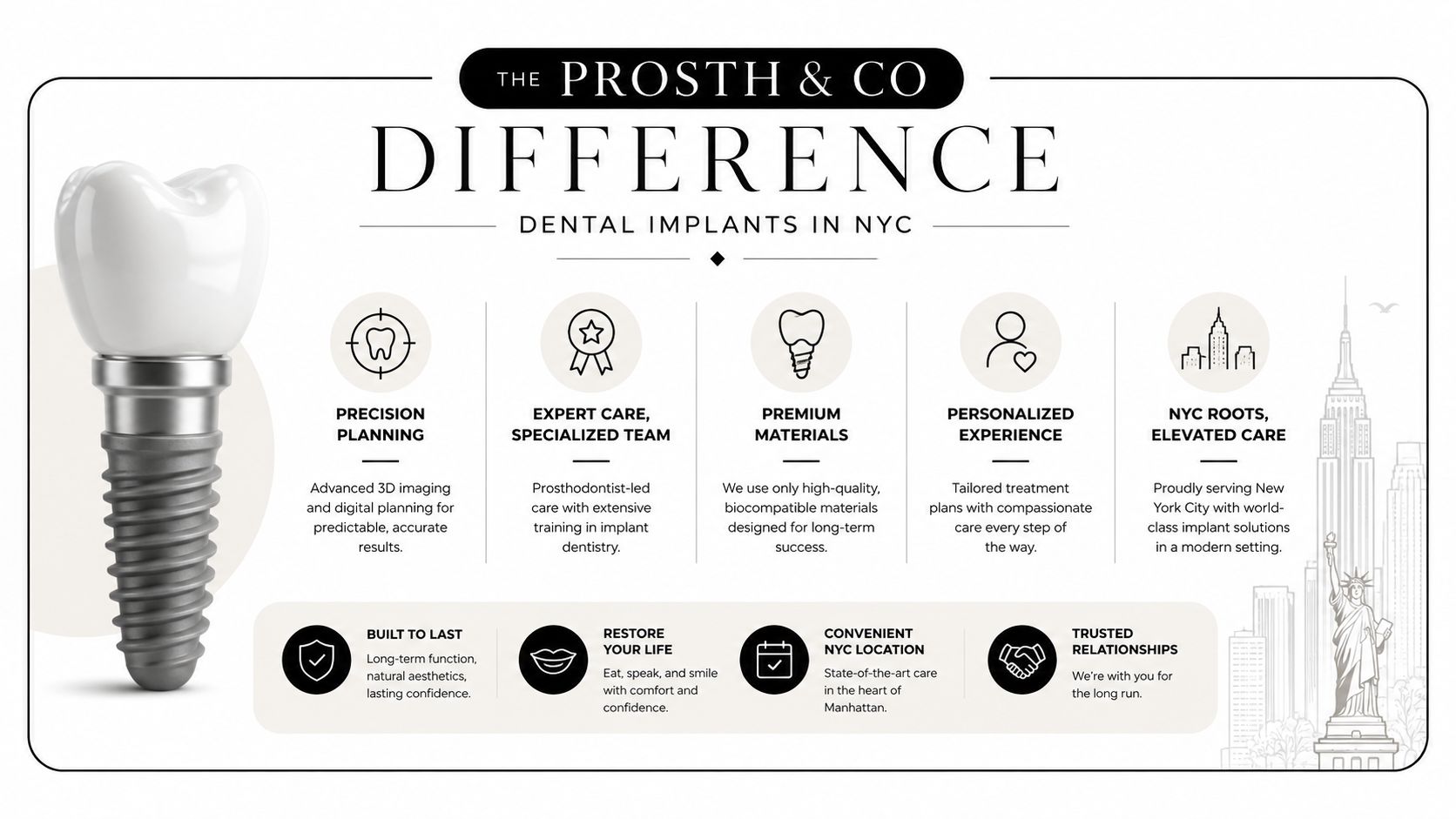
At Prosth & Co., that specialist perspective is part of the treatment model. Dr. Victoria Park's prosthodontic training at Columbia University and the Harvard School of Dental Medicine supports planning that begins with function, esthetics, and long-term maintenance rather than treating implant placement as an isolated surgical task.
What in-house coordination improves
An in-house lab changes the pace and control of restorative work. Shade refinement, contour adjustments, and communication about bite and emergence profile can happen more directly when the restorative team and lab support are closely coordinated.
For busy NYC patients, practical systems matter too. Clear scheduling, prompt communication, and efficient intake can make treatment easier to manage. Anyone curious about how front-desk technology is changing patient communication can see a broader example in this article on how AI helps UK dentists, which explores how dental offices use automation to support responsiveness and patient flow.
The local advantage is straightforward:
- Upper East Side convenience helps patients keep consult, surgery, and follow-up visits on schedule.
- Restorative and surgical coordination reduces the disconnect that can happen when planning and execution are separated.
- In-house lab support gives the final crown phase more control over fit and appearance.
For patients searching dentist near me, cosmetic dentist near me, or dental implants near me in Manhattan, the most important difference is usually predictability. The process should feel coherent from the first scan to the final tooth.
Schedule Your Dental Implant Consultation in Manhattan
A consultation is the visit where uncertainty starts to clear.
Patients often arrive after living with a missing tooth for months, or after a crown, bridge, or older root canal has begun to fail. In my office, the first goal is simple. Identify what is happening now, what can be saved, and whether an implant is the right long-term choice for your bite, appearance, and timeline.
For adults looking for a dentist in New York, NY, an office for restorative dentistry, or a practice that can also help with related needs such as cleaning and exams, dental x-rays, new patient exams, tooth extraction, or urgent care from an emergency dentist, the next step is a consultation centered on diagnosis and treatment planning.
Appointments are available at the Upper East Side office located at 47 E 77th St, Suite 207, New York, NY 10075.
Before the visit, it helps to bring a few basics:
- Current concerns: a missing tooth, a loose crown, discomfort when chewing, or a tooth that may need extraction
- Dental history: prior implants, bridges, root canal treatment, or gum treatment
- Questions about goals: appearance, chewing comfort, timing, and whether a temporary option may be needed
That first appointment should do more than confirm that a tooth is missing. It should show the condition of the bone, the health of neighboring teeth, the bite forces involved, and the sequence that gives the most predictable result. With Dr. Park's prosthodontic perspective, CBCT imaging, and close coordination with the in-house lab, treatment planning is built around the final restoration from the start, not treated as an afterthought.
Patients on the Upper East Side and throughout Manhattan do not need to guess whether they are candidates. A careful evaluation can show what is possible, what needs to happen first, and where the trade-offs are if more than one treatment path is available.
If a missing or failing tooth is affecting daily life, Prosth & Co. offers consultations for dental implants, restorative dentistry, and new patient care in Manhattan. Patients can schedule a visit, review their options, and leave with a clear plan for the next step.
Related topic: Learn more about Dental Implants.

Founder and lead prosthodontist of Prosth & Co. on Manhattan's Upper East Side. DDS, Columbia University; Prosthodontics certificate and MMSc in Oral Biology, Harvard School of Dental Medicine; Implantology fellowship, Columbia University.
Meet Victoria →