
A lot of Upper East Side patients start in the same place. They wake up with a tight jaw, a dull headache behind the temples, or a tooth that suddenly feels sensitive when coffee hits it. They haven't fallen, they aren't sick, and nothing seems obviously wrong. But their teeth and jaw have been working all night.
That usually leads to a practical search. A patient looks for a dentist near me or a dentist in Manhattan who can explain what's happening and stop the damage before it turns into chipped teeth, worn enamel, broken fillings, or more complex restorative dentistry. For many adults, the answer is a custom night guard. The important question isn't only whether a guard exists. It's how do night guards work, and what makes one worth wearing.
Table of Contents
- Your Trusted Dentist on the Upper East Side for Jaw Pain Relief
- What Are the Signs You Might Need a Night Guard
- How a Custom Night Guard Protects Your Smile
- Custom-Fit vs Over-the-Counter Night Guards
- The Prosthodontic Process at Our Upper East Side Practice
- Benefits Limitations and Caring for Your Appliance
- Schedule Your Consultation for Dental Care in Manhattan
Your Trusted Dentist on the Upper East Side for Jaw Pain Relief
For a busy Manhattan patient, nighttime clenching often shows up as a daytime problem. The jaw feels tired during a morning meeting. A front tooth looks a little flatter than it used to. A crown or veneer that once felt invisible starts to feel vulnerable. These symptoms can seem minor until they repeat for weeks or months.
That pattern matters because grinding and clenching place repeated force on the teeth, the bite, and the jaw joints. Patients often assume they would know if they grind, but many only learn about it after a partner hears it, or after a dental exam shows wear. By then, the damage may already be visible.
Why local diagnosis matters
A night guard isn't just a retail product. It's part of dental care. The first job is to determine whether the problem is straightforward bruxism, a bite imbalance, stress-related clenching, a damaged restoration, or jaw joint irritation that needs a more careful plan.
On the Upper East Side, that matters for patients with existing dental work. Someone with veneers, crowns, bridgework, implant crowns, or a history of restorative dentistry needs an appliance that protects those investments without creating new pressure points.
Jaw pain that shows up most mornings usually isn't random. It often means the bite and muscles have been under strain for hours while the patient was asleep.
What patients are usually hoping to avoid
Individuals searching for help want relief, but they also want to avoid a larger treatment cascade later. An untreated grinding habit can contribute to problems that eventually require:
- Restorative repair: chipped bonding, cracked fillings, or damaged crowns
- Cosmetic correction: smoothing, rebuilding, or replacing worn front teeth
- Emergency dental visits: sudden pain, a fractured tooth, or a broken restoration
- More extensive care: in severe cases, treatment planning that may involve extraction or rebuilding the bite
For Upper East Side patients looking for a practical solution, the right starting point is a careful exam, a clear explanation, and a night guard designed for their actual bite rather than a generic guess.
What Are the Signs You Might Need a Night Guard
Some signs are obvious. Others are subtle enough that patients dismiss them for months. A useful rule is simple. If symptoms are strongest in the morning, nighttime clenching or grinding should be considered.
Common symptoms patients notice first
Morning headaches are one of the most common complaints. So is soreness in the cheeks or along the jawline, where the chewing muscles sit. Some patients describe it as feeling like they were chewing gum all night.
Tooth sensitivity is another clue. When enamel and restorations absorb repeated pressure, hot and cold can start to feel sharper than usual. A patient may think the problem is a cavity when the underlying issue is grinding-related stress.
Changes a dentist may see during an exam
A patient may not notice tooth wear until it becomes visible in photos or a mirror. Dental exams often reveal patterns such as:
- Flattened edges: front teeth lose their natural contours
- Small chips: especially along the biting edges
- Cracks or craze lines: pressure can show up as fine lines or larger fractures
- Tender chewing muscles: the muscles feel overworked
- Restoration stress: crowns, veneers, or fillings may show wear or strain
Neck and shoulder tension can sometimes travel with jaw clenching too. It's not a diagnosis by itself, but it can fit the overall picture.
Practical rule: If a patient wakes up with jaw tightness, headaches, and sensitive teeth, it's worth having the bite evaluated before the problem turns into broken tooth structure.
When symptoms become more than an annoyance
Grinding isn't only about noise or inconvenience. It can wear down healthy teeth and push already stressed teeth closer to failure. That matters even more for patients who have invested in cosmetic dentistry, implant restorations, or prior reconstructive work.
A patient doesn't need every symptom on the list to benefit from an evaluation. One chipped tooth, one unexplained sore jaw, or one restoration that keeps feeling “off” can be enough reason to look closer. The earlier the diagnosis, the more conservative the treatment can be.
How a Custom Night Guard Protects Your Smile
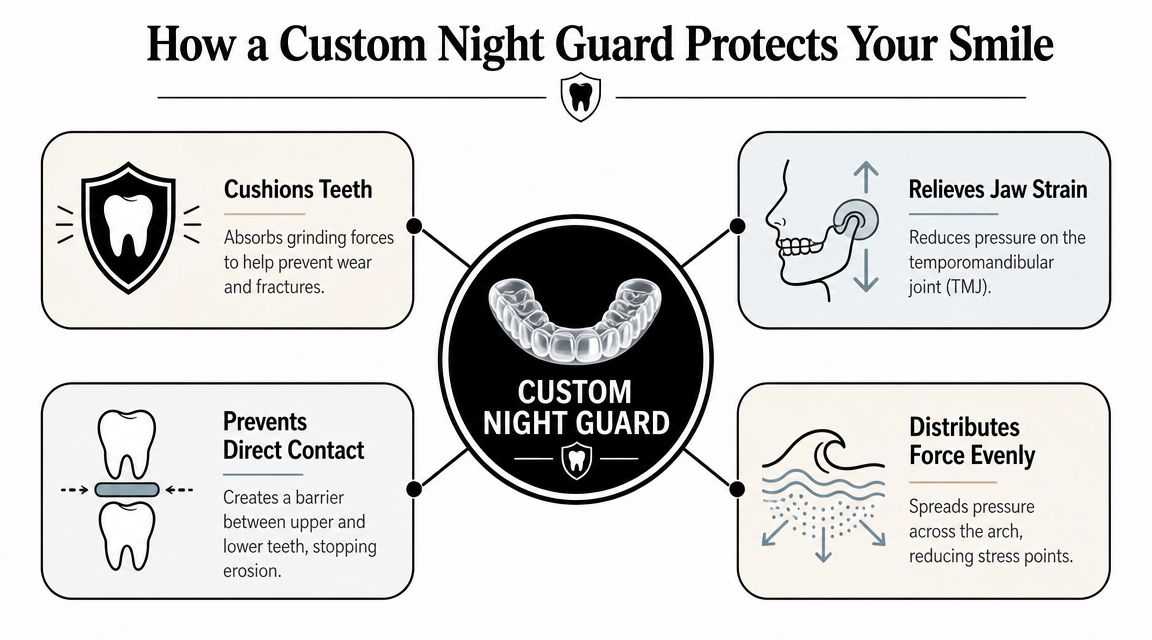
A custom night guard protects teeth by changing how force is absorbed while you sleep. Instead of allowing the upper and lower teeth to grind directly against each other, the appliance takes that contact first and helps control how pressure moves across the bite.
The barrier that protects enamel and dental work
The first job of the guard is straightforward. It creates a physical barrier between the teeth, which helps limit wear on enamel and reduces the risk of chipping or stressing the edges of crowns, veneers, fillings, and other restorations.
That barrier matters most at night, when patients can generate significant bite force without realizing it. A well-made appliance also creates slight separation between the arches and guides the bite into a more controlled position, which can reduce the intensity of clenching for some patients and spread pressure more evenly.
What the appliance is actually doing
From a prosthodontic standpoint, a custom guard is not just a piece of plastic. It is a calibrated appliance designed around the way a specific patient bites, where the heavy contacts occur, and which teeth or restorations need the most protection.
In practice, it helps in three main ways:
- It absorbs wear first: the appliance takes the grinding contact instead of the tooth surface
- It distributes force: pressure is shared more evenly rather than concentrated on one cracked tooth, one veneer, or one side of the jaw
- It helps settle the bite: balanced contact can reduce the strain that an uneven bite places on the teeth and muscles overnight
Some patients also notice fewer morning headaches or less jaw fatigue. Others mainly benefit by preventing more damage. Both outcomes matter.
Why the fit changes the result
This is the part generic articles often skip. The effectiveness of a night guard depends heavily on precision. If the appliance is too loose, too thick in the wrong area, or unbalanced across the bite, it can feel awkward, trigger sore muscles, or end up in the bedside drawer.
A custom-fitted guard is adjusted so it seats fully, contacts evenly, and protects the smile without adding new pressure points. For patients on the Upper East Side who already have cosmetic dentistry, implant restorations, or carefully maintained natural teeth, that level of detail is usually what gives the appliance its long-term value.
Replacing a worn guard is simple. Repairing cracked enamel or remaking damaged dental work is not.
Custom-Fit vs Over-the-Counter Night Guards
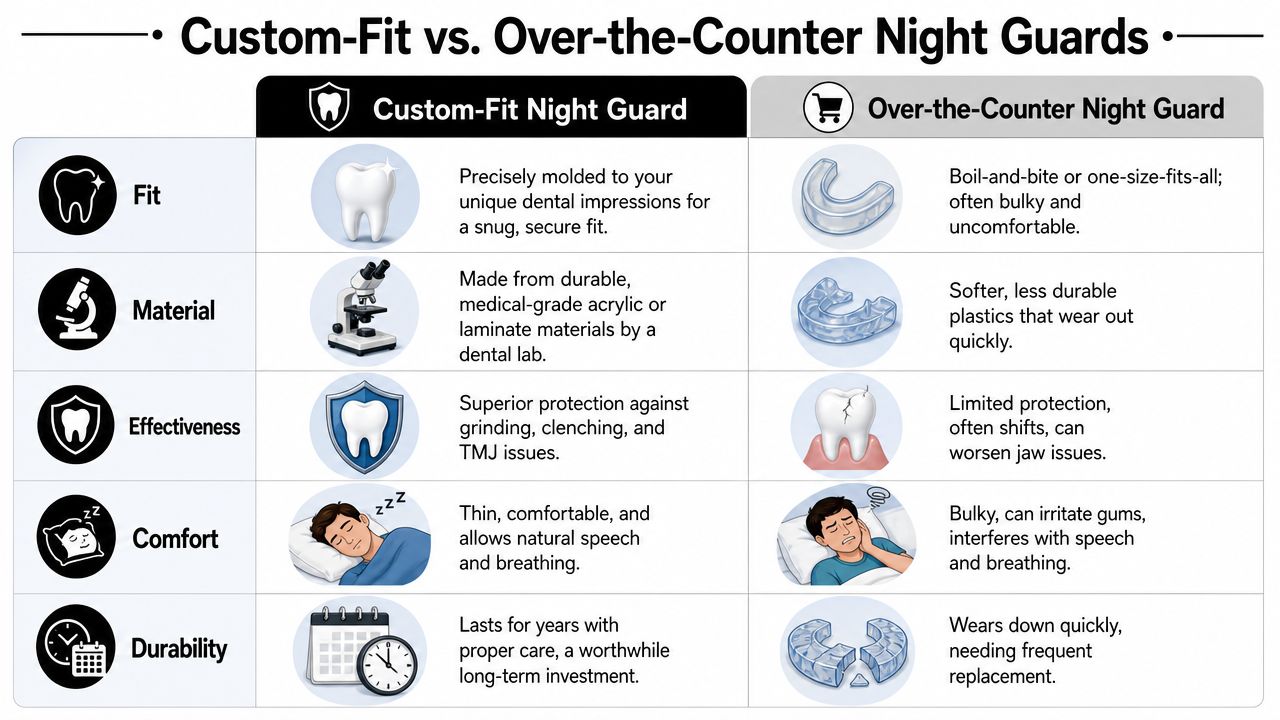
A store-bought guard can cover the teeth. A custom prosthodontic guard is made to fit the bite with precision. For patients with veneers, crowns, implants, or clear signs of grinding, that difference often decides whether the appliance gets worn nightly or left in a drawer.
Side by side differences
| Feature | Custom-fit guard | Over-the-counter guard |
|---|---|---|
| Fit | Made for the patient's exact teeth and bite | Molded at home or sold as a generic shape |
| Material | Dental materials selected for durability and function | Softer retail plastic that may feel bulky |
| Bite balance | Evaluated and adjusted clinically | Rarely checked for even contact |
| Comfort | Usually slimmer and more stable | More likely to shift, feel thick, or trigger gagging |
| Long-term use | Designed as a treatment appliance | Often used as a temporary experiment |
Where retail guards fall short
Over-the-counter guards appeal to patients for a simple reason. They are easy to buy and less expensive at the start. For a short trial, that can be reasonable.
The trade-off is precision. A boil-and-bite guard can warp during molding, sit unevenly, or feel bulky across the back teeth. In practice, those small flaws matter. If one area hits harder than the others, the jaw muscles may stay active through the night instead of relaxing.
Material matters too.
Very soft guards can invite clenching in some patients because the teeth have something compressible to bite into. A thicker guard may also change how the lips close or how the appliance feels at the back of the mouth, which is one reason some patients stop wearing it after a week or two.
When custom makes more sense
Custom fabrication usually makes more sense when the bite is complex, dental work needs protection, or symptoms go beyond mild occasional grinding. I am more cautious with retail guards in patients who already have cracked enamel, implant restorations, porcelain work, or morning jaw pain. Those cases benefit from a guard that is planned with the bite in mind, not just heated and pressed into shape at home.
At Prosth & Co., night guards are part of prosthodontic care, which means the appliance is considered alongside the patient's restorations, bite pattern, and long-term wear risk. That broader view is often what gives a custom guard better value over time.
A night guard has to fit well enough to be worn consistently. Comfort supports protection.
The Prosthodontic Process at Our Upper East Side Practice
A patient often arrives after a few rough mornings. The teeth feel tight, the jaw is sore, and there is a quiet worry about damaging crowns, veneers, or enamel. The process of getting a custom night guard should lower that stress, not add to it.
What happens at the first visit
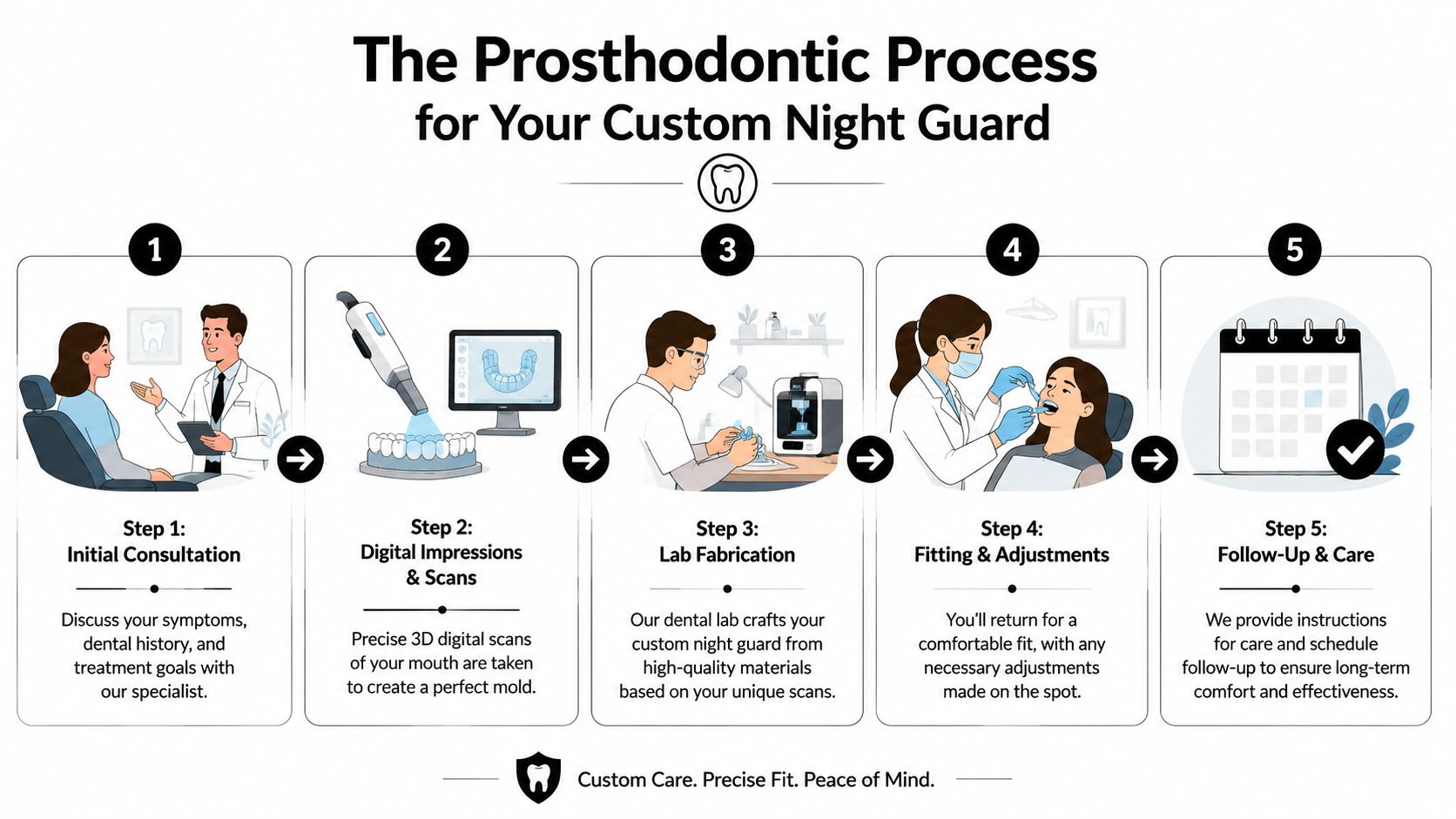
The first appointment is diagnostic. I check where the teeth show wear, how the bite comes together, whether the jaw joints or chewing muscles are tender, and which restorations need protection. If the history suggests something more than routine clenching, I may also recommend a new patient exam, x-rays, or intraoral photos so the guard is planned around the full picture.
That level of planning matters in prosthodontics. A patient with porcelain veneers, implant crowns, or a shifting bite needs more than a generic tray. The appliance has to respect the existing dental work and the way the teeth function together at night.
How the guard is made
Standard clinical workflows use either a precise impression or a digital scan, followed by laboratory fabrication. At our Upper East Side practice, digital scanning often gives the cleanest starting point because it captures the exact contours of the teeth and arch without the distortion that can happen with home-molded materials.
Material selection is part of the prescription, not an afterthought. Some patients do better with a firmer guard that protects restorations and holds its shape well over time. Others need a design that balances durability with comfort, especially if they are sensitive to bulk or have a strong gag reflex. The right choice depends on the bite, the force of clenching, and what the appliance needs to protect.
The fitting and follow-up
The delivery visit is where precision shows up in a way patients can feel. The guard should seat fully, stay in place, and contact evenly so one area is not taking more force than the rest. Small bite adjustments at this stage can make a meaningful difference in comfort and muscle tension.
Patients also leave with clear instructions for storage and cleaning a night guard naturally. If the guard starts to feel tight, loose, or uneven after dental work or bite changes, it should be checked rather than pushed back into service. A well-made appliance lasts longer when it is monitored and adjusted as the mouth changes.
Benefits Limitations and Caring for Your Appliance
A well-made night guard earns its value over time. It protects enamel that cannot be replaced and helps preserve crowns, veneers, fillings, and implant restorations that were designed to last.
For many Upper East Side patients I see, the biggest benefit is prevention. The guard takes the force of clenching and grinding so teeth and dental work do not have to. Patients often notice less morning soreness as well, especially if heavy nighttime pressure has been straining the jaw joints and chewing muscles.
What a night guard does well
A custom guard is a protective appliance first. It creates a controlled surface between the arches, which lowers the risk of wear facets, small fractures, chipped edges, and stress on previous restorative work. That matters even more in a mouth that already has cosmetic or reconstructive treatment, where one cracked porcelain edge can turn into a larger repair than anyone wants.
It also gives the dentist useful information. Wear marks on the appliance can show how and where force is being applied, which helps guide future adjustments if symptoms change.
What it doesn't do
A night guard does not cure bruxism. Many patients still clench or grind while wearing it. The difference is that the appliance absorbs much of that force instead of leaving the teeth, restorations, and supporting muscles completely unprotected.
That distinction matters. If a patient expects the guard to eliminate every symptom immediately, the result can feel disappointing. If the goal is to reduce damage, improve comfort, and protect prior dental investment, the appliance usually performs exactly as intended.
Some of the most successful cases still involve clenching. The success is that the teeth are no longer paying the price for it.
How to care for it properly
Custom appliances should be treated like precision dental work. Daily care is simple, but it should be consistent.
- Rinse it after use: saliva and debris are easier to remove before they dry on the surface.
- Clean it gently: avoid abrasive toothpaste or rough scrubbing that can scratch the material.
- Store it in a protective case: heat, pets, and loose placement on a bathroom counter are common reasons guards get warped or lost.
- Bring it to checkups: the fit, bite contacts, and wear pattern should be reviewed over time.
Patients who want a gentle home routine can follow these natural night guard cleaning tips.
One practical limitation is that the appliance only works well if it still fits the bite it was made for. Dental work, tooth movement, or a guard that has been bent by heat can change that fit. If it starts to feel tight, loose, rough, or uneven, it should be adjusted or remade rather than forced back into use.
For busy Manhattan patients, convenience also affects compliance. Tools such as Rosie's direct calendar appointments can make it easier to get a fit check on the schedule before a small issue turns into a broken appliance or renewed jaw pain.
Schedule Your Consultation for Dental Care in Manhattan
Jaw pain, morning headaches, and tooth sensitivity aren't things a patient should work around. When those symptoms repeat, they deserve a proper diagnosis and a solution that protects both comfort and appearance.
For patients looking for a dentist in New York, NY or an Upper East Side dentist near me, a custom night guard is often one of the most practical ways to protect teeth from ongoing wear. It can also help preserve previous dental work and reduce the chance that a manageable problem becomes a larger restorative one.
Patients considering treatment can review more about custom night guards for teeth clenching before scheduling. For those who appreciate convenient scheduling, tools such as Rosie's direct calendar appointments show how modern booking can remove friction from getting care on the calendar.

A consultation at 47 E 77th St, Suite 207 gives patients a clear next step. The visit can identify whether grinding, clenching, bite imbalance, or restoration stress is behind the symptoms, and whether a custom appliance is the right answer. For many busy Manhattan patients, that first appointment is the point where unexplained pain finally starts to make sense.
If nighttime clenching is leaving your jaw sore or your teeth vulnerable, schedule a consultation with Prosth & Co.. A careful exam and a custom treatment plan can help protect your smile, relieve daily discomfort, and make dental care feel manageable again.
Related topic: Learn more about Bruxism And Night Guards.

Founder and lead prosthodontist of Prosth & Co. on Manhattan's Upper East Side. DDS, Columbia University; Prosthodontics certificate and MMSc in Oral Biology, Harvard School of Dental Medicine; Implantology fellowship, Columbia University.
Meet Victoria →