A patient searching for dental implants near me in Manhattan may expect one appointment for a titanium implant and a final tooth that appears in its place at once. That expectation is more careful and collaborative. Surgery provides the foundation, but an implant dental lab designs and fabricates the visible restoration that must look natural, chew comfortably, protect the surrounding tissues, and remain serviceable over time.
At Prosth & Co. on Manhattan's Upper East Side, a prosthodontist-led team coordinates implant placement, restorative planning, and laboratory craftsmanship in one clinical setting. That integrated approach is relevant whether someone needs a single implant crown, several missing teeth replaced, or a full-arch restoration. Patients comparing a dentist in Manhattan, a dentist in New York, or a prosthodontist should look beyond the surgical procedure and ask how the final restoration will be designed, checked, documented, and maintained.
Table of Contents
- The Hidden Craftsmanship Behind Dental Implants
- How an Implant Dental Lab Creates Your Restoration
- The Clinical Advantages of an In-House Laboratory
- Comparing Digital Scans and Conventional Impressions
- Quality Markers and Long-Term Maintainability
- Protecting the Bone and Tissues Around Your Implant
- Starting Your Implant Journey in Manhattan
The Hidden Craftsmanship Behind Dental Implants
A patient once arrived expecting to discuss only the placement of a titanium implant. The missing tooth had affected chewing, and the patient wanted a natural-looking replacement. During the consultation, the treatment conversation expanded to include the bite, the shape of the neighboring teeth, the available space, the gum contour, the position of the screw access, and how the finished crown could be cleaned and repaired later.
That conversation reflects the part of implant care patients often don't see. The implant sits inside the jawbone, but the crown, bridge, or denture is the component that patients live with every day. It must meet the opposing teeth correctly, guide chewing forces appropriately, support the gum tissues without creating a difficult-to-clean ledge, and blend with the patient's smile.
The modern implant laboratory grew from the development of osseointegration, the predictable biological integration of titanium with living bone. Per-Ingvar Brånemark studied bone healing and titanium in the 1950s after observing that titanium could become firmly attached to bone. In 1965, he placed four commercially pure titanium implants in the mandible of Gösta Larsson, a patient with severe jaw deformities and missing teeth. Several months later, the implants supported a fixed prosthesis, establishing the clinical foundation for today's implant-supported crowns, bridges, and full-arch restorations, as described in this historical review of osseointegration and implant dentistry.
The restoration is a system
An implant case involves more than a replacement tooth. The prosthodontist, surgeon, dental assistant, and laboratory technician must coordinate:
- Implant position: The fixture must provide a sound foundation for the planned restoration.
- Soft-tissue shape: The crown's emergence profile should support a healthy, cleanable gum contour.
- Occlusion: Contact with opposing teeth must be controlled so the implant isn't exposed to unnecessary overload.
- Material and design: Zirconia, layered ceramic, metal components, and screw-retained designs each serve different clinical needs.
- Future access: The restoration should be retrievable when maintenance or repair becomes necessary.
A successful result therefore combines biology, engineering, artistry, and communication. That's why the right restorative provider matters when a patient searches for a cosmetic dentist near me, an implant dentist, or a prosthodontist in New York. The most attractive crown isn't enough if it can't be cleaned, checked, or repaired.
How an Implant Dental Lab Creates Your Restoration
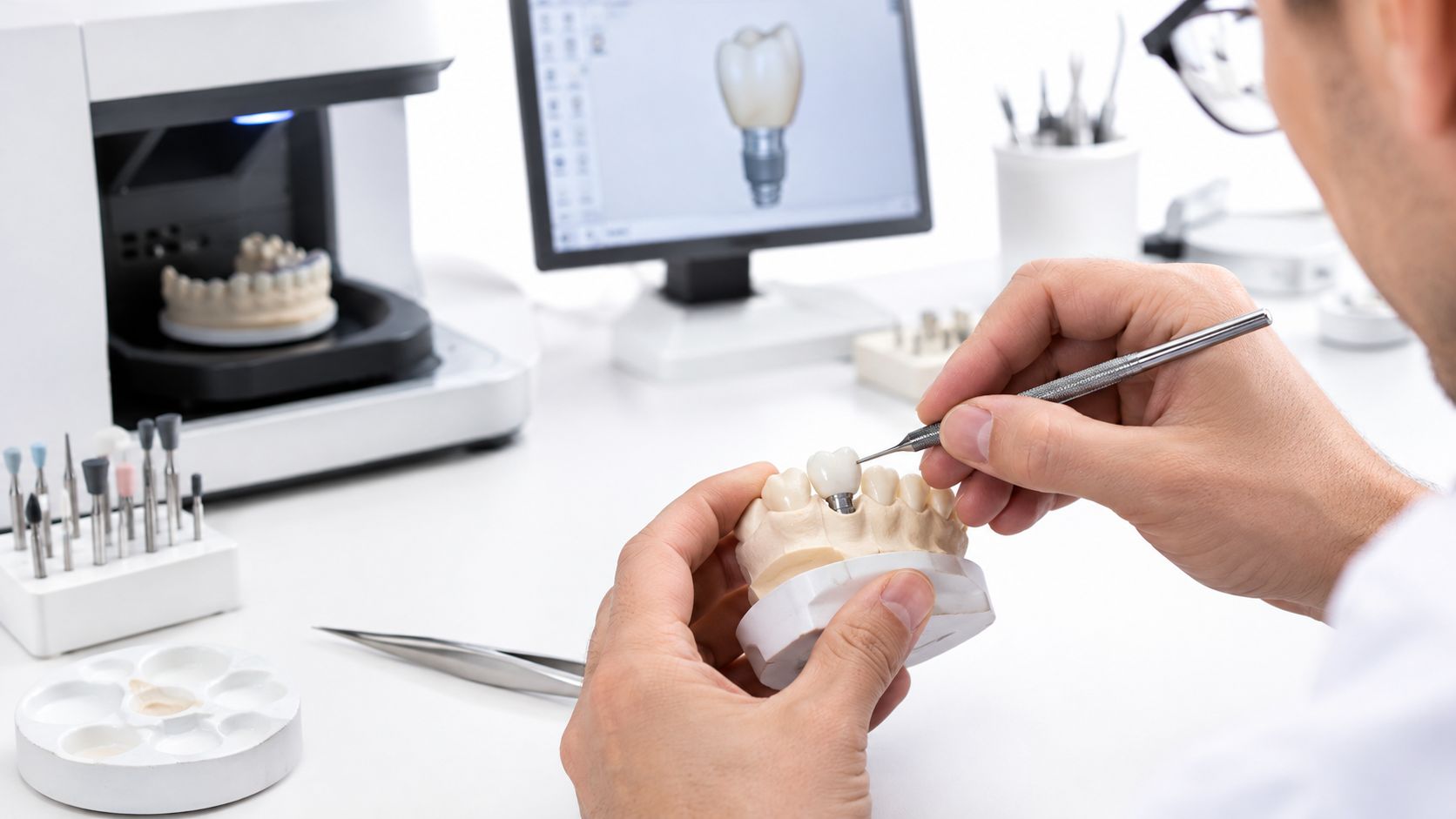
After the implant has integrated and the tissues are ready, the restorative team records the patient's mouth. The record may come from an intraoral scan, a conventional impression, or a combination of clinical records, photographs, bite registrations, and imaging. The implant dental lab uses this information to design a restoration that fits the implant components and functions within the patient's entire bite.
From clinical record to final tooth
First, the team verifies the implant information. The scanbody or impression component must match the implant manufacturer and model. Seating, geometry, implant angulation, and the completeness of the scan are checked before design begins.
Next, the laboratory aligns the records. The digital model or stone cast is combined with the opposing arch and bite record. Without a reliable opposing arch and bite relationship, the technician can't confidently position the new crown within the chewing pattern.
The abutment then connects the implant to the crown. Its height, angulation, margin position, and emergence profile influence both appearance and cleanability. A screw-retained crown may be selected when retrieval is especially important, while other designs may be appropriate for the clinical situation.
The crown receives its anatomy and surface character. High-strength zirconia or layered porcelain can be selected according to location, space, functional demands, and esthetic goals. The technician adjusts shade, translucency, contour, surface texture, and contact points so the restoration doesn't look like a generic replacement.
Fit is checked before delivery. For a multi-unit framework, passive fit is a major quality target. A framework that doesn't seat accurately can create strain in prosthetic components and implants when screws are tightened. The team may use a one-screw test, torque-controlled tightening, radiographic confirmation where indicated, or a rigid verification index for complex cases.
Finally, the restoration is evaluated in the mouth. The prosthodontist checks seating, contacts, bite, speech, shade, tissue response, and the patient's ability to clean around the restoration. Multiple appointments aren't a sign that the process is failing. They allow the team to validate each stage rather than forcing an inaccurate design into place.
The Clinical Advantages of an In-House Laboratory
A patient comes in for an implant crown try-in, and the bite feels slightly off. The contour also presses on the cheek more than expected. In an outsourced workflow, that small discrepancy can trigger a chain of messages, photos, shipping, and delay. In an in-house setting, the prosthodontist and technician can evaluate the restoration together, with the patient present, and decide whether the issue is contour, contacts, access position, or occlusion.
That proximity changes clinical decision-making. Cases still require planning, verification, and restraint, but direct access to the lab shortens the distance between what is seen in the mouth and what is adjusted on the bench.
At Prosth & Co. on the Upper East Side, the laboratory is part of the restorative process, not a separate handoff. The practice outlines that model in its in-house dental laboratory overview. The advantage is practical. The patient, the prosthodontist, and the technician can assess shade, form, fit, and maintainability in the same clinical context.
Some benefits are immediate. A technician can study how light reflects off the adjacent teeth instead of depending only on a shade tab or photograph. The prosthodontist can point out why a margin contour traps plaque, why a screw-access position affects appearance, or why a small change in thickness may protect the ceramic under function. Those conversations are more precise when everyone is looking at the same problem at the same time.
This matters most in demanding restorative care. Full-mouth rehabilitation, multiple implants in one prosthesis, limited restorative space, unusual angulation, and provisional restorations that expose speech or bite issues all place more pressure on communication. In those cases, laboratory work is not just fabrication. It is active participation in diagnosis refinement and restoration design.
Clinical insight: The laboratory supports treatment, function, and long-term maintenance. In complex implant care, it works as part of the clinical team.
An in-house model also helps with troubleshooting during treatment rather than after a remake is needed. If a provisional crown feels bulky, if a contact is too tight, or if the emergence profile makes cleaning harder, the team can often review the problem promptly and adjust with the patient's feedback in mind. That does not mean every case should be finished quickly. It means corrections can happen with better communication and fewer disconnected steps.
For a patient comparing restorative practices in Manhattan, the better question is simple. Who designs the restoration, who verifies it, and how do the clinician and technician communicate when details need to change? An in-house laboratory has real clinical value when it operates under direct oversight and stays connected to long-term oral health, not just to production.
Comparing Digital Scans and Conventional Impressions
A patient may assume the easy appointment is automatically the better one. In implant restorative care, that is not always true. A digital scan is often more comfortable than a conventional impression tray filled with material, especially for patients with a strong gag reflex or anxiety. It also gives the laboratory and clinician a file that is simple to review, store, and compare over time.
What matters to me is whether that record will let the lab build a restoration that fits predictably, contacts properly, and can be maintained years from now. The choice between scan and impression should be based on the restoration being made, the anatomy in front of us, and how much positional accuracy the case demands.
Published findings support that caution. In the review of digital implant impression accuracy, mean three-dimensional deviation for single-implant digital impressions was reported at approximately 8.20 µm in fully edentulous patients and 52.31 µm in partially edentulous patients. In the comparison discussed there, conventional impressions were slightly more accurate for the evaluated scenario, with the difference reported as p = 0.03.
The reason is practical. Scanners perform best when they can capture stable, readable reference geometry. Adjacent teeth can help orient the scan in a partially edentulous case, but saliva, blood, reflective surfaces, soft tissue movement, and limited opening can still reduce reliability. In broader edentulous spans, there may be fewer dependable landmarks, so stitching errors can build across the arch.
That is why I do not treat digital and conventional methods as rivals. I treat them as tools.
For a single implant crown, a well-executed digital workflow can be efficient and very accurate. For multiple implants, a long-span prosthesis, or a full-arch case, the team may add verification steps before fabrication proceeds. Those steps may include a rigid verification jig, photogrammetry, or a conventional verification impression if the implant positions must be transferred with a higher level of confidence.
Before the file reaches production, the lab should confirm scanbody identity and seating, scanbody geometry, implant angulation, scan path and data continuity, complete opposing-arch records, reliable bite registration, and clear soft-tissue and restorative margins.
The better method is the one that gives the lab a dependable starting point for that specific restoration, while still respecting patient comfort.
Quality Markers and Long-Term Maintainability
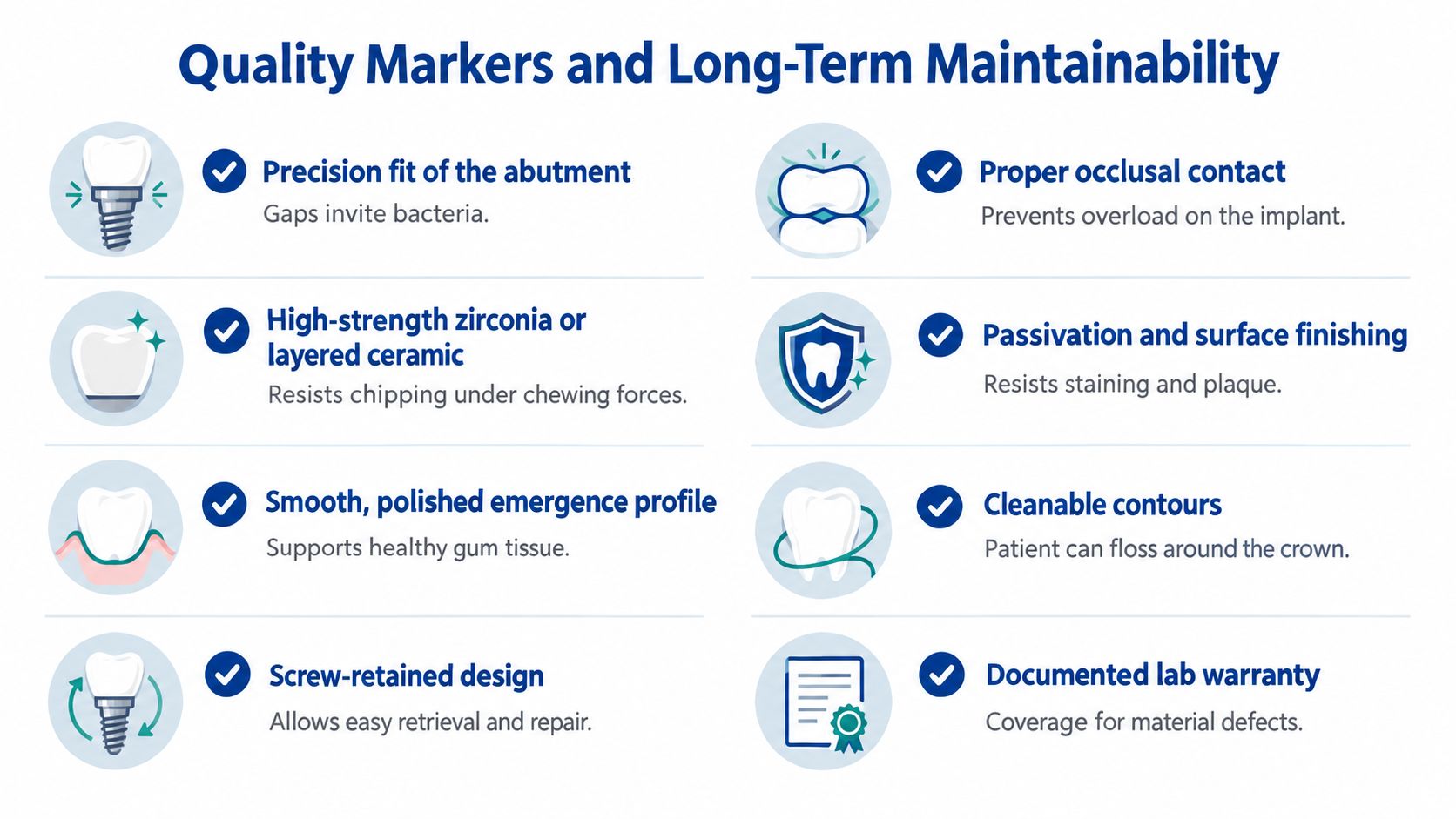
A crown can look excellent on delivery day and still be poorly designed for the years that follow. Long-term maintainability should be assessed before fabrication, not after a patient develops inflammation, a loose screw, or a chipped ceramic surface.
The most important question isn't only, “Does this tooth look natural?” It's also, “Can the patient clean around it, can the clinician inspect it, and can the restoration be repaired without unnecessary destruction?” An implant dental lab should design for those future questions from the beginning.
What patients should ask about
Passive fit matters particularly in multi-unit frameworks. A systematic review identified 92 in-vitro studies and 3 in-vivo studies assessing implant-framework misfit. The evidence associated misfit with induced strain and stress in laboratory or modeling studies, while the clinical relationship with biological complications and prosthesis failure remained weak, as reported in this systematic review of implant framework misfit. The finding supports careful verification, but it doesn't establish one universal clinical threshold.
Retrievability allows the clinical team to remove a screw-retained restoration for inspection, hygiene access, repair, or component replacement. The screw access should be planned rather than placed wherever the implant happens to emerge.
Cleanable contours help patients floss and use other recommended hygiene aids around the crown. A bulky or overcontoured emergence profile may make daily care more difficult, even if the restoration looks attractive from the front.
Material selection should reflect the location of the implant, available space, bite forces, esthetic needs, and the patient's habits. Ceramic chipping or screw loosening can't be addressed through appearance alone. The design must account for how the patient chews and whether clenching or grinding may affect the restoration.
A 10-year study found technical complications in 39.5% of implant-restoration patients, with screw loosening representing 43.4% of those complications. Maintenance and complication treatment averaged 404 CHF per patient per year, or about 9% of initial treatment costs, according to the study summary on technical complications and maintenance of implant restorations. These findings describe a study population and association, not a prediction for every patient.
Maintenance principle: A restoration should be designed for the appointment that may occur years after delivery, not only for the appointment when it is inserted.
Quality improvement also benefits from a repeatable process. Teams interested in structured methods can review improving healthcare quality with PDSA as a framework for testing, checking, and refining clinical workflows.
Every patient should receive a handover record containing the implant manufacturer and model, restorative component information, restoration design, relevant digital files, and maintenance instructions. That record becomes particularly valuable if the patient changes dentists, needs emergency dental care, moves to another city, or requires repair after years of normal use.
Protecting the Bone and Tissues Around Your Implant
A well-made implant crown should disappear into daily life. It should also respect the tissues that keep the implant healthy for years. Bone, gum stability, and cleanability are tied to design choices made before the final restoration is ever seated.
The implant may integrate with bone, yet the surrounding tissues can still break down if the restoration is hard to clean, overloaded in function, or placed into an unhealthy oral environment. The National Institute of Dental and Craniofacial Research notes that implant failure can be associated with lack of integration, excessive physical stress, or inflammation around the implant that contributes to bone loss, as outlined in its patient information on dental materials and implants.
In practice, I look at tissue protection as a design problem as much as a surgical one.
Contour matters. If the crown emerges from the gum with bulky or overextended form, plaque control becomes harder around the margin. If the contacts are too heavy, the implant and its components absorb force without the cushioning a natural tooth has. If inflammation is already present in the gums or around neighboring teeth, the final restoration starts at a disadvantage.
That is why the biological check comes before the finish line. The team needs to assess periodontal health, bone support, radiographic findings, implant position, and how the restoration will meet the opposing teeth during chewing. Sometimes the right sequence includes periodontal treatment, treatment for nearby teeth, extraction of a non-restorable tooth, grafting procedures, or changes in the restorative plan so the final contours are easier to maintain.
For patients seeking a prosthodontist in New York, the important question is whether the team evaluates the whole mouth. An implant does not function in isolation. In more involved cases, prosthodontics, periodontics, oral surgery, and endodontics may all shape the path before the laboratory completes the case.
That same clinical judgment can preserve a natural tooth and avoid an implant altogether. A patient may arrive with pain on biting or lingering hot and cold sensitivity, assuming replacement is the only answer. Sometimes an endodontist or emergency dentist determines the tooth can be saved with root canal treatment. The diseased pulp is removed, the canal is cleaned and disinfected, and the space is filled and sealed with gutta-percha, as explained by the American Association of Endodontists. In the long run, the best implant dentistry includes knowing when not to place an implant.
Starting Your Implant Journey in Manhattan
Patients with missing teeth, failing bridges, or uncomfortable dentures don't need to decide on a restoration before the first appointment. The right starting point is a thorough consultation with a team that can evaluate the biological foundation, the bite, the appearance of the smile, and the laboratory pathway.
A practical first appointment
The visit generally begins with a review of the patient's concerns and medical and dental history. The team then examines the teeth, gums, existing restorations, bite, facial proportions, and available space. Dental X-rays, intraoral photography, digital scans, or other diagnostic records may be used to clarify the treatment options.
The consultation should answer practical questions:
- Is the tooth restorable, or is tooth extraction necessary?
- Would a single implant crown, bridge, or removable option provide the best balance?
- Does the patient need periodontal treatment, bone grafting, or sinus augmentation?
- How will the provisional restoration guide the final design?
- Will the restoration be screw-retained and retrievable?
- Which implant manufacturer and restorative components will be documented?
- How will the patient maintain the implant at home and through professional cleanings?
An integrated practice can coordinate implant surgery, restorative dentistry, cosmetic dentistry, periodontics, endodontics, and oral surgery when those services are relevant. Families seeking a pediatric dentist, kids dentist, or preventive care can also discuss exams, fluoride, and sealants during a separate child-focused visit. The ADA reports that studies involving nearly 2,000 participants found a 73% lower risk of new caries lesions among children who received sealants compared with fluoride varnish alone, as summarized in its guidance on dental sealants. For children younger than age three, the AAPD recommends a smear-sized amount of fluoridated toothpaste under supervision, while children ages three through five should use a pea-sized amount, according to its caries-risk guidance.
Patients researching local care may also find value in learning how Outrank helps dentists rank, particularly when comparing practices and looking for clear explanations of specialized treatment. The more transparent the practice's communication, the easier it is for patients to evaluate not only the procedure, but also the maintenance plan behind it.
Prosth & Co. provides prosthodontist-led implant planning, surgical placement, and custom restorations supported by an in-house dental laboratory on Manhattan's Upper East Side. Patients considering dental implants near me can visit Prosth & Co. to schedule a consultation focused on fit, function, appearance, and long-term maintainability.
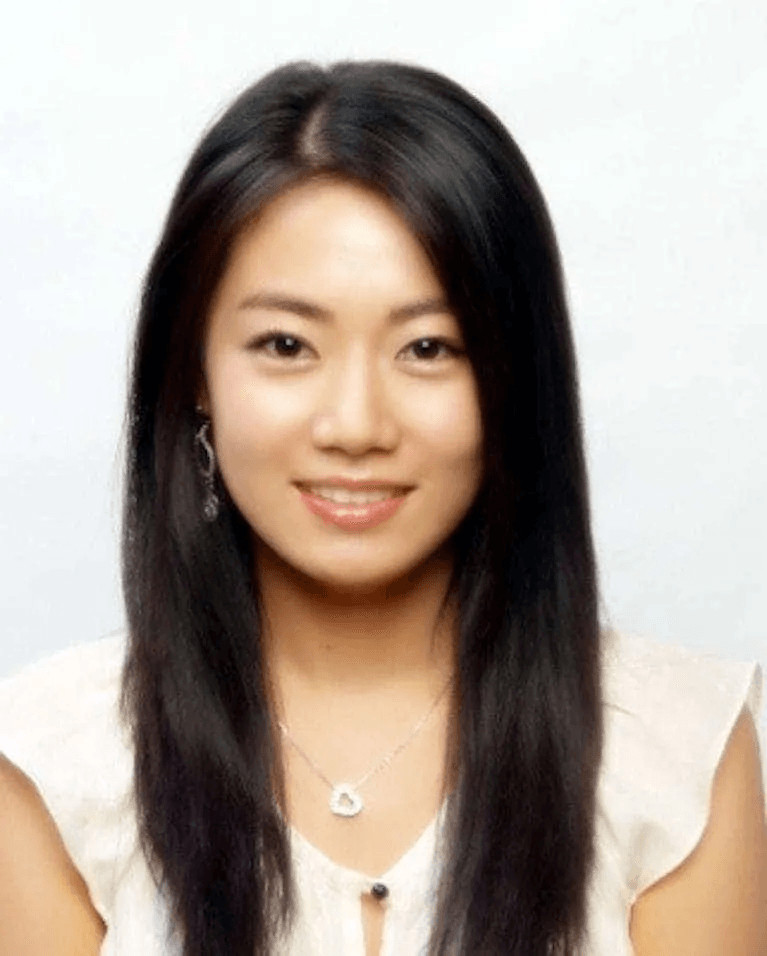
Founder and lead prosthodontist of Prosth & Co. on Manhattan's Upper East Side. DDS, Columbia University; Prosthodontics certificate and MMSc in Oral Biology, Harvard School of Dental Medicine; Implantology fellowship, Columbia University.
Meet Victoria →