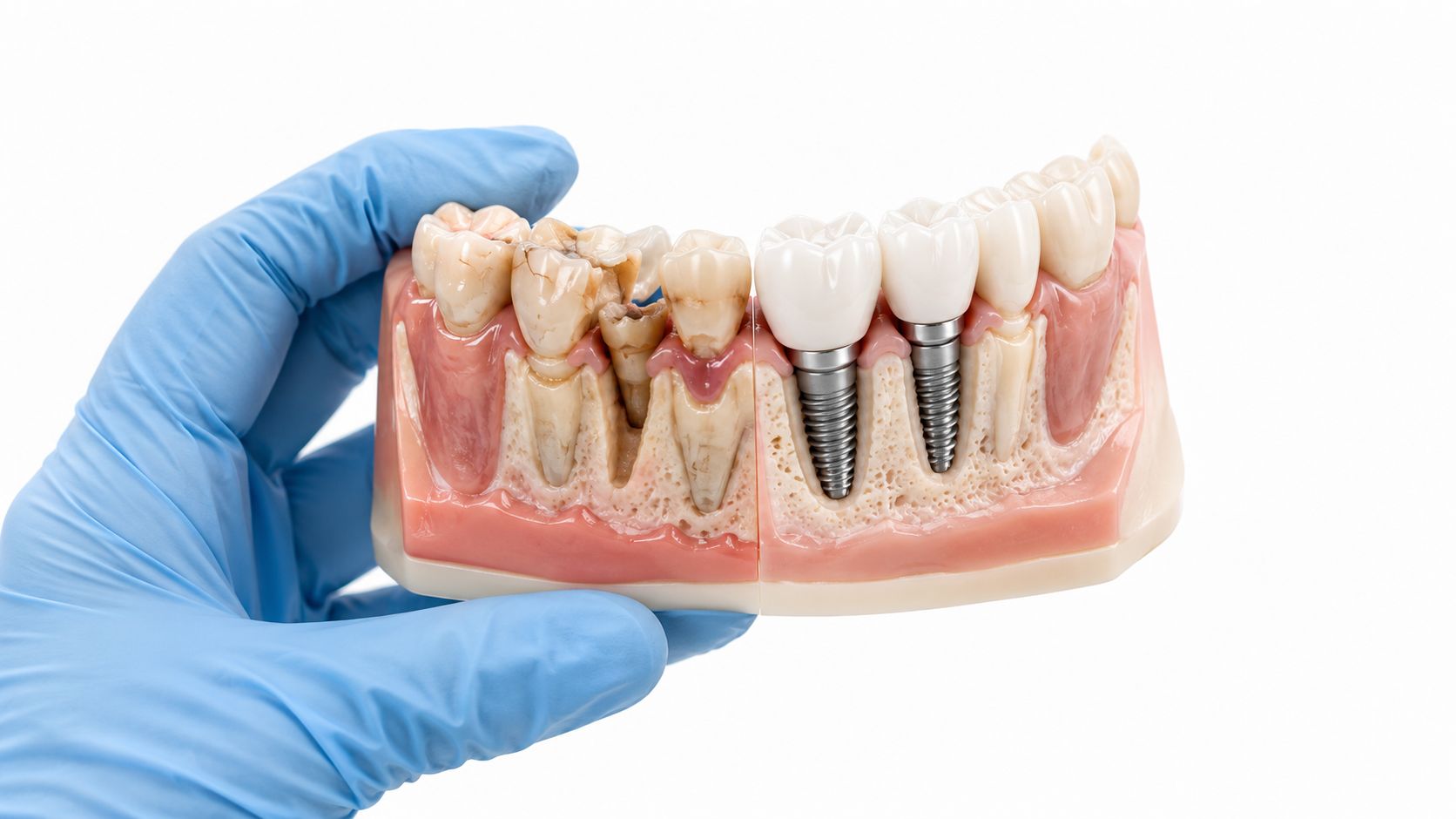
Complete tooth loss affected more than 350 million people worldwide in 2019, and about 23% of adults aged 60 and older were estimated to have lost all natural teeth, so full mouth reconstruction is often a coordinated medical solution, not a cosmetic luxury. For the right patient, it's a staged plan led by a prosthodontist to restore chewing, bite stability, speech, facial support, and long-term oral health.
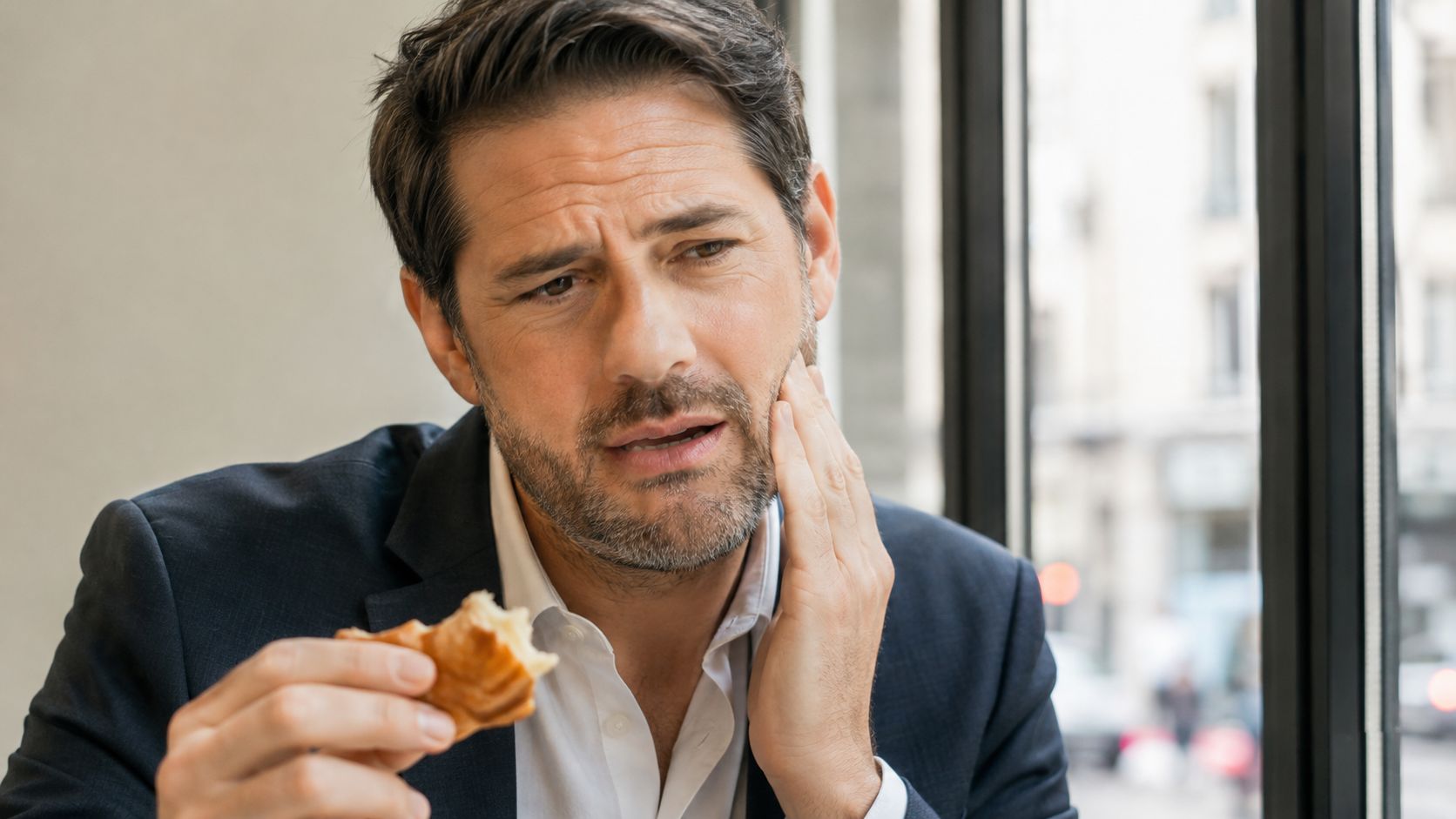
A Manhattan patient usually feels this in everyday life first. A croissant hurts to bite. An old crown chips again. Teeth look shorter, the bite feels uneven, and smiling stops feeling effortless.
Table of Contents
- When Your Smile Feels Broken, What Comes Next in Manhattan
- What Full Mouth Reconstruction Means
- How a Prosthodontist Plans Treatment Step by Step
- Implants, Crowns, and Less Invasive Options Compared
- What the Treatment Timeline Looks Like
- Why Prosthodontist-Led Care Matters on the Upper East Side
- Next Steps for Manhattan Patients Considering Reconstruction
When Your Smile Feels Broken, What Comes Next in Manhattan
On the Upper East Side, many patients reach the same breaking point in different ways. One may have worn teeth and jaw fatigue from grinding. Another may have several failing crowns and a mouth that never feels settled. A third may be dealing with missing back teeth, changing facial support, and the frustration of not knowing whether the next step is a root canal, an extraction, or something more involved.
What patients usually notice first
The early signs are rarely dramatic. Chewing starts to take work. Certain teeth feel too short, too sharp, or too fragile. Some patients notice that old dental work keeps failing, while others see a change in the way their smile supports the lips and face.
The problem usually isn't one tooth. It's a pattern that has outgrown single-tooth fixes.
That's why a search for a dentist in Manhattan often turns into a need for a prosthodontist. A prosthodontist-led practice can look at the whole mouth, not just the most obvious broken tooth, and decide what can be saved, what needs rebuilding, and what should wait until the foundation is stable.
Why a rushed fix can disappoint
A mouth with widespread wear, missing teeth, gum disease, or unstable bite forces needs sequencing. If treatment starts with the visible problem alone, the result can look good for a while and still fail under load.
At Prosth & Co., the clinical question isn't “What looks damaged?” It's “What is the actual path back to function, comfort, and maintainability?” That question matters for patients looking for a dentist near me who can handle restorative dentistry, dental implants, tooth extraction, or a more complex rebuild without fragmenting care across multiple offices.
What Full Mouth Reconstruction Means
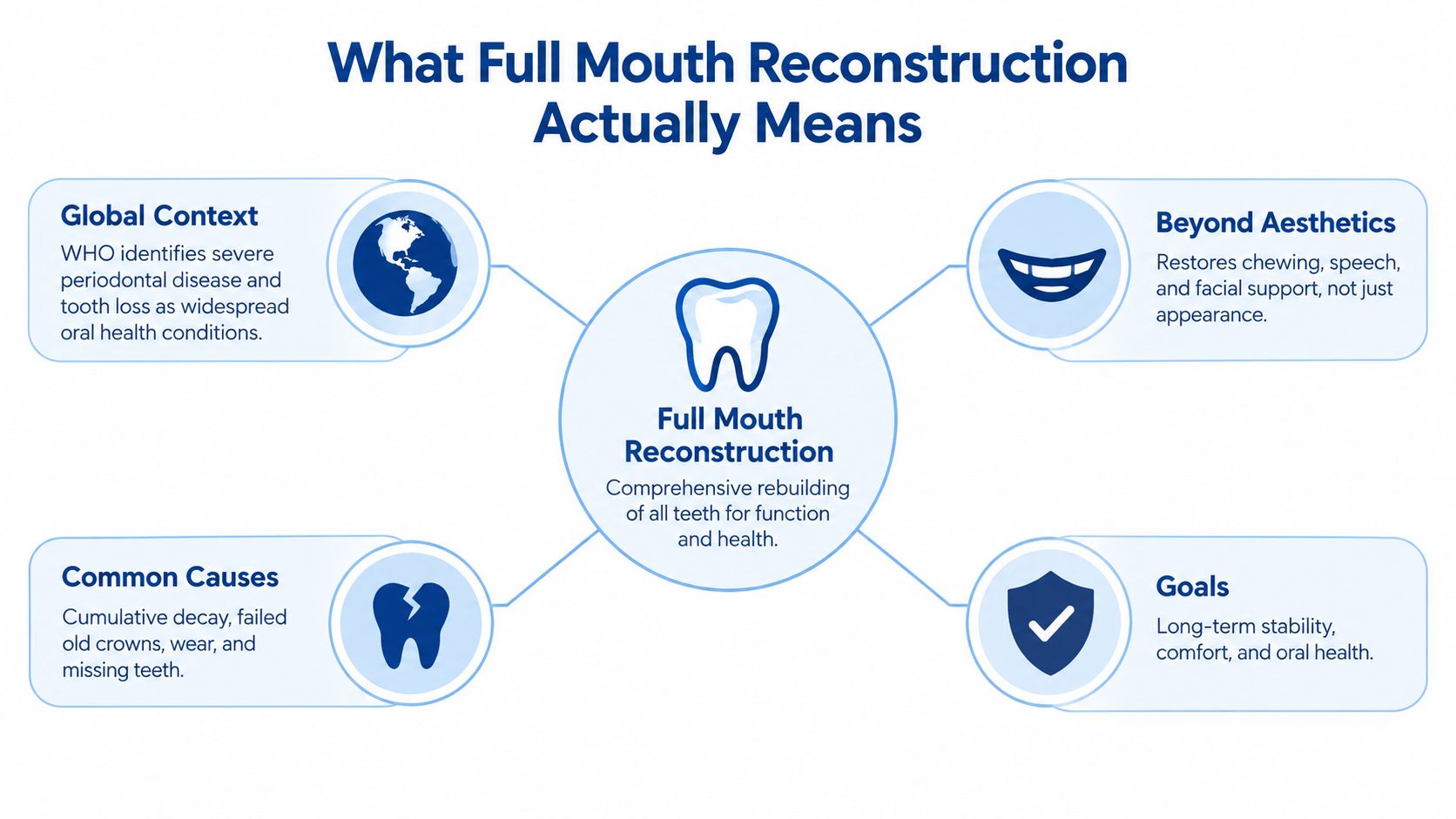
Full mouth reconstruction means rebuilding a mouth that cannot be restored tooth by tooth without addressing the whole system. It is a coordinated plan for teeth, gums, bite, and supporting tissues, aimed at restoring function, not just appearance.
The need for this kind of care is broad. Untreated dental caries affects about 2.5 billion people, and severe periodontal disease affects approximately 1 billion globally (WHO oral health fact sheet). Those conditions are common pathways to wear, breakdown, and tooth loss, which is why full rehabilitation exists at all.
The scope of the treatment
A patient may still have many teeth and need reconstruction because the bite has collapsed, old restorations keep failing, or the remaining teeth are too worn to support normal chewing. Another patient may already be missing most or all teeth and need a plan built around implant-supported or removable prosthetic options.
A useful way to think about it is this:
- Function first: chewing, speaking, and bite stability matter more than a cosmetic finish alone.
- Support matters: the gums and bone under restorations must be healthy enough to last.
- Maintenance matters: the result has to be cleanable, serviceable, and realistic for daily life.
Why the term can be misunderstood
Some people hear “full mouth” and assume every tooth must be crowned or replaced. That is not the point. In a diagnosis-driven plan, some teeth are restored, some are preserved, and some are removed only when they cannot be predictably saved.
The WHO burden data help explain why the field has moved toward coordinated rehabilitation instead of one-off fixes. Full mouth reconstruction is not a standardized package. It is a custom response to cumulative disease, wear, or tooth loss.
How a Prosthodontist Plans Treatment Step by Step
The planning phase is where complex care either becomes stable or becomes expensive guesswork. Occlusal vertical dimension, the height of the bite, should be established from converging evidence, not from a single measurement in isolation. That means looking at phonetics, facial proportions, tooth display, interocclusal space, mandibular function, and diagnostic records together.
Why staging protects the result
For severely worn teeth, the sequence usually starts with a diagnostic wax-up, then provisional restorations, then definitive work. That reversible-to-irreversible path lets the team test appearance, speech, comfort, and bite stability before committing to crowns or adhesive restorations.
A 2025 systematic review of increased-OVD rehabilitations reported 2,201 restorations followed for 3 to 5.5 years, with pooled replacement-free survival of 97.8%, clinical success of 94.0%, and an annual failure rate of 1.28% (systematic review). No temporomandibular or muscular complications were reported when the bite increase stayed within the patient's functional range.
What good sequencing looks like
The order matters because the mouth has to be made stable before it's made beautiful. Disease control comes before final ceramics. Bite testing comes before final cementation. Soft tissue, tooth position, and prosthetic space all need to be considered together.
Practical rule: if a proposal skips diagnostics and jumps straight to definitive restorations, the plan is probably too shallow for a true reconstruction.
For patients searching for an endodontist, pediatric dentist, or even a kids dentist near me, the lesson is the same. Dentistry works best when the diagnosis leads the treatment, not the other way around.
Implants, Crowns, and Less Invasive Options Compared
Full mouth reconstruction doesn't always mean replacing everything with implants or full-coverage crowns. For many patients, the better answer is the least invasive plan that still stabilizes disease and restores function.
The strongest decisions usually come from comparing options by diagnosis, not by trend. A patient with severe wear may do very well with additive composite and selective coverage. A patient with missing teeth and unstable bite support may need implant-based rehabilitation. Another may need crowns on some teeth, onlays on others, and no treatment at all on healthy enamel.
| Restorative Pathway | Best for | Key considerations |
|---|---|---|
| Direct composite or bonding | Moderate wear, shape correction, small defects | Conservative, repairable, but not ideal for every bite load |
| Onlays or partial coverage | Teeth that need protection without full crowns | Preserves more structure when enough tooth remains |
| Crowns and bridges | Teeth with major structural compromise or larger spans of loss | More definitive, but more irreversible |
| Implant-supported full-arch care | Extensive tooth loss or non-restorable teeth | Requires careful planning for space, hygiene access, and maintenance |
| Provisional or monitoring phase | Unclear prognosis or cases where symptoms must be tested first | Helps confirm speech, comfort, and bite before committing |
A 2025 systematic review found favorable patient-reported outcomes for minimally invasive full-mouth rehabilitation, with estimated annual failure rates of about 0.64% for direct composites, 0.13% for resin nanoceramics, and 0.04% for ceramics, while restoration fracture remained the most common complication (systematic review). That's a reminder that no material choice removes risk entirely.
The better question is not “How many teeth can be covered?” It's “Which teeth need irreversible preparation, and what underlying cause is being controlled first?” Bruxism, reflux, eating habits, caries, and periodontal disease all need to be addressed before final work holds up.
What the Treatment Timeline Looks Like
A responsible reconstruction usually unfolds in phases, not a single visit. Patients who understand that sequence tend to feel calmer, make better decisions, and tolerate the process more easily.
The usual phases
The first phase is diagnosis and disease control. That's where the dentist reviews records, evaluates the bite, treats active decay or gum disease, and decides which teeth can be preserved. For implant cases, this is also where bone volume, prosthetic space, and placement strategy are reviewed.
The next phase is foundation work. That may include extractions, root canal treatment, implant surgery, or other procedures that make the mouth ready for restoration. After that comes provisional testing, where temporary restorations are used to confirm that the bite, speech, and appearance are right before the final versions are made.
Why maintenance is part of the plan
Once definitive restorations are delivered, the case is not finished. Long-term care may include professional cleanings, checks around implants, night-guard use when grinding is part of the story, and repairs for chips, wear, or recurrent disease.
Maintenance isn't optional after comprehensive work. It's the part that protects the investment.
This is also where patients looking for dental implants near me need realistic expectations. Implant treatment can be highly effective, but it still involves staged care, home hygiene, and follow-up visits.
Why Prosthodontist-Led Care Matters on the Upper East Side
Complex cases work better with one team coordinating the plan, especially when treatment may involve implants, crowns, periodontal therapy, endodontics, or surgery. On the Upper East Side, many patients want that coordination to be efficient and consistent.
For full-arch implant rehabilitation, planning has to account for implant distribution, bone volume, prosthetic space, cleansability, occlusal loading, and access for maintenance. Fixed full-arch concepts such as All-on-4 and All-on-6 have reported 5 to 10-year survival commonly above 95%, and long-term follow-up in the same review found 94 to 95% cumulative implant survival in 471 patients treated over 10 to 18 years, with prosthetic success above 99% in carefully selected cases. Technical complications still matter, including framework or prosthetic fracture, screw loosening, hygiene-related inflammation, and peri-implant disease. Those outcomes are reported in implant rehabilitation review.
Why the setting changes the experience
A prosthodontist-led practice with an in-house laboratory can shorten communication loops and improve precision in design decisions. It also helps when the team needs to verify occlusion, revise contours, or build a retrievable prosthetic design that can be serviced later. Prosth & Co.’s in-house dental lab supports that kind of workflow.
Patients who want care without fragmentation often value that structure. They are not buying a promise of perfection. They are choosing a treatment model that keeps the restorative plan, the mechanics, and the maintenance plan in the same hands.
The practical lesson is simple. Implant survival alone is not enough. Biologic stability, prosthetic durability, function, esthetics, and serviceability all have to line up.
Next Steps for Manhattan Patients Considering Reconstruction
A patient who has lived with broken crowns, worn teeth, missing back teeth, or a bite that never feels settled usually wants one thing first, clarity. The first visit should answer what's failing, what can still be saved, and what the sequence should be if treatment moves forward.
What a good new-patient visit should include
The exam should be visual, structured, and easy to understand. The dentist should review the teeth, gums, bite, and supporting tissues, then explain whether the case looks more like targeted restorative care, staged rehabilitation, or implant-based reconstruction. If the plan is complex, the patient should leave with a sense of priorities instead of a pile of disconnected procedures.
For Manhattan patients, convenience matters too. Centralized care on the Upper East Side makes it easier to keep appointments aligned, especially when multiple phases or specialists are involved. That matters for those looking for a dentist in New York who can manage restorative dentistry, cosmetic dentistry, and emergency dental services without losing the bigger picture.
The right next step is a consultation with a prosthodontist-led team that can map the mouth carefully and explain the trade-offs plainly. For patients who want a clear, staged path rather than a rushed fix, that conversation is where real progress starts.
Prosth & Co. on Manhattan's Upper East Side provides prosthodontic, implant, restorative, cosmetic, pediatric, endodontic, periodontic, and oral surgery care under one roof, with treatment planning built around function, bite, esthetics, and long-term maintainability. If full mouth reconstruction has felt confusing, visit Prosth & Co. to schedule a consultation and get a clear plan for your next step.

Founder and lead prosthodontist of Prosth & Co. on Manhattan's Upper East Side. DDS, Columbia University; Prosthodontics certificate and MMSc in Oral Biology, Harvard School of Dental Medicine; Implantology fellowship, Columbia University.
Meet Victoria →