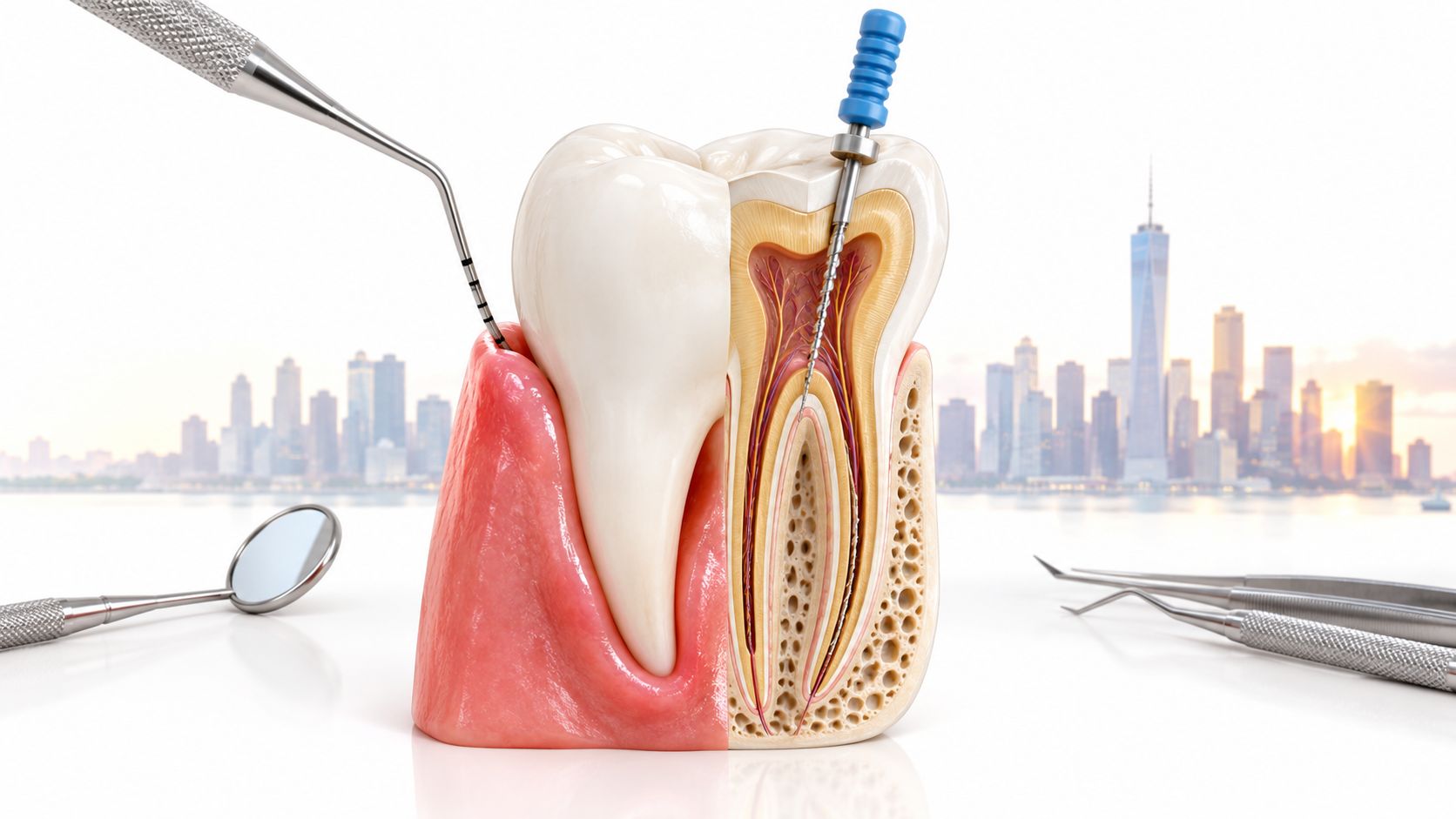
Yes, a periodontist is a licensed dentist who can legally perform a root canal when appropriately trained, competent, and permitted by local regulations. The more useful question is which specialist should own the diagnosis and treatment sequence for that particular tooth.
The familiar advice that periodontists treat gums and endodontists treat roots is a starting point, not a complete treatment plan. A painful tooth with bone loss or a draining gum lesion may need both specialists, plus a restorative assessment before anyone decides whether saving it makes sense.
For patients searching for a dentist near me in Manhattan, especially on the Upper East Side, the priority is getting a clear explanation rather than another unexplained referral. A prosthodontist-led, multi-specialty practice can organize that evaluation around the entire tooth, its supporting tissues, and its eventual restoration.
Table of Contents
- Why Asking Whether a Periodontist Can Do a Root Canal Is the Wrong First Question
- What Each Specialist Actually Trains For
- Where the Two Specialties Overlap and Where They Diverge
- When One Tooth Has Two Diseases at Once
- How to Decide Which Specialist to Call First
- What Coordinated Care Looks Like in a Multi-Specialty Manhattan Practice
- When to Act Quickly and How to Reach the Right Specialist
Why Asking Whether a Periodontist Can Do a Root Canal Is the Wrong First Question
The gums-versus-roots distinction becomes too narrow when a patient arrives with pain, swelling, and an uncertain prognosis. The immediate task isn't choosing a specialty label. It's establishing what is diseased, what can be treated, and whether the remaining tooth can support a useful restoration.
The Ontario Dental Association's explanation of dental specialists distinguishes periodontal care from endodontic care and notes that general dentists can perform root canals, with more difficult cases referred to endodontists. That distinction matters because legal scope and clinical suitability aren't the same thing. A clinician may be permitted to provide a procedure without being the most appropriate choice for its particular difficulty.
Separate the decisions before choosing the clinician
A useful treatment discussion assigns responsibility for three different questions:
- Internal diagnosis: Which clinician will determine whether the pulp, the tissue inside the tooth, needs endodontic treatment?
- Root-canal treatment: Who will clean, shape, and fill the canals, and is the difficulty within that clinician's experience?
- Supporting-tissue prognosis: Who will assess the gums and bone and explain how their condition affects keeping the tooth?
These responsibilities may belong to different clinicians. That isn't fragmented care when the team agrees on the diagnosis and sequence before treatment starts.
Practical rule: Choose the clinician for the problem that needs solving, not simply for the specialty name already written on a referral.
Permission isn't a treatment recommendation
A similar distinction arises with implant treatment. For readers comparing procedure permissions across dental specialties, All Stars Dental on implant treatment provides a related resource on general-dentist involvement. The practical issue remains the same: permission alone doesn't establish experience, case suitability, or responsibility for follow-up.
On Manhattan's Upper East Side, prosthodontic-led planning adds another question before an invasive procedure begins: what will the finished tooth need to function comfortably? That question keeps the discussion from becoming a choice between a root canal and tooth extraction without first evaluating the full treatment pathway.
A patient deserves an explanation of why a specialist is involved, what that specialist will do, and what decision remains unresolved.
What Each Specialist Actually Trains For
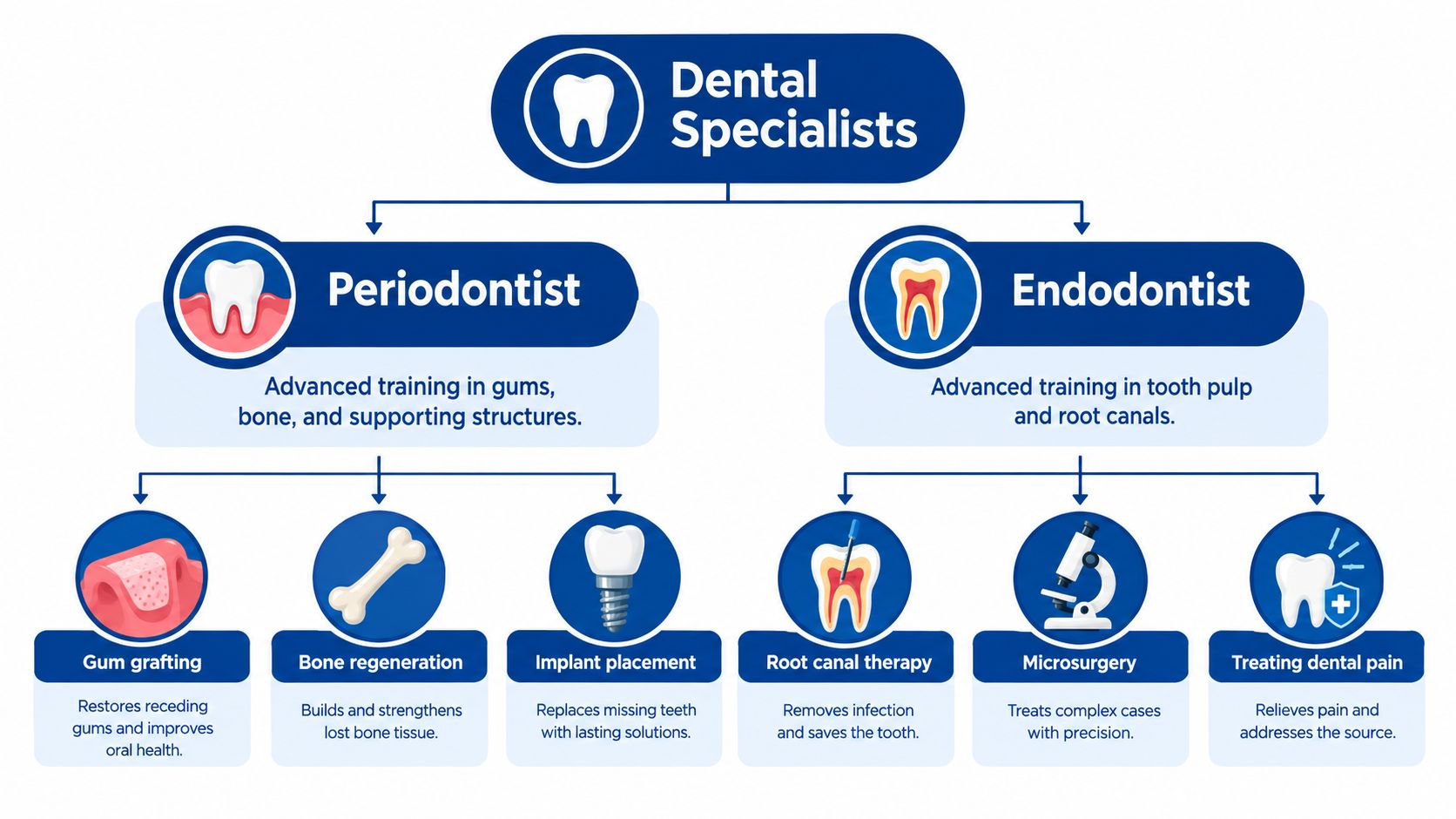
Periodontics focuses on the tissues that hold teeth in place: the gums, periodontal ligament, and alveolar bone. Endodontics focuses on the pulp, root-canal system, and tissues around the root ends. A useful analogy is the soil supporting a tree versus the interior of its trunk, although a tooth's internal and external problems can interact.
The periodontist's focus
Periodontal training prepares a specialist to evaluate and manage supporting-tissue disease and related surgical needs. This includes gum treatment, bone grafting, sinus augmentation, and implant-related care. Patients can explore the Upper East Side practice's periodontal treatment services when the concern involves gum health or the foundation around a tooth.
The Commission on Dental Accreditation's periodontics standards specifically require understanding of endodontic-periodontal lesions. They don't define conventional root-canal therapy as the central competency of periodontics.
That boundary is important. Understanding how pulpal disease affects periodontal tissues helps a periodontist participate in diagnosis and planning, but it doesn't make every periodontist a routine root-canal provider.
The endodontist's focus
Endodontists receive focused training in pulp and root-related diagnosis, nonsurgical and surgical treatment, retreatment, magnification, and complex anatomy. The University of Michigan's patient education resources note that endodontists complete at least two additional years of specialty training beyond dental school.
For patients, the practical distinction is concentrated experience with the tooth's internal treatment. Difficult canal anatomy, uncertain pulp-testing results, or a previously treated tooth may call for that narrower expertise.
The prosthodontist's role in the finished result
A prosthodontist plans how a damaged or missing tooth will be restored, with attention to function, bite, appearance, and maintainability. In a combined case, that restorative perspective belongs in the initial discussion, not only after the specialists finish.
Patients seeking background on the restoration pathway can also review restorative dentistry options from Yoyime Clinic. The relevant planning question is whether the proposed endodontic and periodontal work leads to a tooth that can be restored sensibly.
Specialty boundaries are useful because they identify concentrated training. They shouldn't become barriers to shared decisions.
Where the Two Specialties Overlap and Where They Diverge
For an ordinary root-canal problem, an endodontist's postgraduate focus most directly matches the procedure. Periodontal input becomes more important when the same tooth has compromised supporting tissues. The distinction is easiest to understand through the decisions each specialist is asked to make.
Periodontist vs Endodontist at a Glance
| Decision Factor | Periodontist | Endodontist |
|---|---|---|
| Primary diagnostic focus | Gums, periodontal ligament, and supporting bone | Pulp, root canals, and tissues around root ends |
| Typical treatment focus | Periodontal therapy, supporting-tissue surgery, and implant-related care | Root-canal therapy, retreatment, and endodontic surgery |
| Relevant assessment | Bone support, deep pockets, mobility, and periodontal defects | Pulp status, canal anatomy, and persistent root-related disease |
| Role in combined disease | Determines supporting-tissue needs and periodontal prognosis | Determines and treats the internal component |
| Routine root-canal suitability | Depends on individual competence and permitted scope | Specialty training most directly matches the procedure |
An isolated deep pocket or a loose tooth deserves more than an automatic root-canal appointment. Those findings affect the question of whether the tooth has a reasonable future, even if its internal infection is treatable. Conversely, a gum lesion doesn't automatically establish that gum disease is the primary problem.
What the overlap research actually shows
A 2024 peer-reviewed study on endodontic-periodontal lesions reported that 53% of participating dentists would perform root-canal treatment and initial periodontal treatment simultaneously when both were required. That finding illustrates overlap in management, not evidence that most periodontists routinely perform ordinary root canals.
The important limit is the population and question studied. Treatment choices for combined lesions shouldn't be generalized to every painful tooth or used to settle who should perform a technically demanding procedure.
Shared responsibility for a combined lesion doesn't mean interchangeable responsibility for every procedure.
Why the distinction changes an appointment
A patient looking for an endodontist in New York may primarily need a difficult internal diagnosis. A patient referred for bone loss may need a periodontist to establish whether the tooth has adequate support. When both questions remain open, a joint assessment is more informative than booking treatment based on the strongest symptom alone.
The efficient choice isn't necessarily the clinician who can start immediately. It's the clinician, or coordinated team, who can resolve the important uncertainty before committing to treatment.
That approach also makes referrals easier to understand. A referral may identify a specific technical or diagnostic need rather than signal that the original dentist cannot help or that extraction is inevitable.
When One Tooth Has Two Diseases at Once
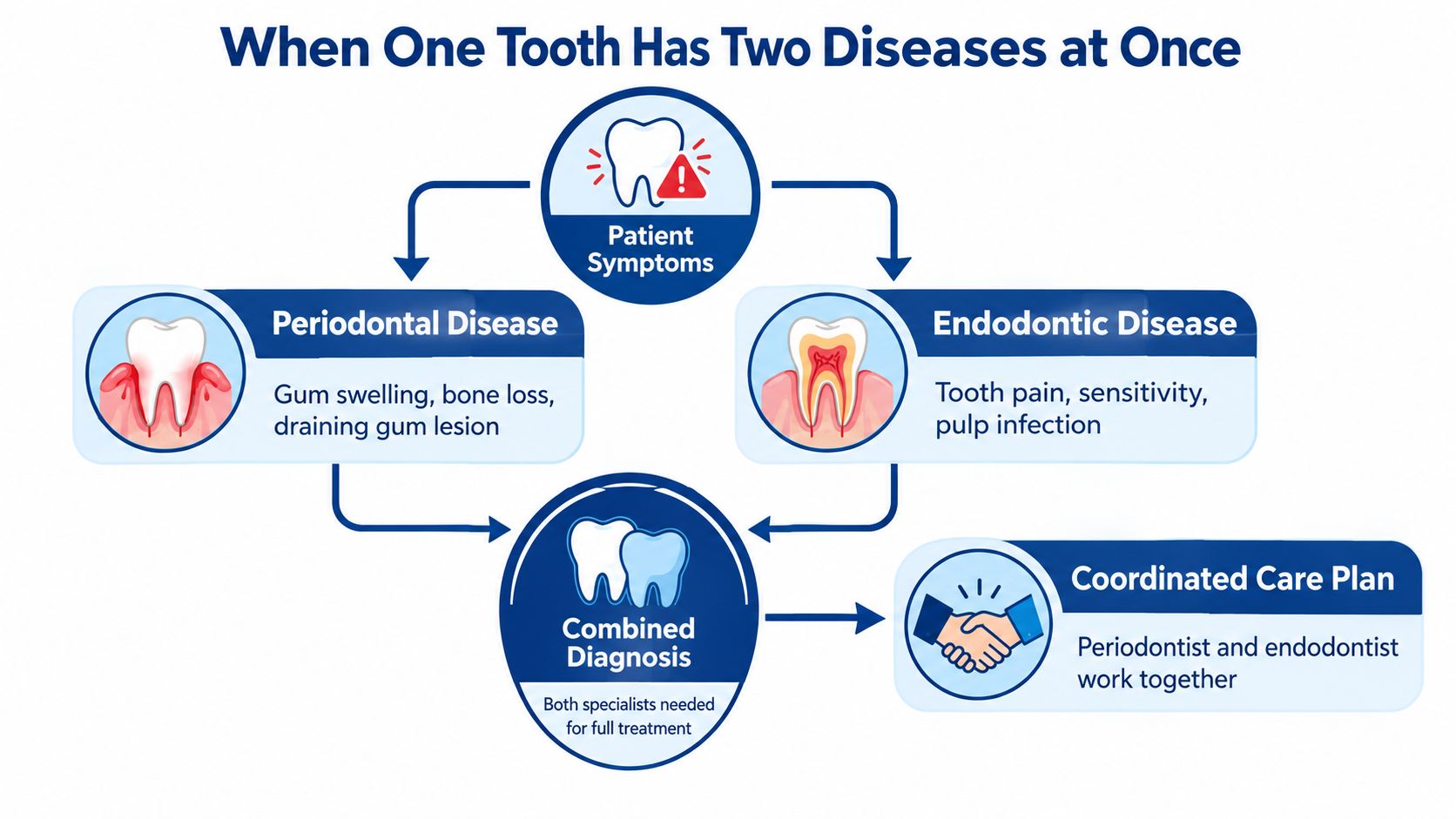
Consider a hypothetical Upper East Side patient with a cracked upper molar, a deep gum pocket, and a nonvital pulp, meaning the internal tissue is no longer living. This is an illustrative clinical situation, not a reported patient case. The findings raise separate questions about internal infection, periodontal support, and the crack's effect on restorability.
Treating the pulp alone wouldn't answer all of them. Neither would treating the gum pocket while leaving the internal diagnosis unresolved.
Establish the source before setting the order
An endodontic-periodontal lesion involves both the tooth's internal system and its supporting tissues. The team must distinguish a primarily internal problem with periodontal involvement from primarily periodontal disease or a combined condition.
The American Association of Endodontists' standard-practice guidance recognizes the value of consultation with other specialists when supporting-tissue problems complicate care. In the hypothetical molar, the endodontist evaluates the internal component, the periodontist evaluates the pocket and bone support, and the restorative clinician assesses whether the crack and remaining structure permit a useful restoration.
The patient-facing explanation should distinguish:
- What is established: The examination has identified particular pulpal and periodontal findings.
- What remains uncertain: The origin of the lesion, crack status, or long-term supporting-tissue prognosis may need further evaluation.
- What determines the next step: The suspected disease source and restorability guide whether treatment proceeds, pauses for consultation, or changes direction.
Sequencing isn't the same for every combined lesion
When the internal disease is primary, endodontic treatment may precede periodontal reassessment. A primarily periodontal problem can require a different initial approach. Concurrent treatment may also be considered when the diagnosis supports it.
The research discussed earlier reflects that variation. It doesn't justify a universal rule that the root canal or gum treatment must always come first.
A sensible plan identifies the immediate disease target, the point at which healing will be reassessed, and the findings that would change the recommendation. This avoids treating a visible symptom while overlooking the other disease process.
For the hypothetical cracked molar, preserving the tooth is a possibility to evaluate, not a promise. The benefit of collaborative care is a more complete prognosis conversation before the patient commits to an extensive restorative plan.
How to Decide Which Specialist to Call First
Patients don't need to diagnose an endodontic-periodontal lesion before requesting an appointment. They need to describe the symptoms clearly and reach a clinician who can arrange the appropriate evaluation. When the source is uncertain, a thorough dental assessment is a reasonable starting point.
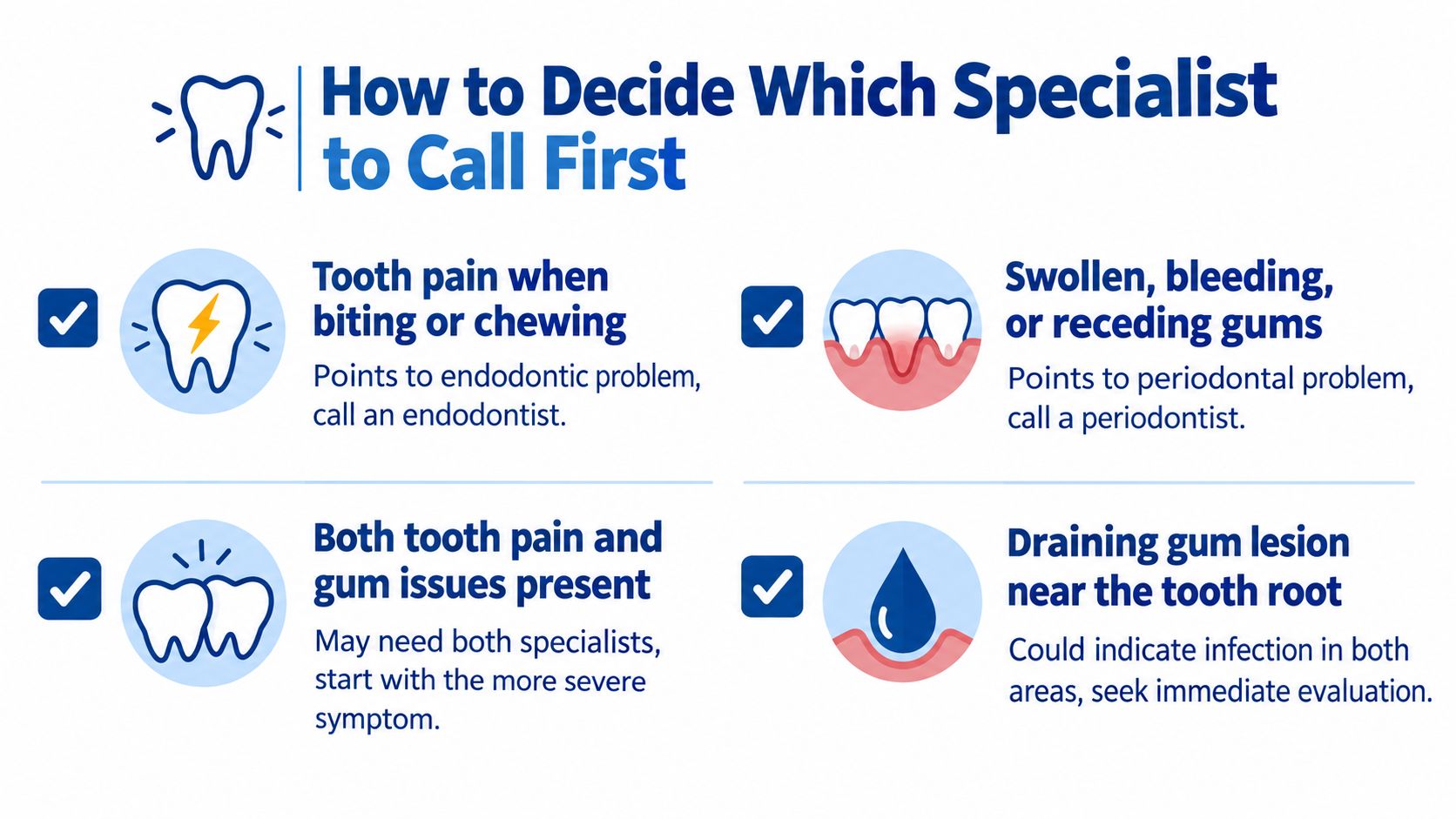
Use symptoms to route the visit, not establish the diagnosis
Severe toothache, traumatic injury, or an unresolved problem in a previously root-canaled tooth makes endodontic assessment particularly relevant. Loose teeth, known bone loss, or a concern centered on gum recession makes periodontal assessment relevant. Symptoms involving both areas call for a broader examination rather than a confident self-diagnosis.
The infographic offers a routing aid, but pain when biting and a draining gum lesion aren't diagnoses by themselves. Their source must be established clinically.
For families searching for a pediatric dentist or kids dentist, the same principle applies: a child's tooth pain needs a children's dentist's assessment rather than assumptions drawn from an adult root-canal explanation. The Upper East Side practice provides pediatric care alongside its adult specialty services.
Ask about difficulty and imaging
The American Association of Endodontists' treatment standards recommend referral when difficulty exceeds the treating clinician's experience or when care may require microscopy, three-dimensional imaging, regenerative procedures, retreatment, or apical surgery.
A practical imaging question is what the proposed dental x-rays or three-dimensional scan need to clarify. The team should explain whether the uncertainty concerns canal anatomy, supporting tissues, or another finding that could alter treatment. Advanced imaging shouldn't be presented as an automatic purchase because a specialist is involved.
Leave with named responsibilities
Useful appointment questions include:
- Pulp diagnosis: Which clinician will establish whether the internal tissue requires treatment?
- Canal treatment: Who will perform instrumentation and obturation, meaning canal cleaning and filling?
- Periodontal follow-up: Who will reassess the gums and supporting bone?
- Restorative completion: Which clinician will plan the final restoration, and when should that phase occur?
Appointment priority: A clear diagnosis, a named treatment provider, and a defined reassessment point are more useful than a referral slip without an explanation.
Patients comparing a dentist in Manhattan with a separately arranged specialist pathway can ask how findings will be shared. Coordination should be explicit, whether care happens under one roof or across offices.
What Coordinated Care Looks Like in a Multi-Specialty Manhattan Practice
Coordination becomes useful when the clinicians make decisions together, not merely when their names appear on the same office directory. For a damaged tooth, the restorative plan should inform the endodontic and periodontal decisions from the beginning.
The Upper East Side practice is led by prosthodontist Dr. Victoria Park and provides endodontic, periodontic, restorative, and implant services under one roof. Its in-house dental laboratory supports custom restorations with direct clinical oversight.

What happens during the evaluation
A new patient exam can bring the symptoms, existing dentistry, periodontal concerns, and restorative goals into one discussion. The practice uses digital planning, intraoral photography, and visual case reviews to help explain findings and proposed care.
The value is a shared plan with meaningful handoffs:
| Phase | Question the team needs to resolve |
|---|---|
| Initial assessment | What explains the symptoms, and what remains uncertain? |
| Treatment planning | Is preserving the tooth realistic and maintainable? |
| Specialty treatment | Which clinician performs each agreed procedure? |
| Restoration and review | How will the tooth be restored and its condition monitored? |
Shared records can help clinicians review existing imaging before ordering additional studies. That is an opportunity to avoid unnecessary duplication, not a guarantee that further imaging won't be needed.
Benefits beyond convenience
Coordinated care aims to address the identified source of pain while also accounting for the tooth's support and eventual function. It helps patients understand the difference between completing an individual procedure and completing the whole treatment plan.
If the tooth cannot be restored sensibly, the discussion can move to tooth extraction, dental implants, or another replacement option without treating extraction as the automatic answer to uncertainty. Implant placement and restoration are available on-site.
Patients arriving through searches such as dental implants near me or cosmetic dentist near me may still need disease evaluation before replacement or appearance-focused care. Cosmetic dentistry, smile design, and routine cleaning and exams belong in a broader plan, but they don't substitute for resolving an active infection or uncertain tooth prognosis.
When to Act Quickly and How to Reach the Right Specialist
Persistent dental pain with suspected infection shouldn't wait for a routine consultation several weeks away. The Merck Manual's overview of dental emergencies advises dental evaluation by the next day or sooner when possible for an infection accompanied by pain. Definitive care may include pulpotomy, pulpectomy, root-canal treatment, extraction, or incision and drainage, depending on the diagnosis.
Urgent symptoms need an urgent conversation
Severe pain, facial swelling, fever, or a suspected draining abscess warrants prompt contact with an emergency dentist. Patients requesting an emergency root canal should understand that the appointment first establishes what treatment is appropriate, rather than assuming the procedure in advance.
The American Dental Association's antibiotic stewardship guidance prioritizes definitive dental treatment over routine antibiotics for most pulpal and periapical conditions in otherwise healthy adults. Antibiotics become appropriate when infection progresses to systemic involvement, such as fever or malaise.
Waiting for antibiotics alone isn't a complete dental treatment plan.
Scheduled concerns still deserve a plan
Known bone loss, mobility without acute pain, or an implant-planning question may be suited to a scheduled periodontal or prosthodontic consultation. Patients seeking a dentist in New York should describe both current symptoms and previous treatment when booking.
The Upper East Side office offers weekday appointments and urgent care availability. Patients should contact the practice to confirm access and allow the team to route the visit to the appropriate clinician.
Prosth & Co. offers coordinated endodontic, periodontal, prosthodontic, and implant-related care on Manhattan's Upper East Side. Visit Prosth & Co. to request a consultation about a painful or compromised tooth, or contact the office promptly for urgent symptoms and current appointment availability.

Founder and lead prosthodontist of Prosth & Co. on Manhattan's Upper East Side. DDS, Columbia University; Prosthodontics certificate and MMSc in Oral Biology, Harvard School of Dental Medicine; Implantology fellowship, Columbia University.
Meet Victoria →