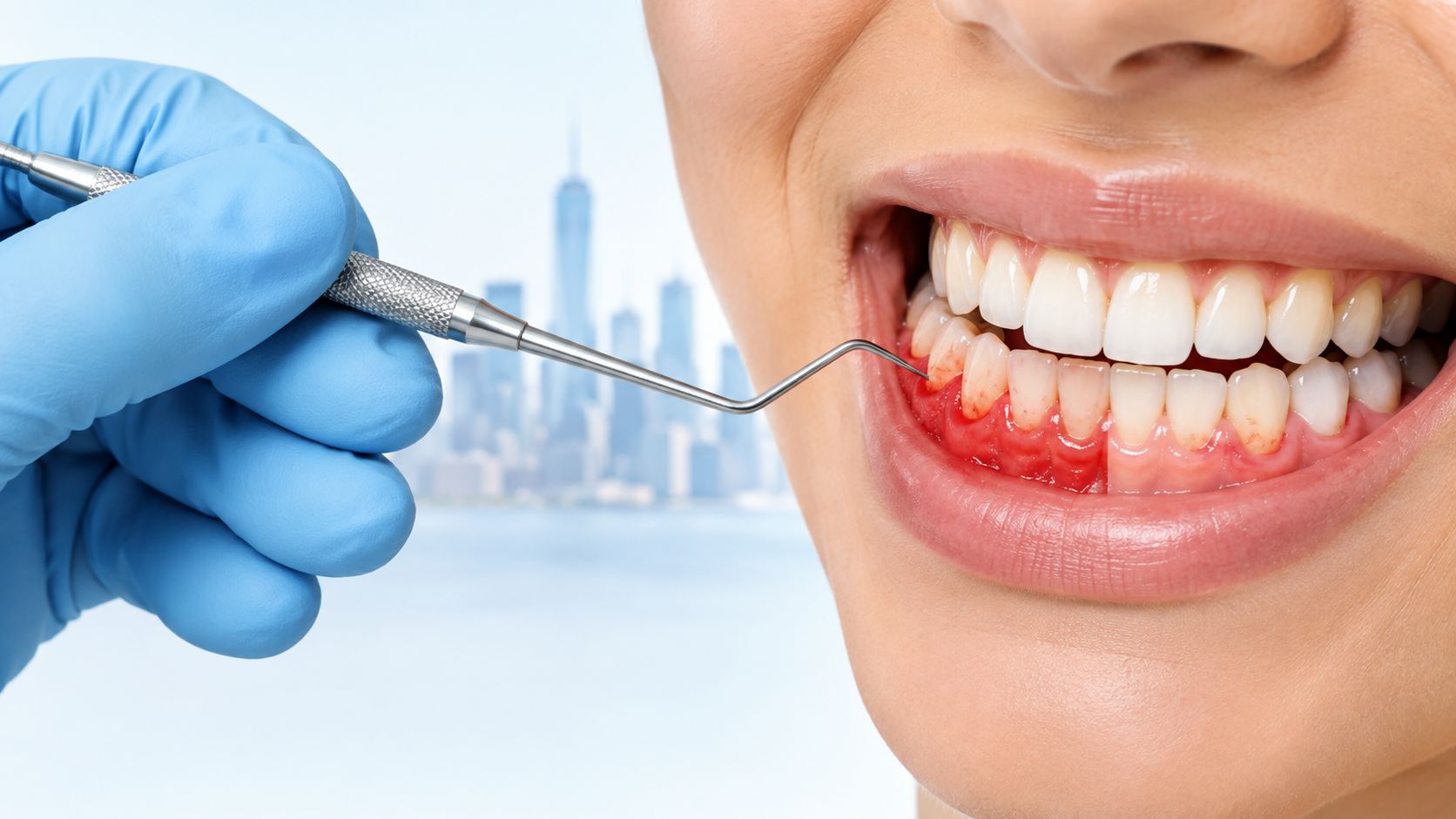
A patient searching for a dentist near me in Manhattan may start with a small concern: blood on the toothbrush, a bad taste, tenderness while eating, or a tooth that feels different. In a busy New York schedule, those signs are easy to postpone until chewing becomes uncomfortable or a loose tooth creates an urgent need for an emergency dentist. Periodontal treatment can often address the underlying problem before it disrupts daily life or limits future restorative options.
At Prosth & Co.’s Upper East Side location, patients can receive coordinated evaluation for gum disease alongside restorative, implant, cosmetic, endodontic, and oral surgery services. The practical priority is simple: stabilize the gums first, then protect natural teeth and plan crowns, bridges, dentures, or dental implants near me around a healthy foundation.
Table of Contents
- Why Gum Health Matters in Manhattan Dental Care
- Recognizing the Signs and Diagnosis Process
- Stepwise Treatment Options for Gum Disease
- Recovery Timeline and What to Expect
- How Periodontal Health Supports Dental Implants
- Prevention and Long-Term Maintenance Strategies
Why Gum Health Matters in Manhattan Dental Care
A common Upper East Side scenario begins at an office desk. A businesswoman notices bleeding while brushing before work, ignores it during a demanding week, and later feels discomfort when eating. Then a tooth feels slightly mobile. The concern changes from “Should this be checked?” to “Does this mean tooth extraction, an implant, or an emergency dental visit?”
That progression matters because periodontal disease affects the tissues and bone supporting the teeth. Early inflammation may cause bleeding and swelling, while advanced disease can damage attachment and supporting bone, increase tooth mobility, and contribute to tooth loss. A patient who is looking for an emergency dentist in New York, an endodontist, or a general dentist near the Upper East Side may need a careful periodontal assessment before any restorative decision is made.

A widespread condition with local consequences
The World Health Organization estimated that severe periodontal disease affected approximately 19% of people older than 15 years, representing more than 1 billion people worldwide (WHO-linked periodontal disease estimates). The same source reports that severe-periodontitis cases doubled between 1990 and 2019. Those figures distinguish severe periodontitis from milder gingivitis and early periodontal disease, which affect additional patients.
The scale of the condition doesn't make an individual diagnosis less personal. Gum inflammation can make eating, speaking, brushing, and smiling uncomfortable. It can also complicate plans for a crown, bridge, denture, veneer, or implant because restorative dentistry depends on stable supporting tissues.
Practical rule: A loose tooth or recurring gum bleeding deserves diagnosis, not guesswork. A local dentist can determine whether the issue is periodontal, endodontic, restorative, or a combination.
Why timely evaluation protects future choices
Periodontal treatment isn't limited to one type of deep cleaning. Care may include prevention, professional debridement, scaling and root planing, pocket management, maintenance, surgical access, or regenerative procedures. The appropriate choice depends on the affected sites, bone levels, bleeding, mobility, medical history, smoking, diabetes, plaque control, and the patient's ability to maintain the result.
A structured plan also helps patients understand what happens next. For readers comparing approaches to organizing complex treatment, TOOLii care plan implementation tips offer a useful framework for turning separate recommendations into a coordinated plan. In dental care, that may mean treating active gum infection before replacing a failing tooth, then sequencing implant or prosthodontic work after the tissues are stable.
Gum health is therefore more than a hygiene concern. For a Manhattan patient considering a cosmetic dentist near me, a prosthodontist, or dental implants, periodontal stability is part of protecting the investment in treatment.
Recognizing the Signs and Diagnosis Process
Gum disease often starts without noticeable symptoms. Bleeding during brushing or flossing, red or swollen tissue, persistent bad breath, gum tenderness, recession, sensitivity, tooth movement, or a change in the bite can all justify an evaluation. Pain isn't required. Some patients have active periodontal disease without the dramatic symptoms that would prompt an emergency dental visit.
The distinction between gingivitis and periodontitis is important. Gingivitis involves inflamed gum tissue and can often improve with professional cleaning and better plaque control. Periodontitis affects the supporting tissues around the teeth and may involve pocket formation, attachment loss, and bone loss. Once support has been damaged, treatment focuses on controlling infection, preserving what remains, and maintaining stability.
What happens during an examination
A thorough periodontal assessment usually combines several findings rather than relying on one symptom:
-
Medical and dental history. The dentist reviews tobacco use, diabetes, medications, previous gum treatment, sensitivity, bleeding, and concerns about loose or missing teeth.
-
Visual examination. Redness, swelling, recession, plaque, calculus, drainage, and changes in the gum contour provide useful clues.
-
Six-point probing. A periodontal probe measures the depth around each tooth at multiple sites. Healthy periodontal pockets are rarely deeper than 3 mm, while pockets greater than 4 mm may indicate disease requiring closer evaluation and active treatment (periodontal probing guidance).
-
Bleeding assessment. Bleeding on probing can indicate inflammation even when the gums don't look severely swollen.
-
Tooth and support evaluation. Mobility, furcation involvement, recession, the bite, and the condition of existing crowns or fillings help establish the prognosis of each tooth.
-
Dental X-rays. Radiographs show bone levels, root shape, areas of bone loss, infection near a root, and other findings that aren't visible during a visual examination.
Why pocket charting matters
Pocket depth doesn't tell the entire story, but it helps identify areas that need treatment and later reassessment. A patient may have a few isolated problem sites around a molar, generalized inflammation, or a combination of periodontal disease and a cracked tooth. Those conditions require different decisions.
A dentist in New York may also distinguish gum-related discomfort from pulpal pain that needs a root canal or an endodontist. A tooth that hurts to bite, reacts strongly to temperature, or develops a localized abscess may have an endodontic problem, while generalized bleeding and deep pockets point toward periodontal involvement. Both conditions can occur in the same mouth, which is why an exam is more reliable than choosing a procedure based on one symptom.
Patients should expect questions, measurements, images, and a discussion of prognosis. A careful diagnosis explains not only what is wrong, but also which teeth can be maintained, which sites need active periodontal treatment, and whether restorative work should wait.
Stepwise Treatment Options for Gum Disease
Periodontal treatment works best as a staged process. The first objective is to control inflammation and remove plaque and calculus from accessible and below-gumline surfaces. The next decision comes after healing and reassessment. Surgery isn't automatically better, and deep cleaning isn't automatically sufficient for every site.
Nonsurgical care comes first
Scaling and root planing, often called a deep cleaning, removes plaque and calculus from tooth and root surfaces below the gumline. The clinician uses specialized instruments to disrupt the bacterial deposits inside periodontal pockets and smooth contaminated root surfaces. Local anesthetic may be used when deposits extend beneath sensitive gum tissue.
The American Dental Association identifies scaling and root planing without additional medications as the treatment of choice for periodontitis (American Dental Association guidance on periodontitis). That recommendation reflects a practical principle: mechanical removal of plaque and calculus is the foundation. Antibiotics, antiseptics, lasers, or other add-ons don't replace access, instrumentation, home plaque control, and reassessment.
Treatment may be organized by quadrant or delivered through a more concentrated full-mouth approach. The choice should reflect tolerance, logistics, infection-control considerations, and patient preference rather than an assumption that one schedule will create substantially better healing. A Cochrane review found no clear clinical advantage for full-mouth scaling or full-mouth disinfection over conventional staged mechanical treatment, with no demonstrated benefit for clinical attachment-level gain or bleeding-on-probing reduction (Cochrane review of full-mouth treatment).
Patients seeking practical information about deep cleaning dental treatment should look for an explanation of the findings that led to the recommendation, not just a procedure name.
When surgery becomes reasonable
Surgical treatment may be considered when deep residual pockets remain after nonsurgical therapy, when deposits can't be predictably reached with closed instrumentation, or when a localized defect may respond to regenerative treatment. Flap surgery lifts the gum tissue temporarily so the clinician can see and clean the root surface and reshape the area for improved maintenance.
The decision should be site-specific. A systematic review and meta-analysis found that for pockets deeper than 6 mm, surgery produced approximately 0.58 mm greater probing-pocket-depth reduction and 0.19 mm greater clinical-attachment-level gain after 12 months (systematic review and meta-analysis summarized by the CDC). Those are average differences, not promises for an individual tooth.
Surgery can also involve:
- Bone grafting: Used in selected areas with bone defects to support regeneration or future tooth and implant planning.
- Guided tissue regeneration: A membrane may be used with other procedures to guide the healing of a specific defect.
- Gum grafting: Tissue can cover exposed roots, reduce sensitivity, and improve protection where recession is significant.
- Sinus augmentation: In selected upper-jaw cases, bone augmentation may support later implant placement when available bone is limited.
How the decision is made
A responsible plan weighs pocket depth, bleeding, attachment, bone architecture, mobility, furcation involvement, root anatomy, restorability, smoking, diabetes, home care, and maintenance attendance. A tooth with advanced bone loss may still be maintainable, while a tooth with a poor restorative prognosis may require extraction and later replacement.
The same logic applies to medications and technology. Routine systemic antibiotics aren't automatically appropriate, and local antimicrobials aren't universal substitutes for mechanical treatment. A selected adjunct may have a role under clinician supervision, but the measurable endpoint should determine whether treatment is working.
Patients should receive a clear sequence: initial periodontal therapy, healing, objective reassessment, targeted retreatment or surgery when indicated, and supportive care. That sequence protects natural teeth while keeping implant and restorative options open.
Recovery Timeline and What to Expect
Recovery depends on the extent of treatment and the number of areas involved. After scaling and root planing, patients may notice temporary gum tenderness, mild bleeding, or sensitivity to cold. Those effects usually reflect inflammation being reduced and previously covered root surfaces becoming more exposed to the mouth, not a sign that treatment has harmed the teeth.
Soft foods, gentle brushing around tender areas, and the prescribed cleaning routine can make the first part of recovery easier. The dental team may recommend a desensitizing product, a modified brushing technique, or an interdental tool based on the patient's gum contour and treatment sites. Specific instructions matter more than copying another patient's routine.
What healing requires
After flap surgery or a grafting procedure, swelling and tenderness can be more noticeable. Patients may need to avoid disturbing the treated area, follow medication instructions, use any recommended rinse correctly, and attend the scheduled review. Sutures, if used, are managed according to the surgical plan.
A patient should contact the practice promptly if pain becomes severe, swelling worsens rather than improves, bleeding doesn't settle with the recommended pressure, or fever and drainage develop. A separate dental problem can also appear during this period. A clear guide to root canal abscess warning signs can help patients distinguish symptoms that may require endodontic attention from routine periodontal healing.
Aftercare principle: Healing isn't passive. The treated tissue needs protection, clean surroundings, and timely review so the clinician can address a problem before it affects the final result.
The first reassessment isn't based only on whether the mouth feels better. The dentist checks gum appearance, bleeding, pocket measurements, plaque control, tooth mobility, and the patient's ability to clean around each area. A reduction in symptoms can be encouraging, but objective findings determine whether periodontal treatment has reached its clinical target.
What results can reasonably mean
Scaling and root planing can produce average pocket-depth reductions of approximately 0.67 to 1.2 mm for molar sites initially measuring 4–6 mm (clinical trial review of scaling and root planing). The result for an individual site depends on starting depth, root anatomy, furcation involvement, plaque control, smoking, diabetes, treatment access, and maintenance.
A patient shouldn't expect every pocket to become identical or every area of lost support to return. The meaningful goal is controlled inflammation, improved cleanability, stable attachment where possible, and a maintenance plan that identifies recurrence early. If a tooth remains questionable, restorative treatment can be sequenced after the periodontal findings are understood rather than rushed into an unstable environment.
How Periodontal Health Supports Dental Implants
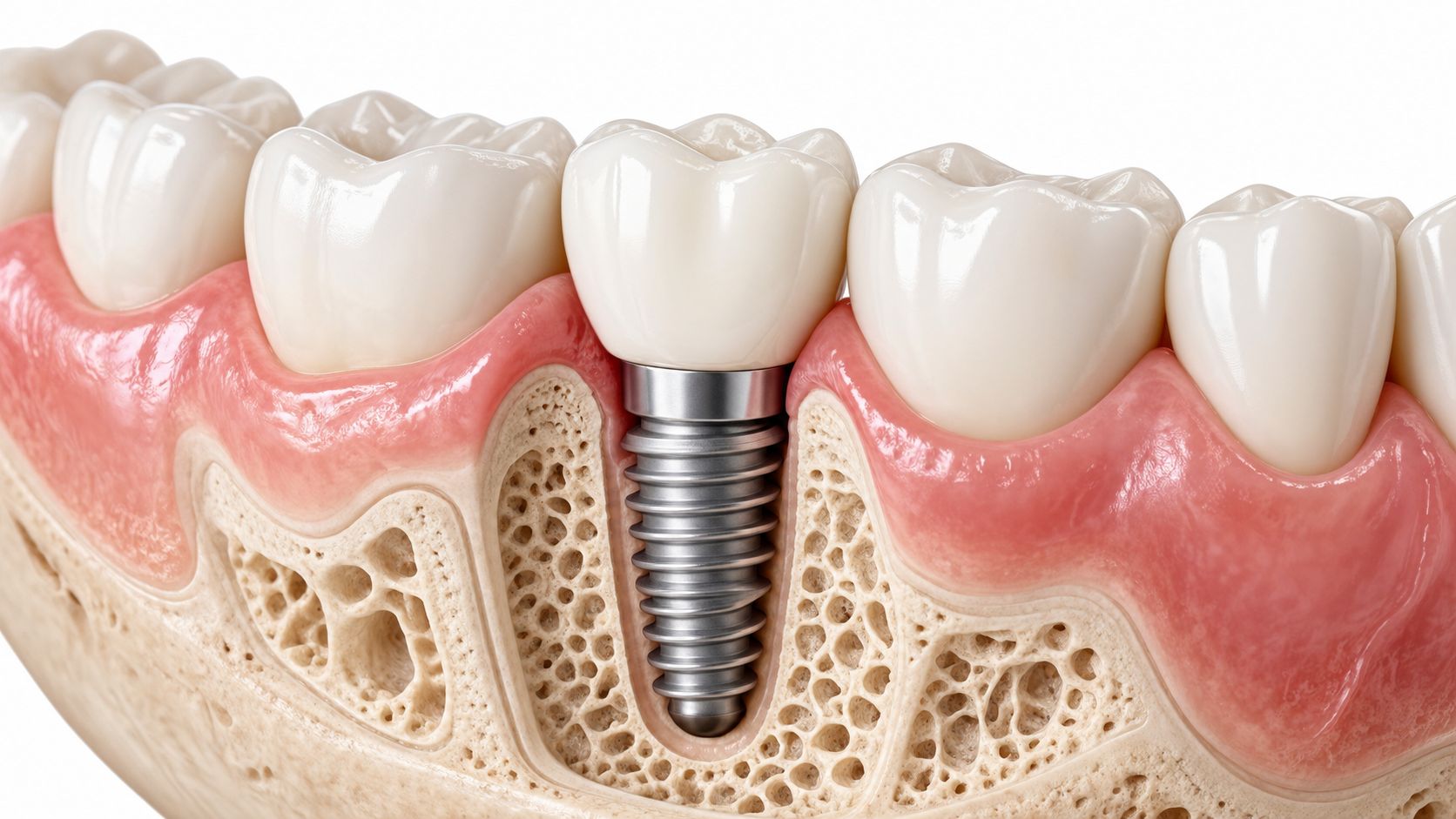
A dental implant replaces a missing tooth, but it doesn't remove the biological requirements for a healthy mouth. The surrounding gums and bone must support the restoration, remain cleanable, and tolerate the forces of chewing. Active periodontal inflammation makes that environment less predictable, which is why implant planning should follow periodontal diagnosis and stabilization.
The same foundation supports crowns, bridges, dentures, and cosmetic work. A crown placed on a tooth with uncontrolled inflammation may be difficult to maintain. A bridge depends on the health of its supporting teeth. Veneers and smile makeovers may improve appearance, but they don't correct untreated periodontal disease. Patients searching for a cosmetic dentist near me, a prosthodontist, or dental implants near me in Manhattan benefit from a plan that evaluates health before esthetics.
Stabilization before restoration
For Stage I to III periodontitis, the European Federation of Periodontology treatment endpoint calls for the absence of periodontal pockets deeper than 4 mm that bleed on probing, along with the absence of deep pockets measuring 6 mm or more (EFP treatment endpoint and supportive care guidance). The important point is that healing should be evaluated with probing data, not symptoms alone.
If bleeding pockets remain, the next step may include targeted re-instrumentation, periodontal surgery, or another specialist measure. A patient may feel comfortable while a deep plaque-retentive site remains active. Treating that site before implant placement or final restorative work can reduce avoidable risk and improve access for long-term cleaning.
Tooth preservation versus replacement
A loose or damaged tooth doesn't automatically need extraction. Prognosis is assessed tooth by tooth using:
- Support: Attachment loss, bone levels, mobility, and furcation involvement.
- Structure: Root anatomy, cracks, decay, restorability, and the quality of existing dentistry.
- Patient factors: Smoking, diabetes, plaque control, comfort with home care, and attendance at maintenance visits.
- Treatment sequence: Periodontal stabilization, any necessary extraction or grafting, healing, implant placement, restoration, and ongoing monitoring.
Some patients with advanced periodontitis can retain natural teeth when periodontal endpoints are achieved and supportive care is consistent. Implants should be considered when a tooth has a poor prognosis or cannot be predictably restored, not merely because a patient has been told that deep cleaning is inconvenient.
This approach also clarifies the role of related services. A tooth may need a root canal from an endodontist, surgical extraction from an oral surgeon, bone grafting before an implant, or a crown designed by a prosthodontist. Families may also need a Pediatric Dentist or Kids Dentist for children, while adults may seek orthodontics, teeth whitening, cosmetic dentistry, or full mouth rehabilitation. Each service fits best when the underlying gum condition is understood.
Prevention and Long-Term Maintenance Strategies
Active periodontal treatment is only one phase of care. Once inflammation is controlled, supportive periodontal care protects the result by finding new bleeding, calculus, pocketing, mobility, or changes around teeth and implants. The maintenance appointment may include a review of brushing and interdental cleaning, risk-factor management, professional plaque and calculus removal, and selective subgingival debridement.
The American Dental Association notes that patients may benefit from more frequent periodontal visits, commonly every 3–6 months, after nonsurgical or surgical therapy (ADA periodontitis care information). The interval should reflect disease history, residual pockets, smoking, diabetes, home plaque control, and adherence rather than a fixed schedule for every patient.
Daily habits that support stability
A soft-bristled manual or electric toothbrush should be directed gently along the gumline. Floss, interdental brushes, or a water flosser can help clean spaces that a toothbrush misses, but the best tool is the one the patient can use consistently and correctly.
Smoking cessation improves the conditions for healing and maintenance. Diabetes management also matters because blood sugar control and periodontal inflammation can affect one another. Patients should report changes such as bleeding, persistent bad breath, gum recession, tooth movement, or difficulty cleaning around a crown or implant instead of waiting for pain.
The long-term objective isn't a promise that gum disease can never recur. It is a manageable partnership between professional monitoring and daily plaque control. That approach protects natural teeth, supports restorative dentistry, and gives future implants a healthier environment.
Prosth & Co. offers periodontal evaluations, deep cleaning, gum grafting, bone grafting, sinus augmentation, and periodontal maintenance as part of coordinated restorative and implant care on Manhattan's Upper East Side. Patients concerned about bleeding gums, loose teeth, a failing restoration, or implant planning can visit Prosth & Co. to request an appointment or consultation.

Founder and lead prosthodontist of Prosth & Co. on Manhattan's Upper East Side. DDS, Columbia University; Prosthodontics certificate and MMSc in Oral Biology, Harvard School of Dental Medicine; Implantology fellowship, Columbia University.
Meet Victoria →