Missing teeth can change ordinary Manhattan routines. A sandwich becomes difficult to chew, speech may feel less clear, and smiling in a meeting or photograph can require conscious effort. Over time, tooth loss can also reduce the support that teeth and bone provide to the lips and lower face.
A search for All-on-4 dental implants near me should lead to more than a map listing and a promise of same-day teeth. Full-arch treatment requires careful diagnosis, restorative planning, surgical coordination, and long-term maintenance. Patients in Manhattan, New York, and nearby Upper East Side communities deserve a provider who explains those trade-offs before treatment begins.
Table of Contents
- Finding a Trusted All-on Four Provider in Manhattan
- How to Evaluate an All-on Four Dental Implant Provider
- Consultation Questions That Protect Your Long-Term Outcome
- Realistic Expectations for All-on Four Success and Maintenance
- Why a Prosthodontist-Led Approach Improves Full-Arch Results
- Next Steps Toward a Confident Restored Smile
Finding a Trusted All-on Four Provider in Manhattan
A thoughtful patient usually starts searching after removable dentures have become unstable, several teeth have failed, or eating has become a matter of avoiding certain foods. The search may begin with “dentist near me,” “dental implants near me,” or “dentist in Manhattan,” but distance alone does not show whether a practice can manage a complex full-arch case.
The better question is how the provider plans the whole treatment path. A full-arch restoration has to fit the patient's bite, facial features, speech, bone anatomy, hygiene routine, and expectations for future repairs. A clinic that focuses only on implant placement may not offer the same level of restorative planning as a prosthodontist-led practice with surgical and laboratory support.

What local patients should look for
A Manhattan provider should explain why four implants are appropriate for a particular arch, where those implants would be positioned, and what type of fixed bridge would be supported. The original All-on-4 concept uses tilted posterior implants to improve support and reduce the cantilever arm, according to a clinical review of the All-on-4 treatment concept.
The consultation should also cover what happens after the temporary restoration. Patients need clear information about the final material, cleaning access, bite adjustments, repair policies, and professional follow-up. A fixed bridge is not maintenance-free just because it does not come out at night.
Practical rule: A provider who discusses possible complications and maintenance before discussing a smile preview is taking the decision seriously.
The Upper East Side has practices that combine prosthodontic planning with periodontic, endodontic, and oral surgery coordination. That model can be valuable when a patient needs tooth extraction, infection control, bone evaluation, implant surgery, and final restorative work within one coordinated plan. Patients comparing local healthcare providers may also find a high-spend PPC partner review useful when assessing how service businesses present trust, transparency, and local credibility online.
How to Evaluate an All-on Four Dental Implant Provider
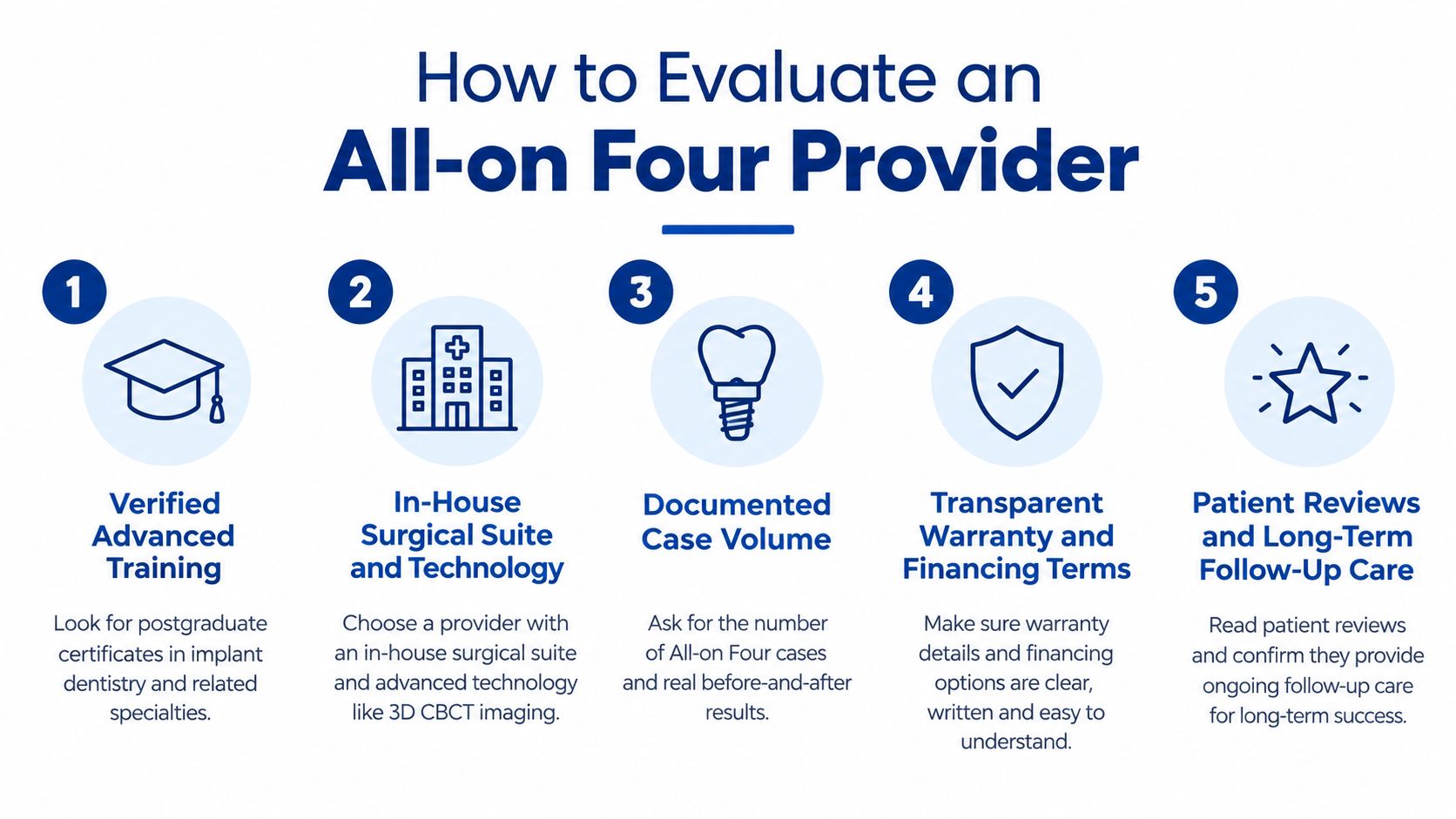
A provider's website can introduce a service, but it shouldn't make the treatment decision. Patients should verify the clinical structure behind the offer and ask to see how the practice handles diagnosis, surgery, restoration, and follow-up.
Start with advanced restorative training
A general dentist may provide excellent routine dental care, yet full-arch rehabilitation involves a different level of planning. Patients should ask whether the treating dentist has postgraduate training in prosthodontics and implantology, and whether the provider regularly plans fixed full-arch restorations rather than only placing individual implants.
Training matters because the final teeth determine much of the patient's daily experience. The bite, tooth position, lip support, smile line, phonetics, and cleaning design must work together. A provider with advanced restorative training is equipped to evaluate the finished result before surgery, rather than just reacting to problems afterward.
Verify laboratory and digital oversight
An in-house dental laboratory can allow direct communication between the clinical team and the technicians designing the restoration. Patients should ask who fabricates the temporary and final teeth, how adjustments are managed, and whether the laboratory team reviews photographs, scans, and bite records directly.
Digital treatment planning should serve a clinical purpose. Intraoral photography, 3D imaging, and visual case reviews can help a provider explain bone anatomy, proposed implant positions, and anticipated tooth proportions. Patients don't need to understand every scan. They do need to see that the treatment plan is based on their anatomy rather than a standard template.
Look for coordinated specialty care
Complex cases may involve periodontal disease, failing root canal treatment, extractions, bone loss, or a need for oral surgery. A practice with periodontics, endodontics, and oral surgery collaboration under one roof can reduce communication gaps and make it easier to sequence treatment.
The local provider should also explain whether implant placement and restoration are coordinated at the same location. Reviews can offer useful context, but they shouldn't replace credential verification, a clinical examination, and a written treatment plan.
| Evaluation area | Questions to ask |
|---|---|
| Training | What advanced education supports full-arch treatment? |
| Laboratory | Who designs and repairs the restoration? |
| Planning | What imaging and digital records guide implant placement? |
| Specialties | Can periodontal, endodontic, and surgical needs be managed together? |
| Continuity | Who will provide maintenance after the final bridge is delivered? |
Consultation Questions That Protect Your Long-Term Outcome
A consultation becomes more useful when patients ask questions that reveal how the provider thinks. The purpose isn't to challenge the dentist. It's to understand the reasoning behind the proposed design and learn how the practice responds when real-life maintenance is required.
Questions about the restoration
Patients should ask what material is proposed for the temporary and final bridge, why that material suits the case, and how the restoration will be repaired if a tooth chips or a component loosens. Acrylic, ceramic, zirconia, and other materials have different handling, wear, appearance, and repair considerations. The provider should explain the choice in relation to the patient's bite and habits.
A second question should address cleaning. Can the patient access beneath the bridge with a water flosser, interdental brush, or other device? Does the design leave enough space for professional instruments? A restoration that looks attractive but traps plaque can create avoidable problems.
Questions about bite control
The provider should explain how the bite will be recorded and checked before the final bridge is made. Patients who clench, grind, have uneven contacts, or have worn teeth may need additional bite planning or a night guard.
Ask how the team will confirm that chewing forces are distributed appropriately. The answer should include more than “the implants will be strong.” It should address implant position, tooth arrangement, cantilever control, provisional testing, and adjustments during follow-up.
A durable result depends on more than whether an implant integrates. The bridge must also remain cleanable, stable, comfortable, and repairable.
Questions about complications and follow-up
A responsible consultation should include a discussion of early implant problems, inflammation around implants, prosthetic fracture, detachment, speech changes, and the possibility of adjustments. Patients should ask what symptoms require an urgent call and which team member will handle that call.
The difference between implant survival and prosthetic durability deserves direct attention. An implant can remain integrated while the bridge needs repair or replacement. Patients should ask how often the restoration will be removed for inspection, what professional maintenance includes, and whether follow-up is provided by the same team that planned the case.
Questions about the financial plan
The written estimate should identify consultation and imaging, extractions, sedation if applicable, temporary teeth, final teeth, adjustments, maintenance, repairs, and replacement terms. Patients comparing cost should ask whether a lower initial fee reflects a different material, a separate laboratory, fewer included visits, or exclusions that may appear later.
A trustworthy provider won't promise that every case will be simple or complication-free. Clear answers, realistic alternatives, and time for questions are stronger signs of clinical maturity than a guarantee based only on the phrase “same-day smile.”
Realistic Expectations for All-on Four Success and Maintenance
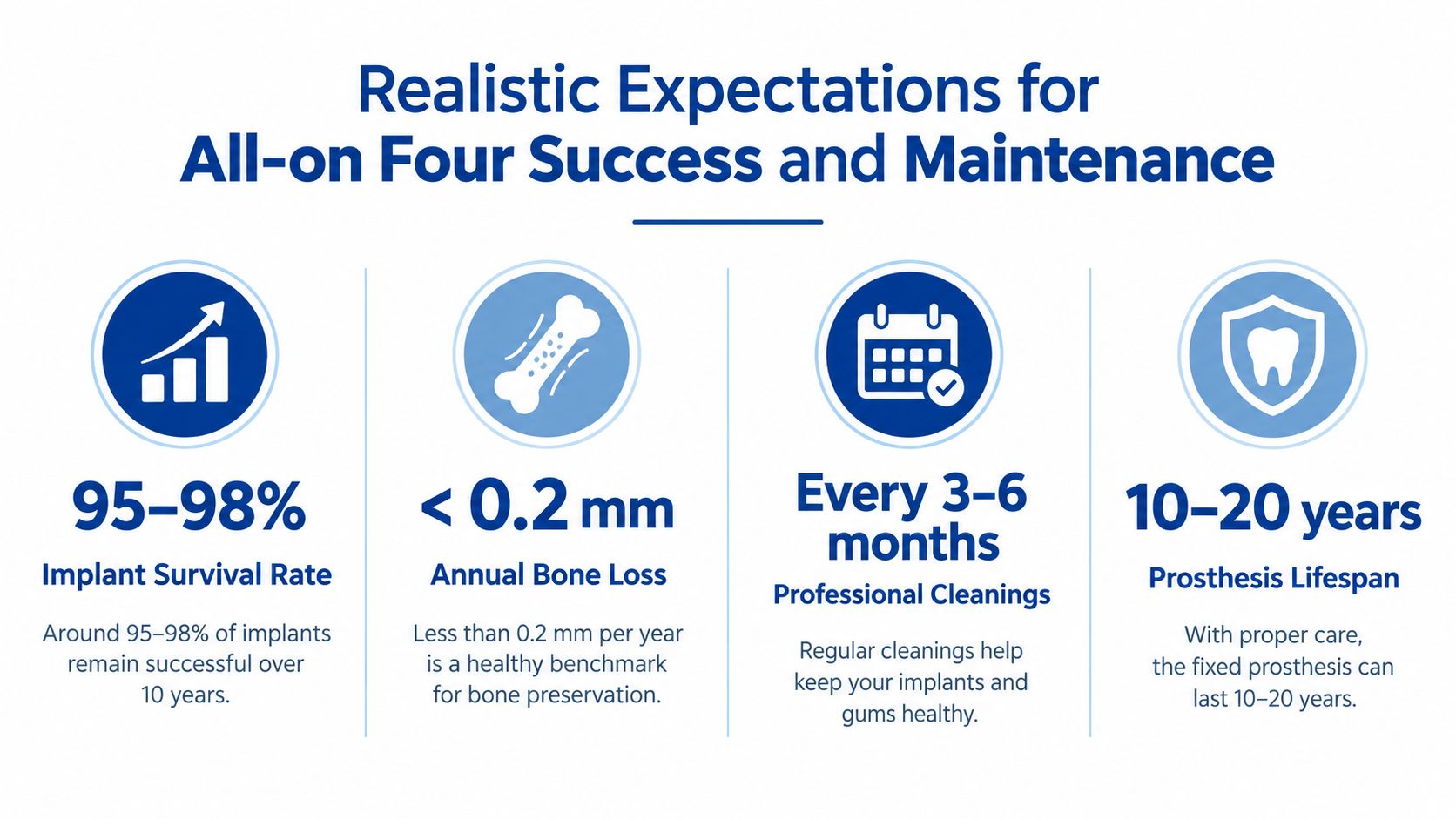
All-on-4 has substantial long-term evidence, but the evidence supports a balanced conclusion rather than an unconditional promise. A retrospective study of 471 fully edentulous mandibles treated with 1,884 implants reported 98.8% cumulative prosthetic survival, 93.0% implant cumulative survival, and 91.7% implant success over 10 to 18 years of follow-up. A separate maxillary series involving 1,072 patients and 4,288 implants reported 99.2% prosthetic success, 94.7% implant cumulative survival, and 93.9% implant success across up to 13 years, as reported in this long-term clinical study of All-on-4 outcomes.
Those results show why All-on-4 is more than a short-term denture alternative. They also show why the terms must be separated. Implant survival concerns the titanium fixtures. Prosthetic survival concerns the bridge supported by those fixtures. A patient can have successful osseointegration and still need restorative maintenance.
Where complications tend to appear
Systematic evidence has identified peri-implantitis as an important biologic concern after the early healing period. Detachment of a prosthesis element was the most frequent technical problem in the cited review, reported in 23.2% of patients in two studies, while another clinical series recorded 33 complications in 27 patients during the first three months. That series reported 98.2% implant survival but 94.4% restoration survival, details discussed in this systematic review of complications and maintenance.
A newer meta-analysis reported pooled implant survival of 99.20% at one year, 99.66% from one to five years, and 98.14% at five years or longer, according to the 2026 All-on-4 survival meta-analysis. These figures are encouraging, yet they don't remove the need for diagnosis, hygiene, bite monitoring, and professional review.
Upper and lower arches aren't identical
The lower jaw may offer more favorable conditions than the upper jaw in some patients. Independent reviews have reported cumulative survival ranges of 94.8% to 99.3% and marginal bone loss of 1.1 to 1.5 millimeters, while also describing high risk of bias and low-quality evidence in many reviews. The independent overview of All-on-4 systematic reviews emphasizes why arch, bone quality, prosthetic design, and maintenance should be discussed individually.
Patients should expect a maintenance plan, not a one-time procedure. That plan may include professional cleaning, examination of the tissues, occlusal review, imaging when indicated, and inspection of the bridge and implant components. Patients considering implant placement and surgical planning should ask how those services connect with the final restoration and later care.
Why a Prosthodontist-Led Approach Improves Full-Arch Results
Full-arch rehabilitation starts with the teeth that patients will wear every day, not only with the implants placed in the jaw. A prosthodontist-led plan gives the restorative design a central role in decisions about implant position, bite, tooth display, speech, facial support, and future maintenance.
That perspective is particularly important when existing teeth are severely worn, damaged, infected, or uneven. A patient may need tooth extraction, a root canal, periodontal treatment, or bone management before implant surgery. If each service is planned in isolation, the final bridge may inherit compromises created earlier in treatment.
The laboratory belongs in the clinical conversation
An in-house laboratory can support rapid communication about tooth shape, shade, contours, bite records, and repair needs. The dentist can review a digital scan or intraoral photograph with the technician, then make changes before the restoration reaches the patient.
Digital planning also helps patients understand the proposed result. Visual case reviews can show the relationship between the existing smile, the planned tooth position, and the patient's facial features. This doesn't guarantee a perfect outcome, but it creates a more concrete basis for discussion than verbal descriptions alone.
The best full-arch plan is the one that remains understandable after the surgical appointment is over.
Interdisciplinary care reduces fragmentation
Periodontics can address gum inflammation, bone loss, grafting, or sinus-related concerns. Endodontics can assess teeth that may be saved with root canal treatment rather than extracted. Oral surgery can manage difficult extractions and implant surgery when the anatomy or medical history requires additional expertise.
The same practice may also provide crowns, bridges, dentures, clear aligners, night guards, pediatric dentistry, and emergency dental services. That broader capability matters when a patient's needs change during treatment. A Manhattan adult looking for an endodontist in New York may need an emergency root canal before deciding whether a full-arch restoration is appropriate. A family may also need a pediatric dentist or kids dentist near me, but those services should remain clinically distinct from adult implant planning.
Continuity improves practical decision-making
When implant placement and restoration are performed locally, the surgical and restorative teams can communicate throughout treatment. Patients can ask who will adjust the provisional bridge, who will evaluate discomfort, and who will manage the final prosthesis.
This model doesn't mean every patient needs All-on-4. Some patients are better served by individual dental implants, a removable partial or full denture, a bridge, or treatment that saves selected teeth. A prosthodontist should compare those options objectively, including the implications for cleaning, function, appearance, and future maintenance.
Next Steps Toward a Confident Restored Smile
The strongest local search result isn't automatically the right treatment choice. Patients looking for “dentist in New York,” “cosmetic dentist near me,” or “dental implants near me” should compare the provider's advanced training, laboratory access, imaging process, specialty coordination, restoration materials, and follow-up policy.
A first consultation should establish whether the patient needs full-arch treatment at all. Thorough exams, dental X-rays or 3D imaging, periodontal assessment, evaluation of existing teeth, and a discussion of the bite can reveal whether tooth extraction, a root canal, restorative dentistry, or implant treatment belongs in the plan. A provider should explain alternatives rather than assuming that a fixed bridge is suitable for every mouth.
A practical decision checklist
Before accepting treatment, patients should be able to answer these questions:
- Who leads the case? Confirm the provider's prosthodontic and implant training.
- Who designs the teeth? Ask about the dental laboratory and direct clinical oversight.
- How is the bite planned? Request an explanation of provisional testing and occlusal checks.
- What happens after delivery? Clarify cleanings, examinations, repairs, and urgent contact.
- What does the estimate include? Review imaging, surgery, temporary teeth, final teeth, and maintenance terms.
- What are the alternatives? Ask whether saving teeth, using a denture, or selecting another implant design would be reasonable.
Manhattan patients shouldn't feel pressured to decide during a first visit. The purpose of evaluation is to understand the condition of the mouth, the available treatment paths, and the responsibilities that come with a fixed restoration. Clear education makes it easier to distinguish a carefully planned case from a sales presentation built around speed.
For patients on the Upper East Side, a prosthodontist-led practice can provide a coordinated setting for restorative, implant, periodontal, endodontic, oral surgery, cosmetic, and preventive care. That can make the process easier to follow while keeping the central question in view: which treatment will provide a healthy, functional, maintainable result for the individual patient?
For Manhattan patients considering All-on-4 dental implants, Prosth & Co. offers prosthodontist-led evaluation, implant placement and restoration planning, in-house laboratory support, and coordinated specialty care. Visit Prosth & Co. to request a consultation and receive personalized guidance before choosing a full-arch treatment plan.
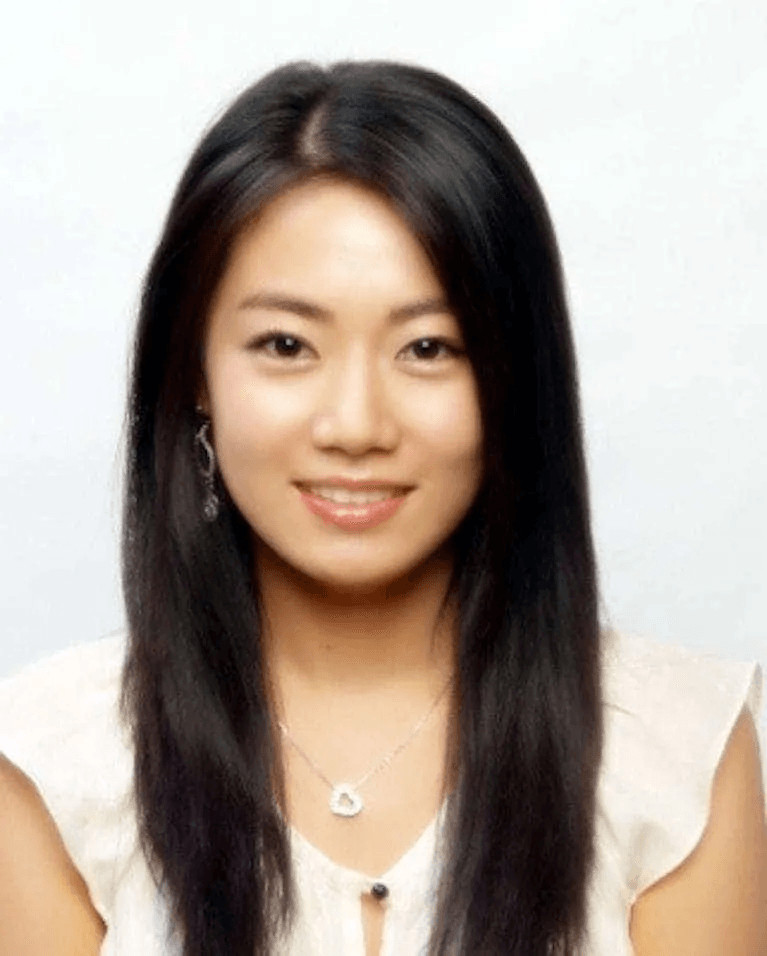
Founder and lead prosthodontist of Prosth & Co. on Manhattan's Upper East Side. DDS, Columbia University; Prosthodontics certificate and MMSc in Oral Biology, Harvard School of Dental Medicine; Implantology fellowship, Columbia University.
Meet Victoria →