
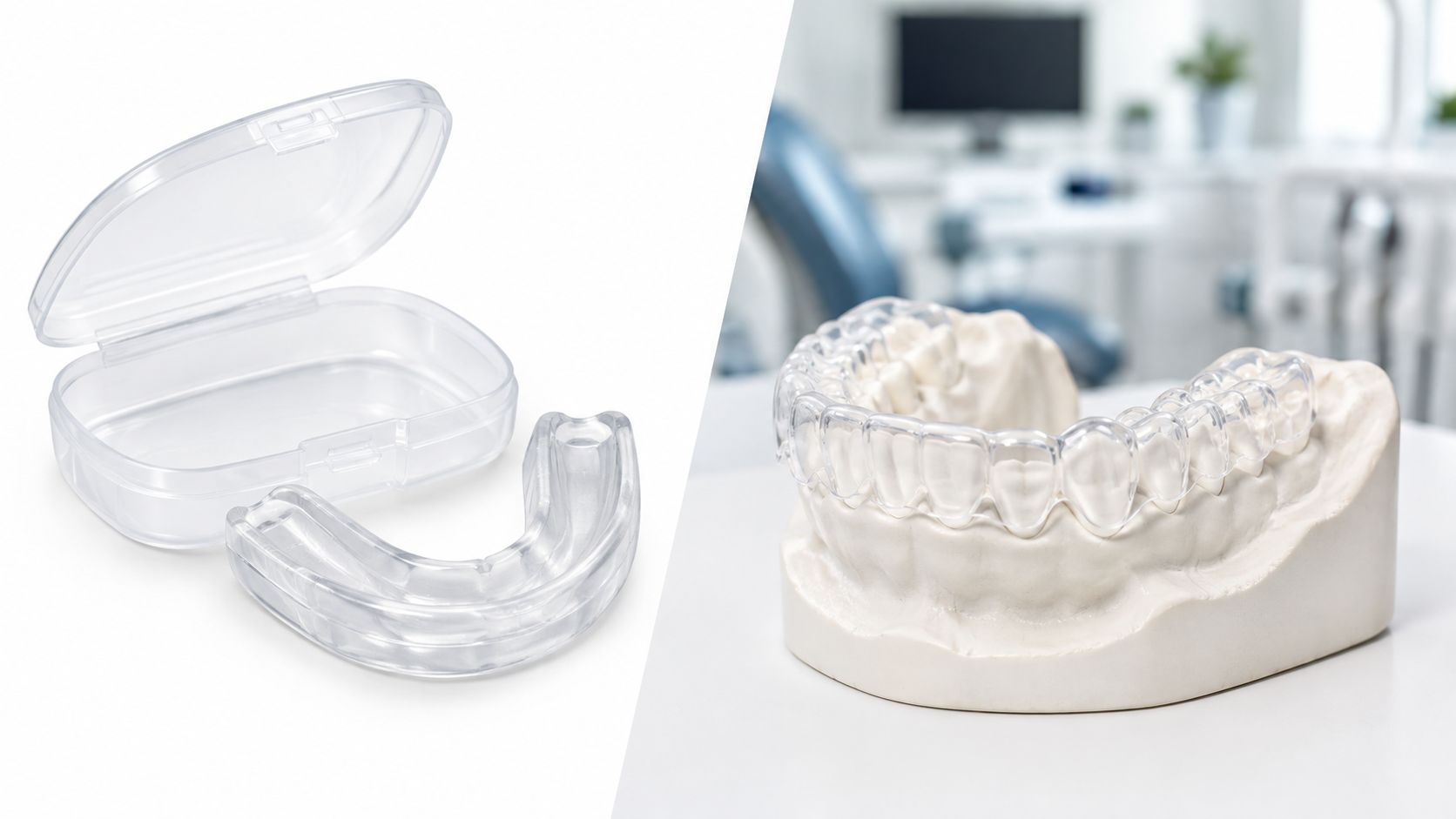
Morning arrives with a tender jaw, another headache, and a pharmacy night guard sitting beside the toothbrush. For an Upper East Side patient searching for a dentist in Manhattan, the question isn't which appliance costs less. The useful comparison is custom night guard vs store bought, considered alongside the condition of the teeth, existing dental work, and the reason for grinding.
A prosthodontist-led evaluation offers a practical starting point when restorations, pain, or a changing bite complicate the decision. For otherwise healthy teeth with occasional clenching, a carefully selected retail guard may be reasonable. The recommendation should follow the patient's needs, not the appliance's marketing.
Table of Contents
- Why Patients Compare Custom and Store-Bought Guards
- How Night Guards Are Actually Made
- Fit, Comfort, and How They Actually Stay in Your Mouth
- Cost, Lifespan, and Real Replacement Cycles
- What a Night Guard Can and Cannot Do
- Matching the Right Guard to Your Situation
- Deciding Between Custom and Store Bought Next Steps
Why Patients Compare Custom and Store-Bought Guards
A patient wakes with jaw tenderness and starts searching before leaving for work. A partner may have mentioned grinding sounds, or a recent checkup may have raised concerns about tooth wear. The immediate choice looks straightforward: buy something at the pharmacy or schedule a dental appointment.
That choice becomes less straightforward when a guard already feels uncomfortable, a crown needs protection, or headaches keep returning. Manhattan patients understandably weigh appointment time and expense against immediate access. Neither concern should be dismissed, but neither establishes which appliance is appropriate.
Protection and diagnosis are different decisions
The first question is whether the patient needs temporary protection or an evaluation of ongoing symptoms. Those aren't equivalent goals. A purchase can put an appliance in the mouth, but it can't establish why the jaw hurts or whether existing dentistry changes the treatment plan.
The second question is whether the bite is straightforward or complex. A patient with otherwise healthy teeth faces a different decision from someone with implants, extensive crowns, loose teeth, or an unstable bite. The clinical issue is the appliance's interaction with that mouth, not the custom or retail label alone.
Practical rule: Pain, damaged dental work, and a changing bite deserve an examination before another appliance purchase.
An appointment shouldn't begin with a sales pitch
A useful consultation starts with symptoms, previous appliances, and the patient's priorities. The clinician should distinguish the need for a guard from the need for other care, then explain whether professional fabrication offers a meaningful advantage.
Patients searching for a dentist near me should look for that kind of decision-making rather than a blanket statement that every pharmacy guard fails. Likewise, a low purchase price shouldn't become a reason to continue wearing an uncomfortable appliance.
- An access concern: An affordable temporary option may matter when an appointment isn't immediately available.
- A comfort concern: An appliance that remains in its case offers no practical benefit.
- A dental-work concern: Restorations and bite changes deserve consideration before material or thickness is chosen.
The defensible recommendation is patient-specific. An uncomplicated mouth may justify a cautious retail trial, while an uncertain diagnosis or complicated bite calls for professional assessment.
How Night Guards Are Actually Made
Store-bought isn't a single manufacturing category. Oral devices are generally classified as stock, mouth-formed, or custom-made, with different methods of adapting the appliance to the teeth. A clinical-trial protocol reviewing oral-appliance categories and prior bruxism research describes these distinctions and notes that custom hard-acrylic and boil-and-bite guards appeared similarly effective in some prior sleep-bruxism research.
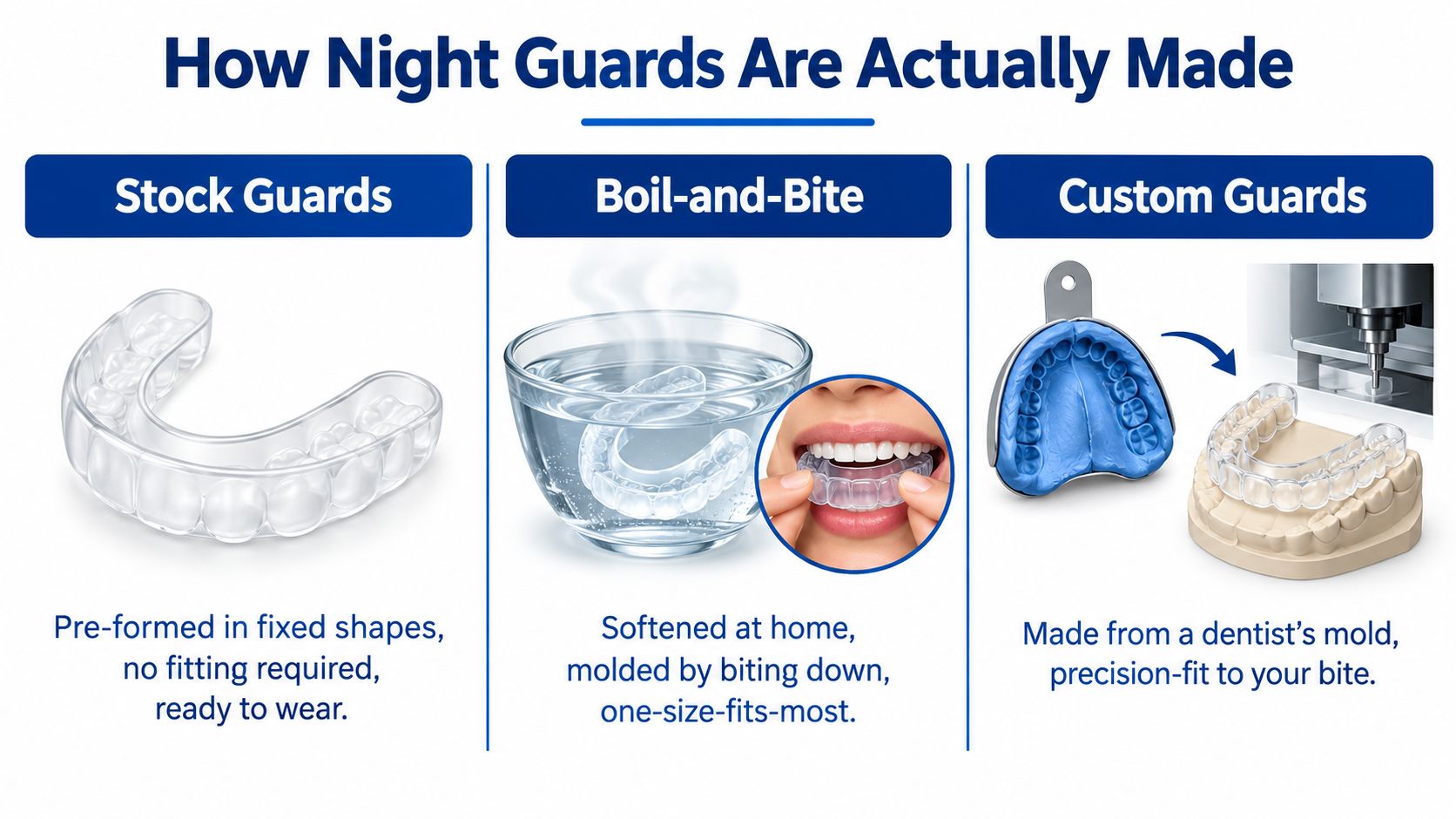
Fixed shapes versus home molding
A stock guard arrives in a predetermined shape. It doesn't capture the wearer's individual dental anatomy, and there's no molding stage to personalize it. Immediate availability is its practical attraction, but “ready to wear” doesn't establish that it fits appropriately.
A boil-and-bite guard uses material softened according to the manufacturer's directions, then molded by the wearer. The home-fitting step distinguishes it from a stock appliance. Its adaptation depends on how successfully the wearer follows the fitting process.
Patient-specific fabrication
A custom guard begins with an impression or digital scan of the dentition. A dental technician fabricates the appliance around those records, rather than asking the patient to adapt a generic shape at home. Professional fitting and bite adjustment are separate from fabrication itself.
| Category | Fabrication | Fit and Adjustability | Typical Price Band | Best-Fit Patient |
|---|---|---|---|---|
| Stock | Manufactured in a fixed shape | No individualized molding; limited adaptation | Lower-cost retail category | A patient whose clinician considers the particular device appropriate |
| Boil-and-bite | Softened and molded at home | User-dependent fit; limited control of bite contacts | Lower-cost retail category | An otherwise low-risk adult considering temporary protection |
| Custom | Fabricated from patient-specific records | Professionally fitted and adjustable | Higher initial professional cost | A patient needing controlled coverage or coordination with restorative care |
Custom vs Store-Bought Night Guards at a Glance
The table uses relative price bands rather than local fee quotes. A meaningful estimate requires the actual appliance design and the services included.
The American Dental Association also recognizes that qualifying over-the-counter mouth-formed guards can meet objective safety and efficacy requirements. That recognition shouldn't be stretched into approval of every retail night guard or every clinical use. It does establish an important boundary: store-bought doesn't automatically mean ineffective, and custom doesn't automatically mean appropriate.
Fit, Comfort, and How They Actually Stay in Your Mouth
A guard can follow the outline of the teeth yet still interact poorly with the opposing bite. Retention describes how securely it stays in place; occlusion describes how the teeth contact it. Both deserve attention, especially when the patient clenches against the appliance.
The American Dental Association's guidance on mouthguard fit and adaptation emphasizes proper fitting and accurate adaptation to oral structures. Its guidance concerns mouthguards broadly, so it shouldn't be interpreted as proof that a particular retail product is suitable for a patient's bruxism.
The practical wearing experience
A stock device relies on its manufactured shape. A boil-and-bite device relies on the home molding process. A professionally fabricated full-coverage appliance allows a dentist to assess retention, check contacts across the dentition, and selectively adjust the surface against which the opposing teeth close.
“Full coverage” means the appliance covers the teeth throughout the selected arch. “Adjusting the contacts” means refining where opposing teeth meet the guard, rather than trimming an uncomfortable edge. These are different tasks, and comfortable edges alone don't demonstrate a balanced bite.
- Secure retention: The guard shouldn't repeatedly shift or dislodge during use.
- Acceptable bulk: Speech or breathing interference warrants a fit review.
- Gum clearance: Edges shouldn't persistently irritate the gum line.
- Appropriate contacts: Concentrated pressure or a changed bite needs clinical attention.
What comfort studies actually establish
In a randomized trial involving patients with fixed orthodontic appliances, custom-made and mouth-formed guards received higher wearability ratings than prefabricated guards. That trial evaluated sports mouthguards, not bruxism-specific night guards. Its findings support taking wearability seriously, not claiming that custom devices universally outperform boil-and-bite appliances during sleep.
A comparative mouthguard study discussing usability and Corflex-fabricated appliances also reported higher usability ratings for custom appliances than self-adapted alternatives. Again, evidence about injury-protection mouthguards shouldn't be presented as direct proof of superior bruxism treatment.
A more controlled fit is a defensible benefit of custom fabrication. A guaranteed comfortable night or guaranteed protection from every dental complication isn't.
For patients with crowns, bridges, implants, or extensive restorative dentistry, professional assessment makes the contact pattern part of the decision. The relevant advantage isn't prestige or laboratory craftsmanship alone. It's the ability to examine the mouth, fit the device, and address problems after delivery.
Cost, Lifespan, and Real Replacement Cycles
The cheapest purchase isn't necessarily the cheapest plan. A retail appliance generally has a lower upfront cost, while professionally fabricated care costs more initially. The useful comparison includes replacement, adjustment, clinical review, and whether the appliance remains suitable as dental treatment progresses.
Precise Manhattan fees should come from a written practice estimate, not a broad online comparison. Patients should ask what the quoted fee includes and whether examination, records, delivery, or later adjustments are separate. An appliance-only price and a coordinated course of care aren't the same purchase.
Lifespan isn't a promise
The U.S. News consumer-health review of night guards describes durability ranging from several days to six years, depending on material, design, fit, and grinding intensity. That wide range is a reason to reject a universal replacement schedule, not a prediction for any individual guard.
A custom appliance can be poor value if its design is inappropriate or its maintenance is neglected. Conversely, a retail appliance can remain an acceptable temporary option if it fits appropriately and survives use without developing problems. Neither label establishes the total cost over time.
Inspect the appliance, not just its age
Replacement and reassessment should follow condition and symptoms. The same consumer-health review recommends replacement when a guard becomes loose, uncomfortable, irritating, cracked, torn, or visibly worn.
- Structural damage: Cracks, tears, holes, and marked thinning call for review.
- Fit deterioration: Looseness or new irritation means the original fit is no longer dependable.
- Unpleasant changes: Persistent odor despite appropriate cleaning deserves attention.
- Clinical changes: New contact interference or worsening jaw symptoms calls for reassessment, not automatic repurchase.
Budget advice: Ask what can be adjusted, what would require replacement, and how follow-up care is handled before comparing prices.
At the Upper East Side practice, on-site fabrication and adjustment connect appliance care with restorative planning. An in-house laboratory allows the clinical team and technicians to coordinate the work, but it doesn't justify an invented durability guarantee or a promised price advantage.
Patients can make the budget conversation concrete by bringing an existing guard to the appointment. Its wear, comfort problems, and fit help the clinician discuss whether adjustment, replacement, or a different diagnostic approach makes sense.
What a Night Guard Can and Cannot Do
A night guard is not a reliable cure for grinding itself. Its primary role is to separate the teeth and redistribute load. The muscle activity and contributing causes of clenching may continue even when an appliance fits well.
The discussion of custom guards and the limits of bruxism treatment evidence distinguishes protective appliance use from treating the underlying behavior. Systematic-review summaries describe insufficient or very-low-quality evidence that occlusal splints reduce grinding, pain, or tooth wear compared with no treatment or alternatives. That uncertainty doesn't make protection pointless, but it rules out a guaranteed treatment claim.
Protection isn't the same as symptom resolution
A patient may tolerate a guard while continuing to wake with headaches or jaw pain. That situation needs reassessment rather than reassurance that a more expensive appliance must solve the problem. Persistent symptoms can justify reviewing tooth wear, restorations, jaw-joint symptoms, medications, stress, and possible sleep-disordered breathing.
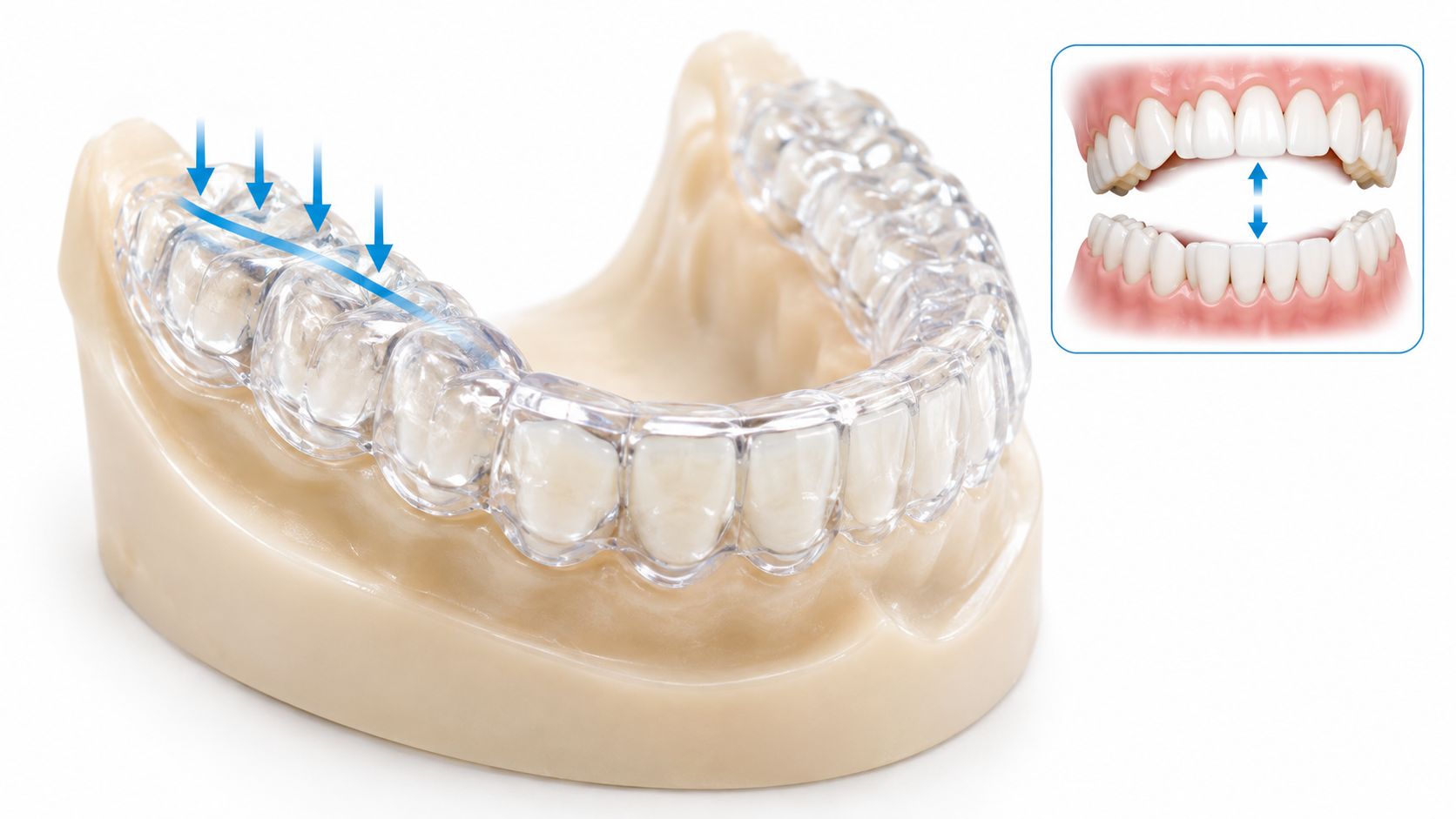
A diagnosis shouldn't be inferred from the appearance of an appliance. The following image depicts an aligner on a dental model, not evidence that an aligner functions as a prescribed bruxism guard.
Design should follow the clinical objective
Material labels such as soft, hard, or premium aren't diagnoses. A registered sleep-bruxism appliance study specifies a 2-mm hard occlusal splint and assessment of maximum occlusal force after two months. Those are study-design details, not completed evidence that this thickness is right for every patient.
Professional selection can account for material, coverage, gum clearance, and the patient's actual contacts. Those controllable features are more meaningful than a promise that the appliance will eliminate clenching. Comfort remains important, but comfort alone doesn't establish appropriate performance.
| Situation | Why a device purchase alone is insufficient |
|---|---|
| Persistent jaw pain or headaches | Symptoms need assessment rather than an assumed grinding diagnosis |
| Loose teeth or significant bite changes | The underlying dental condition needs review |
| Dentures or active orthodontics | Appliance compatibility requires individualized planning |
| Sleep disruption or suspected breathing problems | Protection and sleep-related treatment require separate decisions |
Pain relief should therefore be discussed as a treatment goal, not a guaranteed guard benefit. A dentist in New York can examine the problem and recommend coordinated care when a protective appliance is only part of the answer.
Matching the Right Guard to Your Situation
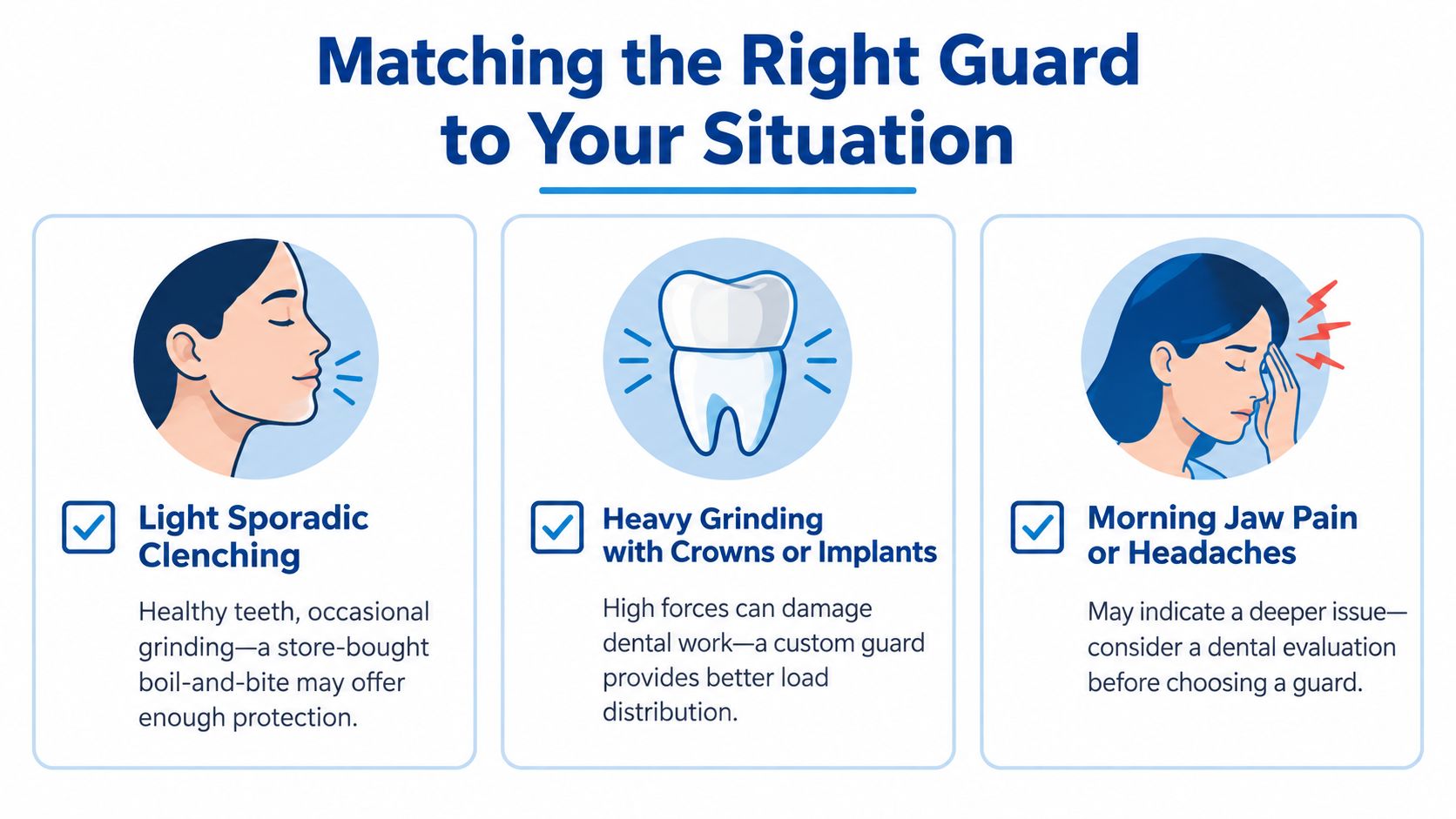
Occasional clenching with otherwise healthy teeth is the clearest setting for considering a temporary boil-and-bite trial. The recommendation is conditional on secure fit, acceptable comfort, and no concerning bite or jaw symptoms. A stock device offers less individual adaptation and shouldn't be treated as equivalent merely because it occupies the same pharmacy shelf.
The reasonable starting point changes when the patient has existing tooth wear or substantial restorations. For those patients, the appointment should precede the appliance decision.
When restorative complexity changes the recommendation
A patient with heavy grinding and crowns or dental implants needs a clinician to consider coverage and contacts around that dentistry. Custom fabrication is more defensible here because adjustment can be coordinated with the restorative plan. Patients searching for dental implants near me or a cosmetic dentist near me should include appliance planning in discussions about crowns, veneers, or implant-supported restorations.
For an Upper East Side patient undergoing full mouth rehabilitation, the guard belongs within the larger bite plan. It shouldn't be selected independently while the shape and arrangement of the teeth are being changed.
When evaluation comes first
Morning jaw pain and headaches call for diagnosis before choosing between devices. Patients already using CPAP or a sleep appliance should bring that information to the consultation so appliance planning isn't done in isolation. Active braces or aligner treatment also warrants coordination with the treating team.
- Persistent morning tenderness: Arrange a review rather than repeatedly remolding the appliance.
- Visible wear or cracked restorations: Request an examination of the teeth and existing dental work.
- New pain or tooth movement during use: Discontinue the problematic OTC guard and contact the dental team.
- An unstable or recently changed bite: Obtain a professional assessment before returning to routine use.
The practice's guidance on how to stop grinding teeth offers additional context for patients considering the broader treatment question.
Families should also keep adult appliance advice separate from children's care. A pediatric dentist, children's dentist, or kids dentist should assess a child's circumstances rather than relying on an adult retail recommendation. The appropriate starting point remains the patient's dental situation, not the package description.
Deciding Between Custom and Store Bought Next Steps
The final choice should follow the purpose of care and the complexity of the bite. An affordable temporary appliance and a diagnostic appointment serve different needs. Professional fabrication becomes useful when the clinician identifies something that requires controlled fit, coverage, or adjustment.
| Patient's main need | Reasonable next step |
|---|---|
| Temporary protection with an uncomplicated mouth | Consider a properly fitted boil-and-bite option |
| Appliance coordination with extensive restorations | Schedule a prosthodontic guard assessment |
| Investigation of persistent symptoms | Request an examination before buying another guard |
| Review of an uncomfortable existing appliance | Bring the guard to the appointment |
| Planning alongside sleep or orthodontic appliances | Ask for coordinated clinical review |
What to expect at a Manhattan consultation
A new patient exam can review symptoms, tooth wear, existing restorations, and the current appliance. Cleaning and exams, dental x-rays when indicated, and restorative planning should support the diagnosis rather than automatically lead to a custom purchase. If another problem requires an endodontist, root canal treatment, tooth extraction, or urgent dental care, the team can address that within a multidisciplinary plan.
The Upper East Side office is near the 77th Street 6-train, with an in-house laboratory supporting coordinated care.
Patients also comparing anti-snoring products may find SleepHabits' discussion of custom vs OTC mouthpieces useful for framing questions about those devices. It shouldn't replace an examination or establish that an anti-snoring mouthpiece is appropriate for tooth protection.
The clearest recommendation is modest: select protection when protection is the need, and arrange diagnosis when symptoms or dental complexity require it.
Prosth & Co. offers custom night guards with fit and bite adjustments, supported by prosthodontic and multidisciplinary care on Manhattan's Upper East Side. Patients with an uncomfortable retail guard, ongoing jaw symptoms, or crowns and implants can visit Prosth & Co. to request a consultation and bring their current appliance for evaluation.

Founder and lead prosthodontist of Prosth & Co. on Manhattan's Upper East Side. DDS, Columbia University; Prosthodontics certificate and MMSc in Oral Biology, Harvard School of Dental Medicine; Implantology fellowship, Columbia University.
Meet Victoria →