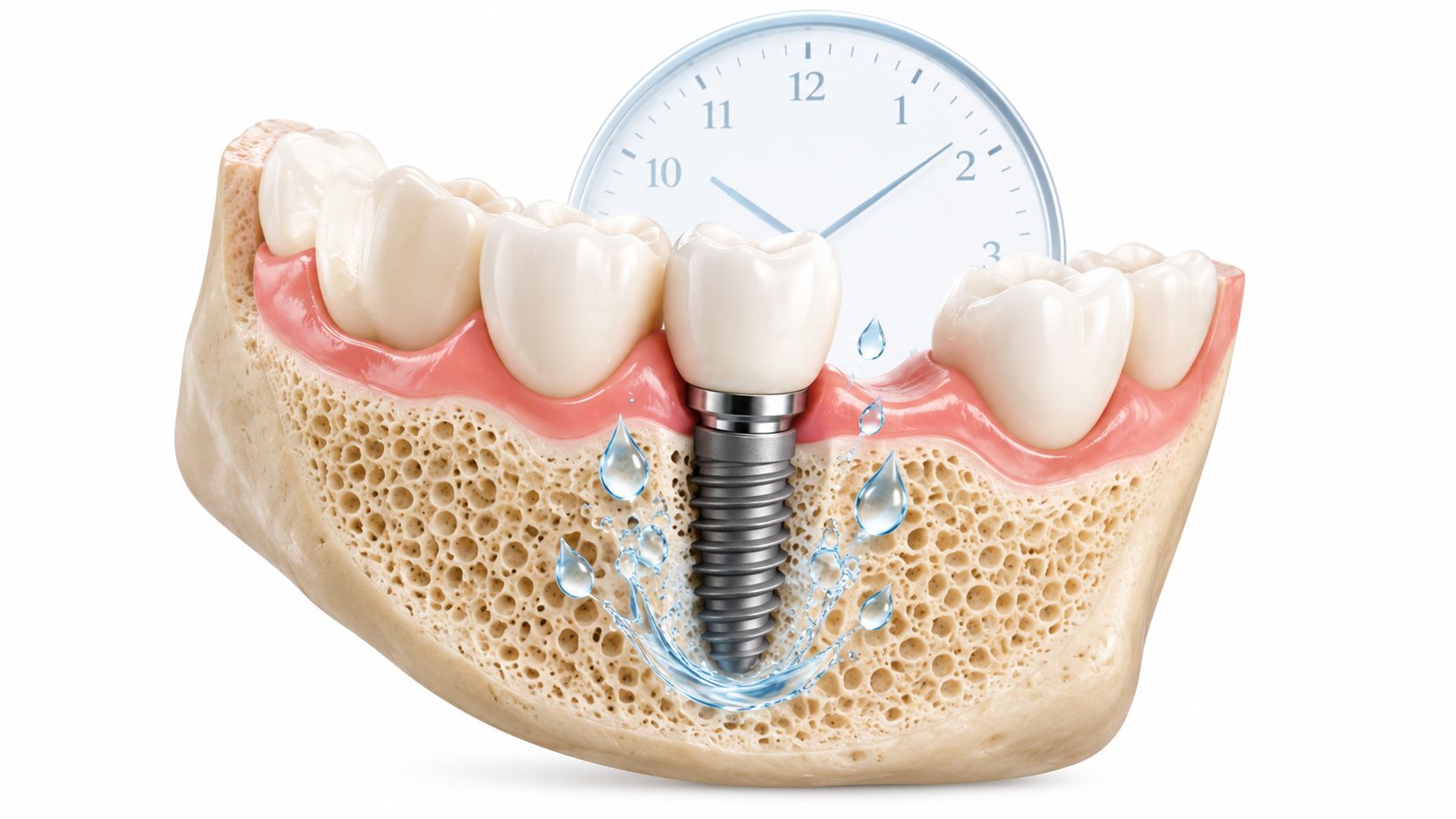
Modern dental implants show approximately 93% to 96% survival at 10 years, and many can last 20 years or more with proper maintenance. That benchmark applies primarily to the implant fixture in the jaw, not necessarily to the visible crown attached to it.
A missing molar can disappear from daily thought surprisingly quickly after treatment. The implant-supported tooth feels stable during breakfast, looks natural in conversation, and restores the confidence that often fades after tooth loss. Yet patients researching how long do dental implants last are asking a more complicated question than a single expiration date can answer.
Implant longevity depends on the health of the surrounding tissue, the forces placed on the restoration, the quality of daily cleaning, and the care plan established before treatment begins. For patients seeking a dentist in Manhattan, an implant consultation should address all of those factors, not just the surgical placement.
Table of Contents
- Your Implant-Supported Tooth on a Manhattan Morning
- What the Evidence Says About Implant Lifespan
- The Fixture and the Crown Are Not the Same Thing
- Factors That Determine How Long Your Implants Last
- The Silent Threat and Biological Maintenance
- Survival, Success, and Long-Term Care With a Prosthodontist
- Questions to Ask Before Scheduling Your Consultation
Your Implant-Supported Tooth on a Manhattan Morning
A patient wakes in an Upper East Side apartment, walks to a coffee shop on 77th Street, and bites into a croissant without thinking about the molar replaced years earlier. The implant-supported tooth doesn't feel like a removable appliance or a temporary patch. It feels like part of the mouth, which is exactly what a well-planned restoration should do.
That ordinary breakfast reveals the true value of dental implants. They restore chewing, speech, and confidence without asking patients to organize every meal around a missing tooth. For people balancing work, commuting, family, and social life in New York, a durable tooth replacement needs to function in real situations, not only look good in a treatment-room photograph.

The question often returns later: how long do dental implants last? The honest answer isn't just “forever” or “ten years.” The titanium fixture can remain integrated in the jaw for decades, while the crown, screw, or abutment may need attention sooner. Biology also changes, and even a stable implant requires professional monitoring.
Longevity is a timeline, not a promise
A consultation with a prosthodontist near the Upper East Side should distinguish the parts of the treatment and explain what may require maintenance. A patient considering dental implants near me, tooth extraction, or treatment after a failed root canal needs a plan that covers the full sequence, from diagnosis through long-term recall.
The same principle applies whether the search begins with “dentist near me,” “cosmetic dentist near me,” or “emergency dentist.” A missing tooth, damaged crown, or painful tooth may need different care, but the long-term result always depends on accurate diagnosis and a restoration that can be kept clean and repaired when necessary.
What the Evidence Says About Implant Lifespan
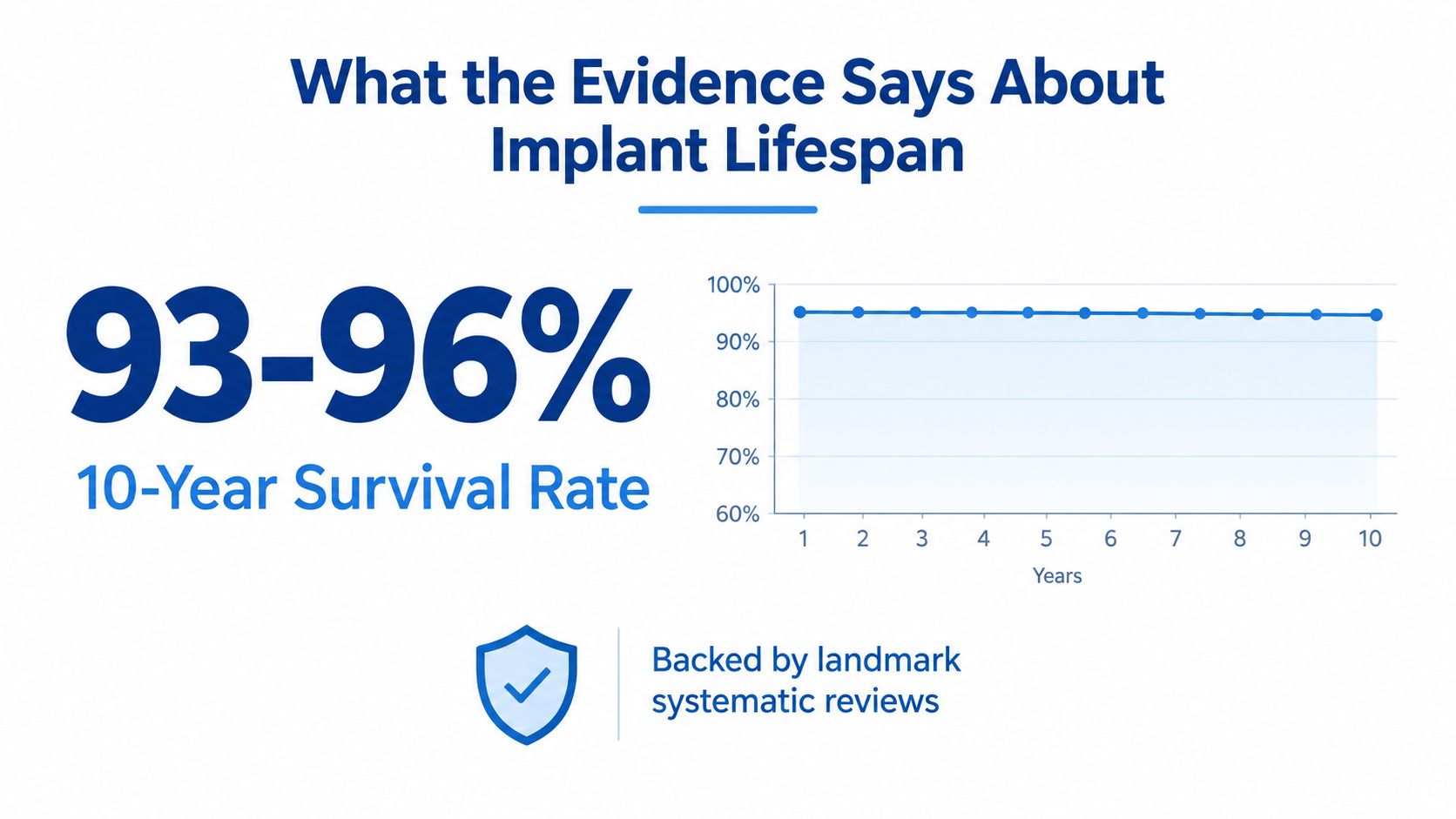
Modern implants commonly remain functional for at least ten years. A 2019 systematic review of 18 prospective studies involving modern solid-screw, roughened-surface implants found a pooled 10-year implant-level survival estimate of 96.4%, with a 95% confidence interval of 95.2% to 97.5%. A more conservative adjustment for loss to follow-up and differences between studies produced an estimate of 93.2%, with a 95% confidence interval of 90.1% to 95.8%. Those figures are reported in the systematic review of long-term implant survival.
For a patient, survival means the implant is still functioning in the jaw. It doesn't mean that every component is original, that no inflammation has occurred, or that the crown has never needed repair. The range also reflects differences in patient health, treatment complexity, follow-up completeness, and study design.
What the benchmark means in practice
The ten-year mark should be treated as a documented clinical benchmark, not a fixed expiration date. Some implants fail earlier, while successfully integrated fixtures can remain serviceable for decades when patients control inflammation, manage bite forces, and attend maintenance visits.
A separate review of studies published from 2010 through 2020 reached a similar conclusion, reporting pooled 10-year survival of 96.0%, with individual study estimates ranging from 86.3% to 100%. These findings support describing implants as long-term replacements, but they don't justify a guarantee of permanence.
| Timepoint | Implant survival rate | Crown or restoration replacement rate |
|---|---|---|
| 10 years | Approximately 93% to 96% in long-term implant reviews | Not represented by implant survival alone. The visible crown has its own survival and repair timeline |
The useful question during a consultation isn't only whether an implant can last ten years. It is how the clinical team will protect the implant, monitor the bone and gums, and maintain the restoration throughout those years.
The Fixture and the Crown Are Not the Same Thing
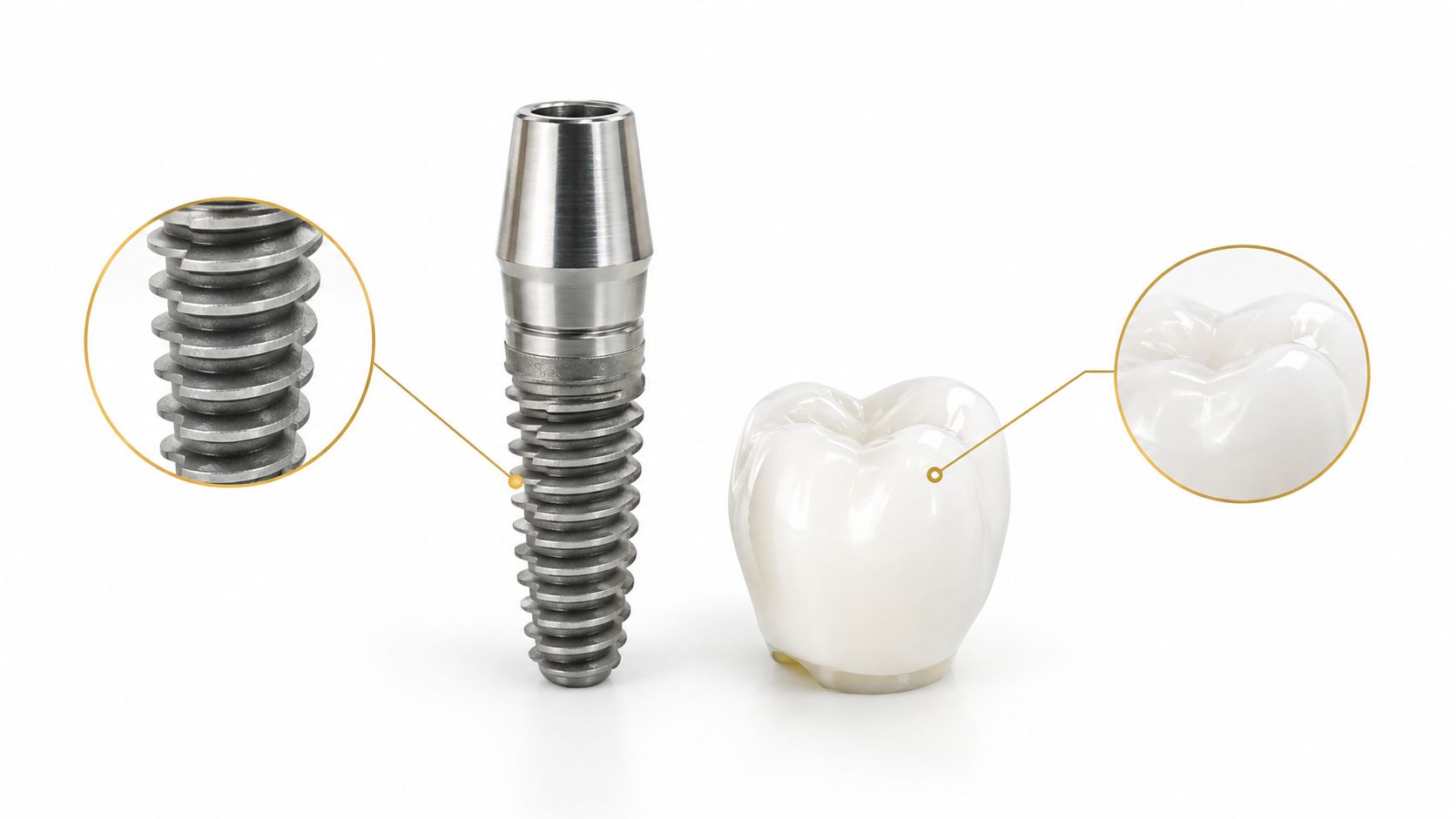
Patients often hear that implants last 20 years or longer and reasonably assume the entire replacement tooth will remain untouched for that period. The statement usually refers to the titanium fixture, the portion anchored in bone. The crown above the gum is a separate component exposed to chewing forces, food, temperature changes, wear, and occasional accidents.
For single crowns, a systematic review found approximately 95.2% implant survival at 10 years, compared with about 89.4% survival for the visible crown. The same review reported cumulative five-year risks of 8.8% for screw loosening, 4.1% for loss of retention, and 3.5% for veneering-material fracture, as documented in this review of implant and single-crown outcomes.
Two timelines require two maintenance plans
A crown may need repair because ceramic chips, cement loses retention, a screw loosens, or the bite places too much pressure on one area. None of those events automatically means the implant fixture has failed. In many cases, the clinician can repair or replace the prosthetic component while preserving the integrated foundation.
Patients comparing treatment options should therefore ask for separate explanations of:
- Implant fixture survival: Whether the titanium implant remains integrated and functional in the jaw.
- Restoration survival: Whether the crown, bridge, denture, abutment, and screws remain intact and serviceable.
- Biological health: Whether the gums and supporting bone remain stable around the implant.
A prosthodontic maintenance plan should examine bone levels, peri-implant tissues, abutment stability, bite contacts, ceramic integrity, and the ability to clean around the restoration. Patients seeking additional context about the visible tooth can review how long dental crowns last, while remembering that an implant crown has different mechanical and biological considerations from a crown supported by a natural tooth.
This distinction makes budgeting more realistic. The implant may remain stable while the visible tooth receives periodic repair, adjustment, or replacement. Planning for that possibility isn't a sign that treatment has failed. It is part of responsible long-term care.
Factors That Determine How Long Your Implants Last
Two patients can receive similar implants and experience different long-term outcomes. The difference often comes from the condition of the jaw, the health of the gums, the amount of force placed on the restoration, and the consistency of maintenance.
Biology at placement
Implants need sufficient healthy bone for stability and healing. Bone quality and quantity are assessed with clinical examination and dental x-rays, and some patients may need bone grafting or sinus augmentation before placement. A history of periodontal disease also matters because the bacteria and inflammation that damaged natural teeth can threaten the tissues around an implant.
Home care remains important after healing. Brushing, interdental cleaning, and professional biofilm removal help keep the tissue around the implant healthier. Patients considering nutrition changes can also review this general resource on bone strength supplements in 2026, while recognizing that supplements don't replace diagnosis, grafting when indicated, or clinical maintenance.
Daily habits and medical conditions
Smoking makes healing and long-term tissue control more difficult. Diabetes requires individualized planning rather than an automatic exclusion, with attention to glucose control, healing capacity, periodontal health, medications, and recall frequency.
Teeth grinding and clenching create a different challenge. Excessive bite force can chip ceramic, loosen screws, or overload the implant-supported restoration. A night guard, adjusted bite, or different restorative design may help reduce that mechanical stress.
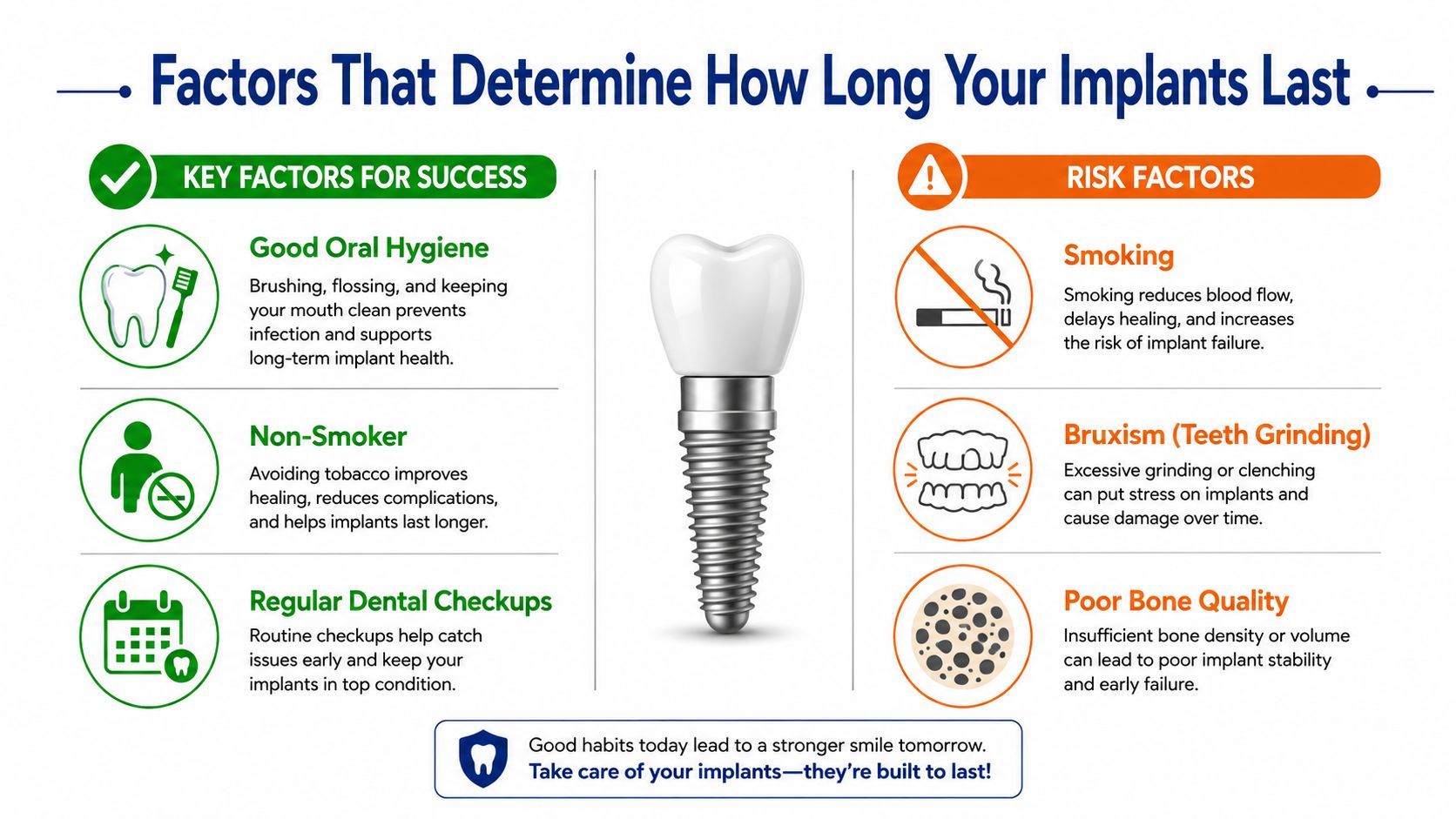
The evidence links smoking with approximately 1.7 times higher odds of peri-implantitis and diabetes with approximately 2.5 times higher odds. A history of periodontitis and absent professional prophylaxis are also established risks, as described in this systematic review of peri-implantitis risk factors.
| Risk factor | Effect on implant survival | Clinical action |
|---|---|---|
| Smoking | Raises the likelihood of inflammatory complications | Smoking cessation support and closer tissue monitoring |
| Diabetes | May affect long-term healing and biological stability | Coordinate glucose control, periodontal care, and recall |
| Periodontitis history | Increases the need for careful inflammation control | Treat active disease and maintain professional cleanings |
| Bruxism | Adds mechanical stress to the crown and implant components | Evaluate the bite and consider protective appliances |
| Poor bone quality | Can complicate initial stability and surgical planning | Use imaging and consider grafting or augmentation |
A thorough new patient exam should identify these variables before treatment begins. The practical advantage of a multi-specialty team is coordination among restorative, periodontal, surgical, and maintenance decisions rather than treating each concern in isolation.
The Silent Threat and Biological Maintenance
Peri-implantitis can progress without the dramatic pain that sends someone to an emergency dentist. The condition involves inflammation and supporting bone loss around an implant, and early changes may be noticed first through bleeding, swelling, suppuration, bad taste, increasing mobility, or a change in the way the teeth meet.
A recent systematic review reported a cumulative implant-level peri-implantitis risk of approximately 6.8%. Earlier evidence found peri-implantitis or soft-tissue complications in approximately 8.6% of patients after five years. These figures vary according to definitions and patient populations, so they shouldn't be treated as a personal forecast.
How inflammation undermines support
Plaque biofilm irritates the tissue around the implant. If inflammation persists, the crestal bone can recede, exposing more of the implant surface. Rough exposed surfaces are harder to clean, which can allow additional plaque accumulation and create a cycle of worsening inflammation and bone loss.
That cycle can be interrupted. A clinician can identify bleeding or changes in tissue contour, remove deposits professionally, compare dental x-rays when clinically indicated, adjust a restoration that traps plaque, and establish a recall schedule suited to the patient's risk.
Practical rule: Bleeding, swelling, pus, persistent bad taste, increasing looseness, or a new bite change deserves an implant evaluation rather than watchful waiting.
Patients with previous periodontitis, diabetes, smoking exposure, or a history of irregular dental care may need more structured follow-up than patients with lower risk. After peri-implantitis treatment, recent reviews support individualized maintenance that can sometimes occur at three- to four-month intervals, rather than assuming every patient needs only an annual visit. Broader advice about the connection between mouth health and general health is available in Healtsy's oral health guide.
Good brushing alone isn't a complete implant-care plan. Professional cleanings, tissue examinations, selective imaging, smoking cessation, periodontal treatment, diabetes optimization, and restoration checks all help protect the biological foundation.
Survival, Success, and Long-Term Care With a Prosthodontist
“Survival” and “success” aren't interchangeable clinical terms. Implant survival generally means the implant remains present and functioning. Implant success applies stricter expectations, which may include stable supporting tissues, acceptable function, comfort, and the absence of significant complications. Restoration longevity describes the separate life of the crown, bridge, denture, abutment, or screw.
A systematic review of implants followed for more than ten years reported mean implant survival of 94.6% and mean success of 89.7%. The difference shows why an implant can remain in place while still having inflammation, bone loss, mechanical problems, or another issue that prevents it from meeting stricter success criteria. The findings are summarized in this long-term review of dental implant survival and success.
Why coordination changes the plan
Diabetes illustrates the need for individualized care. In the reviewed evidence, implant survival in diabetic patients didn't differ from that of healthy patients during the first six years, but reduced survival could appear during observation extending to 20 years. That doesn't mean diabetes automatically rules out implants. It means glucose control, healing, periodontal health, medications, and maintenance need to be discussed before treatment.
A prosthodontist-led plan coordinates surgical placement, restoration design, bite management, material selection, hygiene access, and future repair. Prosth & Co. provides prosthodontic, implant, periodontal, endodontic, pediatric, orthodontic, cosmetic, and oral surgery services with an in-house laboratory and an interdisciplinary team. Dr. Victoria Park's postgraduate training includes prosthodontics at Harvard School of Dental Medicine and implantology at Columbia University.
That broad structure helps patients who may also need a root canal, tooth extraction, bone grafting, full-mouth rehabilitation, or treatment for worn teeth. It also supports families searching for an endodontist in New York, a pediatric dentist in Manhattan, or a kids dentist while an adult family member plans implant care.
The strongest long-term plan isn't the one with the most optimistic promise. It is the one that explains which component may need replacement, how the bite will be managed, and who will monitor the tissues after treatment.
Questions to Ask Before Scheduling Your Consultation
A productive implant consultation should leave patients with clear answers about the fixture, the restoration, the surrounding tissues, and future care. Before booking with a prosthodontist near the Upper East Side, patients can bring a list of questions and relevant medical or dental records.
Five questions that clarify the long-term plan
Which component does the quoted survival statistic describe?
The answer should distinguish the titanium fixture from the crown, bridge, denture, abutment, and screws.What maintenance interval fits the patient's risk profile?
Patients with periodontal disease, diabetes, smoking exposure, bruxism, or prior peri-implantitis may need a more individualized schedule than routine preventive care alone.Who coordinates surgery and restoration?
The team should explain how imaging, extraction, grafting, implant placement, provisional teeth, final restoration, and bite adjustments fit together.How will specific risk factors be managed?
A useful plan may address smoking cessation, periodontal treatment, glucose control, night-guard use, cleaning access, and the design of the crown.What does the long-term cost schedule include?
Patients should ask which visits, maintenance procedures, repairs, replacement components, imaging, and emergency evaluations are included or billed separately.
What the visit may involve
An initial visit may include a complete exam, dental x-rays, photographs, a review of the bite, periodontal assessment, and discussion of tooth replacement alternatives. Depending on the situation, the appropriate solution may be an implant-supported crown, bridge, or denture, or a different restorative option such as a conventional bridge or removable partial denture.
Patients with acute pain may first need urgent evaluation, tooth extraction, or root canal treatment before implant planning. Cosmetic concerns can also be addressed through bonding, veneers, crowns, or other cosmetic dentistry, while cleaning and exams help establish the tissue health needed for predictable care.
Prosth & Co. is located at 47 E 77th St #207, New York, NY 10075, near the 77th Street 6-train, with weekday hours from Monday through Friday, 9:00 AM to 6:00 PM, and urgent care availability. Implant longevity is a partnership between daily habits and ongoing professional monitoring, not a one-time surgical event.
Patients with a missing, damaged, or failing tooth can schedule an implant consultation with Prosth & Co. to review bone health, restoration options, bite forces, and long-term maintenance. The practice can coordinate implant placement and restoration alongside periodontal, endodontic, restorative, cosmetic, pediatric, and urgent dental care in its Upper East Side location.

Founder and lead prosthodontist of Prosth & Co. on Manhattan's Upper East Side. DDS, Columbia University; Prosthodontics certificate and MMSc in Oral Biology, Harvard School of Dental Medicine; Implantology fellowship, Columbia University.
Meet Victoria →