Dental crowns usually last 5 to 15 years, and some metal crowns can last over 20 years with proper care. That range is a useful baseline, not an expiration date, because the way a crown is designed, made, placed, and maintained has a direct effect on how long it serves you.
That's the part many patients in Manhattan want clarified. They aren't just asking, “How long do dental crowns last?” They're asking whether the investment is worth it, whether the tooth underneath will stay healthy, and whether there's a way to stack the odds in their favor. The short answer is yes. A crown that fits precisely, seals well, matches the bite, and is cared for consistently often performs better than the average suggests.
For many adults on the Upper East Side, the decision happens after a cracked tooth, a large filling that keeps breaking down, or a root canal that needs long-term protection. Others are comparing a crown with alternatives such as ceramic inlays, veneers, tooth extraction, or dental implants near me. In each case, durability matters, but so do comfort, appearance, and preserving as much healthy tooth structure as possible.
This guide explains the critical trade-offs. It covers what changes crown lifespan, what habits subtly shorten it, and what to expect if a crown starts to feel off. It also explains why specialist planning, material selection, and lab quality matter so much in a city where patients expect restorations to look natural and last.
Table of Contents
- Your Guide to Dental Crown Longevity in New York City
- Understanding the Lifespan of Different Crown Materials
- Key Factors That Shorten or Extend Your Crown's Life
- How to Protect Your Crown and Maximize Its Lifespan
- Your Crown Consultation at Prosth & Co on the Upper East Side
- Is It Time to Repair or Replace Your Dental Crown?
Your Guide to Dental Crown Longevity in New York City
A patient comes in after chipping a tooth on a Tuesday, has an event on Friday, and wants one answer before we begin. How long will this crown last? The honest answer starts with a range, but as a prosthodontist, I treat that range as a baseline, not a promise. Longevity depends on how the tooth is prepared, how the bite is managed, how the crown is fabricated, and whether the material fits the job.
In practice, two crowns can look equally good on day one and perform very differently five or ten years later. A front tooth with light functional demand asks for something different than a molar absorbing years of clenching, coffee, and late-night grinding. That is why crown longevity is never just about the visible cap. It is about the full system supporting it.
Why the average doesn't tell the whole story
Average lifespan numbers are useful for general guidance, but they do not explain why one patient keeps a crown for many years while another needs replacement much sooner. The details matter. The seal at the margin matters. The fit matters. The bite matters.
Practical rule: A crown lasts best when the restoration, the underlying tooth, and the bite are all working together.
Patients looking for a dentist in New York often focus on shade and shape first. Those matter, especially in the smile zone. A prosthodontic evaluation also looks at the factors patients cannot see. Is the tooth strong enough to hold a crown predictably? Is there enough healthy structure left? Will the patient keep that margin clean? Is the bite placing too much force on one area?
That specialist perspective changes outcomes. A crown that is slightly high in the bite, overcontoured near the gumline, or poorly matched to a patient who clenches may still look acceptable at delivery. Over time, those small errors can lead to chipping, cement washout, gum irritation, recurrent decay, or fracture of the tooth underneath.
Why specialist planning matters
At Prosth & Co., crown planning starts before any final material is chosen. The tooth position, esthetic demands, functional load, gum architecture, and parafunctional habits all shape the recommendation. In many cases, patients considering zirconia and other durable crown options are really deciding between strength, translucency, wear behavior, and how much force that tooth will need to handle over time.
There are real trade-offs. The most lifelike result is not always the longest-lasting choice for a heavy grinder. The strongest material is not always the best esthetic answer for a highly visible front tooth. A well-planned crown respects both.
This is also where an in-house lab changes the standard of care. Close communication between the prosthodontist and the lab allows tighter control over contours, contacts, occlusion, and shade. Small adjustments made early can improve hygiene access, reduce overload, and help the crown disappear naturally into the smile while holding up better in daily use.
For Upper East Side patients who want dentistry that looks refined and lasts, that level of planning is what moves a crown from average service life toward the longest, safest run the tooth can support.
Understanding the Lifespan of Different Crown Materials
Not all crowns wear the same way, and not all crowns fail for the same reason. Material choice affects strength, appearance, how the crown behaves under pressure, and where it makes the most sense in the mouth.
Why material choice changes longevity
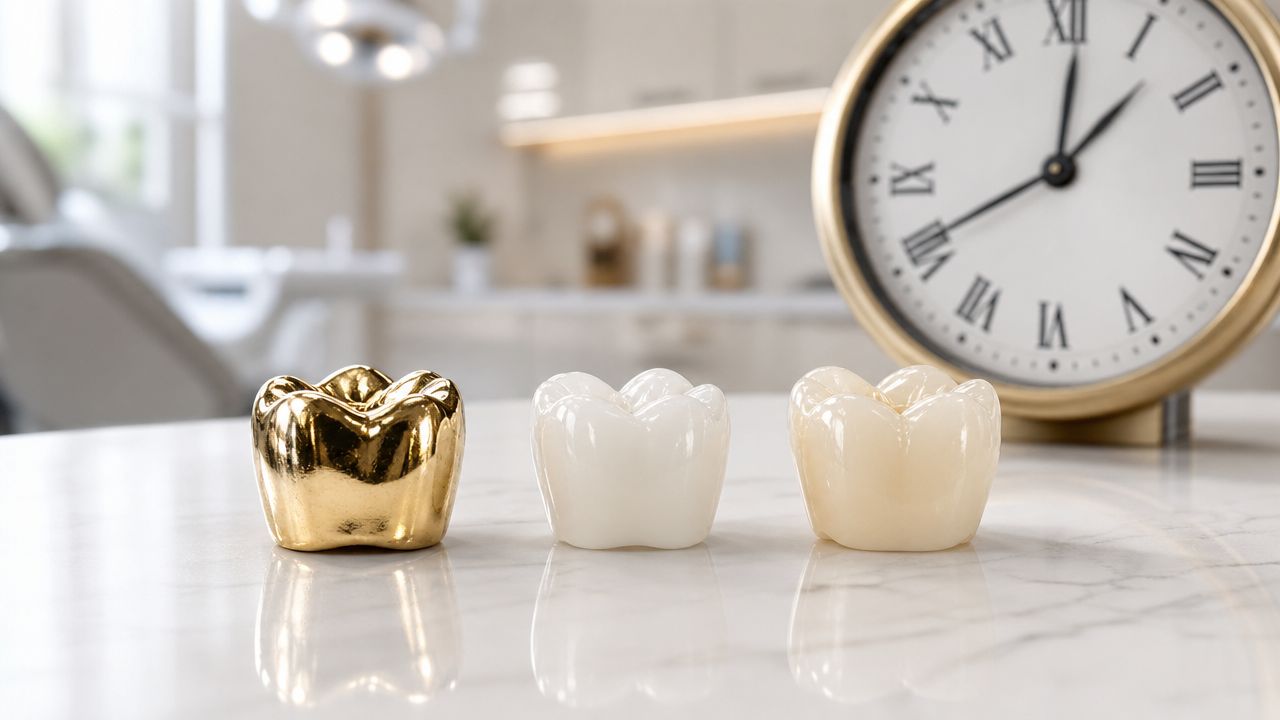
The broad rule is simple. Ceramic and porcelain crowns are often discussed within the 5 to 15 year range, while metal crowns can last over 20 years, and porcelain-fused-to-metal crowns are commonly placed in the 10 to 15 year range, as outlined in Cleveland Clinic's overview of dental crowns. Those numbers matter, but the “why” matters more.
Porcelain and other ceramics are chosen because they can look remarkably natural. They're often excellent for visible areas where translucency and color match matter. Their trade-off is that beauty alone doesn't make a restoration durable if the bite is heavy or the patient clenches. Material selection always has to match function.
Metal remains the durability benchmark because it tolerates force well. That's why gold and other metal alloys still hold an important place in prosthodontics, especially in high-load posterior areas where aesthetics are less critical. Patients don't always ask for metal first, but when longevity is the priority, it remains one of the strongest options.
Zirconia sits in the middle of a conversation patients often care about. They want something that looks good but also feels dependable. In many restorative cases, zirconia is chosen because it offers a strong balance of function and appearance, especially for back teeth and for patients with heavier bite forces. More detail on that option is available in this overview of stainless zirconia crowns.
Dental Crown Material Comparison
| Material Type | Average Lifespan | Best For |
|---|---|---|
| Porcelain or ceramic | 5 to 15 years | Front teeth and visible areas where aesthetics matter most |
| Porcelain-fused-to-metal | 10 to 15 years | Patients who want a blend of strength and tooth-like appearance |
| Metal or gold alloy | Over 20 years | Back teeth and high-force chewing areas where maximum durability matters |
| Zirconia | Qualitatively described as highly durable | Posterior teeth, heavier bites, and cases needing strength with a tooth-colored look |
A prosthodontist doesn't pick from this table by habit. The choice depends on where the tooth sits, how much natural tooth remains, whether the patient grinds, and how visible the area is when speaking or smiling.
The best crown material isn't the strongest one on paper. It's the one that matches the job the tooth has to do every day.
Patients looking for cosmetic dentistry, restorative dentistry, or even emergency dentist care after a fracture often assume one material is “the best.” In practice, every material solves a different problem well. The right decision is usually the one that balances lifespan, appearance, and the stress that tooth will carry.
Key Factors That Shorten or Extend Your Crown's Life
A strong crown can still fail early if it's asked to absorb the wrong kind of force or if the tooth underneath loses support. That's why long-term performance depends on more than the crown material.
A retrospective clinical study of tooth-supported single crowns reported cumulative survival of 89.9% at 5 years, 80.9% at 10 years, and 70.5% at 15 years, and found that the most common failures were loss of retention and tooth fracture. The same study noted that survival was influenced by crown location and bruxism, which is why a back tooth in a grinder carries a different risk profile than a front tooth with lower load (clinical study on crown survival).

Where the crown sits matters
Front teeth and back teeth do different work. Front teeth guide, tear, and show. Molars absorb repeated chewing pressure and are more likely to take concentrated load if a patient clenches or grinds.
That's why location changes recommendations. A crown that performs well in the front may not be the smartest choice for a heavily loaded molar. It's also why patients who break fillings repeatedly in the back of the mouth often need a closer look at their bite, not just another restoration.
The habits that do the most damage
Some threats are obvious. Biting ice, opening packaging with the teeth, and direct sports trauma all put a crown at risk. Others are more subtle. Nighttime grinding can create repeated force that slowly weakens the restoration, the cement seal, or the tooth itself.
The risk factors that most often shorten crown life include:
- Bruxism or clenching: Repeated heavy force can loosen, crack, or overload a crown and the tooth beneath it.
- Poor plaque control: A crown can't decay, but the tooth margin around it can.
- Hard-object chewing: Ice, pens, hard candy, and similar habits create concentrated stress.
- Untreated bite imbalance: If one tooth takes too much force, the crown often shows the problem first.
A crown often fails because the environment around it fails. The bite is off, the margin traps plaque, or the tooth underneath has been under stress for too long.
Patients searching for cleaning and exams, new patient exams, or an emergency dentist in Manhattan often think a crown problem begins the day it becomes painful. In reality, many crown problems start earlier and more insidiously. Food trapping, subtle movement, occasional soreness on biting, or gum irritation at one edge of the crown can all be early signs that the restoration needs attention before the problem becomes more expensive or harder to treat.
How to Protect Your Crown and Maximize Its Lifespan
Long-lasting crowns usually come from ordinary habits done consistently well. That's good news for patients, because most of the protective steps are straightforward and manageable.

The most important technical factor is the seal where the crown meets the tooth. This clinical review of crown longevity notes that the strongest technical predictor of long-term success is the marginal seal between crown and tooth. For patients, the most actionable ways to reduce risk are controlling bruxism with a night guard, maintaining excellent plaque control around the crown margin, and avoiding high-force habits.
Protect the margin every day
The crown margin is where precision dentistry meets home care. If plaque stays at that edge, the surrounding tooth can weaken even when the crown itself still looks intact. Brushing has to reach the gumline, and flossing has to clean the sides of the crown without being rushed.
A practical home routine looks like this:
- Brush the gumline carefully: Angle the bristles where the crown meets the gum, not just across the visible chewing surface.
- Floss with intention: The goal is to clean the sidewalls and margin, where buildup often hides.
- Notice small changes: New sensitivity, food trapping, or localized bleeding around one crowned tooth should be mentioned promptly.
Routine dental cleanings and exams matter here because small margin problems are easiest to manage when they're caught early. A crown doesn't have to be broken to need attention. Sometimes the issue is cement loss, plaque retention, or a bite contact that needs a minor adjustment.
Use prevention, not repair, as the strategy
Patients who grind often need a custom night guard. That isn't a luxury add-on. It's often the difference between a crown that keeps serving dependably and one that starts showing wear or stress too soon.
Avoiding high-force habits is just as practical. Chewing ice, cracking nuts with the teeth, and using teeth as tools all put sudden force into a restoration that was built for normal function, not abuse.
This short video gives a useful visual overview of what good crown care looks like in daily life.
For adults balancing work, family, and long commutes across New York City, maintenance has to be realistic. The goal isn't perfection. It's consistency. Good hygiene, regular checkups, and protection from grinding do far more for crown longevity than trying to fix problems after symptoms become obvious.
Your Crown Consultation at Prosth & Co on the Upper East Side
A careful crown consultation should feel specific, not rushed. Patients deserve to know whether the tooth is restorable, what material fits the case, how the bite will be managed, and whether another option such as an implant crown, inlay, onlay, or extraction is more appropriate.

What a thorough evaluation looks like
A strong consultation starts with diagnosis, not assumptions. That means examining the tooth structure that remains, evaluating the bite, checking the surrounding gums, and using dental x-rays or imaging when needed to confirm what can't be seen from the surface.
Patients should expect clear explanation, not vague reassurance. Intraoral photos can be especially helpful because they let patients see fractured tooth structure, worn edges, leaking margins, or gum inflammation directly. That makes treatment choices easier to understand, especially for patients comparing routine restorative work with more extensive treatment.
For those interested in how dental practices improve communication and patient experience, this dental patient acquisition playbook offers a useful perspective on what modern patients value when choosing care. The same expectations apply in the operatory. Clear explanation, transparency, and follow-through matter.
Why fabrication quality changes the result
A crown doesn't begin and end in the chair. It depends on preparation design, impressions or scans, shade communication, occlusal planning, and the quality of the lab work. That's where an in-house workflow can make a real difference. Better communication between clinician and lab often means tighter control over contours, contacts, and aesthetics.
Patients considering treatment can review more about dental crowns on the Upper East Side to understand how these restorations fit into broader restorative care. That's especially helpful for anyone comparing single-tooth treatment with larger functional or cosmetic goals.
Good crowns don't happen by accident. They come from diagnosis, precise fabrication, and a bite that's adjusted to protect the restoration instead of overload it.
This matters to busy Manhattan patients because they aren't just buying a crown. They're choosing the quality of the entire process behind it.
Is It Time to Repair or Replace Your Dental Crown?
A crown rarely goes from fine to failed overnight. More often, a patient bites into lunch and notices a new sharp spot, a rough edge with the tongue, or a crown that suddenly feels a little high or a little loose. That is the point to get it checked, before a small mechanical problem turns into damage to the tooth underneath.

Signs that deserve attention
A crowned tooth should feel stable, comfortable, and easy to chew on. These changes deserve an exam:
- New pain with chewing: Especially when biting feels sharp, concentrated, or off-balance.
- Temperature sensitivity: Hot or cold that starts suddenly around a crowned tooth.
- Looseness or movement: A crown should not rock, shift, or lift.
- Visible damage: Chipping, roughness, wear, or a changed shape.
- Gum changes at one tooth: Swelling, bleeding, tenderness, or a dark line near the edge of the crown.
- Food trapping: Repeated catching between teeth near the crown often points to a contour or contact issue.
These findings do not all mean replacement. They do mean the crown, the tooth, and the bite need evaluation.
When repair makes sense and when replacement is safer
The decision starts with one question. What failed?
A small chip on the non-biting edge of a front crown may be polished or repaired if the crown still fits well, the margin is sealed, and the appearance can be restored predictably. By contrast, a molar crown that feels loose may look like a simple recementation case, but that is not always the full story. If the cement washed out because the fit was poor, the tooth has decayed underneath, or the bite has been overloading that crown for months, putting it back on is usually a short-term fix. A prosthodontist should identify the cause before recommending the solution.
That is where specialist judgment matters. I do not recommend replacing a crown just because it has reached a certain age. I recommend replacement when the fit is no longer protecting the tooth, when decay or fracture has changed the foundation, or when the bite keeps driving the same failure pattern. In a practice with close control over fabrication and occlusion, those details can be evaluated and corrected rather than guessed at.
For patients in Manhattan who need an emergency dentist, a dentist nearby, or restorative care after a cracked or uncomfortable crown, the right next step is prompt evaluation. Waiting can turn a manageable crown problem into a root canal, a fractured tooth, or tooth loss.
If a crown feels loose, sensitive, worn, or overdue for evaluation, Prosth & Co. provides complete prosthodontic and restorative care on the Upper East Side. Patients in Manhattan can schedule a consultation to assess an existing crown, discuss replacement options, or get a clear treatment plan for long-lasting, aesthetic results.

Founder and lead prosthodontist of Prosth & Co. on Manhattan's Upper East Side. DDS, Columbia University; Prosthodontics certificate and MMSc in Oral Biology, Harvard School of Dental Medicine; Implantology fellowship, Columbia University.
Meet Victoria →