A cracked tooth, a dark old filling, or a gap that changes the way someone chews can make every meal feel like a reminder. In Manhattan, patients often start searching for a dentist in Manhattan or a restorative dentistry near me solution only after the problem has already begun affecting comfort, confidence, and routine. Prosth & Co. on the Upper East Side approaches crowns and bridges as structural treatment, not just cosmetic cover, and that distinction matters when the goal is stable function that lasts.
For patients who need one broken tooth rebuilt or several teeth replaced, the first visit is usually about sorting out the damage, the bite, and the long-term plan. That can include everything from a crown after a root canal to a bridge for a missing tooth, or a more complex rehabilitation when multiple teeth have worn down over time. If phone access becomes a bottleneck for a busy practice, SkipCalls AI for overflow calls can help keep patient communication from slipping through the cracks while care is being arranged.
Table of Contents
- Restoring Your Smile With Crowns and Bridges in Manhattan
- Understanding How Fixed Prosthetics Rebuild Your Bite
- Choosing the Right Material for Your Restoration
- Evaluating Longevity and Long-Term Complications
- Your Treatment Journey at Our Upper East Side Practice
- Protecting Your Investment With Proper Daily Care
Restoring Your Smile With Crowns and Bridges in Manhattan
A patient may walk in thinking the problem is just one chipped molar. After a full exam, the underlying issue is often broader: a cracked cusp, a failing filling, a missing tooth that has changed chewing on that side, or a front tooth that no longer matches the rest of the smile. In that setting, a prosthodontist in Manhattan looks beyond the visible defect and asks what the tooth, the bite, and the surrounding teeth need to stay healthy.
Why the first conversation matters
A crown and a bridge solve different problems. A crown restores and protects a tooth that is still present, while a bridge replaces a tooth that is no longer there by spanning the space with a fixed restoration. Crowns and bridges are both fixed prosthetics, which means they're cemented onto teeth or implants rather than removed at home.
That matters for daily life. A loose, painful, or missing tooth can change how food is cut, where pressure lands, and how the jaw feels by the end of the day. It can also make a person hide a smile in meetings, photos, and dinner conversations, which is why local patients searching for a cosmetic dentist near me often end up needing restorative work first, then aesthetic finishing.
Practical rule: if the tooth is still usable, protection usually comes before replacement. If the tooth is gone, the plan shifts to closing the space with a fixed solution that supports the bite.
Why Manhattan patients ask for durable treatment
In a city where people don't have time for repeated repairs, the right plan is usually the one that respects the remaining structure. That may mean a conservative crown, a bridge with carefully chosen support teeth, or a full-mouth plan when wear and old dentistry have stacked up. The goal is not to hide the damage. It is to rebuild the part of the mouth that does the work.
Patients with urgent pain, swelling, or a tooth that has fractured below the gumline may also need related services such as tooth extraction, endodontist care, or an emergency dentist visit before restoration can begin. For families, the same practice may also coordinate a pediatric dentist or kids dentist visit, so care stays under one roof instead of bouncing between offices.
Understanding How Fixed Prosthetics Rebuild Your Bite
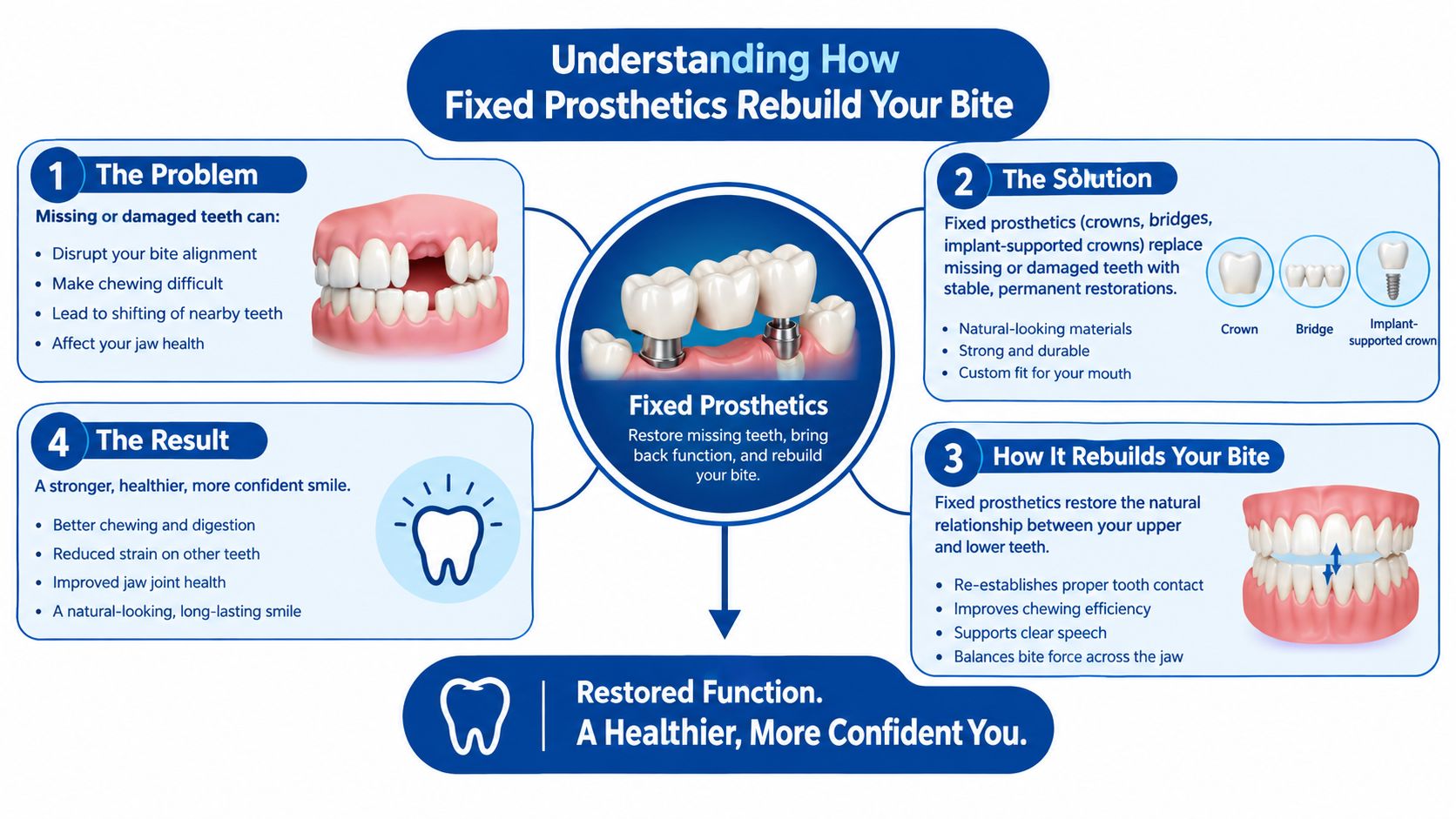
A crown works like a protective shell. It covers a damaged tooth, restores its shape, and gives chewing forces a stronger surface to land on. A bridge fills a gap with an artificial tooth fused between two supports, so the space doesn't stay open and the bite doesn't drift.
What each restoration is actually doing
Crowns are used when a tooth is weakened by decay, fracture, heavy wear, or a large old filling. They're also common after root canal treatment when the remaining tooth needs reinforcement. Bridges are used when one or more teeth are missing and the neighboring teeth or implants can support the span.
The reason this matters is simple, a gap doesn't stay neutral. Adjacent teeth can tip or drift, the bite can become uneven, and the opposing tooth can over-erupt into the empty space. Over time, that changes how the jaw closes and can create wear patterns that are harder to correct later.
The mouth adapts to a missing tooth, but not always in a helpful way. The earlier the space is stabilized, the less likely nearby teeth are to become the weak link.
When a fixed restoration makes sense
Common reasons for recommending a crown or bridge include:
- Protection after root canal treatment, when the tooth needs reinforcement.
- Repair of severe wear or fracture, especially when a filling won't hold.
- Replacement of a missing tooth, when the gap is affecting chewing or aesthetics.
- Improving shape, color, or alignment, when a single tooth stands out.
Fixed prosthetics don't solve every problem. They work best when the supporting teeth are healthy enough, the bite is manageable, and the design respects the forces in the back of the mouth versus the front. For patients comparing options, a dental implants near me search often belongs in the discussion too, since implants can sometimes replace a missing tooth without relying on neighboring teeth.
Choosing the Right Material for Your Restoration
Not every crown or bridge behaves the same way in the mouth. Material choice changes strength, appearance, and the kind of complications a restoration is more likely to have later. That's why a good recommendation isn't “what's newest,” it's “what fits this tooth, this bite, and this patient.”
| Material Comparison for Crowns and Bridges | ||
|---|---|---|
| Material Type | Primary Advantage | Best Clinical Application |
| Zirconia | High strength and a favorable failure profile in selected cases | Posterior teeth, limited space, and situations where chipping risk matters |
| Layered ceramic | Better translucency and esthetics | Front teeth and visible areas where appearance is the priority |
| Metal-ceramic | Longstanding clinical use and dependable support | Mixed-function cases where strength and esthetics both matter |
Why zirconia often comes up first
Zirconia is often considered when a restoration needs strength and the tooth sits in a high-load area. In a 5-year retrospective study, zirconia restorations showed 95% survival versus 88% for metal-ceramic restorations, with veneer chipping in 5% of zirconia cases versus 10% of metal-ceramic cases and prosthesis fractures in 2.5% versus 8.5%, respectively (clinical material comparison data). That doesn't make zirconia a universal answer, but it does show why many clinicians like it for specific indications.
Why esthetics still matter
Layered ceramics can look excellent in the smile zone, where translucency and shade matching are critical. Metal-ceramic restorations remain a practical option when the design needs a dependable framework with a long track record. The point is not to crown one material as “better” in every case. It's to match the material to the job.
For that reason, the newest materials may improve predictability in selected cases, but they don't eliminate biologic problems, bite issues, or the need for careful planning. That is especially true for patients with bruxism, heavy posterior chewing, or limited space between the teeth.
Evaluating Longevity and Long-Term Complications
A crown or bridge should be judged by what it does over time, not by how it looks on day one. The question at hand is how the restoration, the supporting tooth or teeth, and the surrounding gums will hold up under chewing, cleaning, and normal wear.
What medium-term survival looks like
Systematic review data on fixed dental prostheses show that conventional tooth-supported FDPs had an estimated 5-year survival of 93.8% and 10-year survival of 89.2%, while resin-bonded bridges reached 91.4% at 5 years and 82.9% at 10 years (survival review). Those figures fit daily clinical experience. Many restorations perform well, but they still depend on good case selection, sound design, and regular maintenance. For a closer look at what drives crown lifespan, see our guide on how long dental crowns last.
Failures usually do not happen all at once. Small problems tend to appear first, such as a margin that starts to leak, a porcelain chip, or a supporting tooth that weakens over time. Once one part of the system changes, the rest of the restoration has to absorb more stress.
Which complications show up most often
The most common biological problems are caries and loss of pulp vitality in tooth-supported FDPs. Technical problems include veneer fractures, chipping, loosening, and loss of retention. Longer spans and more demanding support conditions shorten service life, which is why bite control and conservative design matter from the start.
Bridgework deserves a careful look here. The visible bridge may still look intact while the abutment teeth carry the burden. Poor hygiene access, large existing restorations, and a heavy bite can make those support teeth the weak point long before the porcelain shows serious wear.
The long view is practical, not pessimistic. A restoration that begins with the right support, the right span, and the right bite is easier to maintain and less likely to develop preventable problems.
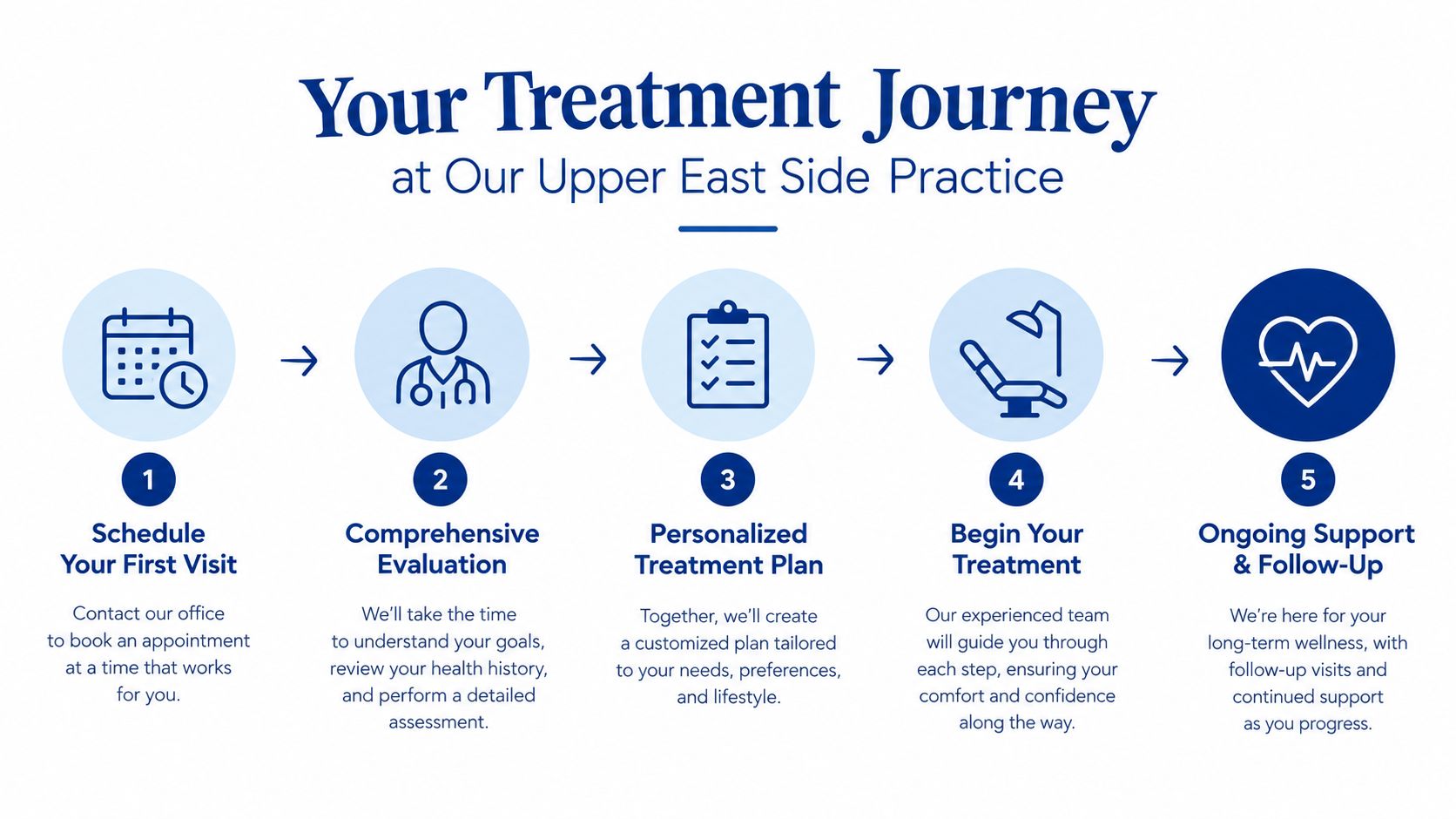
Your Treatment Journey at Our Upper East Side Practice
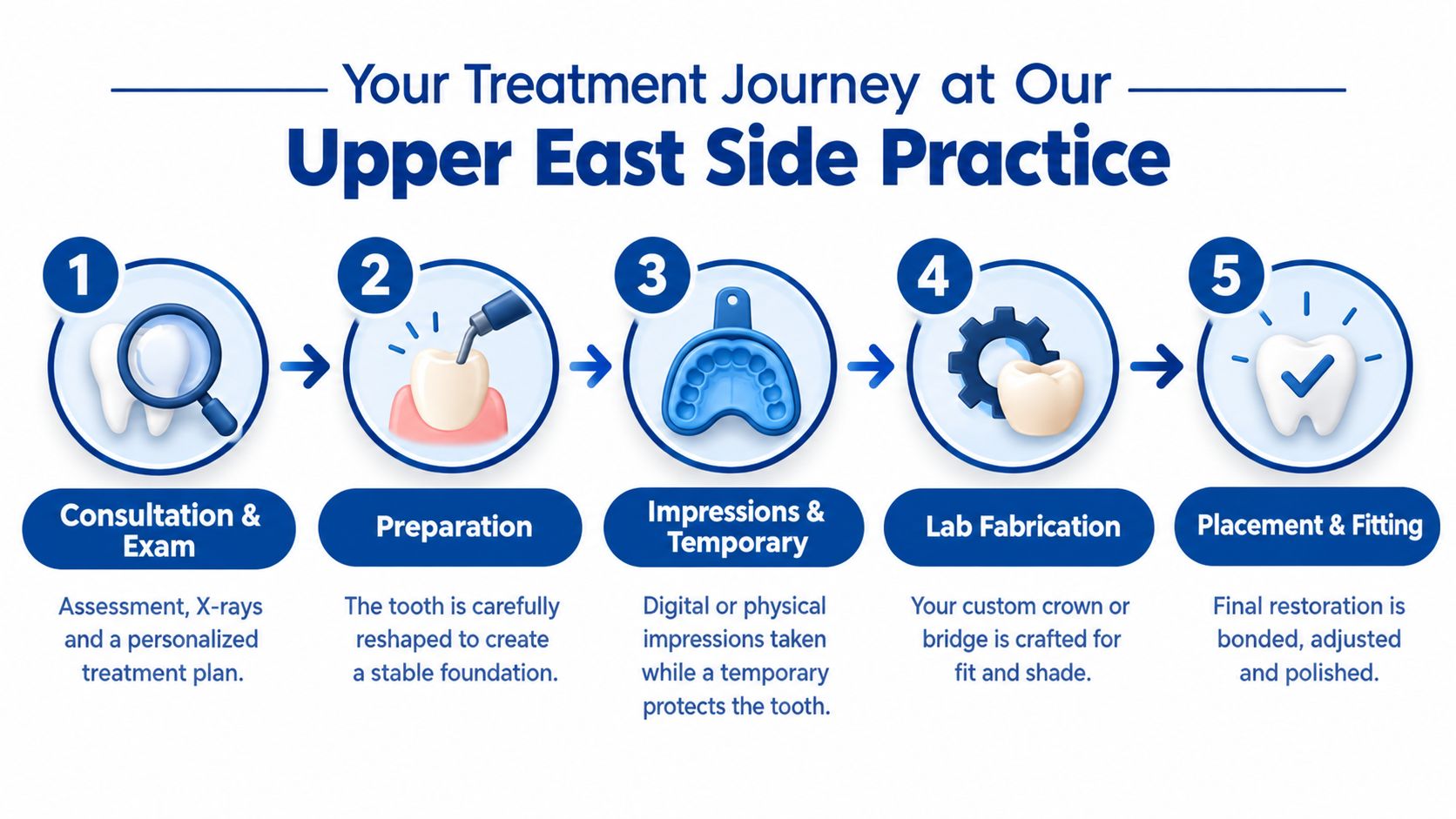
A careful crown or bridge visit starts with diagnosis, not drilling. That usually means a clinical exam, radiographs, bite evaluation, and photos so the team can see how the teeth fit together and how the final restoration should look. At a prosthodontist-led office, that planning step is where a lot of the quality is won.
What the preparation stage really involves
Tooth preparation isn't cosmetic reshaping. Prosthodontic references describe depth reduction targets of less than 2 mm on incisal or occlusal surfaces, about 1 mm facial reduction for porcelain, 0.5 mm for metal, and a 1.5 mm shoulder width to support porcelain-and-metal restorations (prosthodontic preparation guidance). Those measurements help create room for the restoration without overcutting the tooth.
That precision is why preparation should be done with a clear endpoint in mind. If there isn't enough space, the material may end up too thin. If too much tooth is removed, the remaining structure is compromised. The right preparation balances both.
Why an in-house lab changes the workflow
A practice with an in-house dental laboratory can move from scan or impression to fabrication with closer clinical oversight. Shade, contour, contact points, and bite can be adjusted with direct input from the treating prosthodontist, instead of being passed around without context. That kind of communication matters most in complex cases, where small changes in shape can affect comfort and esthetics.
Patients often want to know what the visits feel like in real life. The short answer is that the process usually includes:
- Diagnostic planning, with photos and bite review.
- Preparation and temporaries, so the tooth is protected while the final restoration is made.
- Try-in and adjustment, where fit and color are checked.
- Final cementation or delivery, followed by bite refinement.
For patients who prefer a coordinated office that handles everything from cleaning and exams to dental x-rays, root canal referrals, and restorative planning, Prosth & Co. is one option among several in Manhattan. The practical advantage is continuity, which often makes complex treatment feel more manageable.
Protecting Your Investment With Proper Daily Care
A crown or bridge can't decay, but the tooth margins around it absolutely can. That's where plaque collects, where gum inflammation starts, and where secondary caries can take hold if cleaning gets lazy. The restoration is not fragile, but it does depend on disciplined maintenance.
Daily habits that keep margins healthy
Brushing twice a day with a soft brush matters, but technique matters more than pressure. The goal is to clean the edge where the restoration meets the natural tooth, because that's where biological trouble usually begins. Flossing remains essential, and bridge pontics need special attention because food and plaque can collect underneath them.
A few practical habits help:
- Brush along the margin, not just the visible surface.
- Floss under and around bridge units, using the right threader or aid if needed.
- Keep routine cleanings and exams, so small issues are caught early.
- Wear a night guard when indicated, especially if grinding or clenching is wearing the porcelain.
Good home care doesn't make a restoration last forever. It gives the supporting teeth a fair chance to do their job.
Why follow-up matters in the long run
Patients who clench often don't realize how much force they're putting through a bridge or crown until something starts loosening or chipping. Night protection is one way to reduce that stress. Regular dental visits are another, because the bite can shift, gums can change, and margins can start to open before the patient feels a problem.
For practices that want to manage scheduling without overloading the front desk, some teams also choose to hire virtual dental receptionist support so patients can get a timely response when they call about follow-up care or urgent concerns. That kind of access matters, especially in a city where patients expect the office to keep pace with their lives.
For patients in Manhattan who need crowns and bridges, Prosth & Co. provides prosthodontic planning, restorative care, implant-supported solutions, and coordinated treatment under one roof. A consultation can clarify whether the tooth should be protected, replaced, or rebuilt with a plan designed for long-term function. Visit Prosth & Co. to request an appointment and start with a treatment plan that respects both your bite and your smile.

Founder and lead prosthodontist of Prosth & Co. on Manhattan's Upper East Side. DDS, Columbia University; Prosthodontics certificate and MMSc in Oral Biology, Harvard School of Dental Medicine; Implantology fellowship, Columbia University.
Meet Victoria →