A lot of Manhattan patients start in the same place. They're doing well professionally, they're in photos more often than they'd like, and they notice the same details every time they catch their reflection. A chipped edge. Teeth that look worn or uneven. Color that doesn't improve enough with whitening. A smile that feels older, flatter, or less polished than the rest of them.
That's usually when the search begins for Porcelain Veneers Manhattan patients can trust, not just for a prettier smile, but for a result that looks natural and holds up in real life. On the Upper East Side, that conversation often needs to go beyond cosmetics. Many adults already have wear from grinding, older dental work, or bite changes that affect what will and won't last.
Careful prosthodontic planning matters. Veneers can be a beautiful solution, but they're not interchangeable from one patient to the next. The right design depends on enamel, bite stability, facial balance, and how the teeth function together. Patients who want to understand how smile design works may also find useful context in Transactional LLC's dental marketing guide, which explains how dental practices present care online and why clarity matters when people are choosing treatment.
Before and after examples can also help patients see what thoughtful cosmetic planning looks like in practice through these smile makeover transformations.
Table of Contents
- Your New Smile in Manhattan Starts Here
- What Exactly Are Porcelain Veneers
- Are You a Good Candidate for Veneers
- The Porcelain Veneer Process at Prosth & Co
- Veneers Compared to Other Cosmetic Options
- Porcelain Veneer Cost and Longevity in Manhattan
- Begin Your Smile Transformation on the Upper East Side
Your New Smile in Manhattan Starts Here
A common Manhattan scenario looks like this. Someone feels confident in work, style, and presentation, but their smile still feels like the one thing they've been managing around. They smile with lips closed in photos. They angle their face slightly in meetings. They keep noticing one front tooth that looks darker, shorter, or more worn than the others.

For many of these patients, veneers become appealing because they can correct several concerns at once. Shape, color, proportion, spacing, and mild alignment issues can often be addressed in one coordinated plan. That's different from treating each tooth as a separate cosmetic problem.
Why Manhattan patients often need more than a cosmetic opinion
The smile has to work, not just photograph well. Adults on the Upper East Side often arrive with subtle wear patterns, old bonding, hairline chips, or habits like clenching that change the treatment conversation. A surface-level cosmetic approach can miss the reason the smile changed in the first place.
Clinical reality: A veneer case succeeds when the appearance and the bite are planned together.
That's why the evaluation matters as much as the final porcelain. The strongest cosmetic result usually comes from understanding the whole system first. How the front teeth touch. Whether there's enough enamel. Whether one side is carrying too much force. Whether the patient wants a dramatic change or a refined, conservative improvement.
What patients are usually looking for
Most veneer consultations in Manhattan center on a few practical goals:
- Natural improvement that doesn't look bulky, opaque, or artificial
- Smile balance when teeth are uneven, worn, short, or asymmetrical
- Color correction for teeth that haven't responded well to whitening
- A polished but believable result that fits the face, age, and personality
Patients aren't usually asking for “perfect” teeth. They're asking for a smile that feels like theirs, just healthier, brighter, and more harmonious.
What Exactly Are Porcelain Veneers
Porcelain veneers are ultra-thin ceramic laminates bonded to the front surface of teeth. They're chosen because the material can reproduce the translucency and light transmission of natural enamel, which makes porcelain especially useful for improving color, shape, and minor alignment issues while preserving a natural optical appearance, as described in this Manhattan porcelain veneer reference.
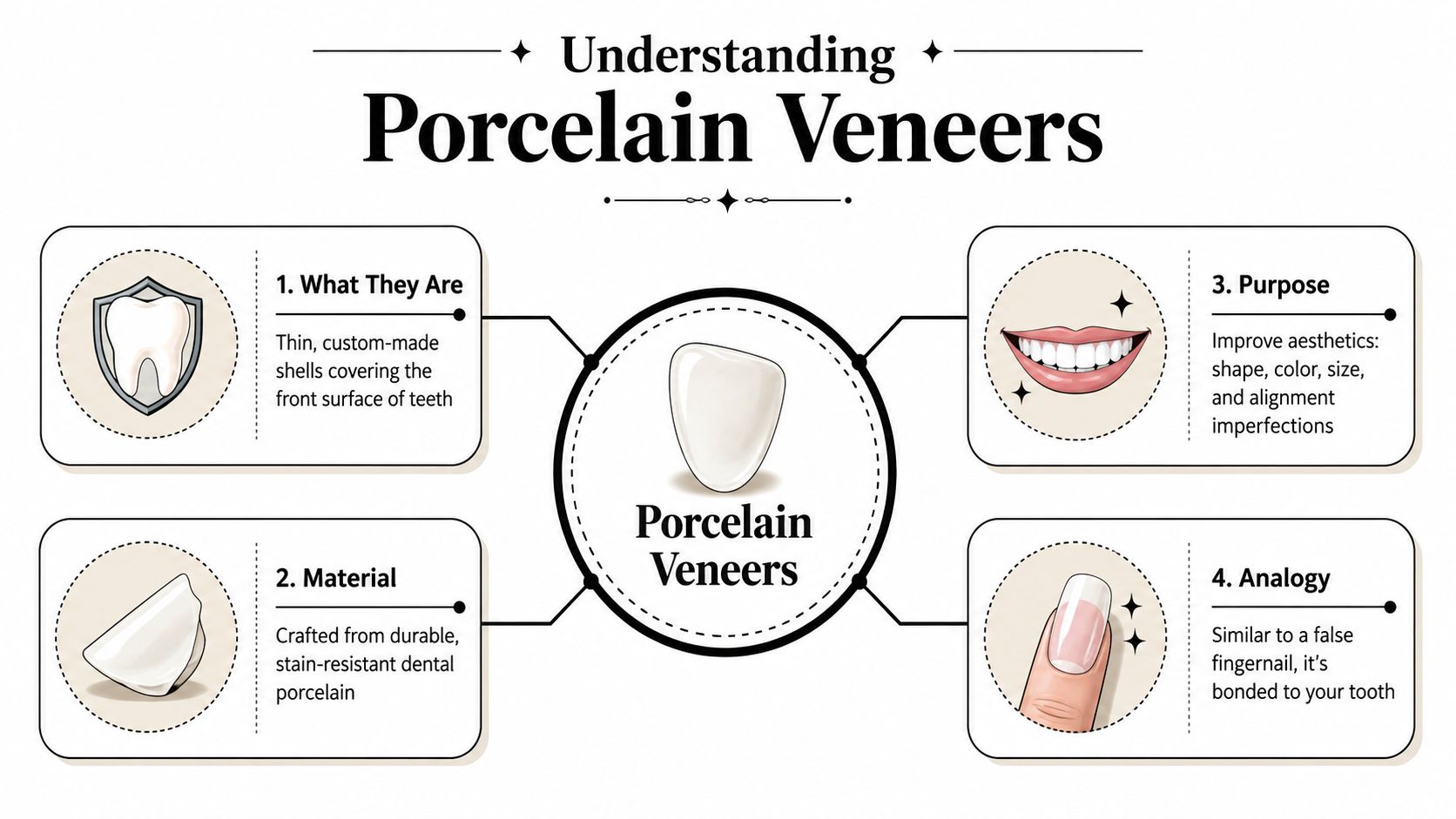
A simple way to think about them is this. A veneer is like a very thin custom shell designed for the visible front of a tooth. It doesn't replace the whole tooth. It refines what's already there.
What veneers can improve
Veneers are often used when teeth are healthy enough to keep, but the visible surfaces no longer look the way a patient wants. They can help when teeth are:
- Chipped or worn along the edges
- Discolored in ways whitening can't fully correct
- Uneven in shape or slightly mismatched in size
- Separated by small gaps
- Mildly misaligned when the issue is visual rather than structural
That range is one reason veneers are such a central treatment in cosmetic dentistry. They can create a cohesive smile instead of a piecemeal fix.
What veneers don't do
They aren't the answer for every cosmetic concern. Veneers can make teeth look straighter, but they don't move teeth the way aligners or braces do. They can improve the visible portion of a tooth, but they don't solve gum disease, untreated decay, or significant bite instability.
Veneers work best when the foundation is healthy. If the underlying problem is functional, that problem has to be addressed first.
They also aren't meant to look flat and bright white across every tooth. Good porcelain has depth, texture, and variation, just like natural enamel. That's why careful design matters. The goal is rarely “white as possible.” The goal is usually believable brightness with the right proportions and edge shape for the patient's face.
Why patients often prefer porcelain
Composite bonding can be useful in the right case, but porcelain is often selected when the patient wants a more refined surface quality and enamel-like light behavior. The restoration should disappear into the smile rather than stand out as a cosmetic add-on.
For patients searching for porcelain veneers Manhattan, that distinction matters. The material itself is part of why the final result can look elegant instead of obvious.
Are You a Good Candidate for Veneers
Not everyone who wants veneers should get them. The right candidate isn't defined only by cosmetic goals. The fundamental question is whether the teeth and bite can support a stable, lasting result.
A strong veneer candidate usually has healthy teeth and gums, enough enamel for bonding, and a clear reason for treatment. The smile concerns may include discoloration, worn edges, uneven tooth shape, or small spaces between teeth. Expectations matter too. Patients tend to do well when they want improvement that looks natural and understand that cosmetic dentistry still has to respect biology and function.
Signs that veneers may be a good fit
A veneer consultation often moves forward smoothly when these conditions are present:
- Healthy oral foundation with no untreated gum disease or active decay
- Adequate enamel so the veneers can bond predictably
- Stable bite without obvious signs of ongoing overload
- Defined cosmetic concerns such as color, contour, proportion, or minor spacing
- Realistic expectations about what veneers can and can't change
When these elements line up, veneers can be a conservative way to create a major visual improvement.
The more important question for worn teeth
Many adults in Manhattan don't fit the simple cosmetic profile. They already have flattening at the edges, old chips, sensitivity, or a history of clenching. That changes the conversation. A key patient question is whether veneers are appropriate for people who clench, grind, or already have wear. Manhattan veneer pages often focus on appearance and give limited guidance on functional screening, even though veneers depend on adequate enamel and stable occlusion to last, which is why a prosthodontic evaluation is critical, as noted in this discussion of functional screening for Manhattan veneer patients.
A smile can look ready for veneers from the front and still be a poor veneer case once the bite is examined.
That's especially true when front teeth have become shorter over time, when one tooth repeatedly chips, or when the jaw closes into an unstable pattern. In those situations, the decision isn't just yes or no. It may be veneers with bite protection. It may be selective restorative treatment first. It may be orthodontic alignment before cosmetic work. It may mean that another option is smarter.
What a functional evaluation looks for
A more complete evaluation checks several things before porcelain is ever designed:
- Wear pattern that suggests grinding or clenching
- Tooth position and whether the planned veneers would be overloaded
- Enamel availability for durable bonding
- Existing dental work that may affect the design
- Jaw relationship and bite contacts during normal function
Prosthodontic training proves especially valuable. Cosmetic design is part of the job. So is making sure the result has a reasonable chance to age well.
The Porcelain Veneer Process at Prosth & Co
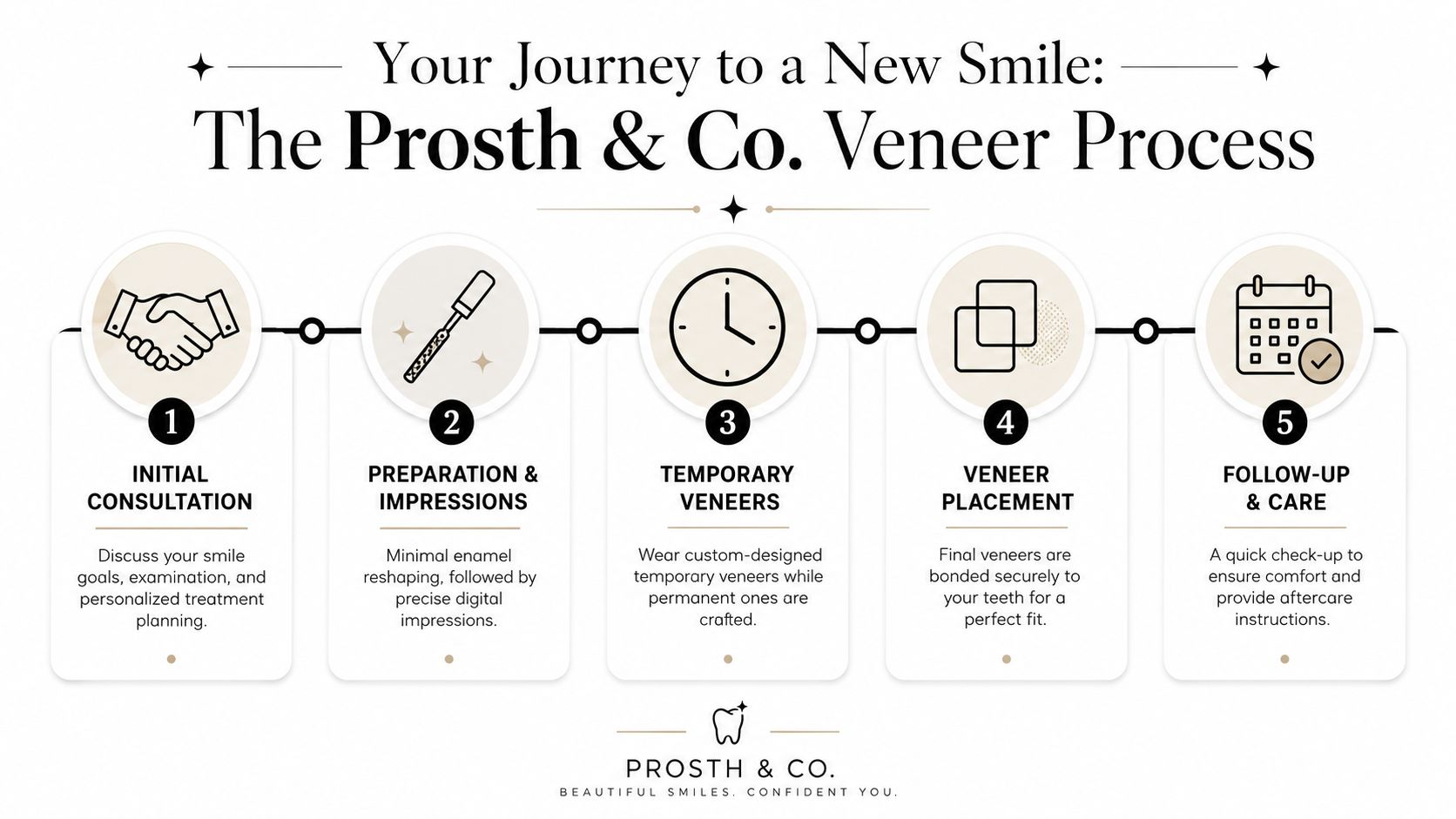
Most veneer cases are easier for patients once the process is broken into clear steps. The appointments are purposeful, and each one answers a different question. What should the smile look like. What preparation is necessary. How will the veneers function when speaking and biting. How will the final result be bonded and maintained.
A veneer journey should feel planned, not rushed.
Consultation and smile design
The first visit is about diagnosis and direction. The teeth, gums, bite, existing restorations, and facial proportions all need review before any cosmetic decision is finalized. Intraoral photos help patients see what the clinical team sees, which makes the conversation more collaborative and less abstract.
This is also where goals get translated into specifics. Some patients want a brighter, cleaner version of their current smile. Others want more length, more symmetry, or a softer shape. Those choices affect contour, edge position, and how much change is appropriate.
What works: patients do better when they react to visuals and examples, not just verbal descriptions like “natural” or “white.”
Preparation and temporary veneers
If veneers are the right treatment, the next phase usually involves conservative preparation of the teeth. The amount varies by case. Some teeth need very little adjustment, while others require more refinement to create space for porcelain that won't look bulky.
Impressions or digital records are then used to fabricate the restorations. Many patients wear temporaries during this stage. That trial period is useful because it gives a preview of length, shape, speech, and overall feel before the final porcelain is bonded.
A short video can make the sequence easier to picture.
Final placement and follow-up
At the bonding appointment, each veneer is checked carefully before it's seated. Fit, contact points, color integration, edge shape, and bite all need confirmation. The bonding process is precise because veneer success depends not only on the porcelain itself but on how well it's integrated with the tooth.
After placement, follow-up matters. Even excellent veneers may need a small adjustment once the patient has spoken, chewed, and lived with them for a short period.
One local option for this type of coordinated veneer workflow is Prosth & Co., a multi-specialty Upper East Side practice that provides prosthodontic, cosmetic, restorative, and preventive care with in-house lab support, modern imaging, and detailed patient communication.
What patients can expect during visits
The process typically feels manageable when expectations are clear:
- A diagnostic first visit focused on goals, exam findings, and candidacy
- A planning phase where the proposed smile is reviewed in detail
- A preparation appointment with records for fabrication and temporary coverage when needed
- A final bonding visit where aesthetics and function are both checked
- A follow-up review to confirm comfort, bite balance, and home care
That structure helps reduce uncertainty. Patients know what's happening, why it matters, and what the smile should feel like at each stage.
Veneers Compared to Other Cosmetic Options
Porcelain veneers are powerful, but they aren't always the first or only answer. Some smiles need a lighter touch. Others need more coverage than a veneer can provide. The right comparison usually comes down to four things. What needs to change, how durable the result should be, how much tooth structure is involved, and whether the problem is cosmetic, structural, or both.
How veneers differ from whitening and bonding
Whitening is the least invasive option when the teeth are well-shaped and the main issue is color. It won't correct chips, asymmetry, or worn contours. If the patient likes the shape of the smile and wants brighter teeth, whitening may be enough.
Composite bonding can be a practical choice for smaller corrections. It can work well for edge repair, minor spacing, or localized reshaping. The trade-off is usually in finish and long-term surface behavior. For patients who want a more extensive smile redesign with ceramic-like optical quality, veneers often provide a more refined result.
When crowns enter the conversation
Crowns cover more of the tooth than veneers do. They're often considered when a tooth is heavily restored, structurally compromised, or has damage that extends beyond the front surface. In that setting, a veneer may be too conservative for the clinical demands of the tooth.
A common mistake is assuming veneers are the “better” cosmetic treatment because they're more popular. They're better only when they fit the tooth.
The most conservative treatment isn't the smallest restoration. It's the option that matches the condition of the tooth and the forces placed on it.
Cosmetic dental treatment comparison
| Treatment | Best For | Durability | Cost |
|---|---|---|---|
| Porcelain veneers | Patients who want to improve color, shape, proportion, and minor alignment across visible front teeth | Designed as a long-term ceramic restoration when the bite and bonding conditions are favorable | Higher cosmetic investment that varies with material, planning, and case complexity |
| Composite bonding | Small chips, limited contour changes, and selective cosmetic correction | Useful, but typically more maintenance-sensitive than porcelain over time | Usually lower upfront cost than porcelain |
| Professional teeth whitening | Teeth with acceptable shape and alignment that mainly need color improvement | Depends on habits and maintenance | Usually the most conservative and lowest-cost cosmetic option |
| Crowns | Teeth with larger restorations, structural weakness, or greater coverage needs | Appropriate when more support and coverage are required | Often varies by restorative complexity and tooth condition |
Patients often benefit from hearing that the most expensive route isn't automatically the smartest one. If only one or two teeth need attention, selective treatment may be more appropriate than a larger cosmetic plan. If the front teeth are worn and unstable, veneers may need to be part of a broader restorative strategy rather than a standalone cosmetic purchase.
Porcelain Veneer Cost and Longevity in Manhattan
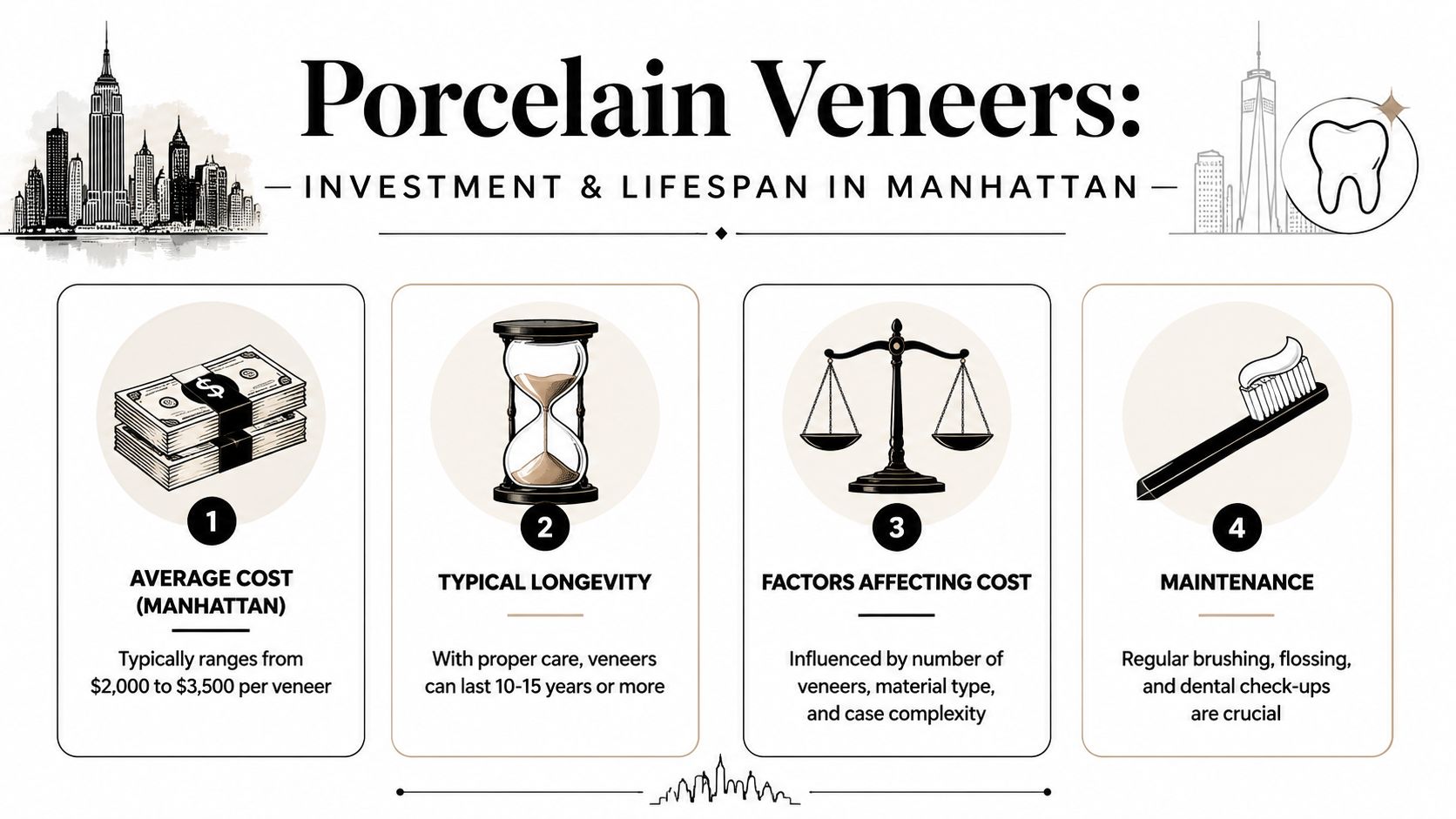
A patient often sits down in consultation with two practical questions. What will veneers cost, and how long will they realistically hold up in daily life. In Manhattan, the honest answer is that the fee and the lifespan depend less on zip code than on diagnosis, design, materials, and whether the bite is stable enough to support porcelain over time.
Porcelain veneers are usually priced per tooth, but the per-tooth number only tells part of the story. The final investment changes based on how many visible teeth are being treated, whether records and mockups are needed before preparation, how much existing wear or old bonding has to be managed, and whether the case includes functional planning for clenching, grinding, or an uneven bite. For patients with stronger bite forces, the planning stage matters as much as the ceramic itself.
Why fees vary so much
Two veneer cases can look similar in a photo and require very different treatment.
A straightforward cosmetic case on healthy front teeth is generally less involved than a case with worn edges, shifting teeth, failing restorations, or signs of bite instability. In the second situation, the work may include more detailed records, provisional restorations, bite adjustments, or a protective night guard after delivery. Those steps add cost, but they also reduce the risk of chipping, debonding, and premature wear.
Material choice also affects the fee. Some patients are candidates for very conservative veneers that preserve more enamel. Others need a stronger or differently layered ceramic because of the way they bite, the amount of discoloration underneath, or the level of shape change required. Good treatment planning matches the ceramic to the tooth and to the forces that tooth will absorb.
Patients who want a more detailed breakdown can review our page on how much porcelain veneers cost in Manhattan.
What to ask about the total treatment cost
The better question is not, “What is the price per tooth?” It is, “What does the full plan include, and what is being done to protect the result?”
Key items to clarify include:
- diagnostic records and smile planning
- wax-up or mockup stages
- temporary restorations, if they are part of the case
- removal or replacement of old bonding or fillings
- post-bonding bite adjustments
- a night guard if grinding or clenching is present
That level of detail matters. Veneers placed on a stable bite usually age better than veneers placed on teeth that are already absorbing excessive force.
Longevity depends on function as well as appearance
Well-made porcelain veneers can last many years, but longevity is never just a property of the material. It depends on enamel for bonding, the way the upper and lower teeth meet, oral hygiene, diet, grinding habits, and whether the patient follows through with maintenance. A beautiful result that ignores function is more likely to need repairs.
This is one reason prosthodontic planning matters for Manhattan patients with complex needs. If the front teeth show flattening, chipping, mobility, or a history of breaking dental work, the discussion should include bite stability before porcelain is bonded. In those cases, the goal is not only a more attractive smile. The goal is a smile that can tolerate normal use without constant patchwork.
A well-planned veneer case should look natural on day one and still make sense years later.
Begin Your Smile Transformation on the Upper East Side
Choosing veneers is rarely just about wanting whiter teeth. For many Manhattan adults, it's about wanting their smile to feel consistent with the rest of their life. They want to stop managing around wear, chips, asymmetry, or discoloration. They want a result that looks polished in close conversation, on video, and in everyday light. They also want confidence that the treatment has been planned responsibly.
That's why the right consultation should answer more than aesthetic questions. It should clarify whether the teeth are good candidates, whether the bite is stable enough for porcelain, what alternatives make sense, and what kind of maintenance will protect the investment over time. For patients with grinding, old dental work, or worn front teeth, that functional review can be the difference between a smile that looks nice and one that lasts.
On the Upper East Side, patients should expect a calm and detailed first visit. Records are gathered carefully. Concerns are discussed plainly. The conversation should cover cosmetic goals, existing dental conditions, and any signs that suggest the smile needs a restorative plan rather than a purely cosmetic one.
A well-run veneer consultation also helps patients understand what not to do. Sometimes that means delaying veneers until the gums are healthier. Sometimes it means considering bonding, crowns, clear aligners, or a night guard first. That kind of honesty builds trust because it puts long-term success ahead of a fast yes.
Patients looking for a dentist near me, a cosmetic dentist near me, or a dentist in Manhattan, NY often want one thing above all else. A clear path forward. Veneers can absolutely be that path when the smile is evaluated with both aesthetics and function in mind.
If a smile no longer feels like it matches the way life looks and feels now, a consultation is the next practical step. Prosth & Co. offers Upper East Side patients a full range of cosmetic, restorative, and prosthodontic care at 47 E 77th St, Suite 207, New York, NY 10075. Patients can contact the office or use the online booking option to schedule a veneer consultation and learn whether porcelain veneers are the right fit for their smile, bite, and long-term goals.