A patient sits down in my office wanting a brighter, more even smile and asks the question almost everyone asks first. How much do veneers cost? Fair question. In Manhattan, the harder part is understanding what that number includes, and whether the result will still feel like a good decision years later.
Veneer pricing can vary a lot from one case to the next. Material matters. So do the condition of the teeth, the bite, the number of veneers planned, the quality of the laboratory work, and the level of detail in the design process. A lower quote may reflect a simpler material or a faster workflow. A higher quote often reflects more planning, more customization, and a better chance of getting a result that looks natural and holds up well in daily function.
That distinction matters.
Veneers are not just a cosmetic purchase. They change how teeth reflect light, how they meet when you bite, and how your smile fits your face. From a prosthodontic perspective, the question is not only the fee per tooth. It is whether the treatment respects your tooth structure, suits your bite, and avoids problems that become expensive to fix later.
On the Upper East Side, patients often weigh veneers against whitening, bonding, aligners, crowns, or broader aesthetic treatments. Someone exploring facial aesthetics may also weigh smile improvements against other appearance-focused options, which is why broader resources like BotoxBarb's procedure guide can help place veneers in a larger cosmetic plan.
For patients looking for a cosmetic dentist near me or a dentist in New York, NY, two estimates can appear close at first glance and still represent very different levels of care. The difference is often in what you do not see on a price sheet: diagnosis, preparation style, provisional design, lab communication, and the judgment to know when veneers are the right choice and when they are not.
Table of Contents
- Considering Veneers in Manhattan? Understanding the Investment in Your Smile
- Veneer Costs Explained A Price Breakdown for NYC Patients
- Porcelain vs Composite Veneers How Material Affects Your Cost
- Beyond Material 5 Factors That Influence Your Final Veneer Price
- The Total Cost of Ownership Veneer Maintenance and Lifecycle Costs
- Your Veneer Journey on the Upper East Side What to Expect at Prosth Co
- Your Veneer Questions Answered by a Prosthodontist
Considering Veneers in Manhattan? Understanding the Investment in Your Smile
A patient may spend months hiding one chipped front tooth in photos, or feeling self-conscious about uneven spacing, staining, or worn edges. By the time that patient searches for a cosmetic dentist near me or a dentist near me on the Upper East Side, the desire for change is usually clear. The uncertainty is the price.
That uncertainty makes sense. Veneers can be a straightforward cosmetic treatment for one or two teeth, or they can become part of a larger smile makeover that touches esthetics, bite balance, and long-term restorative planning. In Manhattan, patients also expect precision. They don't want a smile that looks generic, bulky, or too opaque under city lighting and close conversation.
Practical rule: The right veneer plan should answer three questions at once. How will it look, how will it function, and what will it require to maintain over time?
For that reason, veneers are better understood as an investment in design and execution, not just a purchase of ceramic shells. The fee reflects material, planning, laboratory craftsmanship, and the clinical judgment needed to decide whether veneers are even the right treatment. In some cases, a patient asking about cosmetic dentistry also needs restorative dentistry first, especially if grinding, old dental work, or enamel loss is part of the picture.
Patients in New York, NY often benefit from a consultation that looks beyond surface color alone. The most successful veneer cases usually begin with a clear discussion about smile goals, bite habits, oral health, and whether related care such as cleaning and exams, dental x-rays, or a night guard should be part of the plan.
A thoughtful smile makeover should never feel mysterious. It should feel explained.
Veneer Costs Explained A Price Breakdown for NYC Patients
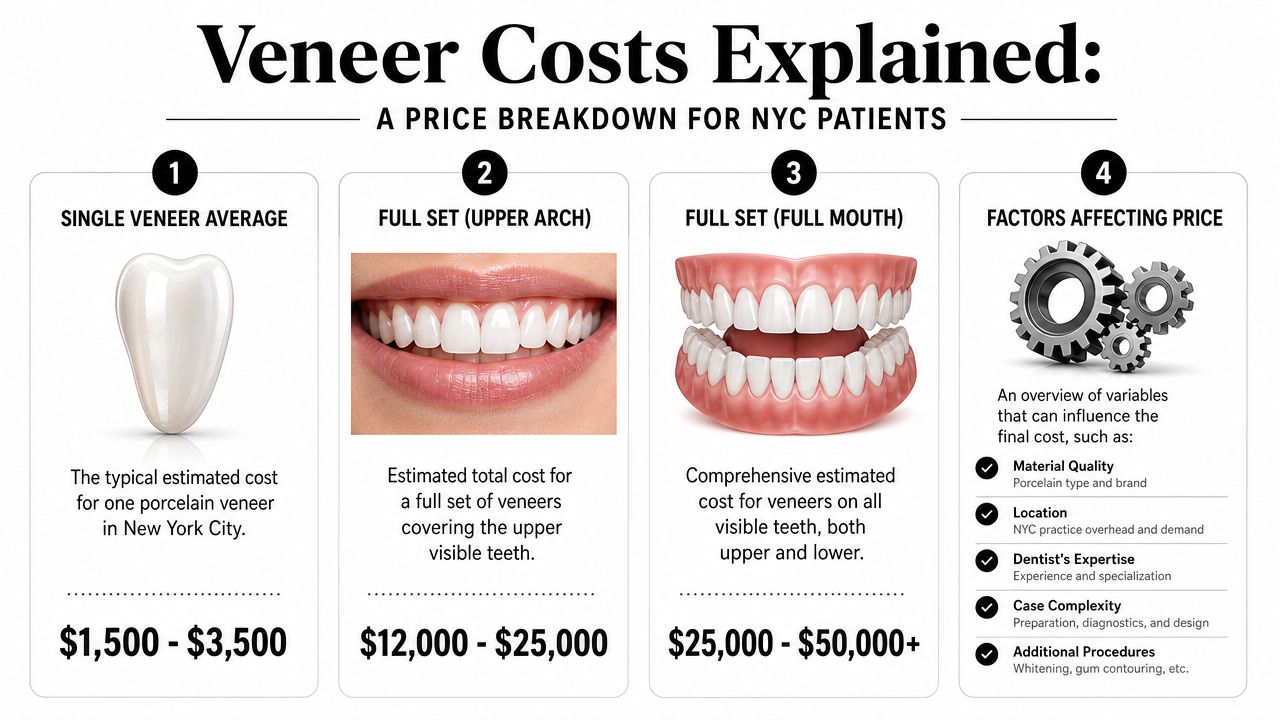
A patient may come in asking for “the price per veneer” and leave realizing the underlying question is, “What will it take to get this result done well?” That distinction matters in New York, where a cosmetic case often involves more planning and more judgment than the fee schedule alone suggests.
A useful starting point is the national range discussed earlier. It gives patients a rough frame of reference, but it does not predict the cost of a carefully designed case in Manhattan.
What broad price ranges actually mean
The widest ranges usually reflect one simple truth. Veneers are not priced like identical retail items.
A single veneer placed to repair one damaged front tooth is a different clinical problem from designing six, eight, or ten teeth that need to look balanced together in motion, in photographs, and at conversational distance. In my field, that difference affects the time spent on records, provisional shaping, bite review, shade communication, and laboratory direction. Those steps are part of the treatment, not extras added for appearance.
Patients evaluating costs across different elective treatments sometimes benefit from seeing how pricing is structured in other fields. This full microneedling price breakdown illustrates a similar point. The listed fee is only part of the decision. Provider judgment, treatment design, and the amount of treatment needed all shape the final number.
Why Manhattan fees are often higher
Manhattan pricing reflects more than rent. The stronger explanation is customization.
High-end veneer cases often involve detailed photography, mock-ups, closer shade analysis, and laboratory work aimed at subtle natural features such as translucency, surface texture, and edge form. Those details are easy to overlook in a quote and impossible to ignore in the mouth once the case is finished.
There is also a real clinical trade-off between efficiency and precision. A lower-fee approach may be perfectly reasonable for a small cosmetic repair. It is less reassuring in a case where several front teeth must match each other, support the bite comfortably, and avoid an overbuilt or artificial look. That is where prosthodontic planning changes the value equation.
For budgeting, patients should ask for a written estimate that separates veneer treatment from any related care, such as records, temporaries, replacement of failing restorations, or a night guard after treatment. Reviewing financial and insurance information at Prosth & Co. before the consultation can make that discussion clearer and more practical.
A short overview can also help patients get oriented before an appointment:
A veneer estimate should make sense tooth by tooth, not just as a lump sum. If a plan cannot be explained clearly, it is hard to judge its value.
Porcelain vs Composite Veneers How Material Affects Your Cost
A patient may come in expecting the lower-priced material to be the better value, then realize the decision is really about goals. If the aim is a small repair on one tooth, composite can be a sensible place to start. If the aim is a durable smile makeover across several front teeth, porcelain often earns its higher fee.
Material changes both the lab bill and the clinical strategy. It affects how the veneer reflects light, how well it holds its polish, how it responds to wear, and how likely it is to need maintenance earlier than expected. From a prosthodontic perspective, that is a key cost discussion.
How the two materials differ in real practice
Porcelain usually carries a higher upfront price because it is fabricated indirectly, then bonded with careful control of fit, contour, and color. In the smile zone, that extra precision matters. Small differences in translucency, surface texture, and edge shape are easy to miss on a quote and very easy to see in person.
Composite has a lower entry cost and can be completed more conservatively in the right case. It is often a reasonable choice for a chipped edge, a minor space, or a modest shape change where the patient wants improvement without committing to a more extensive porcelain plan.
The trade-off is maintenance. Composite is more likely to pick up stain, lose surface luster, or need repair over time. Porcelain is usually more stable esthetically, but repairs are less simple and replacement costs can be higher if a veneer fails.
That is why I do not frame this as a simple price comparison. I look at bite force, wear patterns, the number of teeth involved, and how exact the color match needs to be.
Veneer Material Comparison
| Feature | Porcelain Veneers | Composite Resin Veneers |
|---|---|---|
| Typical cost | Higher upfront fee | Lower upfront fee in many cases |
| Appearance | Strong translucency and polish, often preferred for highly visible smile zones | Can look attractive in the right case, but surface texture and polish are usually more limited |
| Stain resistance | Better long-term color stability | More prone to staining over time |
| Repairability | More difficult to patch naturally | Easier to repair directly in the office |
| Best fit | Patients prioritizing long-term esthetics and durability | Patients prioritizing lower initial cost or limited cosmetic correction |
Porcelain often makes more sense when several front teeth need to match, when the patient shows a lot of tooth in the smile, or when expectations are high for color stability over many years. Composite can still be the right answer for selective treatment, especially if the case is conservative by design and the patient understands the likely upkeep.
Patients exploring this option can review porcelain veneer treatment at Prosth & Co..
Material choice should fit the case, not just the budget. The better value is the option that matches the patient's esthetic goals, bite demands, and willingness to maintain the result.
Beyond Material 5 Factors That Influence Your Final Veneer Price
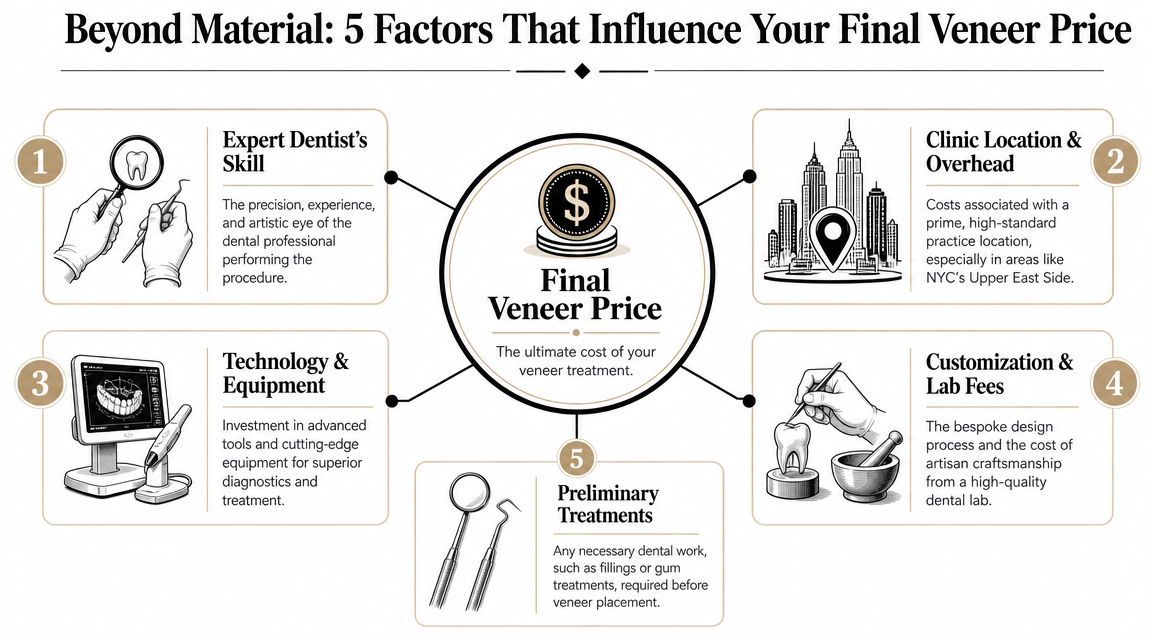
Even after material is chosen, two veneer plans can still land far apart in cost. That difference usually comes from the quality of planning and execution.
The provider and the planning
The provider's training affects every stage of treatment. Veneers look simple from the outside, but they demand judgment about proportions, bite pathways, gum symmetry, and how much natural tooth structure should be preserved. A patient who also needs restorative dentistry, a bite adjustment, or protection from bruxism benefits from that wider lens.
Planning tools matter too. Many cosmetic cases involve detailed photography, close evaluation of the existing bite, and mockups that help the patient preview shape and length before final work begins. Those steps take time, but they reduce surprises.
Three planning elements often shape the final quote:
- Diagnostic detail helps determine whether veneers alone are appropriate, or whether a patient also needs care such as fillings, gum treatment, or a night guard.
- Smile design work refines length, width, embrasures, and symmetry so the final result doesn't look bulky or artificial.
- Functional review checks whether the patient's bite will overload the veneers after placement.
The lab, the case, and the details patients don't always see
The laboratory is another major factor. Veneers aren't mass-produced. A higher-end case usually includes more customization in shade layering, contour, and surface texture. When the smile is fully visible, those details can be the difference between “nice teeth” and “natural teeth.”
Case complexity also changes price. A single chipped incisor can require intense color matching. A broader smile makeover may require coordination across several teeth so the smile looks balanced from the center outward. Sometimes minor adjunctive procedures are needed first, such as whitening before shade selection or treating a structurally compromised tooth before cosmetic work begins.
Patients can ask these five direct questions in consultation:
- Who is designing the case and how is the final shape decided?
- What kind of lab work is involved and how customized is the result?
- How many teeth need treatment for the patient's goal?
- What diagnostics are included before final approval?
- Are any preliminary treatments recommended before veneer placement?
A clear answer to those questions usually reveals why one estimate is higher, and whether that higher fee reflects better planning or a different pricing model.
The Total Cost of Ownership Veneer Maintenance and Lifecycle Costs
A veneer quote is the opening cost, not the lifetime cost. That matters because the less expensive option may require more maintenance, more polishing, or earlier replacement.
Upfront cost is only one part of the decision
GoodRx notes that composite veneers typically last about 5 years, while porcelain often lasts 10 to 20 years (GoodRx veneer cost overview). That difference changes the value conversation immediately. A lower initial fee can still become the more expensive path if the restoration needs to be redone sooner.
For many patients, the smarter comparison is cost per year of service rather than cost per tooth. A prosthodontic mindset naturally looks at the restoration over its usable life, not just on the day it's bonded.
Lower entry cost doesn't always mean lower total spending. In cosmetic dentistry, earlier replacement often rewrites the original bargain.
What usually protects the investment
Long-term veneer success is tied to maintenance habits and routine dental care. Regular cleaning and exams help monitor margins, polish surfaces, and catch small issues before they turn into repairs. Patients who grind or clench may also need a night guard to reduce fracture risk.
The daily checklist is simple:
- Gentle home care with non-abrasive hygiene habits helps preserve polish and gum health.
- Routine follow-up gives the dental team a chance to monitor wear, bonding integrity, and bite changes.
- Bite protection matters for patients with bruxism or heavy function.
- Realistic expectations help patients choose a material that matches how they eat, drink, and use their teeth.
Veneers aren't permanent in the sense of never needing future attention. But when they're selected carefully and maintained well, they can remain a predictable part of long-term smile planning rather than an ongoing surprise expense.
Your Veneer Journey on the Upper East Side What to Expect at Prosth Co
The consultation process should feel calm, methodical, and easy to understand. For many adults in Manhattan, especially those balancing work and family schedules, that clarity matters as much as the clinical treatment itself.

The first visit is a planning visit
An Upper East Side veneer consultation typically begins with a conversation about what the patient wants to change. Some people want brighter teeth. Others want to correct chips, spacing, uneven edges, or a smile that looks worn down from grinding.
From there, the clinical review looks at oral health, existing dental work, tooth position, and bite function. That's where cosmetic dentistry and restorative dentistry start to overlap. If a tooth is cracked, heavily filled, or structurally weak, the conversation may broaden beyond veneers alone.
Patients searching for a dentist in New York, NY often feel relieved when the process is broken down into plain language. Clear photos, simple explanations, and a visible plan help remove the fear that cosmetic treatment is guesswork.
What patients usually leave with
A good consultation ends with a clearer decision, even if treatment doesn't start right away. The patient should understand whether veneers are appropriate, how many teeth are involved, what kind of material makes sense, and whether any preparatory care is needed first.
That preparation may include preventive work such as cleaning and exams, updating dental x-rays, or stabilizing other concerns before cosmetic treatment begins. In some cases, related services like crowns, dental implants, or even tooth extraction are more appropriate than veneers for a specific tooth.
The result should feel personalized, not rushed. For busy New Yorkers, that kind of structure often turns a vague cosmetic interest into a practical treatment plan.
Your Veneer Questions Answered by a Prosthodontist
A patient often arrives at this point with a practical question, not a cosmetic one. If veneers cost this much, how do you know they are the right investment for your teeth and not just an expensive upgrade.
How can veneers be financed
Because veneers are usually elective, payment planning matters. Many patients choose to complete treatment in phases or use monthly financing if the practice offers it.
Ask for a written estimate that separates veneer fees from any related care, such as records, whitening, replacement of old fillings, bite protection, or gum treatment. That level of detail makes the decision clearer and helps you see what is optional, what is preparatory, and what protects the long-term result.
Do veneers ruin natural teeth
Conservative veneers do not automatically damage healthy teeth. The primary issue is case selection and preparation design.
If the teeth are well positioned and the cosmetic change is modest, preparation can be very limited. If the teeth are severely rotated, heavily restored, fractured, or worn down, the treatment may require more than veneers or may point to a different restoration entirely. In my field, problems usually come from removing too much tooth structure, forcing veneers onto a poor candidate, or ignoring bite forces that will shorten the life of the work.
Are veneers always the best value
No. Veneers can be a very good use of money in the right case, but they are not the default answer for every front-tooth problem.
The question is whether veneers make sense for the condition of the teeth and the outcome the patient wants. For a healthy tooth that needs shape, color, or minor position improvement, a porcelain veneer can preserve more natural structure than a full-coverage crown. For a tooth with major cracks, large old fillings, or significant wear from grinding, another restorative option may provide better protection and a more predictable long-term result.
That is the cost-versus-value decision patients deserve to understand. Lower treatment fees can look appealing at first, but the better value often comes from careful planning, strong materials, precise lab work, and a design that fits the bite from the start.
The most ethical veneer recommendation is sometimes no veneer recommendation at all.
How does someone know when to schedule a consultation
Schedule a consultation when online price ranges stop being useful.
That usually happens when the concern is visible in the smile zone, such as chipped edges, uneven teeth, old bonding, discoloration that will not respond to whitening, or front teeth that are getting shorter from wear. A consultation is also the right step when you are unsure whether you need cosmetic treatment, restorative treatment, or a combination of both.
Patients who want a clearer answer on how much veneers cost, and whether veneers are the right investment for their smile, can schedule a consultation with Prosth & Co.. The practice serves the Upper East Side with prosthodontic, cosmetic, restorative, preventive, and implant care, and the consultation process is built to give patients a practical treatment plan they can understand before making any commitment.

Founder and lead prosthodontist of Prosth & Co. on Manhattan's Upper East Side. DDS, Columbia University; Prosthodontics certificate and MMSc in Oral Biology, Harvard School of Dental Medicine; Implantology fellowship, Columbia University.
Meet Victoria →