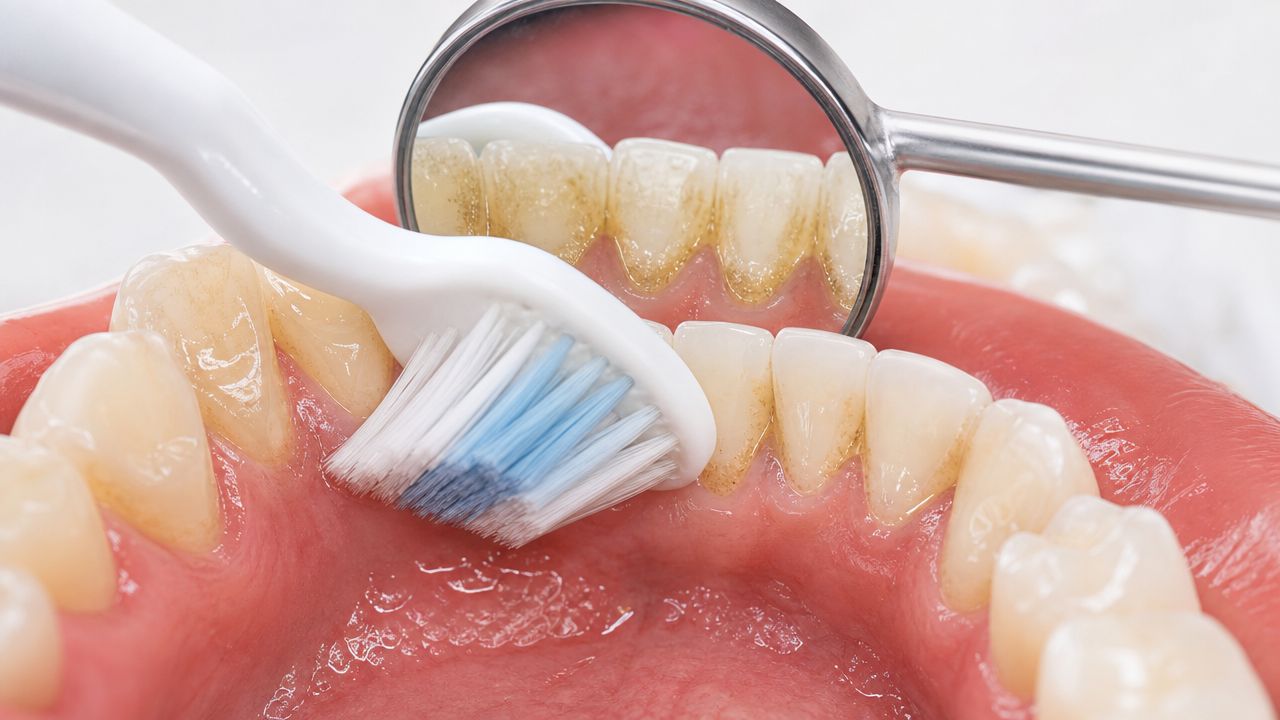
A lot of adults notice the same thing at the sink or in the mirror. The bottom front teeth keep collecting a stubborn film or rough buildup, even when brushing is part of the daily routine. It can feel confusing, and sometimes a little discouraging, especially when the rest of the mouth seems easier to keep clean.
That frustration is common among patients looking for a dentist near me in Manhattan, especially on the Upper East Side. The concern usually isn't only appearance. Patients want to know why plaque on bottom teeth keeps coming back, whether it means something is wrong, and what works without damaging the teeth or gums.
For adults in New York City, this is one of those dental issues that seems simple at first but has a very specific explanation. The lower front teeth sit in a part of the mouth where plaque tends to harden faster, and once that happens, home care reaches its limit. The good news is that there are clear steps that help, and there are professional solutions when brushing and flossing aren't enough.
Table of Contents
- Worried About Plaque on Your Lower Teeth You Are Not Alone
- The Science of Plaque and Why It Targets Lower Teeth
- Health Risks of Untreated Plaque and Tartar
- Your Home Care Guide for Managing Plaque on Lower Teeth
- When to See Your Upper East Side Dentist for Tartar Removal
- Your Professional Cleaning and Exam at Prosth & Co
- Schedule Your Dental Cleaning in Manhattan Today
Worried About Plaque on Your Lower Teeth You Are Not Alone
Patients often describe the same pattern. They brush, they rinse, they try to angle the toothbrush better, and yet the backs of the lower front teeth still feel coated or rough. By the end of the day, that area can seem like it collects buildup faster than anywhere else.
That doesn't automatically mean someone is neglecting oral hygiene. Independent dental guidance notes that tartar commonly shows up on the back surfaces of the lower front teeth because of nearby salivary glands, and once plaque hardens, home brushing can't remove it. That makes this a recurrent site-specific issue rather than a simple hygiene failure, as noted in this discussion of tartar on teeth.
Why this concern feels so persistent
The lower front teeth are small, close together, and easy to miss on the tongue side. Even patients who are otherwise careful can leave behind soft plaque there. When that spot repeatedly feels rough, many people assume they need to brush harder.
Usually, that isn't the right answer.
Practical rule: If an area keeps building up despite regular brushing, the issue is often access and mineralization, not lack of effort.
For Upper East Side patients searching for a dentist in New York, NY, this is one of the most useful distinctions to understand. Soft plaque can be managed at home. Hardened tartar requires professional removal.
What patients usually notice first
The first signs are often subtle:
- A fuzzy film by evening that returns soon after brushing
- A rough patch behind the bottom front teeth that the tongue keeps finding
- Yellow or tan buildup near the gumline that doesn't brush away
- Gums that look irritated around the lower incisors
Those signs matter because plaque on bottom teeth tends to be one of the most visible examples of how anatomy shapes dental problems. The issue isn't random. There is a reason those teeth are a hotspot, and understanding that reason makes prevention much easier.
The Science of Plaque and Why It Targets Lower Teeth
Many patients tell me the same thing. They brush every day, then still feel a rough patch behind the bottom front teeth by the end of the week.
That pattern usually comes down to anatomy more than effort.
Plaque is a normal biofilm that forms on teeth throughout the day. It starts as a soft layer made of bacteria, saliva, and food debris. If you remove it thoroughly, it stays manageable. If it sits in place, minerals in saliva can harden it into tartar, and that changes what home care can accomplish.
Why lower front teeth are a plaque hotspot
The tongue-side surfaces of the lower front teeth sit very close to the openings of the submandibular and sublingual salivary ducts. Those ducts constantly release saliva into the floor of the mouth. Saliva protects oral tissues and helps digestion, but in this location it also supplies the minerals that can calcify plaque.
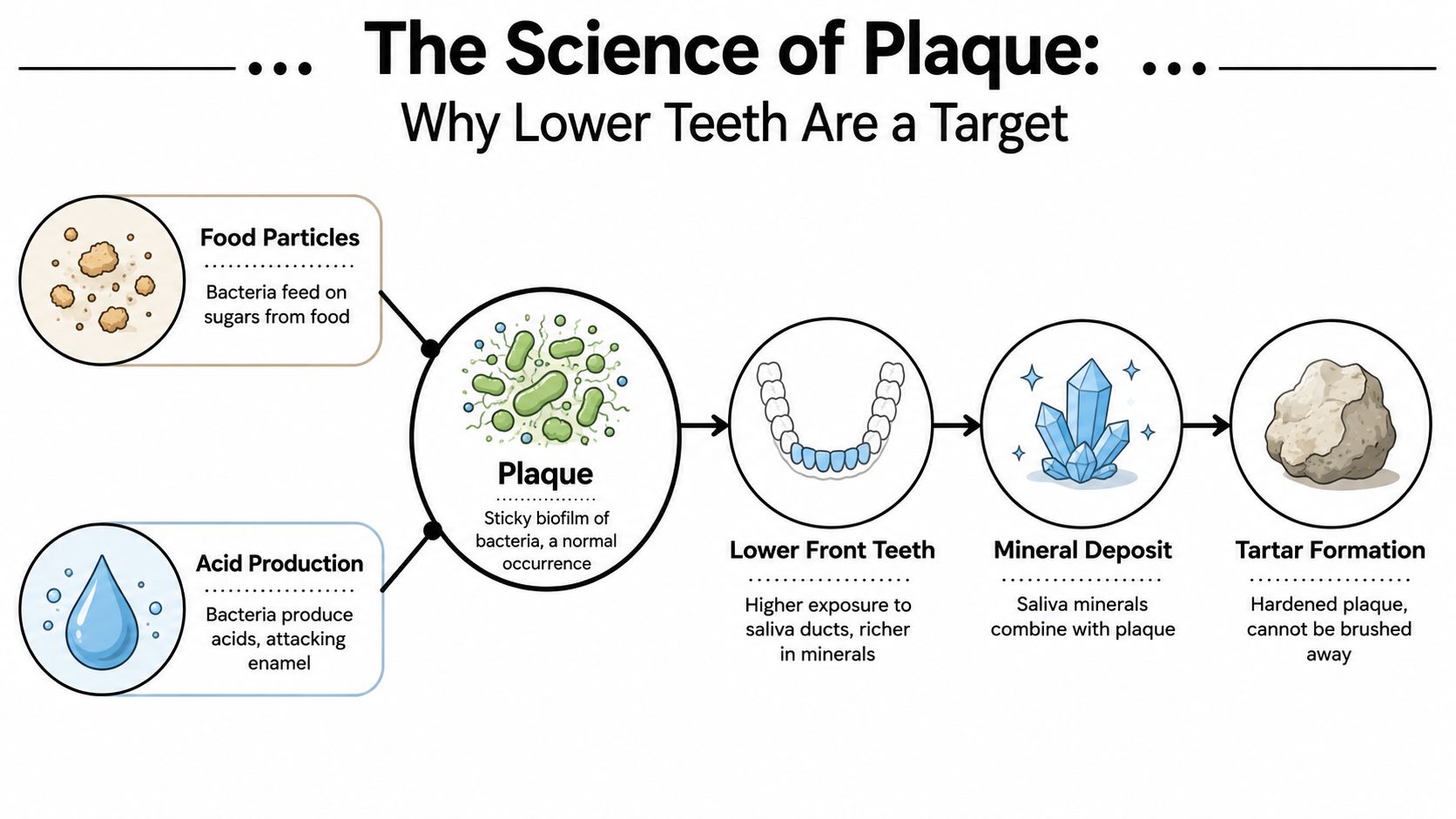
In practice, that means the lower incisors face two problems at once. They collect plaque in a narrow, hard-to-see area, and they sit in one of the most mineral-rich zones in the mouth. That is why buildup there can seem unfairly persistent, even in patients who brush regularly.
A faucet-and-mineral-scale comparison fits well here. A surface that stays wet tends to collect deposits faster. The same principle applies behind the bottom teeth.
Soft plaque and hardened tartar are different problems
This distinction matters because the solution changes once plaque hardens. Soft plaque can usually be disrupted at home with good brushing along the gumline and careful flossing. Tartar is different. Once that deposit mineralizes and bonds to the tooth, brushing will not lift it off.
| Surface buildup | What it feels like | What usually works |
|---|---|---|
| Soft plaque | Film or fuzziness | Careful brushing and flossing |
| Hardened tartar | Rough, crusty, fixed deposit | Professional instrumentation |
Patients often assume they need to brush harder when they feel that rough ledge behind the lower front teeth. Usually, they need a more precise approach, or they need the area professionally cleaned because the buildup has already calcified.
Why this area defeats otherwise good hygiene
Lower front teeth are small, close together, and partly blocked by the tongue during brushing. If there is any crowding, plaque gets even more shelter near the gumline and between the teeth. That gives it more time to remain undisturbed.
The more precise question is why this area turns soft plaque into hard tartar so efficiently.
The answer is local anatomy. Salivary duct proximity, tight spacing, and limited visibility all work together. That is why plaque on bottom teeth often feels stubborn, and why regular brushing helps but does not always fully solve the problem once tartar has formed.
Health Risks of Untreated Plaque and Tartar
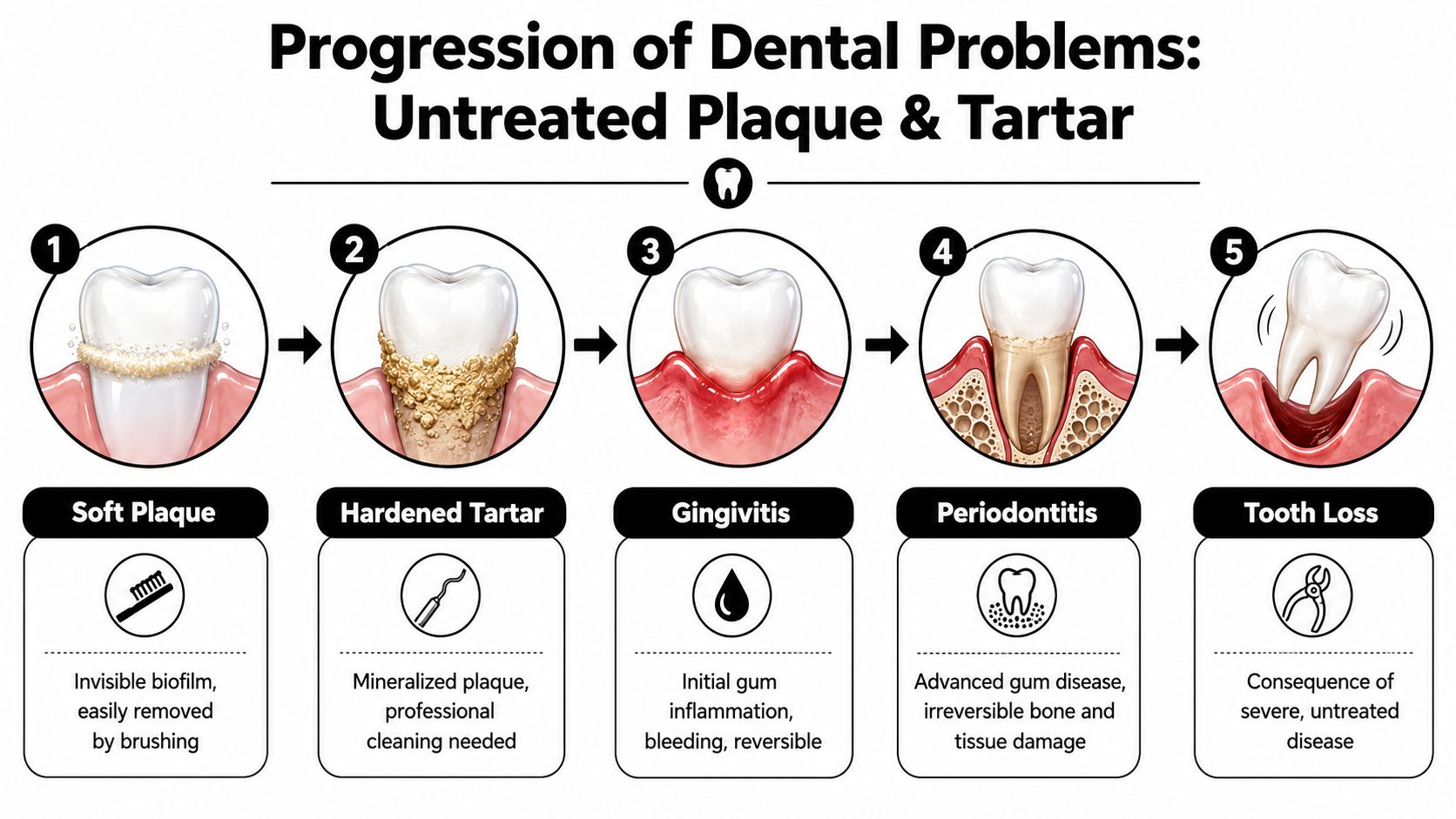
Soft plaque is irritating enough. Hardened tartar changes the problem because it creates a rough surface that holds onto even more plaque and keeps the gumline inflamed.
When this is ignored, the progression is usually predictable. Buildup near the gums leads to inflammation. Inflammation can become gingivitis. If bacterial accumulation continues below the gumline, the condition can advance into periodontitis, which affects the supporting tissues around the teeth.
What starts as buildup can become gum disease
Many patients think of lower front tartar as mainly cosmetic because it's easy to see and feel. Clinically, that view is too narrow. Rough deposits at the gumline make it easier for bacteria to stay in place and harder for the gums to calm down.
Common consequences include:
- Bleeding during brushing or flossing because inflamed gum tissue becomes more reactive
- Bad breath that keeps returning because bacteria stay trapped around the deposit
- Gum recession risk when inflammation remains active over time
- Higher cavity risk near the gumline when plaque stays undisturbed
Why repeated lower front buildup deserves attention
A 2020 clinical study found a statistically significant association (p = 0.002) between faster calculus formation and more severe periodontal disease in its study on rapid calculus formation and periodontal risk. That matters because recurring buildup on the lower front teeth may be a marker of increased periodontal risk, not just a cosmetic nuisance.
This doesn't mean every patient with tartar behind the bottom front teeth has advanced disease. It does mean the pattern deserves a proper exam, especially when the area keeps returning soon after a cleaning or when the gums bleed easily.
Recurrent buildup is often a maintenance issue at first. Left alone long enough, it can become a structural one.
For some patients, the right next step is a routine cleaning and exam. For others, care may expand into periodontal therapy, restorative dentistry, or in severe cases removal of teeth that can no longer be predictably supported. Catching the problem early keeps treatment simpler.
Your Home Care Guide for Managing Plaque on Lower Teeth
Home care matters most while the buildup is still soft. The goal isn't aggressive scrubbing. The goal is consistent disruption of plaque before it mineralizes.
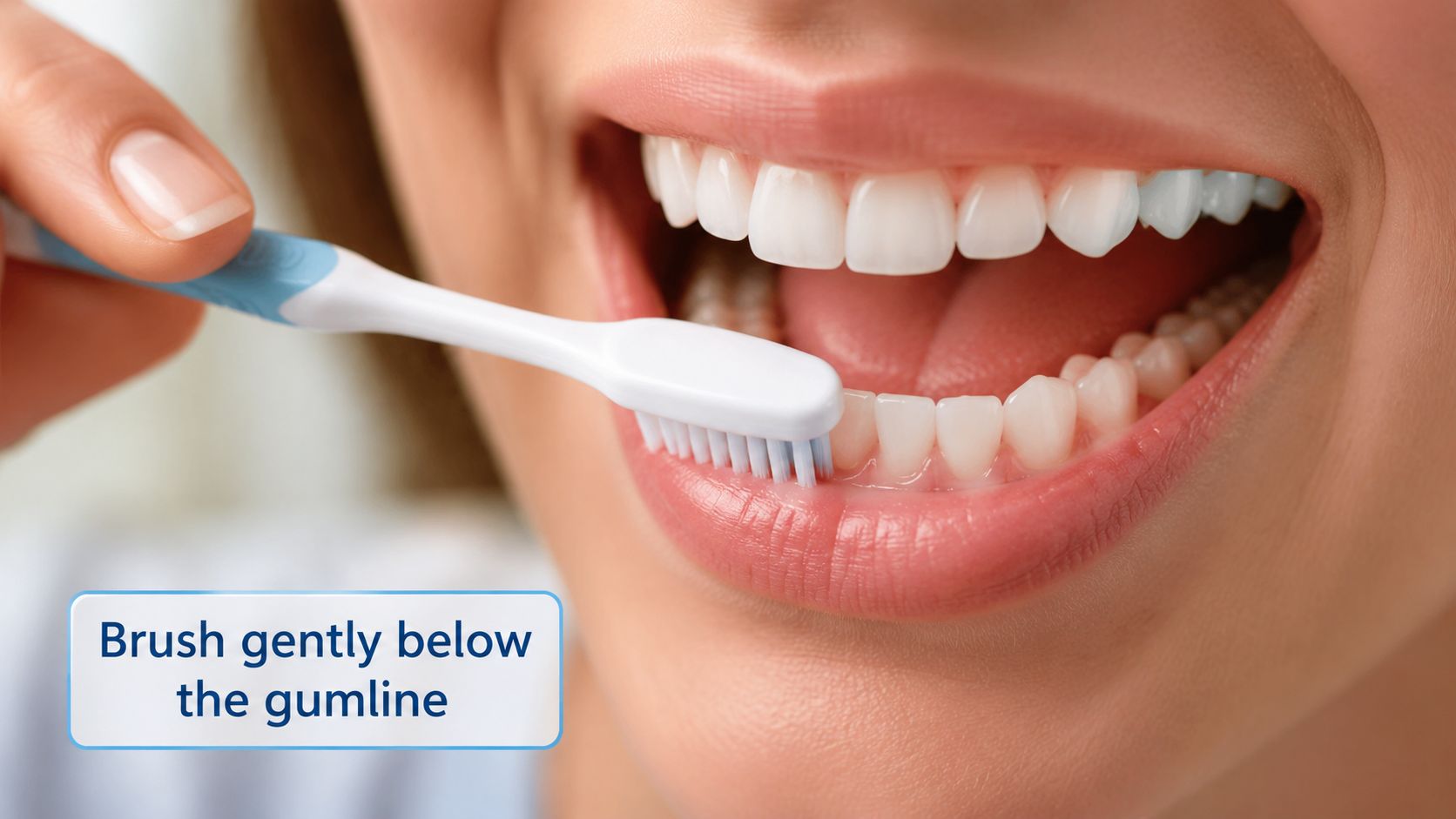
One practical challenge is that brushing alone doesn't cover everything. Guidance on hard plaque notes that brushing may miss about 40% of tooth surfaces, which is especially relevant for crowded lower incisors, in this overview of plaque control and tartar risk.
How to brush the lower front teeth more effectively
The tongue-side surfaces of the lower front teeth need a different angle than the easy-to-see front surfaces.
A useful routine:
Turn the brush vertically for the inside surfaces
This makes it easier to fit the brush head behind the lower front teeth.Aim the bristles toward the gumline
A gentle angle helps the bristles reach where plaque gathers.Use short, controlled strokes
Long side-to-side scrubbing often skips the narrow contours of these teeth.Slow down on the lingual surfaces
Most patients rush this area because it feels awkward.Don't press harder
More pressure doesn't equal better cleaning. It can irritate the gums and wear the brush out faster.
A fluoride toothpaste twice daily remains the standard. If patients are comparing tools, this guide on whether an electric toothbrush cleans better can help clarify where powered brushing may improve consistency.
How to clean the tight spaces brushing misses
Flossing matters more on lower front teeth than many patients realize. The spaces are often narrow, and crowding can make access frustrating, but those interproximal surfaces are where plaque likes to stay hidden.
Helpful options include:
- Traditional floss for tight contacts where a thin material can slide below the gumline
- Floss picks for patients who struggle with finger placement
- Interdental brushes when there is enough space and the embrasures are open
- Water flossers as a support tool, especially for braces or dexterity limitations
A short demonstration often makes technique easier to copy at home:
Home care goal: remove soft plaque daily before it has time to harden on the lower front teeth.
The trade-off is straightforward. Better home technique reduces the amount of buildup that forms. It does not remove tartar that is already bonded to the tooth.
When to See Your Upper East Side Dentist for Tartar Removal
You brush, you floss, and the area behind the lower front teeth still feels gritty by the end of the week. That pattern is frustrating, but it is also very common. Those teeth sit close to the salivary ducts, so mineral-rich saliva keeps bathing the tongue-side surfaces. Soft plaque in that spot can harden faster than patients expect.
Once the buildup feels hard and stuck to the tooth, home care will not lift it off safely. At that stage, the issue is usually tartar, and tartar requires professional instruments and visibility to remove without injuring the enamel or gums.

Signs home care is no longer enough
Schedule an exam if you notice any of the following around the lower front teeth:
- A hard yellow or brown ledge behind the teeth
- A rough area that stays rough after brushing and flossing
- Bleeding when you clean that area
- Bad breath that keeps returning
- Gum puffiness or tenderness near the buildup
- Buildup that seems to come back quickly even with regular brushing
One detail matters here. Soft plaque is manageable at home if it is removed every day. Hardened tartar is different. It bonds tightly to the tooth surface and creates a rough area that holds even more plaque, which is why the cycle often feels endless.
Patients sometimes ask whether they need a routine cleaning or something more involved. That depends on where the deposits sit and how the gums are responding. If buildup extends below the gumline or there are signs of periodontal inflammation, deep cleaning treatment in New York may be the more appropriate next step.
Why scraping at home is a poor trade-off
I understand the temptation. Patients can feel the deposit with their tongue and want it gone immediately. But using fingernails, metal picks, or online scraping tools often scratches the tooth, cuts the gumline, or leaves tartar behind in the areas you cannot see clearly.
A small chip taken off the surface does not solve the problem if the deposit remains attached near the gums. In some cases, home scraping also makes the area more sensitive for no real benefit.
If the buildup does not brush away, leave removal to the office. Keep brushing and flossing to slow new plaque from collecting, then have the area evaluated before the gums get more inflamed.
Your Professional Cleaning and Exam at Prosth & Co
A cleaning visit is often the moment patients realize the problem was more specific than they thought. The area behind the lower front teeth may feel impossible to manage at home, then becomes smooth again once the hardened deposits are professionally removed.
What happens during the visit
At Prosth & Co, the appointment typically starts with a close look at the lower front teeth, gumline, and the pattern of buildup. That matters because plaque on bottom teeth can reflect several different issues. Sometimes it is mostly site-specific tartar formation. Sometimes crowding, gum inflammation, or bite-related wear is part of the picture.
The cleaning itself uses professional instruments designed to remove deposits without the guesswork of home scraping. Those tools are used to access the tight tongue-side surfaces, the areas between the lower incisors, and the gumline where rough buildup tends to cling.
Patients are often shown what is happening with intraoral images or chairside explanations so they can see where plaque and tartar were collecting. That kind of visual feedback helps patients understand why a certain area keeps returning and how home care can be adjusted.
When cleaning leads to a larger treatment plan
A straightforward cleaning is enough for many patients. Others need a broader plan after the exam reveals additional concerns.
Possible next steps may include:
- More frequent preventive cleanings when tartar forms quickly in the same area
- Deep cleaning if buildup has extended below the gumline and the tissues are inflamed
- Restorative dentistry if existing wear, rough margins, or broken dental work are trapping plaque
- Orthodontic evaluation or aligner planning when crowding keeps the lower front teeth hard to clean
- Night guards if grinding is contributing to tooth wear and gum stress
A good cleaning doesn't just remove buildup. It also shows why the buildup formed where it did.
That matters in a multi-specialty practice because patients don't have to treat lower front plaque as an isolated problem. If the exam points to restorative, preventive, or cosmetic needs, those options can be evaluated in the same setting. For adults in Manhattan looking for a long-term dental home, that kind of continuity is often more useful than a one-time cleaning alone.
Schedule Your Dental Cleaning in Manhattan Today
You brush, you floss, and the back of the lower front teeth still feels rough. That pattern is common because those teeth sit close to the salivary ducts, where plaque tends to collect and harden faster than people expect.
If the buildup is still soft, home care can remove it. If it has turned into tartar, brushing will not lift it off the tooth surface. A cleaning is the practical next step, especially if you have gum irritation, bleeding when you floss, or a persistent gritty feeling behind the bottom teeth.
At Prosth & Co, we see this concern often in patients from the Upper East Side and across Manhattan. The visit is straightforward. We examine the lower front teeth closely, remove hardened buildup, check the gums, and determine whether the issue is limited to a routine cleaning or points to something more involved, such as deeper buildup below the gumline or plaque traps caused by crowding, wear, or older dental work.
The office is located at 47 E 77th St, Suite 207, New York, NY 10075.
Patients can reach the office by phone at call Prosth & Co at (332) 334-8291.
For patients ready to address stubborn buildup, gum irritation, or a rough feeling behind the lower front teeth, Prosth & Co. offers full dental care on Manhattan's Upper East Side. Scheduling a cleaning and exam is a simple way to find out whether you are dealing with soft plaque that needs better daily control, hardened tartar that needs professional removal, or a pattern that calls for a more specific plan.

Founder and lead prosthodontist of Prosth & Co. on Manhattan's Upper East Side. DDS, Columbia University; Prosthodontics certificate and MMSc in Oral Biology, Harvard School of Dental Medicine; Implantology fellowship, Columbia University.
Meet Victoria →