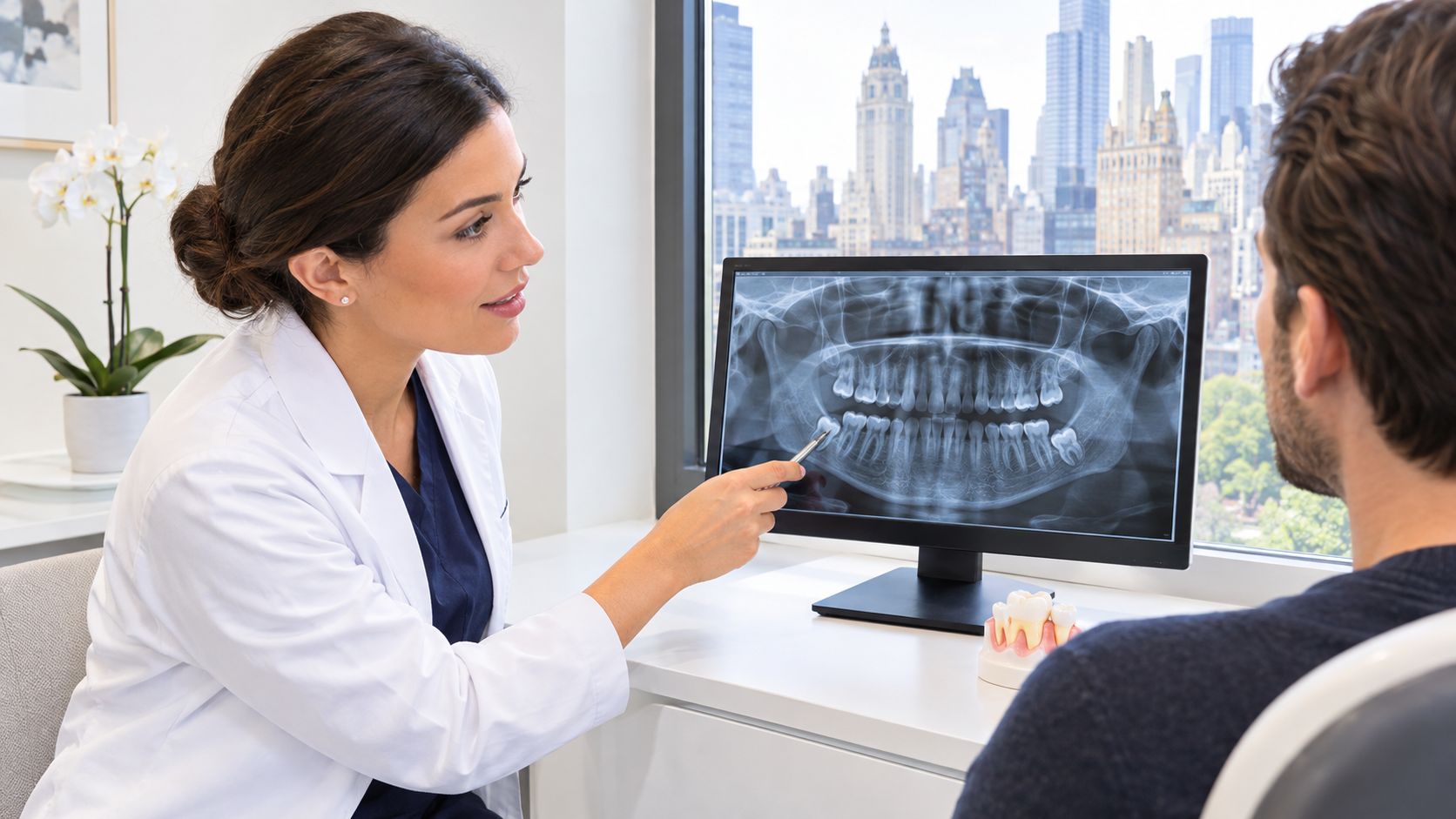
A patient notices pressure behind the last molar while eating, then finds the gum at the back of the mouth tender and difficult to clean. A visit to an emergency dentist on Manhattan's Upper East Side reveals a partially erupted wisdom tooth angled toward its neighbor. The immediate question is whether it should come out. The more useful question is whether its position, symptoms, and effect on nearby teeth make removal safer than monitoring.
At Prosth & Co., prosthodontists, oral surgeons, and restorative dentists can consider that decision alongside the health of the second molar, the bite, and future treatment needs. For those seeking dentists for wisdom teeth removal in Manhattan, the practical issues include when extraction is indicated, which provider and anesthesia may fit, what happens at the appointment, and how to plan for recovery. Wisdom-tooth decisions should be anatomy-driven, individualized, and planned with the rest of the bite in mind, not treated as a universal rite of passage.
Table of Contents
- A Manhattan Patient's First Wisdom Tooth Decision
- What Wisdom Teeth Are and How They Behave
- When Removal Is the Right Call and When It Is Not
- Who Performs the Procedure and How You Stay Comfortable
- What Happens at Your Appointment
- How Removal Fits Into the Rest of Your Mouth
- Recovery Day by Day and When to Call the Office
- Schedule Your Wisdom Tooth Consultation on the Upper East Side
A Manhattan Patient's First Wisdom Tooth Decision
Pressure behind a back tooth can make even ordinary chewing uncomfortable. When a partially erupted wisdom tooth traps food or irritates the gum, a patient may search for a dentist near me or an emergency dentist in Manhattan, hoping to know whether the tooth needs to come out right away.
The answer depends on what an exam shows. A dentist checks whether the tooth has erupted, how it's angled, whether the surrounding gum is inflamed, and whether decay or damage affects the wisdom tooth or the second molar in front of it. Pain matters, but it isn't the only deciding factor. A tooth can be problematic without causing constant pain, while a symptom-free tooth may be suitable for monitoring if it's healthy and can be kept clean.
For patients considering dentists' wisdom-teeth removal recommendations, a useful first step is understanding the trade-off: extraction addresses present disease or a meaningful risk of harm, but surgery also carries recovery demands and possible complications. A decision to monitor isn't neglect if the tooth can be examined, assessed on imaging when appropriate, and followed over time.
The question behind the recommendation
Wisdom teeth, also called third molars, don't automatically require removal. A claims analysis of privately insured U.S. patients estimated that about 50% had undergone at least one wisdom-tooth extraction by age 25, rising to about 70% by age 60. The same analysis found that only a portion of all recorded extractions were specifically identified as third molars, and its results shouldn't be treated as a universal estimate for every population. The claims analysis and its limits
Those figures show that wisdom-tooth extraction is common, not that it's necessary for everyone. The decision should turn on clinical findings and the practicality of ongoing monitoring. The rest of this guide looks at how tooth position, symptoms, surgical complexity, and longer-term restorative plans shape that choice for Manhattan patients.
What Wisdom Teeth Are and How They Behave
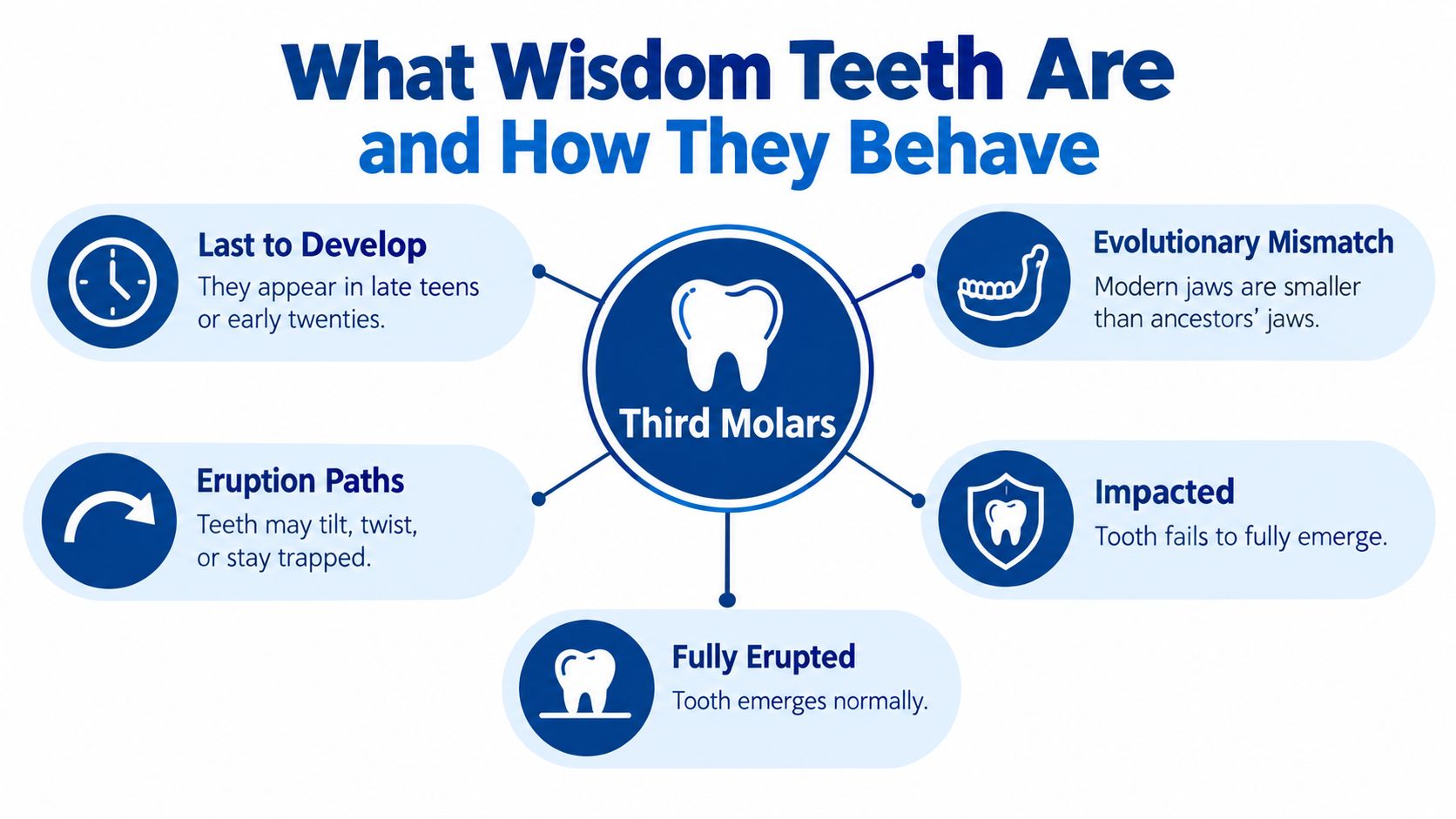
Wisdom teeth are the third molars, the last teeth to develop at the back of the mouth. They often emerge in late adolescence or early adulthood, but the timing of eruption doesn't decide on its own whether removal is needed. What matters is whether there's room for the tooth to emerge in a useful position and whether the patient can clean and monitor it.
A tooth is fully erupted when it has come through the gum into the mouth. An impacted tooth hasn't emerged fully, often because it's blocked by gum, bone, another tooth, or its own angle. A partially erupted tooth may leave a flap of gum around it where food and bacteria can collect.
How position changes the risk
Impactions have different orientations. A mesioangular tooth tilts forward toward the second molar; a distoangular tooth tilts toward the back of the mouth. A vertical tooth points upward but may still lack space, while a horizontal tooth lies on its side. Dentists also describe impactions by how much of the tooth is covered: soft-tissue impaction means gum covers it, partial-bony impaction means some bone covers it, and full-bony impaction means it remains within the jawbone.
A crowded subway car is a useful Manhattan comparison. A wisdom tooth trying to board a packed 6 train may be blocked, pushed sideways, or left only partly through the door. In the mouth, that crowding can make a tooth harder to clean and can press its crown against the second molar.
Practical rule: Position is more informative than a birthday. Angulation affects plaque retention and access for cleaning, while root shape and proximity to the inferior alveolar nerve influence the complexity of surgery. Evidence-based guidance on third-molar anatomy and treatment decisions
A dental exam and appropriate imaging help show what's happening beneath the gum. Patients preparing for a trip may also find these hotel dental kit stocking tips useful for keeping everyday oral-care supplies accessible away from home.
When Removal Is the Right Call and When It Is Not
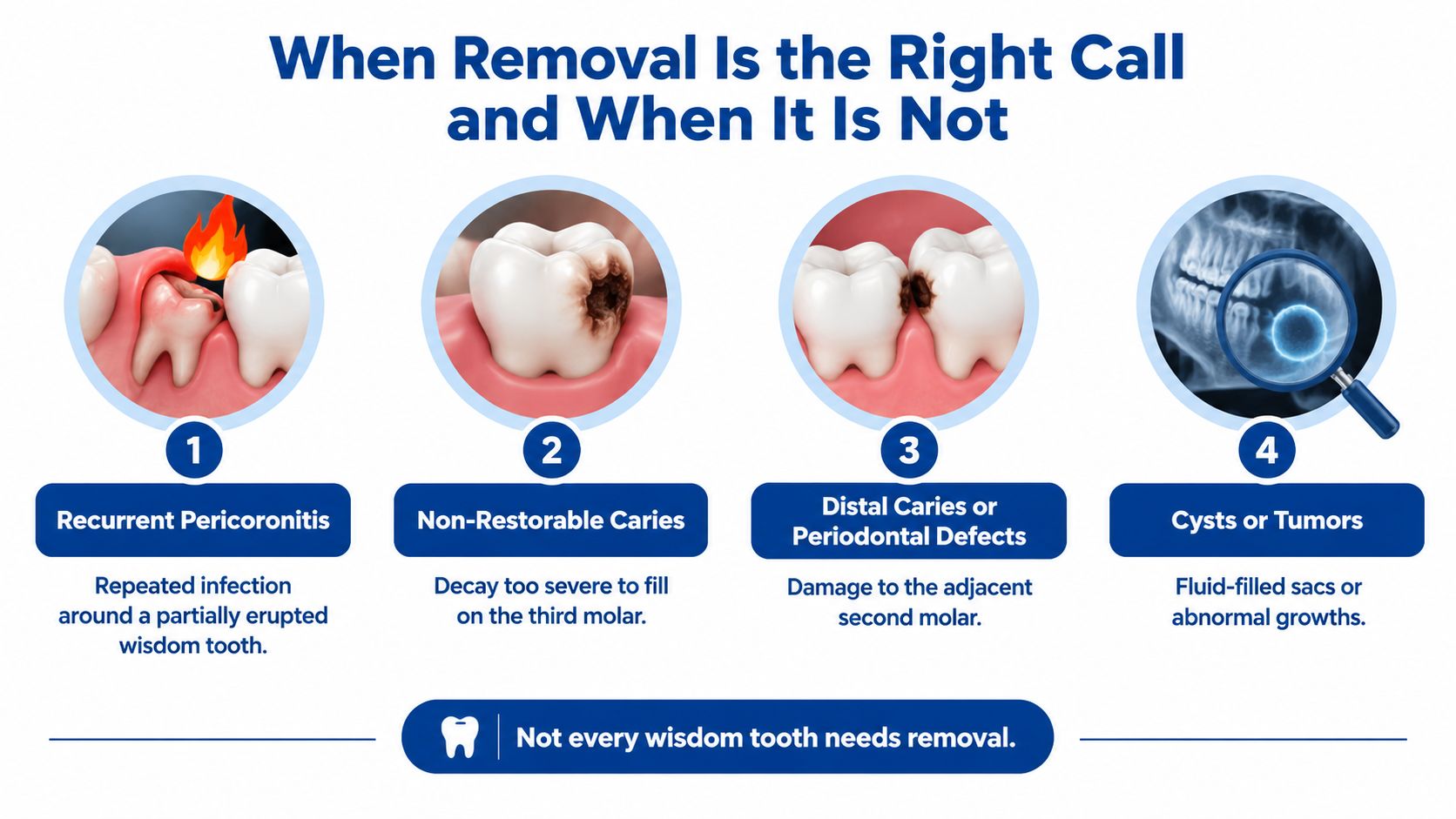
Removal is easier to justify when a wisdom tooth is causing disease or threatening a nearby tooth. The recommendation should be tied to a finding the dentist can explain, not just to the fact that a third molar exists.
Common reasons to discuss extraction include repeated inflammation or infection around a partially erupted tooth, decay that can't be restored, periodontal damage, root resorption, cysts or other pathology, and harm to the adjacent second molar. An unfavorable eruption path can also matter, particularly if the tooth's position makes cleaning difficult or puts the second molar at risk. A tooth that repeatedly traps food and inflames the gum is a different situation from a healthy tooth that can be examined and cleaned.
When monitoring is reasonable
A fully erupted, functional, painless wisdom tooth with healthy surrounding tissue and good cleaning access may not need extraction. For disease-free, symptom-free impacted teeth, evidence doesn't establish that routine preventive removal is necessary in every case. Active surveillance, with clinical review and imaging when indicated, can be a defensible alternative. Mayo Clinic's overview of the disagreement and trade-offs
That doesn't mean a monitored tooth is ignored. The dentist should explain what will be checked and what changes would prompt treatment. A review of historical U.S. practice estimated approximately 10 million wisdom teeth removed each year from about 5 million people, with annual spending exceeding $3 billion. The analysis also described prophylactic removal as controversial when a tooth is healthy and its future benefit is uncertain. Public-health analysis of wisdom-tooth extraction
At a consultation, patients can ask:
- What specific finding supports removal? Ask whether there's infection, decay, periodontal damage, or a concerning position.
- What's the risk to the second molar? Request an explanation of any decay, pocketing, or pressure near that tooth.
- Could the tooth be monitored? Discuss how the team would follow it and what would change the recommendation.
- How complex is surgery likely to be? Ask about root development, tooth depth, and proximity to nerves or the sinus.
Who Performs the Procedure and How You Stay Comfortable
A general dentist may be well suited to remove a fully erupted wisdom tooth with a straightforward root shape and accessible position. A very impacted lower wisdom tooth, complex roots, or close proximity to a nerve can call for an oral surgeon with experience in more involved procedures. The decision depends on examination and imaging, as well as the clinician's training and the patient's health history.
Comfort planning also depends on the case and the patient's anxiety. Local anesthetic numbs the area while the patient remains awake, often making sense for a simple extraction. Nitrous oxide is inhaled and can ease mild anxiety; oral conscious sedation may be considered when a patient needs more relaxation. IV sedation provides deeper relaxation and may limit memory of the procedure. General anesthesia may be used for complex or multi-tooth surgery when clinically appropriate. The provider should explain the safety requirements and preparation for the option being considered.
Anesthesia options for wisdom tooth removal
| Option | Best for | What it feels like |
|---|---|---|
| Local anesthetic | Straightforward extraction or use alongside another method | The area feels numb; the patient remains awake |
| Nitrous oxide | Mild anxiety or added relaxation | The patient breathes a gas that can help them feel calmer |
| Oral conscious sedation | Patients who need more relaxation | Drowsiness and reduced anxiety; effects depend on the medication |
| IV sedation | Deeper relaxation or more involved treatment | A drowsy state, often with limited memory of the procedure |
| General anesthesia | Selected complex or multi-tooth cases | The patient is unconscious during the procedure |
Sedation choices require careful review of medications, health conditions, and transportation plans. Patients receiving sedation should follow the practice's instructions, including any requirement for someone to accompany them home. At a multi-specialty practice, evaluation, imaging, and treatment planning can be coordinated in one location, with referral or shared care considered when the case calls for it.
What Happens at Your Appointment
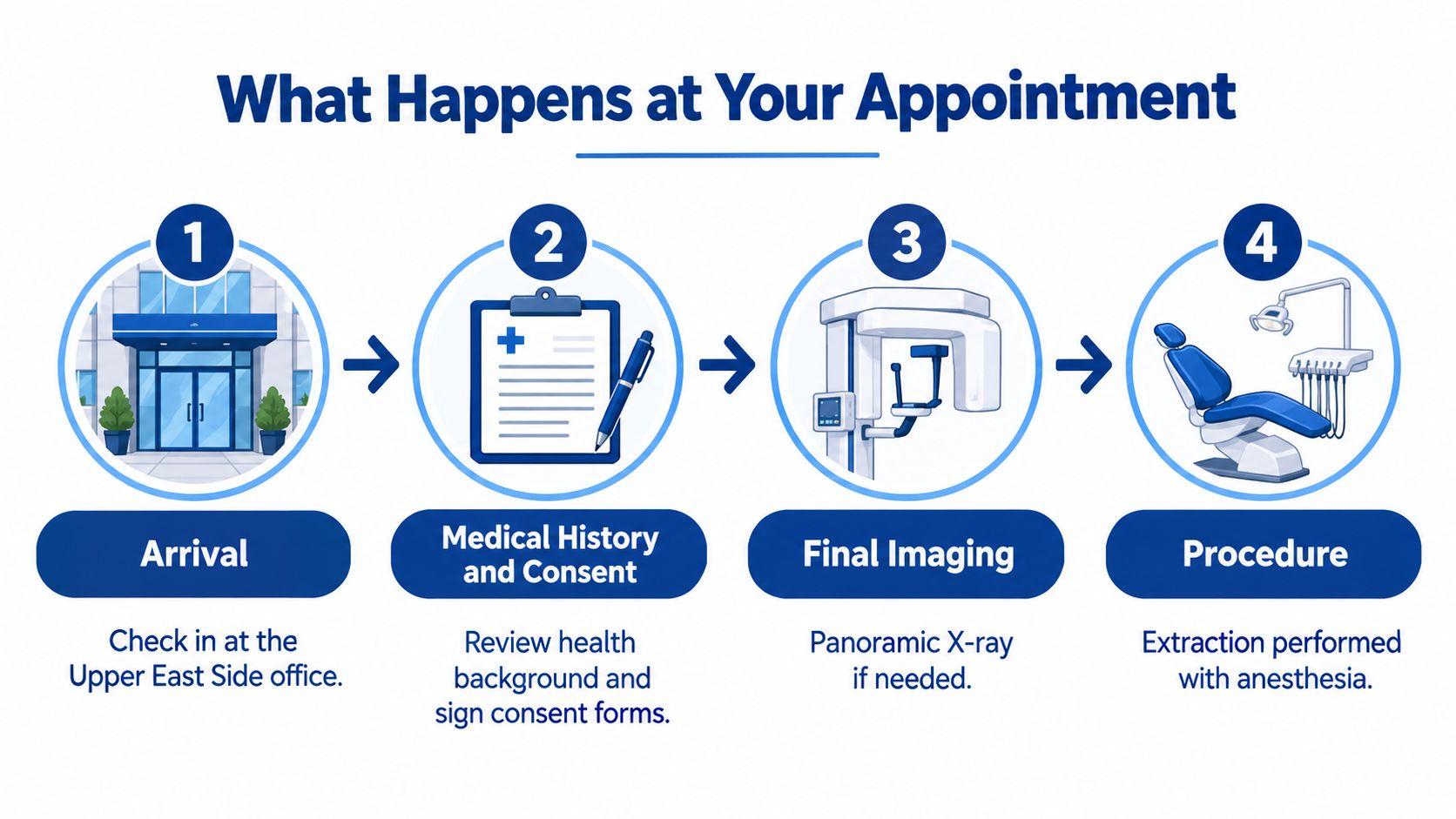
A wisdom-tooth visit begins with a review of symptoms, medical history, medications, and the reason for considering treatment. The clinician examines the gums and teeth, explains the findings, and reviews consent before surgery. If additional images are needed, a panoramic X-ray can show the teeth and jaw; a CBCT scan may help assess a tooth's relationship to a nerve in selected cases.
From numbing to aftercare
Once the agreed anesthesia is in place, the dentist or oral surgeon loosens the tooth and removes it. If it's impacted, the clinician may make an opening in the gum or divide the tooth into smaller pieces rather than force it out intact. This approach can help limit pressure on surrounding structures and protect the second molar.
The clinician then cleans the socket and controls bleeding. Sutures may be placed when needed, and gauze is positioned over the area to support clot formation. The exact steps depend on whether the tooth is erupted or impacted and on its roots and position. The provider should tell the patient what's happening and pause if the patient has concerns.
Procedure time varies with the tooth, number of teeth, and anesthesia plan. Rather than relying on a general estimate, patients should ask how their own surgical plan affects the appointment and recovery arrangements.
After surgery, patients are observed as needed. Sedated patients may need an escort, and the practice provides written postoperative instructions covering eating, oral hygiene, medication use, and symptoms that require a call. Before leaving, patients should know whom to contact if bleeding or pain becomes concerning.
How Removal Fits Into the Rest of Your Mouth
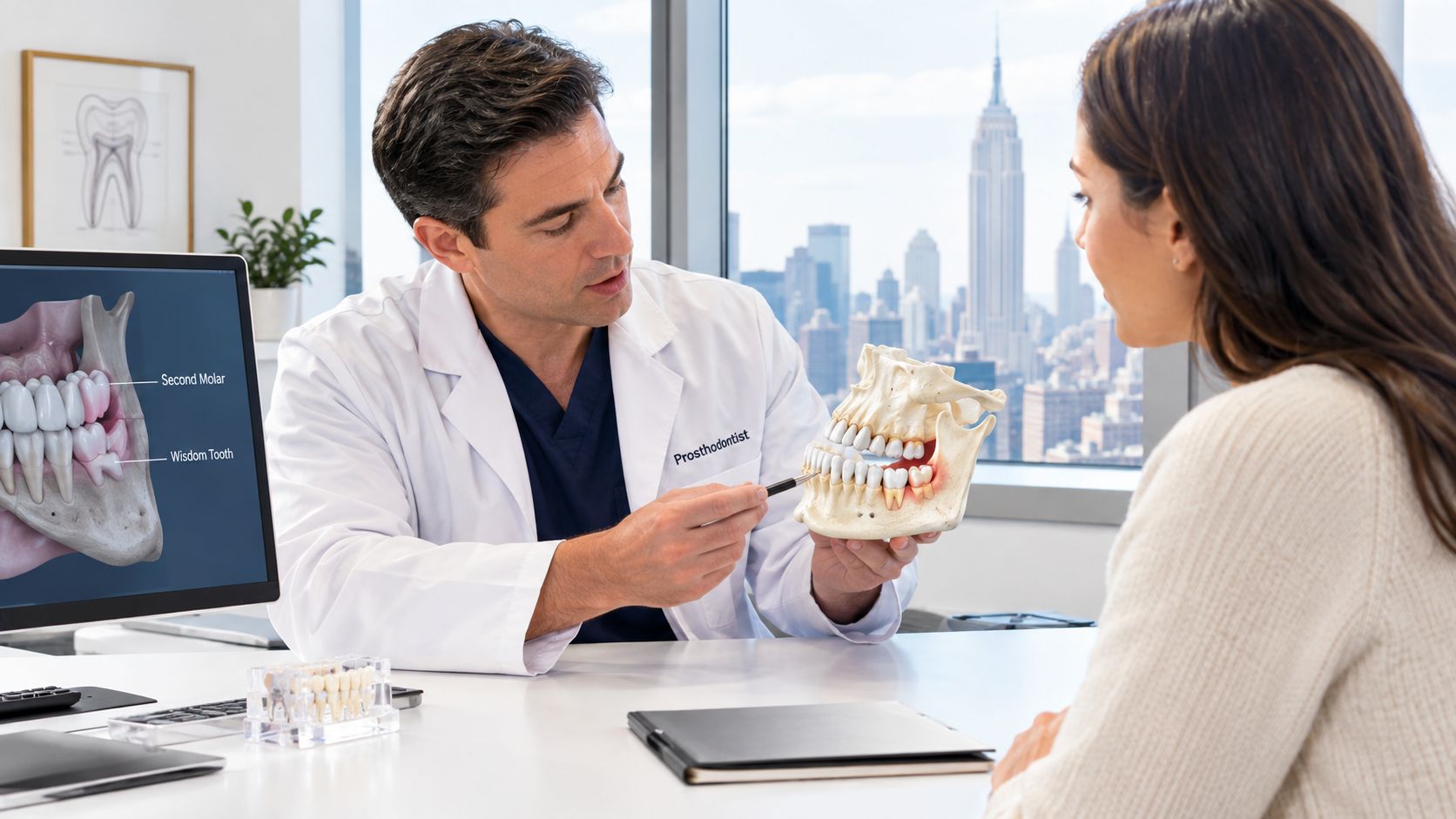
A wisdom tooth doesn't exist in isolation. A prosthodontic perspective considers how a decision affects the second molar, the bite, gum health, and potential future restorative work. If the second molar has decay or periodontal damage, preserving its function may be more important than removing the third molar. If the third molar is healthy and maintainable, removing it without a clear reason may add surgical risk without a certain preventive benefit.
Planning beyond the extraction
Future dental implants, bridges, orthodontic alignment, and restorative treatment can influence how a team approaches the area. For example, a second molar with a poor prognosis may need coordinated planning before an extraction, while a healthy neighboring tooth may benefit from careful protection during surgery. Periodontal evaluation also matters when the gum and bone around the second molar are at risk.
When roots lie very close to the inferior alveolar nerve, a clinician may discuss coronectomy. This technique removes the crown while intentionally leaving roots in place when the tooth is suitable for partial removal. It may reduce nerve-injury risk in selected cases, but retained roots need follow-up and the evidence doesn't support firm recommendations for every surgical situation. Systematic review of mandibular wisdom-tooth surgery and complications
The better question isn't whether wisdom teeth should come out. It's whether removal, partial removal, or monitoring best supports the health, function, and maintainability of the whole mouth. Prosth & Co. is a prosthodontist-led Manhattan practice with oral surgery, restorative, orthodontic, and periodontal services, allowing those considerations to be discussed together.
Recovery Day by Day and When to Call the Office
The first day is for rest, gauze pressure as directed, and soft foods that don't require chewing near the surgical area. Use ice only as instructed by the dental team. Avoid disturbing the socket, and follow the written guidance for rinsing, brushing, and medication. A prescription or over-the-counter medicine may not be suitable for every patient, so medication choices should account for medical history and other drugs.
Swelling and discomfort commonly peak during the first 2–3 days and usually improve over roughly 1–2 weeks. A usual recovery estimate is about 5–7 days, but the tooth's position, the extent of surgery, and individual health affect healing. NHS Inform guidance on wisdom-tooth removal and recovery
Eating, working, and watching for changes
Choose soft foods such as yogurt, smoothies eaten without a straw, scrambled eggs, or soft pasta, and increase texture as comfort allows. Keep food away from the surgical area where possible. Follow the practice's instructions about cleaning around the socket, and don't smoke during recovery because smoking can increase the likelihood of infection and delayed healing.
Mild oozing, bruising, jaw soreness, and limited opening can occur after surgery. Contact the dental team if pain worsens instead of improving, especially with bad breath or a bad taste, which can suggest dry socket. Fever, persistent numbness, or heavy bleeding also warrant prompt guidance. If symptoms are sudden or concerning, use the practice's emergency dental care information.
A review of 14 studies covering 4,990 cases found that mandibular wisdom-tooth extraction temporarily worsened quality of life during the first postoperative days, followed by progressive improvement when patients followed postoperative instructions. Systematic review of quality of life after mandibular wisdom-tooth extraction Patients should plan work and exercise around their symptoms and the clinician's advice, rather than assuming every recovery follows the same timetable.
Schedule Your Wisdom Tooth Consultation on the Upper East Side
A consultation can clarify whether a wisdom tooth needs treatment now, can be monitored, or should be assessed further before a decision. At Prosth & Co., the team can evaluate tooth position, coordinate imaging, discuss anesthesia options, and consider related restorative, orthodontic, or periodontal care. That joined-up view is useful when the second molar or the future bite may affect the plan.
The practice is at 47 E 77th St #207, New York, NY 10075, near the 77th Street 6-train. Weekday hours are 9:00 AM to 6:00 PM, with urgent care availability for sudden pain or swelling. Patients looking for a dentist in Manhattan or a dentist in New York can contact the office to ask about an evaluation and the appropriate next step.
The prosthodontist-led team uses an in-house dental laboratory and emphasizes clear communication about findings, options, and follow-up. The practice also provides restorative, implant, cosmetic, orthodontic, pediatric, endodontic, periodontal, and oral surgery services, so patients can discuss how wisdom-tooth care fits with other dental needs. Schedule a consultation to review the tooth's position, the condition of nearby teeth, and whether removal or monitoring is the safer choice.
Prosth & Co. offers wisdom-tooth evaluations and oral surgery alongside prosthodontic, restorative, and periodontal planning, helping Manhattan patients consider the whole bite as well as the tooth. Visit Prosth & Co. or contact the Upper East Side office to schedule a consultation and discuss your options.

Founder and lead prosthodontist of Prosth & Co. on Manhattan's Upper East Side. DDS, Columbia University; Prosthodontics certificate and MMSc in Oral Biology, Harvard School of Dental Medicine; Implantology fellowship, Columbia University.
Meet Victoria →