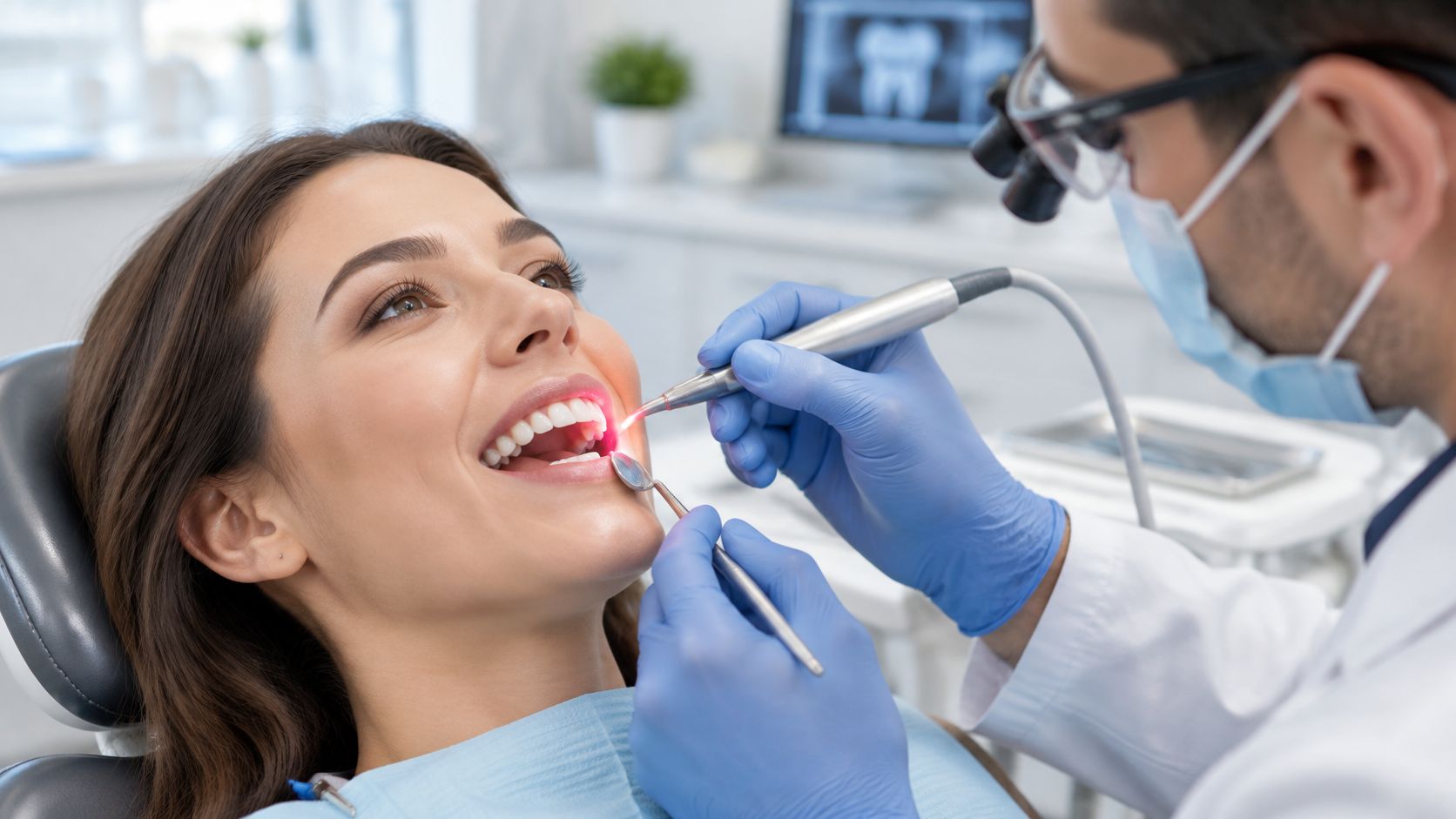
The most popular advice about gum lasers says a laser can replace deep cleaning, remove infection in one step, and spare patients from conventional care. That claim goes further than the evidence supports. Dental laser treatment for gums is better understood as a family of tools that may support mechanical cleaning in selected cases, not as a universal substitute for it. Patients searching for a dentist near me or a dentist in Manhattan deserve a clearer test for any recommendation. The useful questions are measurable. Did pocket depth shrink, did bleeding stop, did attachment improve, and did those gains still hold months later?
Table of Contents
- Why Gum Problems Deserve Attention Early
- What Laser Gum Treatment Is and How It Works
- Laser Therapy Compared With Conventional Gum Care
- When Laser Care Is Worth Discussing
- What Happens at Your Gum Evaluation Visit
- Recovery, Results, and Keeping Gums Healthy
- Booking a Gum Consultation Near Me on the Upper East Side
Why Gum Problems Deserve Attention Early
A patient brushes before work, spits, and notices pink in the sink. The gums don't ache, so the moment passes. Weeks later, flossing still causes bleeding, the gum line looks puffy, and a lingering bad taste keeps returning. That pattern is common because early gum disease often develops without obvious pain, even while changes progress below the surface.
Healthy gums fit closely around teeth and don't bleed during normal brushing. When plaque stays along the gum line, bacteria irritate the tissue and the gum can pull slightly away from the tooth. That small space, called a periodontal pocket, traps more plaque where a toothbrush can't reach. Readers who want to understand soreness after flossing can separate temporary tenderness from bleeding that keeps happening and deserves an exam.
Signs That Should Not Wait
- Bleeding that repeats: Gums bleed during brushing or flossing on most days, not only after a missed week of flossing.
- Visible change: Tissue looks red, swollen, shiny, or lower on a tooth than it did before.
- Persistent odor or taste: Bad breath returns soon after brushing, even with careful home care.
- Sensitivity or looseness: A tooth feels different when biting, or exposed root surfaces react to cold.
None of those signs proves a specific diagnosis. A professional exam measures pocket depth, checks for bleeding and recession, and uses dental x-rays to assess bone around the teeth. That sequence matters because two mouths with similar bleeding can need very different care, from routine cleaning and exams to periodontal therapy coordinated with restorative dentistry.
Bleeding is information, not a verdict. It tells a clinician where to measure, not which technology to buy.
On the Upper East Side, Prosth & Co. evaluates gum health as part of complete dental care for patients seeking a dentist in New York. Early assessment preserves choices. It also prevents a rush toward any single device before the cause, severity, and anatomy of the problem are clear.
What Laser Gum Treatment Is and How It Works
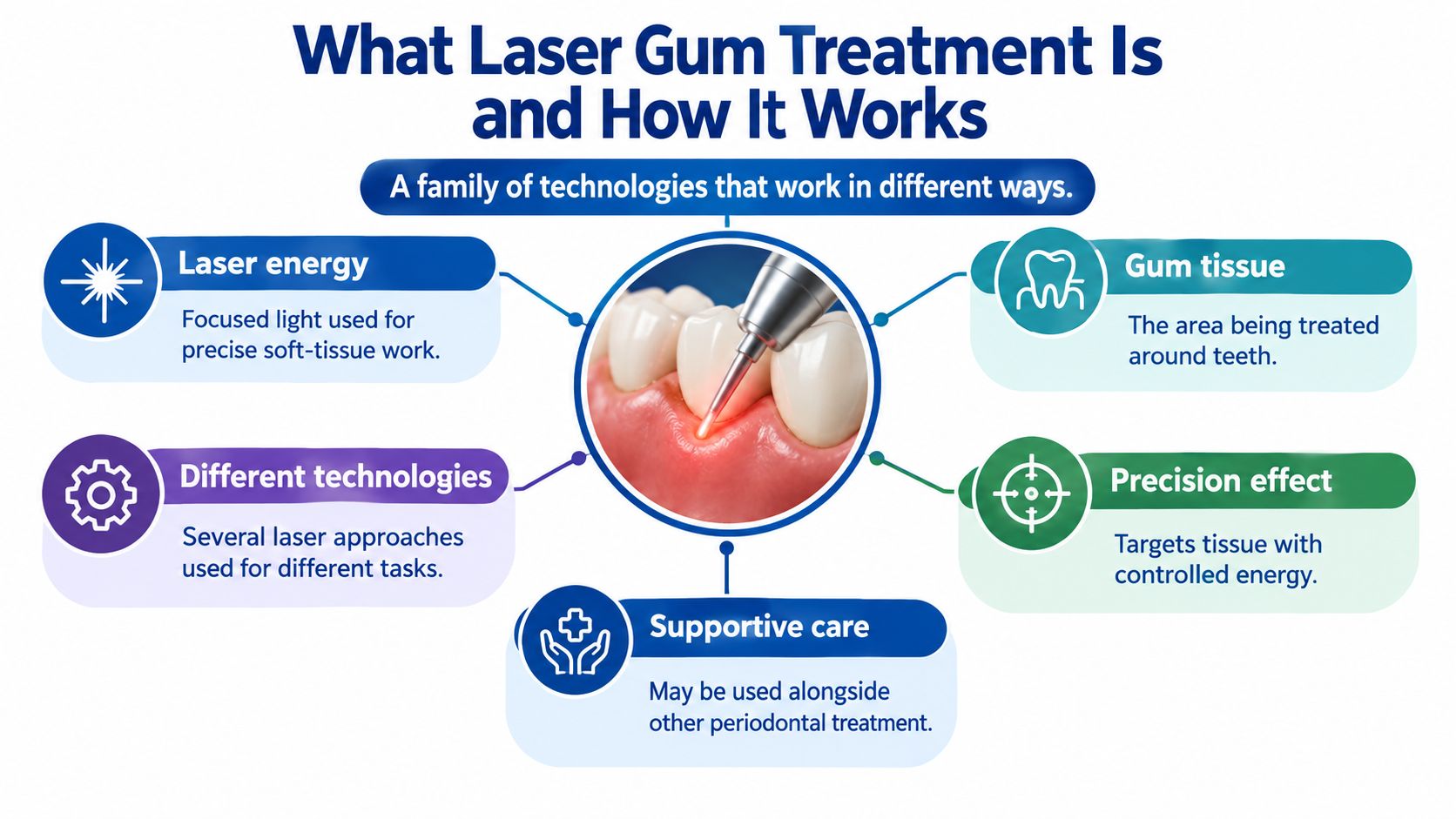
A gum laser is an optional tool used alongside mechanical cleaning, not a substitute for removing plaque and hardened tartar from root surfaces. Depending on the technology and treatment plan, it can target inflamed tissue or support bacterial reduction within a gum pocket. The clinician's aim is measurable healing, such as reduced pocket depth and bleeding, not just using a device.
One Label, Several Technologies
Er:YAG lasers operate at approximately 2,940 nm. Water absorbs this wavelength strongly, allowing the laser to remove, or ablate, hard and soft tissue. Nd:YAG systems commonly operate at 1,064 nm and are used mainly on soft tissue. Their energy can affect inflamed tissue and support decontamination within periodontal pockets. These wavelength and protocol differences are described in a review of laser wavelengths and periodontal protocols.
Diode lasers also act on soft tissue, with effects shaped by the wavelength and settings. Photodynamic therapy is different: a light-activated agent is applied, then illuminated so it can produce a bacteria-killing effect. It is not just another name for diode laser treatment.
Wavelength alone does not predict the result. Energy, pulse duration, cooling, tip design, and pocket shape influence how tissue responds and how much heat develops. Ask which device and settings are proposed, what tissue they target, and what outcome the clinician will measure.
Why Results Have Varied Over Time
The evidence has not pointed to one consistent benefit across all laser types. A 2010 evidence review considered 11 trials comparing laser treatment with mechanical debridement. Its findings, summarized in an evidence review of periodontal laser trials, describe mixed results rather than a reliable advantage across every measure.
A separate later meta-analysis reported additional pocket-depth reductions of 0.47 mm at 4 weeks, 0.29 mm at 12 weeks, and 0.24 mm at 24 weeks. These figures suggest a possible modest benefit for some protocols, not that laser treatment replaces mechanical cleaning or guarantees tooth retention. Results from one wavelength and protocol do not automatically apply to another. Ask how the proposed treatment will be judged, including changes in pocket depth and bleeding, and whether those changes persist.
Laser Therapy Compared With Conventional Gum Care
Conventional nonsurgical periodontal care centers on scaling and root planing, often called deep cleaning. The clinician removes plaque and tartar above and below the gum line and smooths root surfaces so tissue can heal against a cleaner surface. Laser assisted care usually adds a laser step to that foundation. The comparison, therefore, isn't laser versus nothing. It's mechanical cleaning alone versus mechanical cleaning plus a specific laser protocol.
A 2020 systematic review searched studies from January 2010 through April 2020, identified 1,294 records, and included 20 randomized clinical trial reports, according to the 2020 systematic review of adjunctive dental lasers. Of those studies, 14, or 70%, reported significant improvement in at least some measures when a laser was added, while 6, or 30%, found no significant difference. Only 3 studies, or 15%, improved across every evaluated parameter. Partial improvement is not the same as complete success, and outcomes varied by device, protocol, patient group, and measure.
Laser-Assisted Therapy and Conventional Gum Care at a Glance
| Factor | Laser-Assisted Therapy | Conventional Scaling and Root Planing |
|---|---|---|
| Main role | Optional adjunct in selected cases | Foundation of nonsurgical periodontal care |
| Pocket depth | May add a modest short term reduction in some protocols | Directly addresses plaque and tartar causing inflammation |
| Bleeding and attachment | Results differ by laser type and study design | Measured again after healing to judge response |
| Comfort | Depends on anesthesia, settings, disease severity, and procedure type | Depends on depth, sensitivity, and number of areas treated |
| Cost discussion | Requires itemized fees and clarification of the added benefit | Requires scope, maintenance needs, and coverage review |
| If pockets persist | Repeated sessions shouldn't replace reassessment | Surgery or another established step may be considered |
Patients comparing deep cleaning treatment for periodontal care with a laser add on should ask what extra outcome the laser is expected to produce. A fraction of a millimeter can be statistically detectable without changing whether a tooth still needs surgery, closer maintenance, or monitoring. Bleeding on probing, attachment level, recession, mobility, comfort, retreatment, and tooth retention give a fuller picture than pocket depth alone.
Cost belongs in that same conversation. A patient shouldn't pay for an undefined infection removal claim. The fee should connect to a named protocol, a defined area of treatment, and a follow up measurement that shows whether the added step helped.
When Laser Care Is Worth Discussing
Laser care becomes a reasonable discussion after diagnosis, not before it. Mild gum inflammation without deep pockets may respond to professional cleaning and improved plaque control. Deeper or persistent pockets require a more detailed decision, especially when bleeding continues after initial therapy or anatomy makes root surfaces hard to reach.
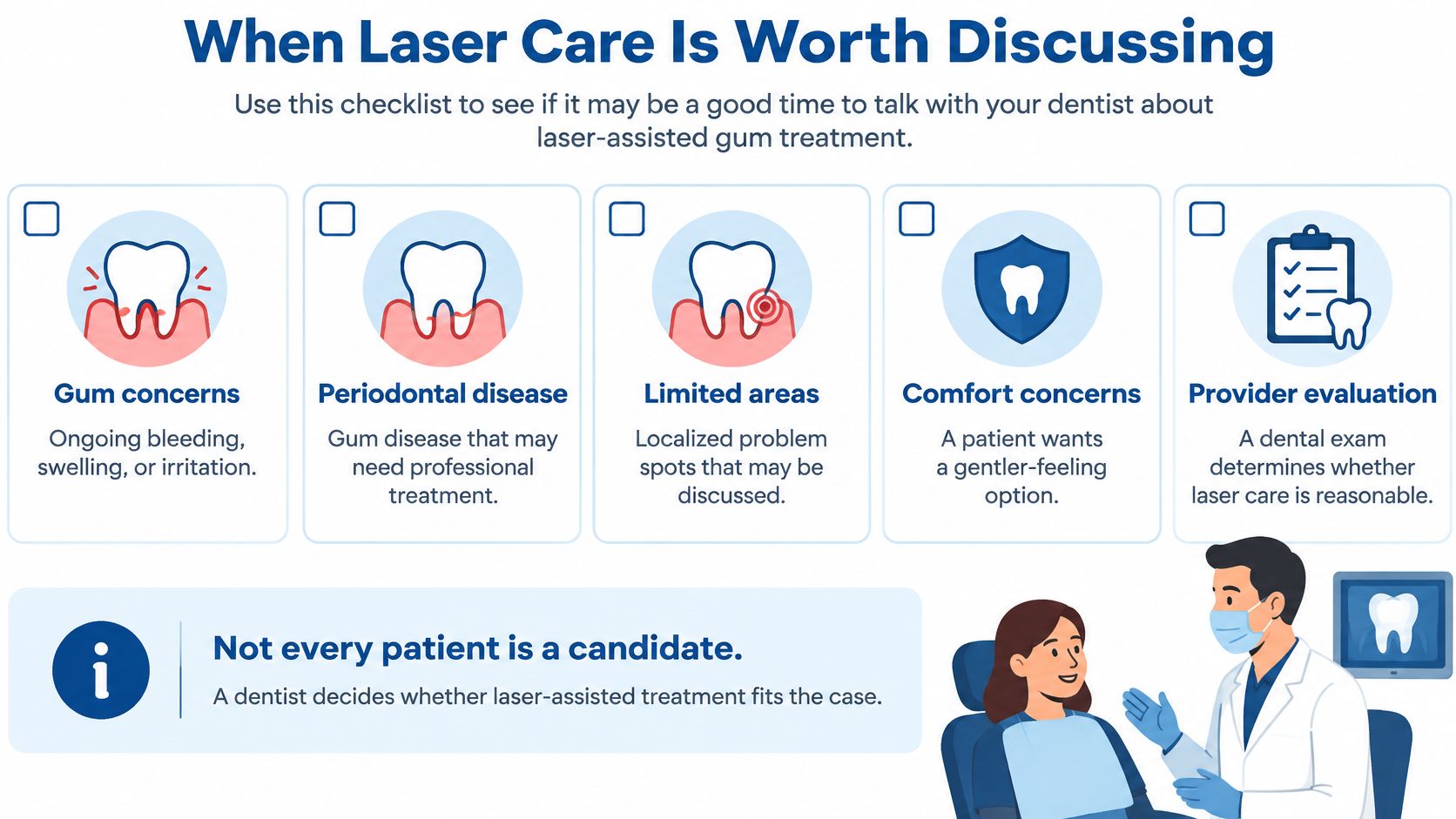
An American Academy of Periodontology consensus found evidence insufficient to conclude that laser monotherapy is superior or equivalent to conventional therapy for moderate to severe periodontitis, while limited evidence suggested possible added benefit from Er:YAG or Nd:YAG lasers in pockets of at least 7 mm, according to the American Academy of Periodontology consensus report. The same source reports no significant advantage for laser monotherapy in probing depth, with a weighted mean difference of 0.14 mm, or attachment level, with a weighted mean difference of 0.04 mm.
Checkpoints Before Any Laser Recommendation
- Probing depth and bleeding: Deep sites that still bleed carry more concern than shallow, quiet sites.
- Attachment and recession: Measurements show how much support has changed and whether roots are exposed.
- Mobility and bite: Movement or heavy biting forces can alter the long term plan.
- Radiographic bone status: X-rays help show defect shape and remaining support.
- Response to initial care: Healing after scaling and root planing reveals whether another step is needed.
Persistent deep bleeding pockets may still require conventional periodontal surgery or another established intervention. Repeating laser sessions without a new diagnosis can delay care that directly addresses inaccessible deposits or bone defects. Tissue injury is also possible when an inappropriate wavelength or power level is used, a safety concern described in a periodontal education document on laser technique. Eye protection, controlled settings, cooling where indicated, and a trained operator aren't optional details.
The clearest candidate conversation sounds specific. It names the pocket, explains why conventional care alone may be insufficient, defines the target tissue, and states what result will trigger a different plan.
What Happens at Your Gum Evaluation Visit
The visit starts with symptoms, medical history, medicines, smoking status, diabetes control, and prior gum treatment. Those details affect healing and risk, so they belong in the record before instruments touch the teeth. A patient may also mention sensitivity, food trapping, a loose feeling tooth, or concern about treatment cost.
Next, the clinician examines the gums and uses a fine probe around each tooth. The probe records pocket depth and whether a site bleeds. Recession, attachment level, plaque, tartar, mobility, and bite contacts add context. Dental x-rays then show bone levels and root anatomy that can't be judged from the surface.
From Measurements to a Plan
Those findings support a diagnosis and staging conversation in plain language. Treatment may begin with scaling and root planing, followed by a healing interval and repeat measurements. A laser enters the discussion only if the clinician can explain its role for a particular site or procedure. That order matters because a device shouldn't determine the diagnosis.
Safety, patient experience, and cost effectiveness remain evidence gaps, and a recent guideline summary distinguishes photodynamic therapy from several non photodynamic laser approaches, as discussed in a 2025 review of periodontal laser evidence gaps. Patients therefore need more than a general promise that treatment is gentle or modern.
- Exact protocol: Which laser will be used, at what point in treatment, and for which tissue?
- Clinician experience: Who operates the device, and what training supports that protocol?
- Anesthesia and comfort: What's planned during treatment, and what sensitivity may follow?
- Expected trade offs: Could recession, root sensitivity, retreatment, or surgery still occur?
- Fees and coverage: What's itemized, what may insurance cover, and what maintenance will cost?
- Failure plan: What happens if deep bleeding pockets remain at reassessment?
At Prosth & Co., periodontic care such as deep cleaning and bone grafting can be coordinated within a multi specialty team that also addresses restorative dentistry, a root canal need through an endodontist, tooth extraction, and dental implants. That coordination helps when gum stability affects whether a tooth can support a crown, bridge, or implant restoration.
Recovery, Results, and Keeping Gums Healthy
Recovery doesn't follow one timetable for every laser procedure. Comfort and tissue response depend on the laser type, settings, disease severity, treated area, and whether the laser accompanied scaling and root planing or surgery. Tenderness, temporary sensitivity, and changes in how the gum sits against the tooth should be discussed before treatment rather than discovered afterward.
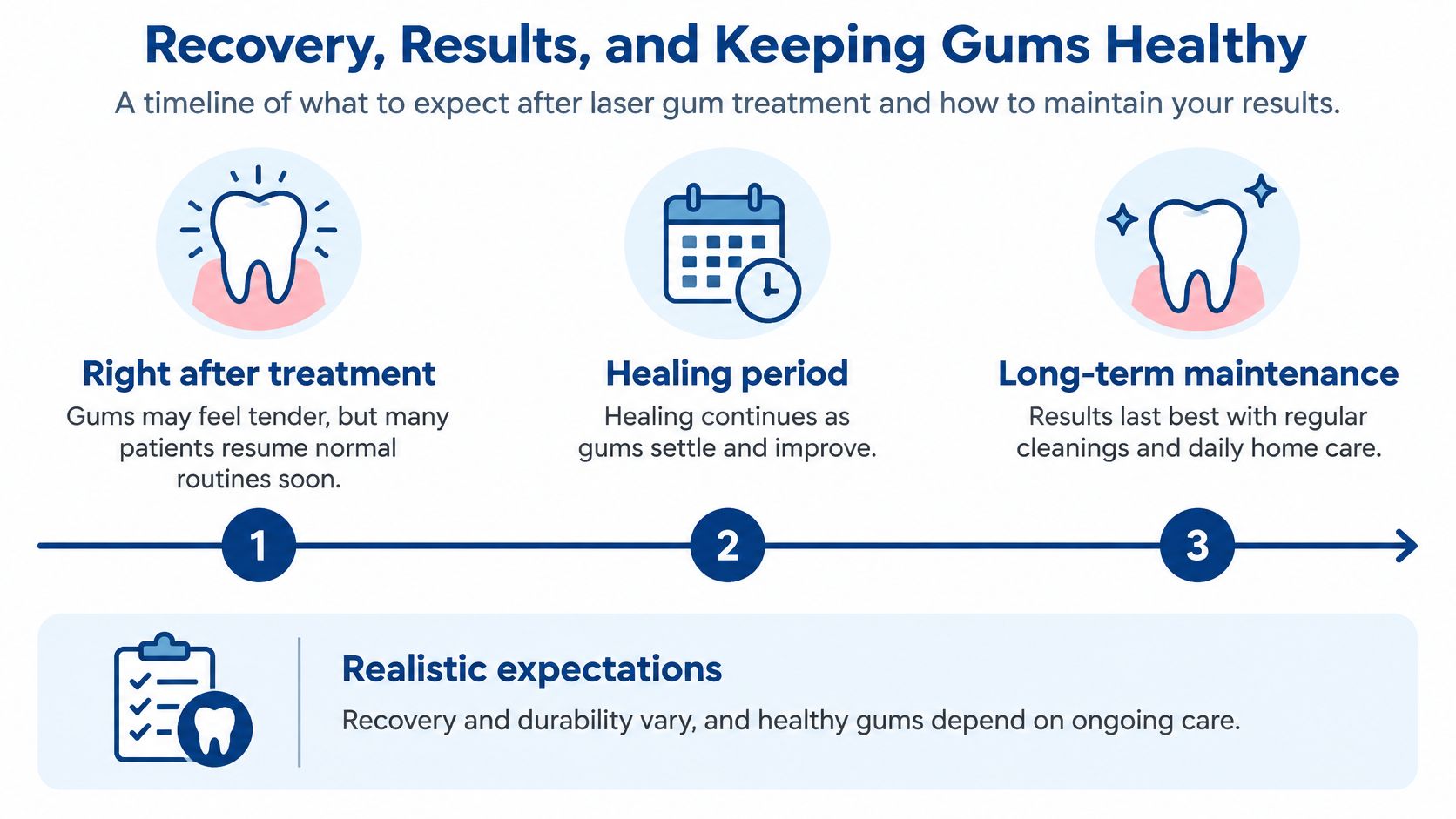
A review of randomized trials found that about 70% of included studies reported significant improvement in at least one key measure when lasers were added to scaling and root planing, while about 30% found no additional advantage, and benefits at shorter follow up did not consistently remain at six months or longer, according to a review of randomized laser periodontal trials. That pattern explains why early comfort or a small early pocket change shouldn't be treated as proof of lasting control.
Measurement rule: A result counts more when pocket depth, bleeding, and attachment are checked again after healing and tracked over time.
What Protects the Result
Daily plaque control remains central. Brushing, cleaning between teeth, and following site specific instructions reduce the bacterial challenge that caused inflammation. A clinician may adjust tools for bridges, implants, braces, or crowded areas where standard floss is difficult to use well.
Periodontal maintenance gives the dental team repeated chances to remove deposits, remeasure vulnerable sites, and catch recurrence before a pocket deepens again. Visit intervals should reflect disease history and current measurements, not a generic calendar. Smoking, poorly controlled diabetes, dry mouth, and inconsistent home care also require direct attention because no laser setting can cancel those risks.
A useful review at six to twelve months asks whether bleeding has stayed down, pockets remain stable, teeth feel comfortable, and no new recession or mobility has appeared. If a site deteriorates, the response should be based on the new measurements. Options may include renewed mechanical debridement, a different adjunct, periodontal surgery, or restorative changes that make the area easier to clean.
Booking a Gum Consultation Near Me on the Upper East Side
A patient searching for dental laser treatment for gums often wants two things at once, relief from worry and a plan that won't waste money on the wrong procedure. A consultation should deliver both. It should identify whether gum disease is present, explain how advanced it is, and separate essential mechanical care from any optional laser step.
Prosth & Co. is located at 47 E 77th St #207, New York, NY 10075, near the 77th Street 6 train. Weekday hours run from 9:00 AM to 6:00 PM, with urgent care availability for patients who need prompt attention from an emergency dentist. The Upper East Side location serves Manhattan patients looking for a dentist in Manhattan who can evaluate gums in the context of the whole mouth.
Care Planned Around the Whole Mouth
A prosthodontist led team considers gum health alongside bite, function, appearance, and long term maintainability. That perspective matters when a periodontal problem sits next to a failing crown, a missing tooth, or a planned implant. The practice also offers Laser Bacterial Reduction, which uses a diode laser as an adjunct to periodontal cleaning and maintenance for inflamed gums, deep pockets, and peri implant care. Its role should still be explained case by case, with the same measurable endpoints used for any other adjunct.
An in house dental laboratory and collaborative specialty care support treatment that may involve restorative or cosmetic dentistry after gum health stabilizes. Families can also coordinate care with a pediatric dentist or kids dentist within the broader practice setting, while adults may discuss dental implants near me, teeth whitening, or a cosmetic dentist near me search only after active gum inflammation is controlled. Healthy tissue provides a better foundation for those decisions.
Clear communication should continue from the first measurements through maintenance. Patients from the Upper East Side and nearby Manhattan neighborhoods can schedule through prosthandconyc.com and arrive with a focused question. Is a laser likely to add a measurable benefit for a specific pocket, or will conventional periodontal care provide the stronger path?
Prosth & Co. provides periodontal evaluation, deep cleaning, Laser Bacterial Reduction as a selected adjunct, and coordinated restorative planning on Manhattan's Upper East Side. Patients who want a specific answer about pocket depth, bleeding, and whether a laser belongs in treatment can schedule a gum consultation through Prosth & Co..

Founder and lead prosthodontist of Prosth & Co. on Manhattan's Upper East Side. DDS, Columbia University; Prosthodontics certificate and MMSc in Oral Biology, Harvard School of Dental Medicine; Implantology fellowship, Columbia University.
Meet Victoria →