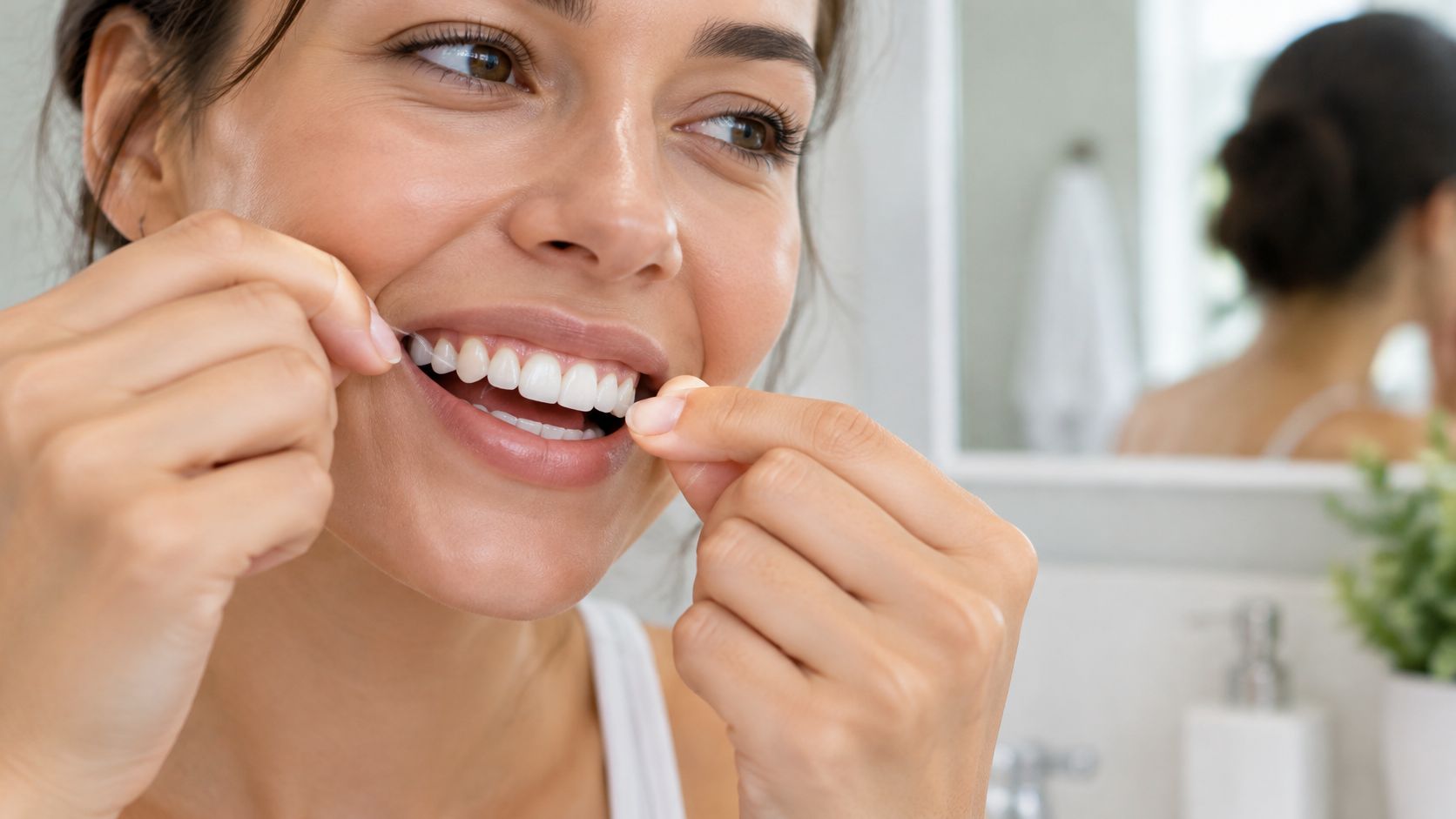
Only 21% of respondents cleaned between their teeth daily in the Australian Dental Association's 2024 Dental Health Week survey, while 74% rarely or never flossed. The practical challenge isn't just knowing that flossing matters. It's knowing how to use dental floss without cutting the gums, missing tooth surfaces, or struggling around dental work.
For patients looking for a dentist in Manhattan, bleeding gums or floss that repeatedly catches can be a useful reason to arrange an examination. On New York's Upper East Side, preventive care should include a cleaning method that fits the patient's teeth, restorations, and hand control, rather than a generic instruction to floss harder.
Table of Contents
- Why Daily Flossing Still Matters Between Your Teeth
- How to Floss Step by Step, Tooth by Tooth
- Bleeding Gums and Common Flossing Mistakes
- Choosing Floss Picks, Brushes or Water Flossers
- Habits That Make Flossing Stick Every Day
- Schedule Your Flossing Check on the Upper East Side
Why Daily Flossing Still Matters Between Your Teeth
A toothbrush cannot adequately clean every tightly contacting tooth surface or the narrow area where neighboring teeth meet the gums. The American Dental Association recommends brushing twice daily and cleaning between teeth once daily, using floss or another suitable interdental cleaner, in its professional guidance on flossing.
That makes flossing a separate job, not an optional extra pass over surfaces already brushed. Patients noticing plaque on bottom teeth also need to consider the surfaces between those teeth, not just the visible fronts.
What the evidence actually supports
A 2011 Cochrane review included 12 trials, with 582 participants assigned to flossing plus brushing and 501 assigned to brushing alone. It found statistically significant reductions in gingivitis at one, three, and six months, but only weak, very unreliable evidence of a small plaque reduction.
A later Cochrane review of interdental cleaning devices considered 35 randomized trials involving nearly 4,000 adults. It concluded that adding floss or interdental brushes may reduce gingivitis, while rating the evidence as low or very low certainty and questioning the long-term clinical importance of the differences.
Realistic benefit: Flossing complements brushing. It isn't a guarantee against every cavity or periodontal problem.
The most defensible benefit is better management of gum inflammation, rather than a promise that floss prevents every dental disease. More pressure doesn't make that benefit larger.
Some early tenderness or light bleeding can occur in areas that haven't been cleaned consistently. The useful distinction is whether symptoms improve with careful cleaning or persist, which calls for assessment rather than prolonged experimentation.
How to Floss Step by Step, Tooth by Tooth
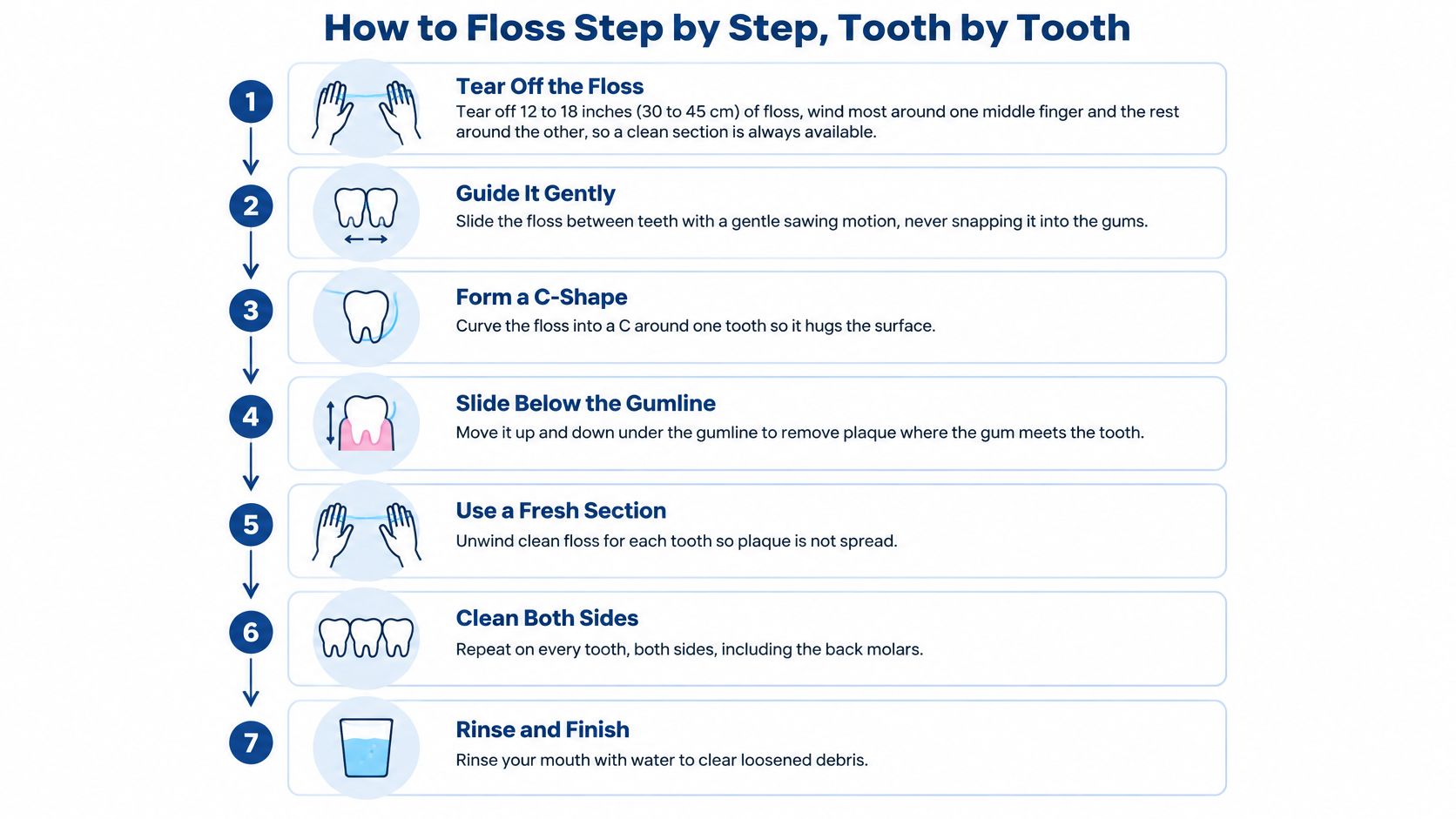
The routine below follows NHS guidance on keeping teeth clean. The important movement is along the tooth's surface, not straight down into the gum.
A controlled routine
Prepare enough floss. Use approximately 12–18 inches (30–45 cm), winding most around one middle finger and the remainder around the other, as described in the NHS guidance linked above. This arrangement leaves clean floss available as the routine continues.
Keep a short working section taut between the thumbs and forefingers. Approximately 1–1.5 inches (3–4 cm) provides control, according to the same NHS guidance; a long, loose span is harder to direct.
Ease through the contact. Guide the floss between neighboring teeth with a gentle rocking motion. The aim is to pass through the tight meeting point without suddenly dropping into the gum beneath it.
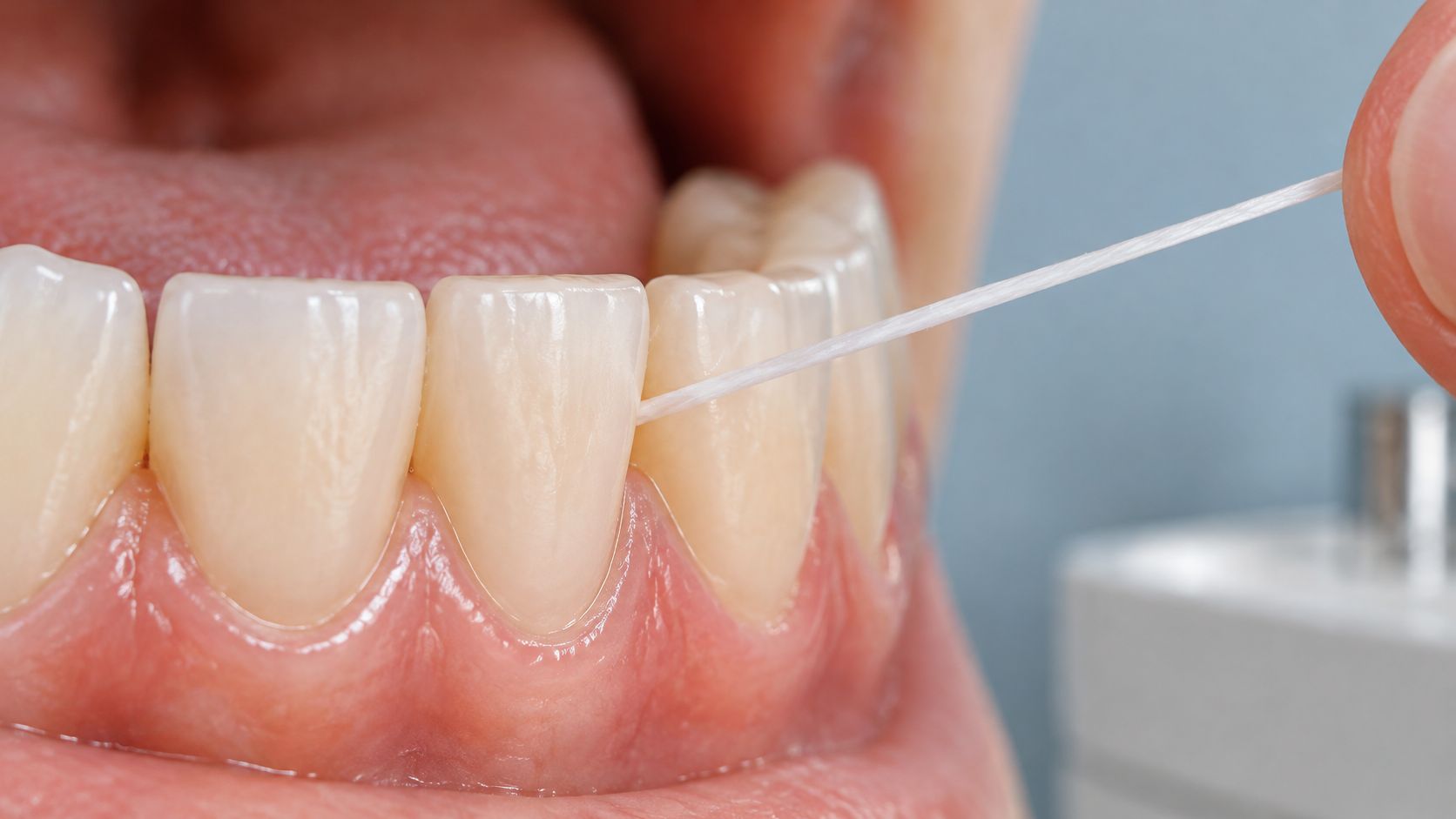
At the gumline, curve the strand into a C-shape against one tooth. Slide it gently just beneath the gum margin until resistance is felt, rather than trying to reach as far down as possible.
Clean the tooth's side. Move the floss in controlled up-and-down strokes while maintaining contact with the curved tooth surface. Merely passing through the contact doesn't complete the cleaning.
Shift the floss against the adjacent tooth and repeat the vertical motion. Then advance to a fresh section before moving to the next space, rather than carrying the same soiled section throughout the mouth.
Follow a fixed route. Work across the upper teeth from left to right, then follow the same pattern below. Include the back surface of the last tooth in each arch, even though no neighboring tooth sits behind it.
The illustration provides a visual reminder of the movements and the need to reach the back teeth.
What effective cleaning should feel like
The strand should remain supported by the fingers and adapted to the tooth. A controlled stroke feels different from pulling a loose length of floss through the mouth and hoping it contacts the right surfaces.
Flossing before brushing can loosen material that brushing then removes. Either order can be maintained, but completeness matters more than repeatedly changing the sequence.
Both tooth surfaces bordering each space need attention. Getting the floss through is only the beginning.
A useful self-check is whether every space was cleaned on both sides and whether the last teeth were included. If the routine repeatedly stops at the same difficult contact, that location deserves a demonstration at the dental chair, not increasing force at home.
Bleeding Gums and Common Flossing Mistakes
Light, improving bleeding isn't the same as an injury. A small pink mark after cleaning a previously neglected area can occur, but sharp pain or tearing when floss drops into the gum points toward a different problem.
The American Dental Association's patient guidance emphasizes gentle pressure, adaptation around the tooth, and avoiding snapped floss. It also advises dental evaluation when bleeding doesn't resolve after a few days.
Mistakes that change cleaning into irritation
- Snapping downward: A sudden drop through the contact can strike the gum instead of cleaning the tooth.
- Sawing against gum tissue: Aggressive back-and-forth movement can traumatize the area.
- Forcing thick floss: Resistance isn't an instruction to push harder.
- Stopping at the contact: Cleaning only where teeth touch leaves the tooth surfaces below that point untreated.
- Reusing a soiled section: Advancing fresh floss is part of the method, not wasted material.
Flossing symptoms, likely causes and what to do
These are possible explanations, not diagnoses. An examination is needed when symptoms persist or the cause isn't clear.
| Symptom | Likely cause | What to do |
|---|---|---|
| Light pink on floss in the first few days of daily flossing | Gums responding to newly cleaned areas | Continue gently; bleeding should lessen within days |
| Bleeding that continues after several days of careful flossing | Gingivitis or plaque buildup may be involved | Book an exam and cleaning to confirm the cause |
| Sharp pain, tearing or bleeding when floss snaps into the gum | Trauma from snapping or sawing | Stop forcing floss and request a technique check |
| Bleeding around a crown, bridge or implant | Floss may be catching or fraying on restoration edges | Ask about a threader or correctly sized interdental brush |
| Food and floss trapped in a gap with receded gums | An open space that string floss doesn't fill effectively | Ask about an interdental brush or water flosser |
| Bleeding with swelling, bad taste or a loose tooth | Possible periodontal disease or infection | Seek prompt evaluation rather than more flossing |
Persistent bleeding needs an explanation. Gingivitis, periodontal disease, medication effects, or another condition may be involved, and changing floss alone may not address it.
A patient seeking an emergency dentist because of sudden pain or swelling shouldn't treat the problem as a flossing challenge. Professional assessment can distinguish an irritated area from a concern requiring treatment.
Choosing Floss Picks, Brushes or Water Flossers
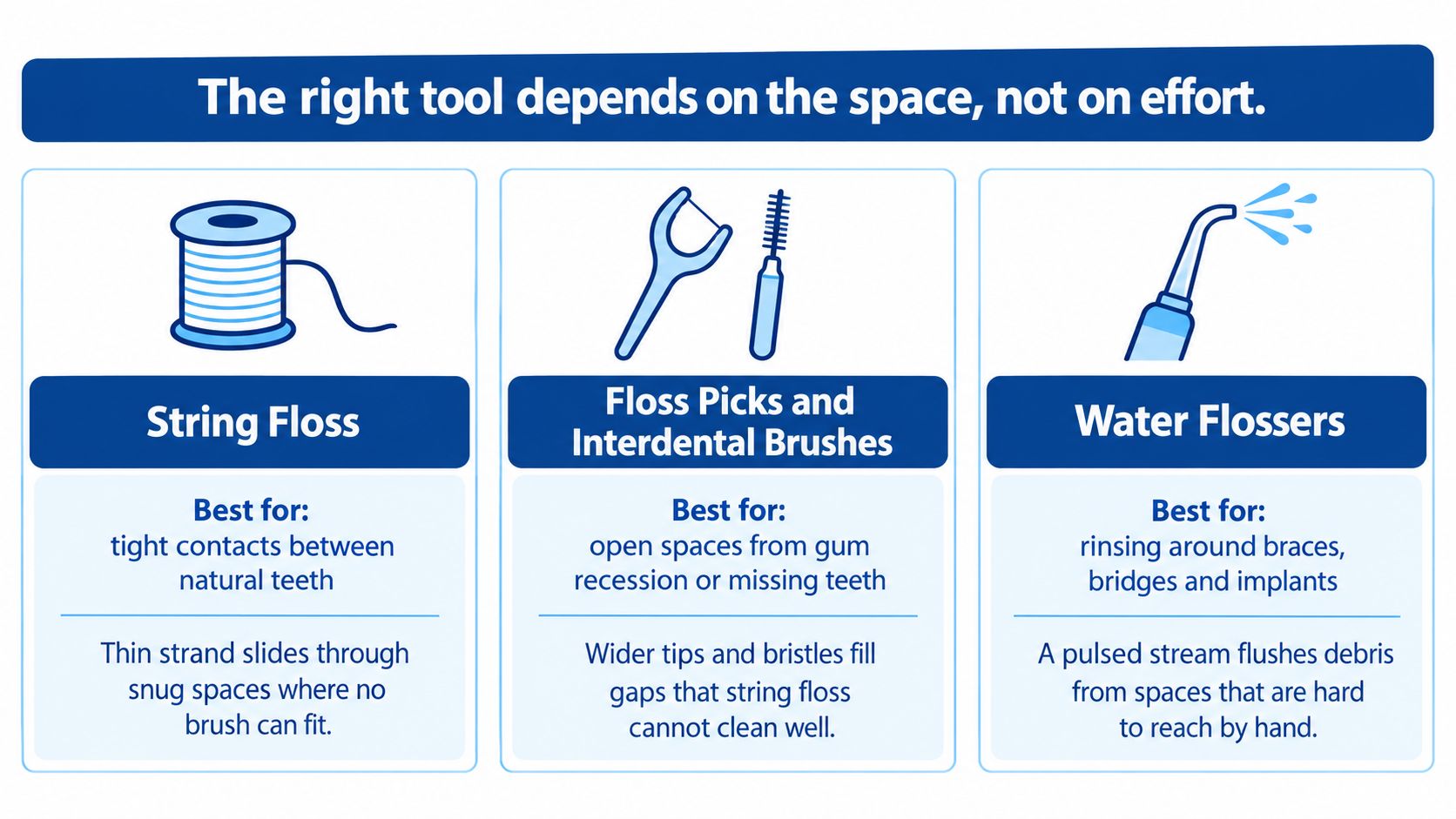
The right tool depends on the space, not on effort. String floss suits tight contacts between natural teeth. Open spaces, recession, and dental work can require a different approach.
The Cochrane discussion of home interdental cleaning devices supports individualized selection. Interdental brushes may outperform floss in some situations, although the clinical importance of the difference remains uncertain.
Interdental tools matched to the space
| Tool | Best for | Watch out for |
|---|---|---|
| String or tape floss | Tight contacts between natural teeth | Difficult with limited hand control; may fray near bridges |
| Floss picks | Quick daily use, back teeth, travel | Can be less thorough in very tight contacts; limited positioning |
| Floss threaders | Under bridges, around implants and orthodontic wires | Takes practice and can be slower |
| Interdental brushes | Open spaces, gum recession, larger gaps | Incorrect sizing can injure gums; professional sizing matters |
| Water flossers | Braces, implants, sensitive gums, as an addition | Doesn't automatically replace string floss for tight contacts; needs counter space |
A pick can make the handle easier to manage, but it still has to contact the tooth surfaces. Convenience is useful only if the device reaches the intended area.
A threader solves a different problem: access beneath bridgework or around an orthodontic wire. It helps place the floss where ordinary top-down threading isn't possible.
Dental work changes the choice
An interdental brush shouldn't be forced through a space that won't accept it. Likewise, floss that repeatedly catches or frays around prosthetic components needs professional review rather than a stronger pull.
For patients searching for dental implants near me, home maintenance should be part of the implant consultation. A prosthodontist can help determine how the planned crown or bridge will be cleaned, not just how it will look.
Prosth & Co. offers examinations and restorative care where interdental anatomy and tool selection can be reviewed. Patients can bring their current floss, pick, or brush so the recommendation addresses an actual difficulty.
Device check: A tool should fit the space safely and remain manageable enough for regular use.
String type also deserves discussion. Waxed floss can be considered for snug contacts, unwaxed floss for patients preferring a different grip, shred-resistant options when fraying is a concern, and wider tape for broader contacts.
Repeated shredding shouldn't be covered up by buying tougher floss. The appointment should establish whether the issue is the material, the technique, or a restoration that needs attention.
Habits That Make Flossing Stick Every Day
A routine works best when it has a clear cue and takes little effort to start. Choose one daily moment, such as brushing before bed, and floss immediately afterward. Keep a spool or suitable pick beside the sink, where it is easy to see and reach. A travel supply helps keep the same cue when you are away from home.
Small changes that reduce skipped cleaning
- Choose a fixed cue: Attach flossing to an established bedtime step, such as putting the toothbrush away. The familiar sequence makes it easier to remember.
- Record completion: Mark a calendar after flossing. Use the marks to spot patterns, not to demand a perfect streak.
- Plan for missed nights: Resume your usual gentle routine the next day. Trying to make up for a missed session with forceful or prolonged flossing can injure the gums.
- Make the routine easy to repeat: Choose a time when you are not rushed, and keep the flossing step brief and consistent.
A practical habit can bend without breaking. If an evening gets busy, return to the same cue the following night instead of treating one missed session as a reason to stop.
Family routines need supervision
Children often need help flossing until they can guide the floss gently and clean each contact without hurting their gums. Once a child's back teeth touch, food and plaque can collect between those teeth, so a caregiver should floss those spaces or closely supervise. Take over if the child repeatedly misses the back teeth, snaps floss into the gums, or cannot curve it around each tooth.
Parents can ask a pediatric dentist or children's dentist to demonstrate the technique at a visit. Watch how the floss is placed against each tooth, how it moves below the gumline without force, and how the caregiver steadies the child's head. Then practise together at home, with the adult doing the difficult spaces until the child can handle them safely.
For Upper East Side families seeking a kids dentist, bring the child's floss or holder to a checkup. The dentist can check which spaces need cleaning and whether the child can manage the tool independently. Adults who have difficulty controlling floss can also ask for a demonstration, then use the method they can perform gently and consistently.
Schedule Your Flossing Check on the Upper East Side
Bleeding that continues despite gentle, careful flossing deserves an examination. So does floss that repeatedly catches, or pain or swelling during cleaning. If you snap floss into the gums or force it past a tight contact, stop and ask a dental professional to check your technique and the area.
A bridge, implant, crown, or braces can change which tool fits safely. Bring your floss or interdental tool to an appointment so the team can demonstrate how to clean around your specific dental work. An overdue cleaning is another reason to arrange care. A visit can include an examination, professional cleaning, gum-health assessment, and tool guidance based on your anatomy.
What patients can expect in Manhattan
Patients looking for a dentist in New York can request a new-patient exam or consultation at the Upper East Side practice. If the exam finds a concern, the team can discuss preventive, restorative, or implant care, including gum treatment, fillings, crowns, or implants. Flossing difficulty alone does not mean treatment is needed.
- Location: 47 E 77th St #207, New York, NY 10075, near the 77th Street 6-train.
- Hours: Monday to Friday, 9:00 AM to 6:00 PM.
- Sudden pain or swelling: Call the practice directly for guidance and an appointment. If symptoms are severe, seek emergency care.
Manhattan residents searching for a dentist near me can request a visit about persistent bleeding, hard-to-clean dental work, or preventive care. Keep cleaning gently between your teeth, and arrange an exam if bleeding continues.
Prosth & Co. offers preventive, restorative, and implant care, with guidance on cleaning around natural teeth and dental work. Visit Prosth & Co. to request an Upper East Side appointment and bring the tool that has been causing difficulty.

Founder and lead prosthodontist of Prosth & Co. on Manhattan's Upper East Side. DDS, Columbia University; Prosthodontics certificate and MMSc in Oral Biology, Harvard School of Dental Medicine; Implantology fellowship, Columbia University.
Meet Victoria →