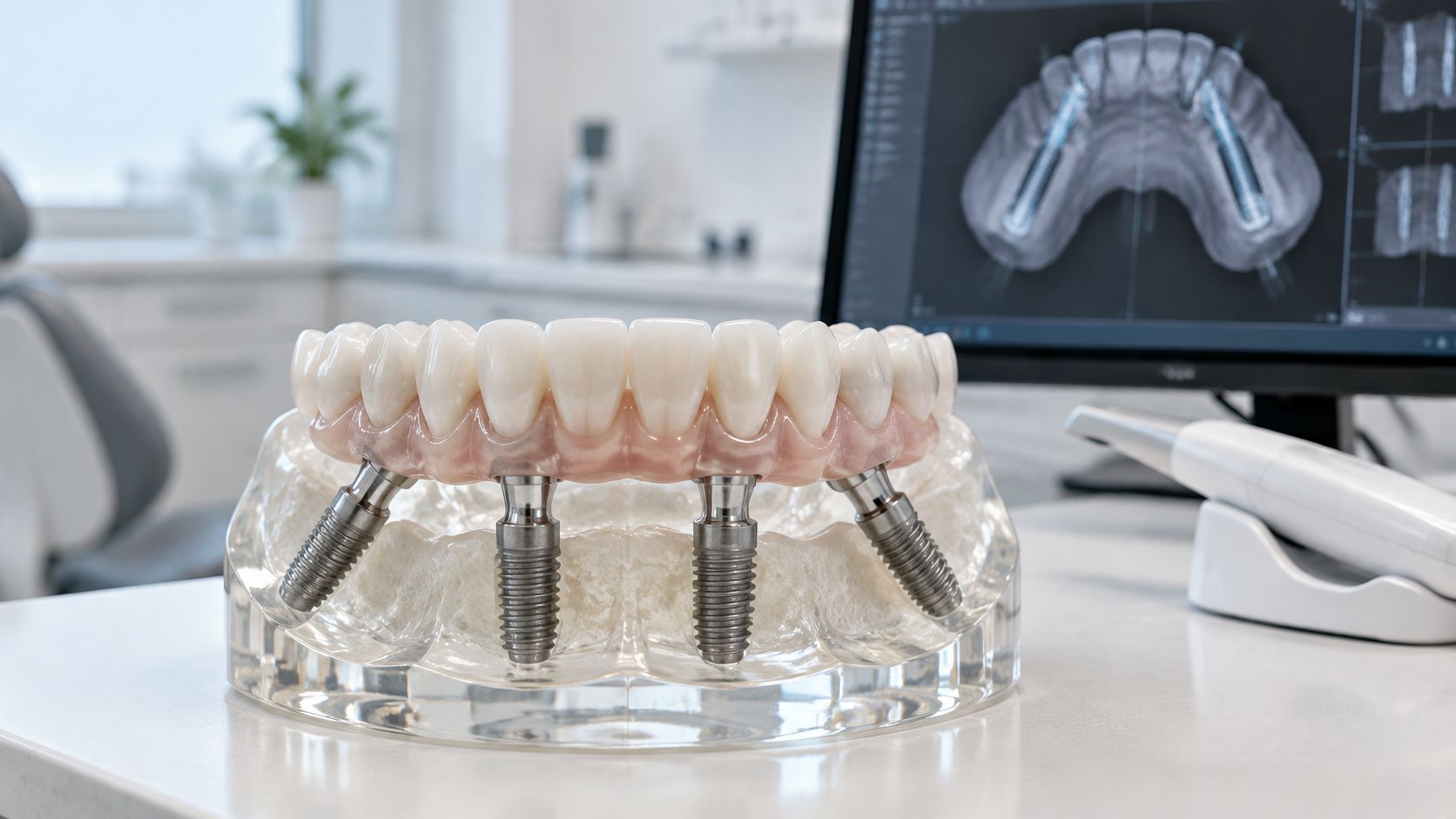
4M dental implants most commonly refers to a four-implant full-arch restoration such as the All-on-4 concept, where four implants support one fixed prosthesis for an entire upper or lower arch, not four independent replacement teeth. That distinction shapes candidacy, because each implant carries a large share of the bite, and it shapes maintenance, because the fixed bridge must be cleaned underneath every day and checked professionally over time.
For adults searching for dental implants near me or a dentist in Manhattan after years of loose dentures, failing bridges, or teeth that hurt when chewing, that plain definition matters more than any brand name. The phrase sounds like a specific product. In practice, it's usually shorthand for a treatment design, and the right question isn't whether the name sounds advanced. It's whether four implants, placed in the available bone, can support fixed teeth safely for a particular mouth.
Table of Contents
- Why Patients Are Searching for 4M Dental Implants
- How the Four-Implant Full-Arch Concept Works
- Comparing Full-Arch Implants to Other Ways to Replace Teeth
- How Implant Brands and Systems Are Evaluated
- What Realistic Outcomes and Maintenance Actually Look Like
- What to Expect at a Prosthodontist-Led Consultation on the Upper East Side
- Making a Confident Decision About 4M Dental Implants
Why Patients Are Searching for 4M Dental Implants
A common search starts late at night. A lower denture slips during dinner, a cracked tooth needs a tooth extraction, or several teeth have already been lost and chewing on one side has become routine. The person types 4M dental implants hoping for one clear answer, then finds pages promising permanent teeth quickly, pages about a branded center, and pages using the same words to mean different things.
That confusion is understandable. Tooth loss is widespread, yet implant treatment still reaches a minority of adults who could consider it. Published industry summaries report approximately 3 million people in the United States have dental implants, about 500,000 new implants are placed annually, roughly 6% of Americans currently have implants, and more than 69% of adults aged 35 to 44 have lost at least one permanent tooth. Those figures describe people and placements in one country, not a single universal count of implants worldwide.
What the phrase usually means
In everyday use, 4M dental implants generally points to a branded full-arch workflow built on the All-on-4 concept, not to a distinct implant material or a universal standard that every practice follows in identical form. The technical description behind that workflow involves four implants per arch, with two anterior implants placed axially and two posterior implants tilted to increase anterior-posterior spread and engage available bone.
It doesn't mean four separate crowns. It doesn't guarantee that permanent teeth are finished on surgery day. It also doesn't remove the need for diagnosis, because bone volume, gum health, medical history, and bite forces differ from patient to patient.
A useful translation is simple. Four implants act as the foundation, and one connected bridge provides the visible teeth for the arch.
Why the wording creates false certainty
Marketing language often compresses a multi-step treatment into a short promise. Words like permanent, same day, and full mouth can be accurate in a narrow sense and misleading in a practical sense. A patient may receive a fixed provisional bridge soon after surgery, then return months later for the final prosthesis after healing. That's very different from walking out with the definitive restoration that must serve for years.
The scale of implant dentistry also gets blurred. Global market value, people who have implants, implants placed each year, and teeth supported by implants are different measures. Treating them as interchangeable makes big numbers sound more precise than they are. A calmer approach starts with anatomy and goals. How many teeth are missing or failing? Is one arch affected or both? Can the patient clean under a fixed bridge? Those questions predict satisfaction far better than a label.
How the Four-Implant Full-Arch Concept Works
A single dental implant replaces the root of one missing tooth with a post placed in the jaw, and that post supports a crown. The **U.S. Food and Drug Administration describes dental implants as posts that support a crown, bridge, or denture while restoring chewing function and appearance, with titanium able to fuse with jawbone through osseointegration](https://www.fda.gov/medical-devices/dental-devices/dental-implants-what-you-should-know). A full-arch design applies the same root-replacement idea at a larger scale.
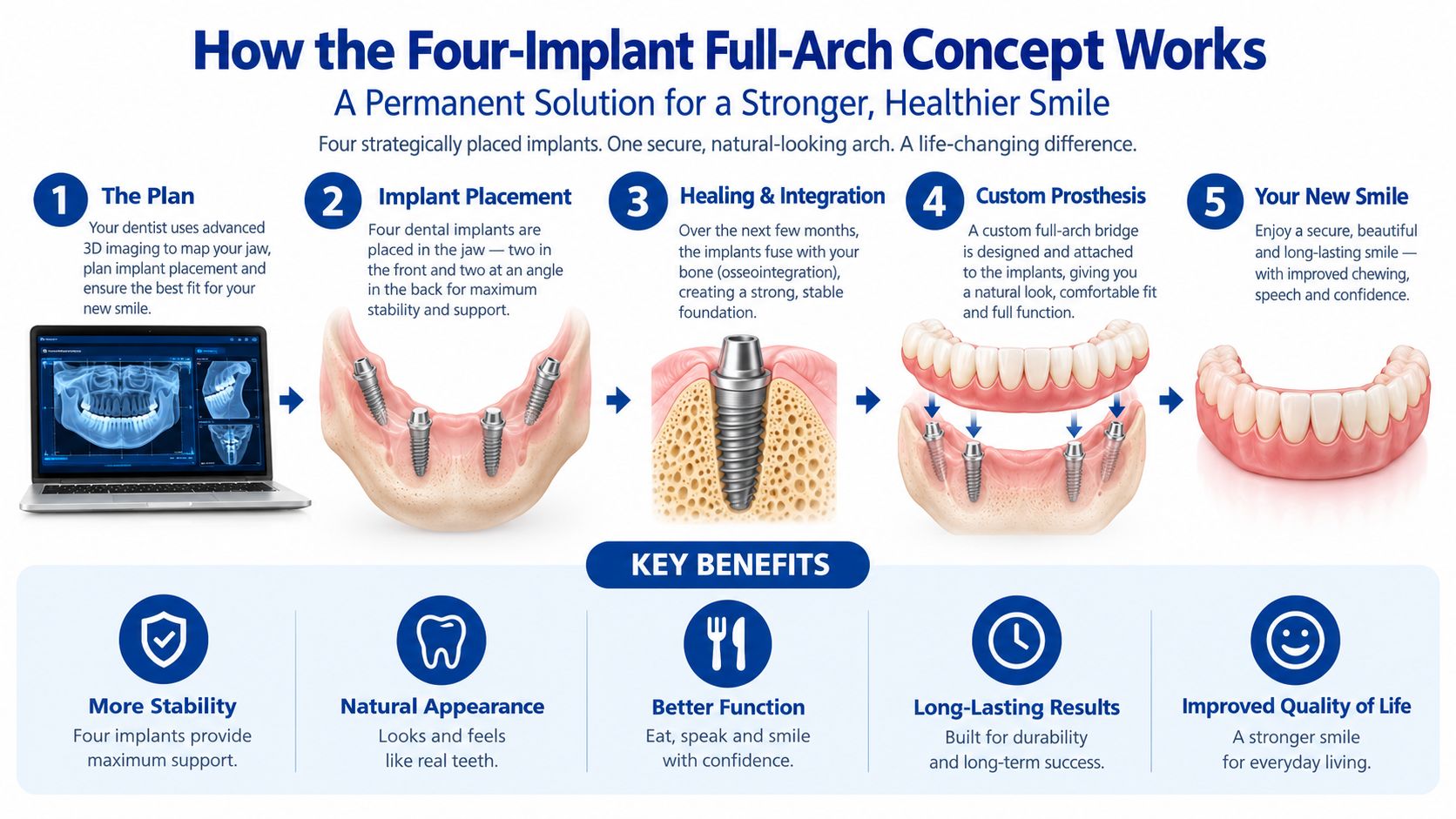
Instead of placing an implant for every missing tooth, the clinician places four implants in strategic positions and connects them with one fixed bridge. The bridge contains the full row of replacement teeth for that arch. Because the implants are splinted together, they share load as a unit rather than working alone.
The geometry in plain language
A helpful analogy is a wide tabletop on four legs. Legs placed too close together make the top feel unstable at the edges. Legs spread farther apart support the top more evenly. In the mouth, the two front implants usually stand upright in bone near the front of the jaw, where bone often remains even after tooth loss. The two back implants are tilted so their bases engage available front bone while their tops emerge farther back.
That tilt serves two purposes. It increases the front-to-back spread supporting the bridge, and it can help the surgical plan avoid structures such as the sinuses in the upper jaw or nerves in the lower jaw. In selected patients, it also reduces the need for posterior bone grafting. The trade-off is precision. With only four foundations, position, angle, and bite design carry more weight than they would if more implants shared the load.
Planning before surgery
CBCT imaging, a three-dimensional dental scan, shows bone height and width, sinus position, nerve pathways, and the space available for the prosthesis. Digital planning then links the surgical positions to the planned tooth positions, because implants placed without regard to the final bridge can create cleaning problems or awkward bite contacts. A prosthodontist plans from the finished teeth backward, checking lip support, speech space, and hygiene access before surgery begins.
What same day really means
Immediate loading means a fixed provisional bridge is attached shortly after implant placement. It's possible only when the implants achieve strong stability at placement and the bite can be controlled during healing. Bone still needs time to heal tightly around the implants, a process called osseointegration, before the final restoration carries full function. Patients considering whether a plan is immediate or staged should ask how temporary teeth will be managed while bone healing occurs.
When conditions don't support immediate loading, a staged approach isn't a failure. It's a deliberate choice to protect healing. The patient experience differs, often with a removable temporary during healing, but the biological goal stays the same. Stable implants first, definitive teeth second.
Comparing Full-Arch Implants to Other Ways to Replace Teeth
A four-implant bridge solves a specific problem, a full arch of missing or failing teeth. It isn't the default answer for every gap. Someone missing one molar with healthy neighboring teeth faces a different decision from someone whose remaining upper teeth can't be saved. Matching the treatment to the pattern of tooth loss prevents both undertreatment and unnecessary surgery.
Single implants replace individual teeth and let each crown be cleaned like a natural tooth. They're often the cleanest long-term solution for scattered missing teeth, though several implants can add cost and surgical steps. A tooth-supported bridge can close a short gap without implant surgery, but the dentist must reshape the neighboring teeth that hold it. If those teeth are already crowned or heavily restored, that trade-off may be reasonable. If they're untouched and healthy, preserving them often favors an implant.
Where removable options fit
A removable partial or full denture costs less at the start and involves no implant surgery. It rests on the gums, so chewing power and stability are lower, and the fit changes as bone gradually resorbs. Some patients value removability for cleaning. Others dislike movement during speech or meals. Neither reaction is wrong. The question is which compromise fits daily life.
Full-arch treatment on more than four implants is another path when bone and budget allow. Additional implants can spread load further and may offer a safety margin if one implant has trouble later. They can also require grafting to create bone where posterior implants would stand upright. More isn't automatically better, but the option deserves discussion rather than dismissal.
| Option | Best For | Invasiveness | Maintenance | Longevity |
|---|---|---|---|---|
| Four-implant full-arch bridge | A full arch of missing or failing teeth | Surgery for four implants, often without posterior grafting | Daily cleaning under the bridge, professional recalls, periodic repairs | Long term with maintenance, prosthesis may need repair or replacement |
| Single implants with crowns | One or several scattered missing teeth | Surgery at each implant site | Brushing and flossing around each crown | Long term, individual crowns can be serviced separately |
| Tooth-supported bridge | A short gap with suitable neighboring teeth | No implant surgery, neighboring teeth reshaped | Cleaning under the bridge with threaders or brushes | Depends heavily on the supporting teeth |
| Removable denture | Multiple or all teeth missing, lower upfront cost | No surgery required | Daily removal and cleaning, relines as fit changes | Periodic remakes expected as bone and fit change |
| Full-arch on more than four implants | Full arch cases needing wider load distribution | More implants, grafting may be needed | Similar fixed-bridge cleaning and recalls | Long term with maintenance and repair planning |
Decision check: The right comparison isn't fixed versus removable in the abstract. It's cleaning access, bone anatomy, bite force, and repair tolerance in one specific mouth.
Cost comparisons need the same care. A denture looks less expensive on day one, while a fixed bridge concentrates cost upfront and adds maintenance over years. A fair discussion separates surgery, provisional teeth, final prosthesis, and future repairs, rather than hiding everything inside one number.
How Implant Brands and Systems Are Evaluated
Patients often ask which implant brand is best, as if one name guarantees success. Brand matters, but mostly for reasons that aren't visible in advertisements. The implant that goes into bone is one part of a system that includes connecting components, screws, abutments, and the tools needed to service the restoration years later.
Material is the starting point. Most implants are titanium or titanium alloy, chosen because bone can integrate with the surface and the metal tolerates chewing load. Surface treatments roughen or modify that outer layer to support bone attachment during healing. Patients don't need to memorize surface names. They do benefit from asking whether the system has published clinical follow-up and whether components remain available over the long term.
Questions that reveal serviceability
A fixed full-arch bridge will need attention eventually, even when everything goes well. Screws can loosen, acrylic or ceramic can wear, and a component may need replacement. Serviceability depends on whether another qualified dentist could identify the system, obtain parts, and remove the prosthesis safely if the patient moves from New York to another state.
- Component availability: Are abutments, screws, and drivers standard parts that remain in production?
- Prosthetic compatibility: Can the bridge design be repaired or remade without replacing well-integrated implants?
- Documentation: Will the patient receive records identifying implant sizes, positions, and component types?
- Evidence depth: Does the manufacturer publish long-term clinical data, or only short-term promotional summaries?
Established manufacturers tend to offer broader training for restorative dentists and deeper component catalogs. Smaller or proprietary systems may work well in the hands of the placing team yet create friction later if parts or expertise are scarce. That risk doesn't disqualify a system automatically. It should be discussed openly before surgery, not discovered during a repair.
Why the team outweighs the logo
An excellent implant placed at the wrong angle can make a bridge impossible to clean. A well-known brand restored with poor bite control can still chip or loosen. Surgical placement, prosthetic design, laboratory work, and follow-up form one chain, and weak links matter more than branding. That's why evaluation should include who plans the case, who places the implants, who designs the teeth, and who handles complications.
Implant dentistry is also a large, growing field rather than a niche experiment. Industry data place the worldwide dental-implant market at approximately USD 5.00 billion in 2025, projected to reach USD 8.98 billion by 2034 at a compound annual growth rate of 6.8% from 2026 through 2034, with Europe accounting for 35.2% of global market revenue in 2025. Market size doesn't validate any single brand. It does explain why patients encounter many competing names and why component continuity deserves attention.
A short, calm conversation covers the essentials. Which system is planned? Why does it suit this bone and this bridge design? How would repairs be handled in five or ten years? Clear answers signal a practice thinking beyond surgery day.
What Realistic Outcomes and Maintenance Actually Look Like
Fixed teeth on four implants can perform very well over many years. They aren't maintenance-free, and high survival doesn't mean nothing ever needs repair. Holding both facts at once leads to better decisions than either hype or alarm.
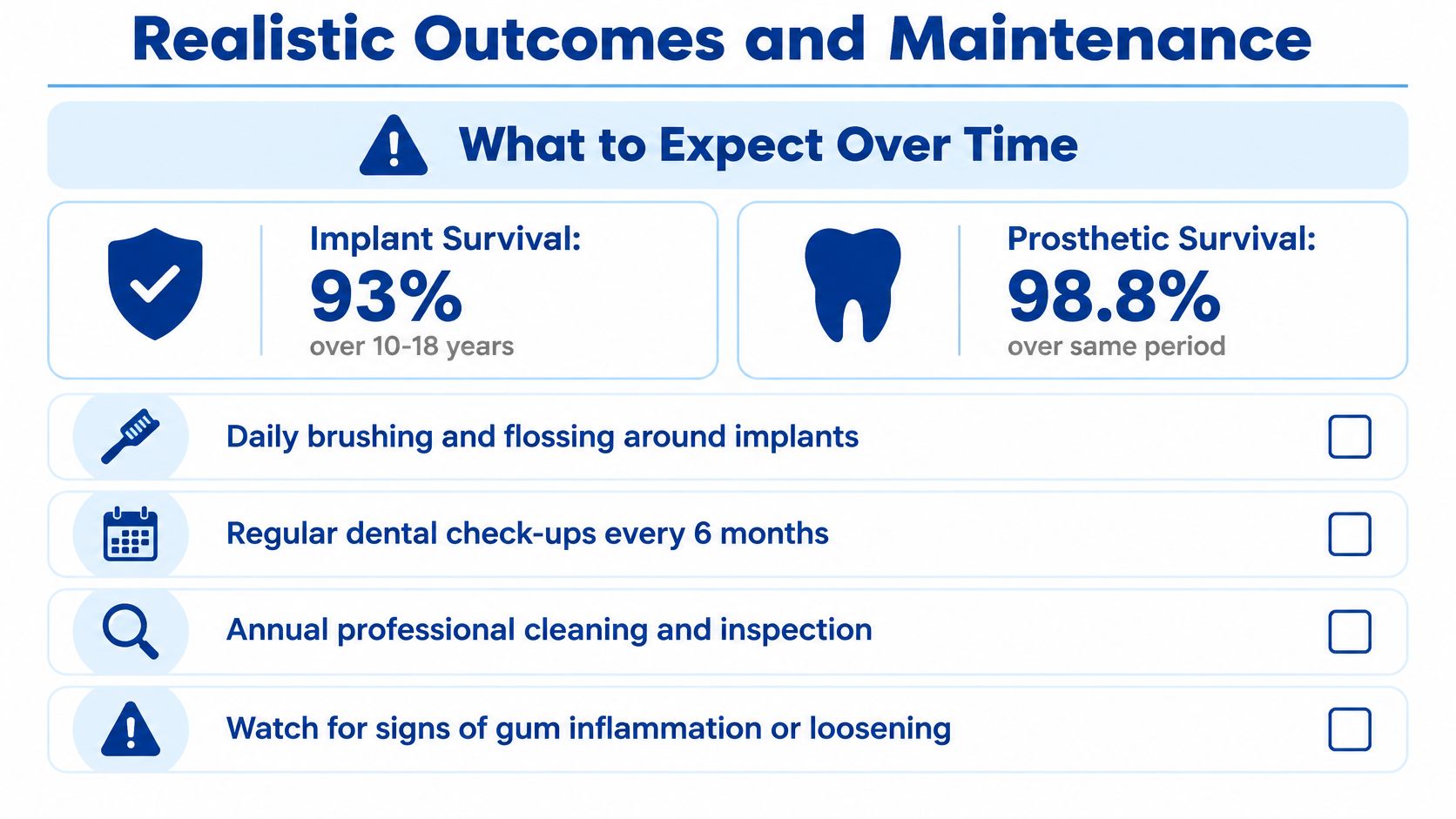
Long-term evidence gives useful scale. In a 10 to 18 year study of 471 patients, implant survival was 93%, prosthetic survival was 98.8%, biological complications occurred in 11.8% of implants, and mechanical complications occurred in 36.7%. Survival means the implant or prosthesis remained in service. It doesn't mean the patient never returned for a tightened screw, a repaired chip, or treatment for inflamed tissue.
The complications patients actually notice
Review evidence lists peri-implant mucositis as the most common biological complication, followed by screw loosening, occlusal wear, peri-implantitis, implant mobility, screw fracture, and framework or prosthesis fracture, with 17.7% of patients experiencing at least one biological or mechanical complication. In plain terms, the gum around an implant can become inflamed, small screws can loosen under bite forces, and the bridge material can wear where teeth meet.
Risk isn't evenly distributed. That same body of evidence associates biological complications with smoking and systemic conditions, reporting that smoking increased the odds by 1.75 and systemic conditions by 1.65. A history of chronic periodontitis also deserves direct discussion, because patients with chronic periodontitis have a significantly greater risk of peri-implantitis, which can compromise implant stability and survival. None of these factors automatically rule out treatment. They change preparation, timing, and the intensity of follow-up.
Daily cleaning under a fixed bridge
A full-arch prosthesis creates sheltered spaces where plaque collects out of sight. Regular brushing alone usually isn't enough. Patients typically learn to clean beneath the bridge with custom interdental brushes, floss threaders, or an oral irrigator, and the technique must match the shape of the prosthesis. Limited hand dexterity is a genuine planning factor, not a character flaw. If cleaning access will be poor, a removable implant-supported option may serve the patient better.
Professional recalls let the team check tissue health, bite contacts, screw stability, and wear before small problems become expensive ones. The bridge may need removal by the dentist for thorough cleaning or repair, which is another reason component documentation matters. Patients researching how long dental implants last in everyday service should separate the lifespan of the titanium implant in bone from the lifespan of the bridge attached to it, because those timelines differ.
Budgeting should reflect that separation. The initial fee covers surgery and the first prosthesis. Over years, repairs, replacement parts, and eventually a new prosthesis may be needed even when the implants remain healthy. Some patients also encounter emerging regenerative topics online, and resources on dental stem cell therapy in Mexico can help distinguish experimental regenerative dentistry from established implant maintenance. For a four-implant bridge, the proven levers remain unglamorous. Treat gum inflammation before surgery, control smoking and systemic risk where possible, clean under the bridge daily, and keep recall appointments even when nothing hurts.
What to Expect at a Prosthodontist-Led Consultation on the Upper East Side
A thorough consultation feels less like a sales presentation and more like a diagnostic workup. For someone looking for a dentist in New York to address a failing arch, the first visit should answer three questions. What's happening in the mouth now? Which options fit that anatomy? What sequence would treatment follow?
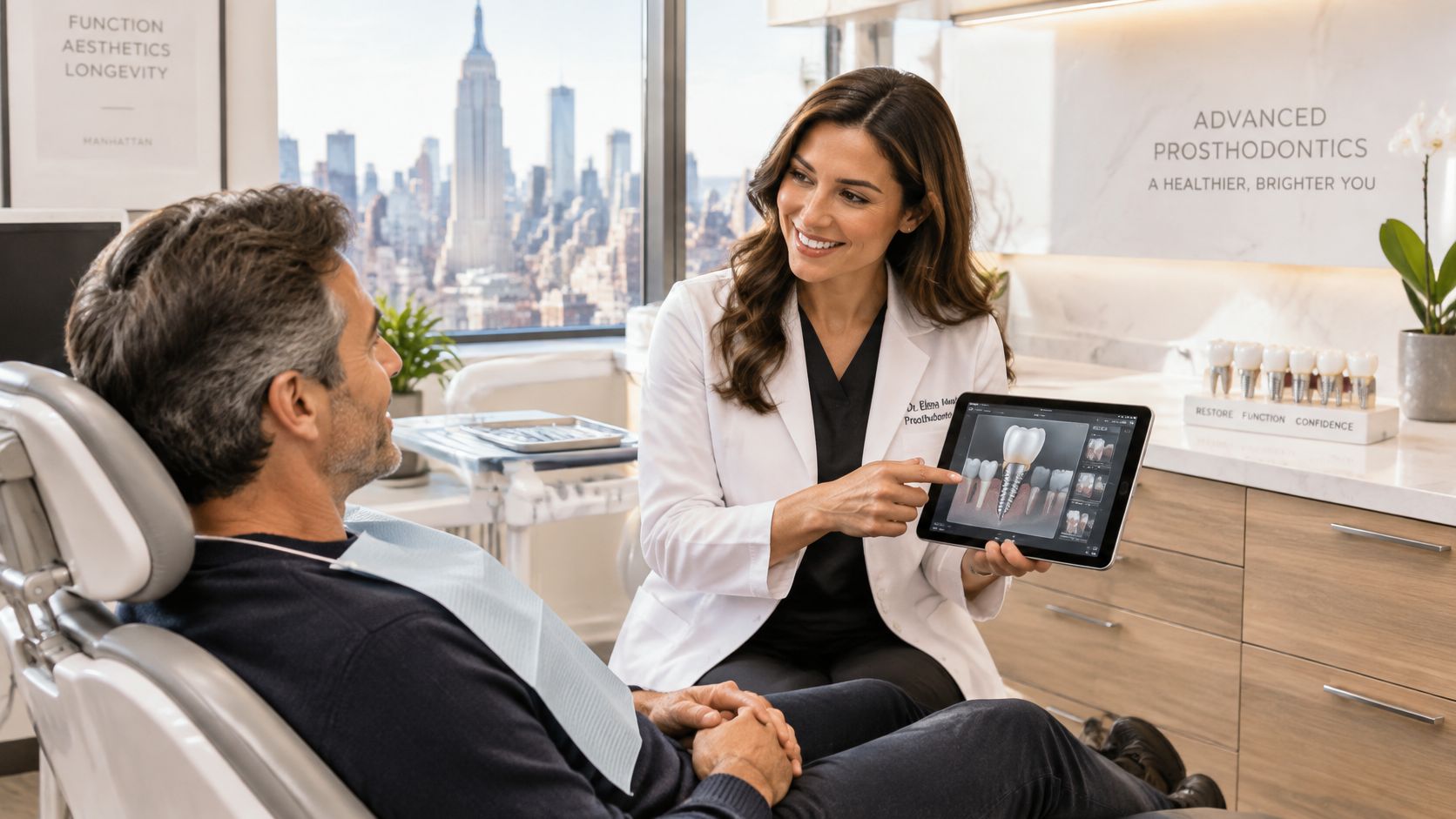
The appointment typically begins with a thorough exam, medical and dental history, photographs, and dental x-rays or CBCT imaging when implant planning requires three-dimensional detail. The dentist checks remaining teeth for decay, cracks, and periodontal stability, because keeping a hopeless tooth inside a full-arch plan helps no one. Bite relationships and the condition of the opposing arch also matter. A new fixed bridge biting against natural teeth behaves differently from one biting against a denture.
From preparation to final teeth
Preparation may include periodontal therapy, treatment of infection, or extraction of teeth that can't be restored. An endodontist may evaluate whether a strategic tooth can be saved with a root canal, since full-arch treatment isn't always the right answer when several teeth remain healthy. Only after that sorting does implant placement make sense.
Surgery places the implants according to the digital plan. When stability allows, a fixed provisional bridge follows. When it doesn't, healing proceeds with a temporary alternative. After osseointegration, the team verifies fit and bite, then delivers the final prosthesis and reviews cleaning technique in detail. Maintenance visits become part of the treatment, not an optional extra.
Why an in-house laboratory changes the experience
At Prosth & Co. on the Upper East Side, an in-house dental laboratory works under direct clinical oversight, so shading, tooth shape, and adjustments happen with the restorative team in the same location. That proximity shortens the feedback loop between the patient's mouth and the technician's bench. It also helps when a provisional needs a small change before the final bridge is made.
The multi-specialty setting matters for the same reason. Periodontics, oral surgery, endodontics, orthodontics, and prosthodontics under one roof reduce handoffs when a case crosses disciplines. Families at the same practice may also encounter a pediatric dentist or kids dentist for children's care, plus cosmetic dentistry services such as veneers and teeth whitening for adults. Someone searching for an emergency dentist or a cosmetic dentist near me often lands on the same doorstep for very different reasons. For implant patients, the relevant point is continuity. Planning, surgery, restoration, and maintenance stay connected.
Making a Confident Decision About 4M Dental Implants
A confident decision starts with the translation. Four implants means four foundations carrying one fixed bridge for an arch, with tilted posterior implants used to engage available bone and spread support. Suitability depends on bone anatomy, periodontal stability, smoking status, systemic health, bite forces, and the ability to clean under the finished bridge.
Evaluation then turns to the system and the team. Which components are planned, can they be serviced years later, and who handles repairs if a screw loosens or the prosthesis wears? Maintenance belongs in the same conversation, including daily cleaning tools, professional recalls, and a realistic budget for prosthetic repair or replacement over time.
Cost deserves itemized clarity. The total varies with case complexity, materials, extractions, grafting, and whether immediate loading is appropriate. Transparent estimates separate surgical, provisional, laboratory, and final restorative components. Patients comparing options for a dentist near me can request that breakdown in writing, along with the contingency plan if one implant fails. Clear answers, offered without pressure, are the strongest sign that a plan fits.
Adults considering 4M dental implants or other full-arch treatment can schedule a prosthodontist-led consultation at Prosth & Co., located at 47 E 77th St #207, New York, NY 10075, with weekday hours Monday through Friday from 9:00 AM to 6:00 PM. The visit includes an exam, imaging based discussion of candidacy, and an itemized review of treatment options, timelines, and maintenance expectations.

Founder and lead prosthodontist of Prosth & Co. on Manhattan's Upper East Side. DDS, Columbia University; Prosthodontics certificate and MMSc in Oral Biology, Harvard School of Dental Medicine; Implantology fellowship, Columbia University.
Meet Victoria →