
After Invisalign, retainers are typically worn full-time for the first 3 to 6 months, usually about 20 to 22 hours per day, before most patients transition to nighttime-only wear for long-term maintenance. That long-term phase matters because teeth can shift back if retention stops, even after a beautifully finished case.
A lot of Manhattan patients reach this moment with the same mix of excitement and uncertainty. The aligners are done, the smile looks better, and the natural question is whether the hard part is over. In reality, this is the stage that protects everything that came before it.
For adults on the Upper East Side, retention is rarely just about wearing a plastic tray at night. Many are also thinking about veneers, crowns, implants, whitening, or repairing worn teeth. Others are balancing packed workdays, travel, dining out, and the simple reality that removable appliances can be lost, cracked, or forgotten. That's why practical guidance matters more than generic instructions.
Retainers after Invisalign treatment should feel straightforward, but the details make the difference. The right type, the right schedule, and the right follow-up plan help preserve tooth position and support whatever restorative or cosmetic care comes next. For patients looking for a dentist near me or a cosmetic dentist near me in Manhattan, this is often where a prosthodontic perspective becomes especially helpful.
Table of Contents
- Protect Your New Smile After Invisalign in Manhattan
- Why Retainers Are Essential After Your Invisalign Treatment
- Vivera vs Hawley vs Bonded A Comparison of Retainer Types
- Your Retainer Schedule Wear Care and Replacement
- Retainer Costs and Next Steps at Our Upper East Side Practice
- Your Lifelong Smile Partner on the Upper East Side
Protect Your New Smile After Invisalign in Manhattan
Finishing Invisalign often feels like crossing a finish line. A patient walks out, checks the mirror again, smiles a little wider, and assumes the process is mostly complete. Then comes the next instruction. Wear the retainer.
That step can sound minor, but it isn't. Retainers are what hold the result in place while the teeth settle into their new positions. Without that phase, patients can lose ground in ways that are frustrating precisely because the smile looked so good at the end of treatment.
On the Upper East Side, that reality shows up in very ordinary situations. A patient keeps a retainer wrapped in a napkin during dinner and it disappears. Another leaves it near a radiator and it warps. Someone else finishes aligner treatment and soon after schedules veneers or a crown, only to find that retention planning wasn't discussed clearly enough.
Clinical point: A straight smile isn't preserved by intention alone. It's preserved by a retainer that fits, a schedule that's followed, and follow-up when something changes.
Patients searching for a dentist in New York, NY or a cosmetic dentist near me usually aren't looking for abstract orthodontic theory. They want clear advice that fits real life in Manhattan. They want to know what works, what doesn't, and what to do when the plan gets interrupted.
That's especially important for adults who may be combining alignment with restorative dentistry. A smile may look aligned but still need bite refinement, replacement of older dental work, or planning for implants and crowns. Patients exploring clear aligner treatment in New York often benefit from hearing that retention isn't separate from complete dental care. It's part of it.
The good news is that retainers after Invisalign treatment don't have to be complicated. With the right retainer choice and a realistic maintenance plan, most patients can protect their result confidently and avoid the common problems that lead to relapse.
Why Retainers Are Essential After Your Invisalign Treatment
Teeth don't become permanently fixed in place the moment aligners end. They've been guided into a new position, but the surrounding tissues need time to adapt. That's why retention matters.
A simple way to think about it is elastic memory. Teeth have been moved, but the structures around them may still “remember” where they used to be. A retainer holds the new position while the mouth adjusts. Without that support, teeth can drift.
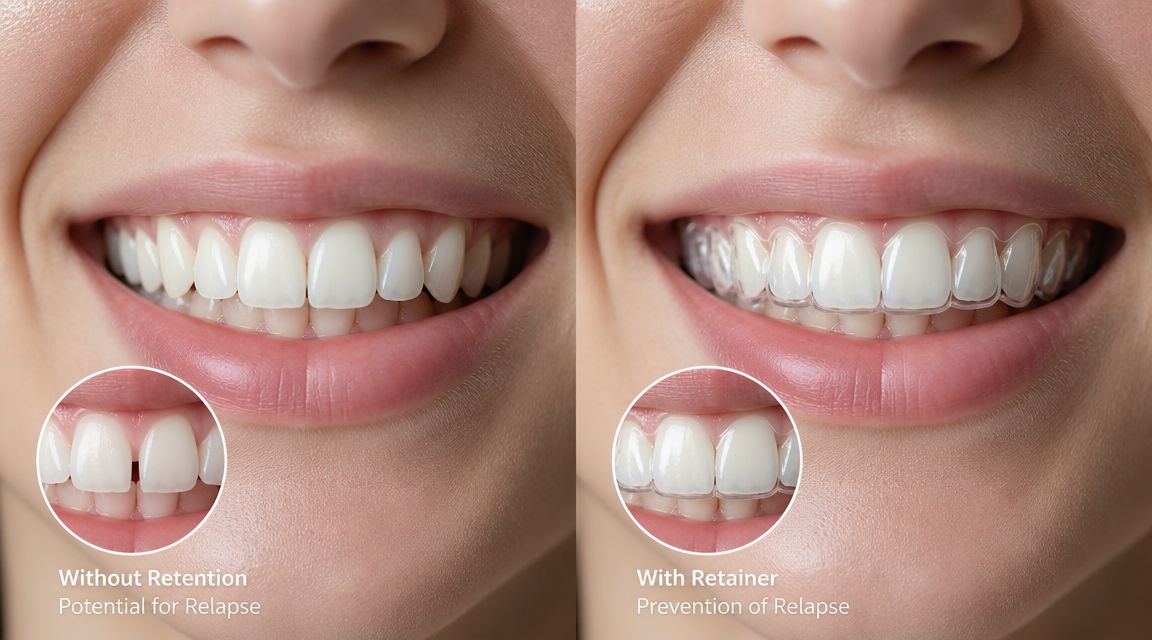
Why retention matters even when teeth look finished
Patients sometimes assume that if the smile looks straight, the work is complete. Functionally, that isn't the whole picture. The retainer phase is what stabilizes the outcome.
This is particularly relevant in restorative and cosmetic cases. Some adults finish Invisalign with plans for crowns, veneers, implants, or other bite-related treatment soon after. In those cases, retention isn't just about keeping teeth straight. It has to fit into the broader treatment sequence.
According to guidance on post-Invisalign retention and maintenance, retention timing may need to be coordinated with restorative work like crowns, veneers, or implants because a retainer that fits today may become ineffective if the bite is altered by new restorations.
Where patients get into trouble
The biggest problems usually come from underestimating the retainer phase. Patients may think missing a few nights won't matter, or they may delay replacement because the appliance is only slightly cracked. Others continue wearing an old retainer even after dental work changes the fit.
A few patterns tend to cause relapse faster than expected:
- Interrupted wear: The retainer is left out for stretches of time because the patient assumes teeth are already stable.
- Poor fit: The appliance still goes in, but it feels noticeably different and no longer seats fully.
- Unplanned restorative changes: A crown, veneer, or implant changes the bite, but the retention plan isn't updated.
- No follow-up: Small issues stay small only if someone checks them.
Retention protects tooth position. It does not continue active orthodontic movement, and it should not be treated like a one-size-fits-all afterthought.
For patients looking for a dentist near me in Manhattan, thoughtful dental care stands apart. Good retention planning doesn't just hand over a retainer. It accounts for bite, restorations, hygiene, and the practical habits that affect whether a patient can maintain the result.
Vivera vs Hawley vs Bonded A Comparison of Retainer Types
Not all retainers solve the same problem in the same way. The right choice depends on appearance, durability, hygiene, compliance, and whether the patient's dental work is likely to change.
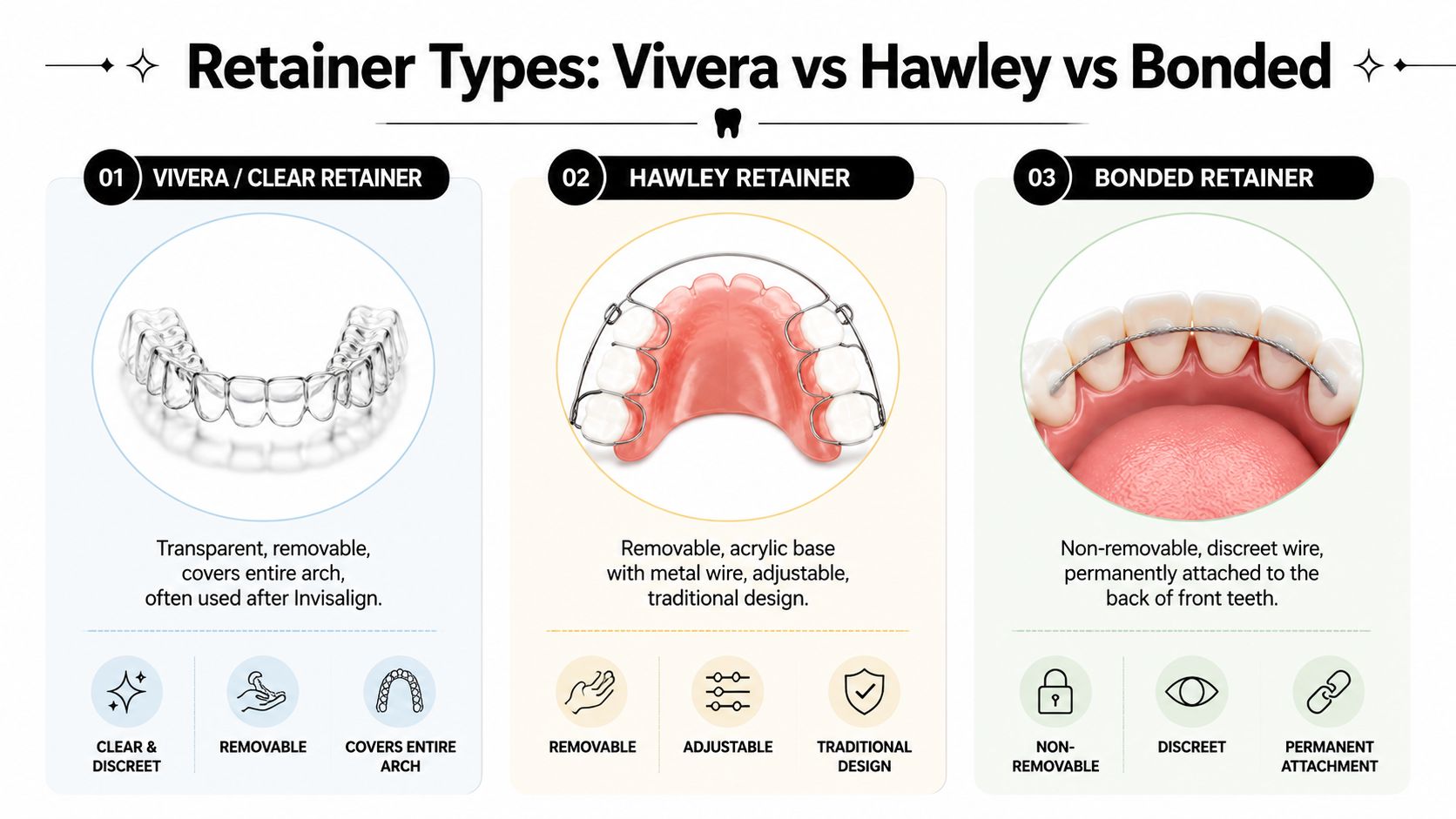
Invisalign identifies three main retainer categories in its retainer types and aftercare overview: Hawley retainers, fixed retainers, and clear thermoplastic retainers such as Essix or Vivera. The same resource notes that clear retainers are commonly cited as lasting about 6 to 12 months to 1 to 3 years, Hawley retainers around 5 to 10 years or longer, and fixed retainers 5 to 10 years+ with repairs or rebonding as needed.
Clear retainers
Clear retainers are popular because they're discreet and familiar to former aligner patients. They cover the teeth, are removable, and usually feel like a natural continuation of Invisalign.
For many adults in New York City, this is the easiest option to accept socially and professionally. They're subtle, simple to insert, and easy to remove for meals and cleaning.
Trade-offs matter, though.
- Best for aesthetics: They're the least noticeable option in everyday wear.
- Easy for hygiene: Because they're removable, brushing and flossing the teeth is straightforward.
- More vulnerable to wear: They can warp, scratch, crack, or loosen over time.
- Less forgiving of bad habits: Heat, grinding, and inconsistent storage shorten their useful life.
Invisalign states in its retainer information for patients that Vivera retainers are 30% stronger and twice as durable, and that 93% of surveyed users agreed Vivera retainers were the most comfortable. The company also cites an IQVIA survey of 289 U.S. dentists (August 2021) in which Vivera was the retainer chosen most often at 99% among surveyed practitioners who straighten teeth.
Hawley retainers
A Hawley retainer uses acrylic with a visible wire. It's the traditional design many patients picture when they hear the word retainer.
It isn't as invisible as a clear retainer, but it remains a strong option when durability and adjustability matter more than appearance. For some patients, especially those who are rough on appliances, that can be a practical advantage.
| Retainer type | Main strength | Main drawback | Wear style |
|---|---|---|---|
| Clear | Discreet appearance | More frequent replacement | Removable |
| Hawley | Long service life and adjustability | More visible | Removable |
| Bonded | Doesn't rely on remembering to wear it | Harder to clean around | Fixed |
A Hawley retainer often works well for patients who don't mind a more traditional look and want something sturdier over the long term.
Bonded retainers
A bonded retainer is a thin wire attached to the back of the teeth, usually in the front. It stays in place continuously, so it doesn't depend on the patient remembering to wear it.
That's the main benefit. Compliance is built in.
The trade-off is maintenance. Because the wire is fixed, plaque control becomes more technique-sensitive. Patients need to clean carefully around it, and the bond or wire can fail without the patient noticing immediately.
Practical rule: A fixed retainer helps when remembering a removable retainer is the weak link. It is not a substitute for monitoring hygiene and fit.
How dentists decide
There isn't one universal winner. The right choice comes from matching the appliance to the patient's risks and routine.
A dentist may think through questions like these:
- Does the patient want the least visible option? Clear retainers usually fit that goal.
- Is long-term durability the priority? Hawley and bonded options often hold up longer.
- Is the patient likely to forget nightly wear? A bonded retainer may reduce that risk.
- Will upcoming restorative dentistry change the bite? A removable option may need to be remade as treatment progresses.
For patients who have grinding, older restorations, or an evolving bite, the retainer choice should support the bigger dental picture, not just the alignment result. That's often where prosthodontic planning adds value, because retention has to coexist with restorative dentistry, cosmetic dentistry, and long-term bite stability.
Your Retainer Schedule Wear Care and Replacement
The day-to-day part of retention is where success is either protected or slowly undermined. Patients usually do well when the instructions are simple, the routine fits their life, and they know what to do when something goes wrong.
A helpful visual summary can make that routine easier to follow.
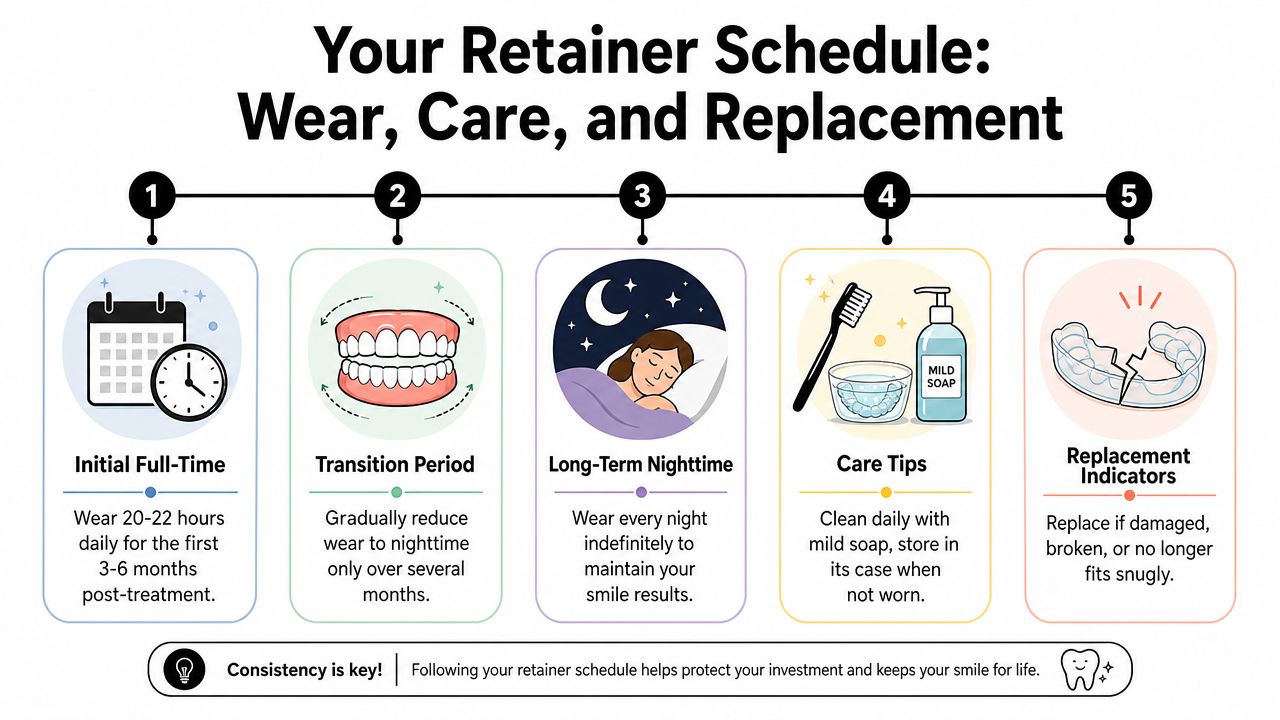
How the wear schedule usually works
After Invisalign, retainers are generally worn full-time for the first 3 to 6 months, usually 20 to 22 hours per day, before many patients move to nighttime-only wear, as described in this overview of retainer wear after Invisalign.
That first phase is where consistency matters most. A patient can't treat a new retainer like an occasional accessory and expect stable teeth.
What tends to work well:
- Keep the same routine every day: Insert the retainer right after brushing in the morning and after meals.
- Use one storage habit: The retainer should be either in the mouth or in its case.
- Treat nighttime wear as permanent maintenance: Many patients continue this as a long-term habit to reduce relapse risk.
A short demonstration can help patients understand wear and care expectations in a more practical format.
Daily care that keeps a retainer usable
Cleaning matters because buildup changes comfort, odor, and sometimes fit. Storage matters because damage often happens outside the mouth, not inside it.
For removable retainers, practical habits usually matter more than elaborate routines:
- Rinse after removal: This helps prevent dried saliva and debris from hardening on the surface.
- Clean gently every day: Mild soap and a soft brush are commonly recommended approaches.
- Avoid heat exposure: A clear retainer can warp if left in a hot car, near steam, or cleaned with hot water.
- Store it properly: A protective case prevents accidental loss or breakage.
Patients who already wear an appliance at night often appreciate similar care principles. This guide on how to clean a night guard naturally is useful because the same common-sense habits apply to many removable dental appliances.
What to do if it is lost cracked or tight
Many generic articles often fall short. They say to wear the retainer, but they don't address the practical problems that lead patients to stop.
According to guidance on wearing retainers after Invisalign, clear retainers may need replacement about every 9 to 12 months due to wear and tear, and if a retainer is lost or broken, it's important to act quickly.
That matters for three reasons:
- A lost retainer creates a time gap. Teeth don't need a dramatic event to shift. They just need time without support.
- A cracked retainer isn't reliable. Even if it still goes in, it may not be holding the teeth evenly.
- A tight retainer is information. Mild tightness can mean teeth have started to move. Forcing an obviously poor-fitting retainer can create new problems.
If a retainer no longer fits the way it used to, the answer isn't to ignore it for a month and hope it settles. That's when a dental office should check whether it can still be used or needs replacement.
Patients searching for an emergency dentist in Manhattan often think only of pain, swelling, or trauma. But a broken retainer after orthodontic treatment can become time-sensitive too, especially when preserving a recent result is the priority.
Retainer Costs and Next Steps at Our Upper East Side Practice
A retainer is part of the total cost of orthodontic care, not an optional add-on. Patients who've invested months in Invisalign usually understand that quickly once they see how easily a lost or worn appliance can jeopardize the result.
That doesn't mean every patient needs the same type or the same replacement pattern. A clear retainer may suit one patient's lifestyle because it's discreet and easy to remove. Another may do better with a Hawley or bonded retainer because durability or compliance is the bigger concern. Cost follows those practical differences, along with whether replacement, repair, monitoring, or coordination with restorative treatment is involved.

Why replacement should be treated like maintenance not an afterthought
Patients often budget for Invisalign and then mentally close the chapter. That's understandable, but retention works better when it's viewed the way patients view cleanings, exams, or replacing a worn night guard. It's ongoing maintenance.
This is also where office systems matter more than people realize. Follow-up visits, appliance checks, and replacement timing are easier to keep on track when communication is consistent. For practices working to prevent dental practice no-shows, reminder systems and organized follow-up can directly support retention outcomes because missed checks often delay action on damaged or ill-fitting retainers.
What patients can expect in the office
At Prosth & Co., a retainer visit may include checking fit, reviewing the bite, examining any existing restorations, and discussing whether upcoming treatment could affect the appliance. That matters for adults who are also considering crowns, veneers, implant dentistry, or broader restorative dentistry.
Patients on the Upper East Side often want one office that can handle more than one concern at a time. A person may come in asking about retainers after Invisalign treatment and also need a broken filling evaluated, a cosmetic consultation, or planning for dental implants near me after tooth loss. When those conversations happen together, the long-term plan is usually stronger.
A new patient appointment in Manhattan should feel clear, not rushed. Patients should expect an explanation of what the retainer is doing, what signs suggest replacement, and how any future dental work may affect fit. That same visit can also connect to broader dental care, including cleaning and exams, restorative dentistry, cosmetic dentistry, and help for urgent problems such as a cracked tooth or possible tooth extraction needs.
Your Lifelong Smile Partner on the Upper East Side
The main lesson is simple. Straight teeth after Invisalign don't stay that way automatically. Retention is the final step that protects the result, and in many adults, it becomes part of long-term oral health maintenance.
The right retainer isn't always the most invisible one or the one a friend happened to receive. It's the one that fits the patient's bite, habits, hygiene, and future treatment needs. That's especially true for adults who are also navigating cosmetic work, restorative dentistry, grinding, or missing teeth.
A strong retention plan also fits into the bigger picture of dental care. Patients who need routine cleanings, dental x-rays, new patient exams, teeth whitening, veneers, crowns, implant restorations, or access to an emergency dentist benefit from a dental home that can follow the smile over time instead of treating each issue in isolation.
A retainer protects alignment, but long-term smile stability depends on more than one appliance. It depends on regular care, timely repairs, and a dental team that sees the whole picture.
For Manhattan patients, especially those on the Upper East Side, that kind of continuity matters. It keeps small issues from turning into larger ones and helps preserve both aesthetics and function.
If you're looking for a trusted dental team on the Upper East Side to help with retainers after Invisalign treatment, restorative dentistry, cosmetic dentistry, dental implants, or routine preventive care, Prosth & Co. offers extensive treatment in a patient-focused setting at 47 E 77th St, Suite 207, New York, NY 10075. Schedule a consultation to have your retainer fit, bite, and next steps evaluated with a plan designed for your long-term smile.