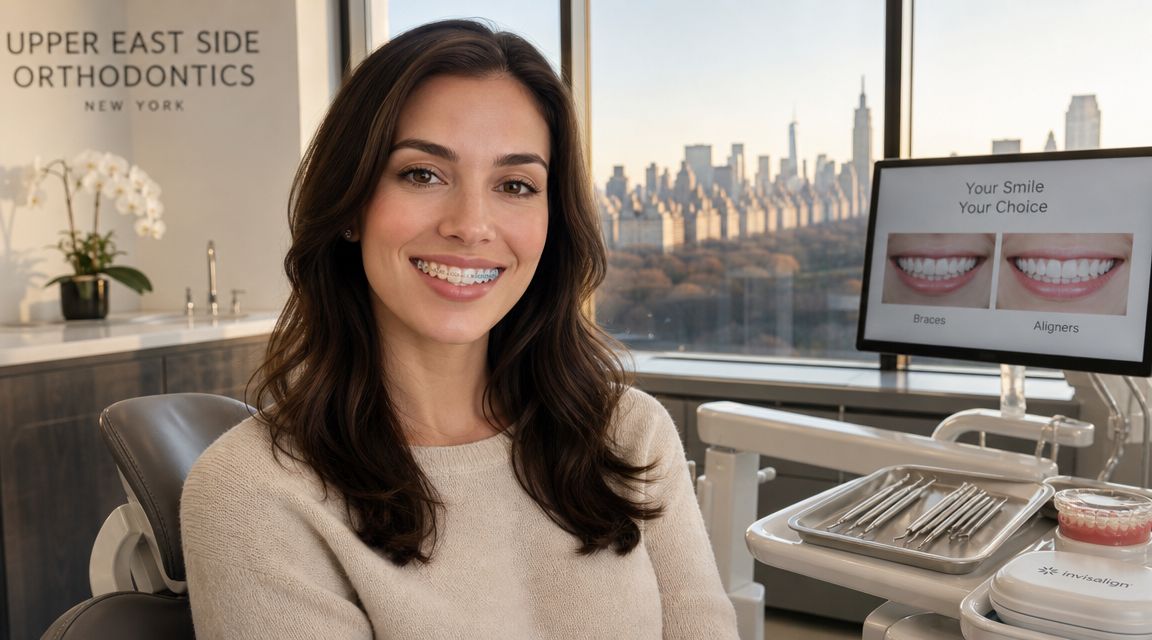
Clear braces usually means one of two things. It can refer to tooth-colored ceramic braces that work like metal braces, or clear aligners that are removable trays, and aligners are most effective for mild to moderate cases, where reviews commonly report about 80% to 90% success when patients follow wear instructions.
A lot of adults in Manhattan start in the same place. They notice crowding in photos, a bite that doesn't feel quite right, or front teeth that have shifted over time, but they don't want a treatment that feels too obvious in meetings, dinners, or day-to-day city life. The confusion usually starts with the phrase what is clear braces, because people often use it to describe two completely different orthodontic options.
That distinction matters. One option stays attached to the teeth and offers strong control. The other comes in and out, which many patients love, but it asks more from the person wearing it. The right choice depends less on what looks most discreet on paper and more on what will effectively move the teeth predictably and comfortably for that specific bite.
Table of Contents
- Considering a Straighter Smile in NYC You Have Options
- Defining Clear Braces Two Types Explained
- Ceramic Braces vs Clear Aligners Which Is Better for You
- The Clear Braces Treatment Journey From Consultation to Retention
- Cost and Care What to Expect with Your Investment
- Why Choose Prosth and Co for Your Smile Makeover in Manhattan
- Your Clear Braces Questions Answered
Considering a Straighter Smile in NYC You Have Options
A common Upper East Side scenario looks like this. A patient has done well with routine cleanings and exams, keeps up with cosmetic dentistry, and maybe has even thought about teeth whitening, yet still feels distracted by one crooked front tooth or a bite that makes the smile look uneven. The hesitation isn't about whether straighter teeth would help. It's about whether treatment will feel too visible, too disruptive, or too complicated for life in New York.

That's why discreet orthodontics has become such a common starting point for adults searching for a dentist near me or a cosmetic dentist in New York, NY. Many people don't want traditional metal braces, but they also don't want to choose a less visible option that won't handle the actual problem. A smile can be cosmetic and functional at the same time. If the bite is off, if teeth overlap, or if wear is building up, the treatment plan has to respect all of that.
At an Upper East Side practice that provides both restorative dentistry and orthodontic options, patients can compare appliances instead of being pushed toward a single format. For some, traditional braces in New York still make the most sense. For others, clear treatment can fit beautifully into work, family life, and social routines.
Clear treatment isn't one thing. The smart question isn't “Which option is most invisible?” It's “Which option will move these teeth and this bite safely, predictably, and with the least disruption?”
That's especially relevant in Manhattan, where adults often arrive with mixed goals. They may want straighter teeth, but they may also need help with worn edges, old dental work, clenching, or a smile makeover that includes restorative care. In those cases, the orthodontic choice should support the larger treatment plan, not work against it.
Defining Clear Braces Two Types Explained
The phrase clear braces causes confusion because patients use it for two different treatments. One uses brackets and wires. The other uses removable plastic trays. Both are designed to be less noticeable than metal braces, but they work in different ways and suit different kinds of cases.

Ceramic braces
Ceramic braces are fixed braces with tooth-colored or clear-looking brackets. They stay on the teeth, just like traditional braces, so the orthodontic force is present all the time. According to Godley Family Orthodontics on what clear braces are made of, ceramic braces use the same force system as metal braces. An archwire delivers continuous light force to move teeth into position, and they can treat a wide range of malocclusions, including crowding, spacing, overbites, and underbites.
That fixed design is a big reason ceramic braces remain useful when a case needs more control. If a tooth has to rotate significantly, if the bite relationship needs more precise correction, or if there's concern that a removable system won't be worn consistently, fixed braces can offer a steadier path.
A simple way to think about ceramic braces is this. They're closer to a standard rail system. Once placed, they keep guiding the teeth every hour of the day.
Clear aligners
Clear aligners are removable trays made from transparent plastic. They're custom fitted and changed in sequence so each set nudges the teeth farther along the treatment plan. A peer-reviewed review in the National Library of Medicine article on aligner materials and limits notes that aligners are manufactured in thicknesses of 0.020, 0.025, or 0.030 inches, and that thicker sequences can offer more control over movement.
Clear aligners are usually strongest in mild to moderate crowding or spacing. They can also reduce pain, white-spot lesions, and emergency visits compared with fixed appliances, but they require excellent compliance and have limits in more complex malocclusions.
Practical rule: If a patient wants freedom to remove the appliance for meals and brushing, aligners are appealing. If a patient needs the appliance to keep working without daily decision-making, ceramic braces often have an advantage.
Many adults ask, “What is clear braces really referring to?” The honest answer is that the phrase isn't precise enough on its own. A consultation has to sort out whether the patient means the attached kind or the removable kind, because the treatment planning is very different.
Ceramic Braces vs Clear Aligners Which Is Better for You
A common Manhattan consult starts like this. A patient says, "I want clear braces," but means removable trays. Another says the same phrase and is asking for tooth-colored brackets. Those are two different treatments, and the better choice depends less on the word "clear" and more on what your teeth and bite need to do.
From a prosthodontist's point of view, that distinction matters. Straightening teeth is not only about making the front teeth look even in photos. It also affects how the teeth meet, how restorations will fit, and whether the result will stay comfortable over time. At Prosth & Co., we help patients choose the option that matches both the cosmetic goal and the clinical reality.
A quick side by side view
| Feature | Ceramic Braces | Clear Aligners |
|---|---|---|
| Appearance | Less noticeable than metal braces, but still attached to teeth | Very discreet when worn |
| How they work | Fixed brackets and archwire move teeth continuously | Removable trays move teeth in stages |
| Best fit | Broader range of bite and alignment problems | Usually mild to moderate crowding and spacing |
| Lifestyle | No need to remember wear time, but food choices and hygiene matter | Must be removed for meals and worn consistently |
| Maintenance | Brackets and elastic ties can stain and brackets can break | Trays need cleaning and disciplined daily use |
| Complex movement | Often stronger choice when more control is needed | More limited for some rotations and bite corrections |
How the choice plays out in real life
Ceramic braces work like a train fixed to its track. Once they are bonded in place, they keep guiding the teeth all day and all night. That can be a real advantage for adults who are busy, forgetful, or do not want treatment success to depend on remembering trays after every coffee, lunch, or late meeting.
Clear aligners ask more of the patient, but they offer more day-to-day freedom. You remove them to eat, brush, and floss. For the right person, that feels easy and clean. Patients looking into clear aligner treatment in New York often like that they are hard to notice in professional and social settings.
The tradeoff is control. If teeth need significant rotation, more vertical movement, or better bite coordination, ceramic braces often give the doctor a firmer hand on the steering wheel. Aligners can do beautiful work in simpler cases, especially small spacing issues or mild crowding, but they are not always the strongest tool for every bite problem.
There are also practical details patients do not always hear at the start. Ceramic brackets are more discreet than metal, but the clear ties around them can pick up color from coffee, tea, red wine, or curry between visits. Aligners stay clearer in appearance, yet they only work well if they are worn as directed every day.
A helpful way to sort the decision is to ask one question. Is your main goal a modest cosmetic refinement, or do you also need the bite itself corrected?
- Ceramic braces may be the better fit if you need more complex tooth movement, stronger bite correction, or a treatment method that keeps working without daily wear decisions.
- Clear aligners may be the better fit if your case is more straightforward and you are comfortable wearing trays consistently.
- A closer restorative review is wise if you have crowns, veneers, missing teeth, worn edges, or future cosmetic dentistry plans that could affect the final bite.
For many adults, the "better" option is the one that reaches the finish line with the fewest compromises. The less visible appliance is not always the easier treatment overall. A fixed system can be simpler for the patient and more predictable for the clinician.
Cost matters, of course. Still, the first decision should be clinical fit. Once that is clear, the investment makes a lot more sense.
The Clear Braces Treatment Journey From Consultation to Retention
A patient often comes in expecting the process to begin with trays or brackets. In reality, good treatment starts with a diagnosis. That first step matters because the right plan depends on more than how the front teeth look in a mirror.

Step one starts with records and diagnosis
At the consultation, we talk about what is bothering you, what you hope to change, and whether timing matters. Some adults want a small adjustment before a major life event. Others have a deeper functional concern, such as chewing imbalance, tooth wear, or spaces that collect food.
Records help separate those two situations.
Photos, an exam, and dental x-rays show how the teeth sit in the bone and how the jaws relate to each other. If you have crowns, veneers, missing teeth, or worn edges, those details are part of the plan from the beginning. A prosthodontic perspective is helpful here because straightening teeth is only one part of the picture. The bite has to work well with the teeth you have now and with any future restorative or cosmetic treatment you may want later.
Active treatment and follow up visits
Once the diagnosis is complete, active treatment begins. Ceramic braces are attached to the teeth and adjusted over time. Clear aligners come as a series of trays, with instructions for wear, cleaning, and how to switch to the next set.
The process is different, but the goal is the same. We move teeth in a controlled way so the smile looks better and the bite fits together more comfortably.
Follow up visits are how that control is maintained. With ceramic braces, visits focus on wires, brackets, tooth movement, and home care. With clear aligners, visits focus on tray fit, tracking, and whether the teeth are following the planned sequence. If a tooth is not moving as expected, early correction saves time and frustration.
Treatment usually follows a pattern like this:
- Initial records and exam with imaging, bite analysis, and a discussion of goals.
- Delivery appointment for ceramic braces or the first aligner series.
- Progress visits to monitor movement and make adjustments as needed.
- Refinement or finishing to fine tune tooth position, bite contact, and smile details.
- Retention with retainers to hold the result.
Each phase builds on the one before it.
That is why the middle of treatment can feel slower than patients expect. Teeth do not move like pieces on a screen. They move through bone, and that biology sets the pace. A careful plan is usually more stable than a rushed one.
Retention is part of treatment, not an afterthought. Teeth can drift after active movement, especially when they were crowded or rotated before.
Retainers protect the result once the active phase is complete. Whether you started with ceramic braces or clear aligners, retention keeps the smile from gradually slipping back toward its old position.
At Prosth & Co., this final stage gets the same attention as the first. For many adults in New York, the best outcome is not just straighter teeth at the finish line. It is a result that still looks and feels right years later.
Cost and Care What to Expect with Your Investment
A patient on the Upper East Side will often ask two very practical questions after learning the difference between ceramic braces and clear aligners. What will this cost, and how hard will it be to live with day to day? Those questions matter because the right choice is not only about which option looks less noticeable. It is also about which one fits your bite, your schedule, and your habits well enough to carry treatment to the finish line.
What affects the cost in Manhattan
Orthodontic fees in Manhattan are shaped by diagnosis more than by the label on the appliance. A small spacing issue near the front teeth may be simpler to correct than a case with crowding, tooth rotation, or a bite that needs to be guided into a healthier position. If treatment also needs to coordinate with crowns, veneers, implant planning, or older dental work, the planning becomes more detailed and the fee can change with it.
That is one reason a quick mirror check at home can be misleading.
Teeth are a little like the visible part of a building. The front view shows one piece. The way the teeth meet, the condition of the gums, and the position of the roots tell the rest of the story. From a prosthodontist's point of view, that bigger picture matters because a smile should look good and function well at the same time.
Insurance sometimes helps, depending on the plan and the reason for treatment. Financing may also be available to spread the cost over time. The clearest estimate usually comes after records, imaging, and a bite analysis, because that is when the treatment plan becomes specific rather than approximate.
Daily care depends on which type of clear braces you choose
This is also where many patients sorting out the phrase "clear braces" get tripped up. Ceramic braces and clear aligners may both look discreet, but they ask very different things of you at home.
Ceramic braces stay on the teeth full time, so success depends on cleaning thoroughly around brackets and wires and being careful with foods that can break parts or stain the ties. Clear aligners are removable, which gives you more freedom at meals and for brushing, but they only work when they are worn consistently for most of the day. If they spend too much time in a napkin, a pocket, or a handbag, tooth movement can stall.
In plain terms, fixed braces ask for more care while they are in your mouth. Aligners ask for more self-discipline because you can take them out.
A simple care routine helps keep either option on track:
- Ceramic braces: brush carefully around each bracket, floss with the tools recommended by your dentist, and avoid sticky or very hard foods.
- Clear aligners: remove trays before eating or drinking anything other than water, clean them daily, and place them back in promptly after meals.
- Both options: keep regular professional visits and keep the gums healthy, because inflammation can make orthodontic treatment harder to manage.
For some adults in New York, ceramic braces are the better clinical choice because they do not rely on patient wear time and can handle more involved tooth movement. For others, aligners fit work, dining, and social routines better and still meet the clinical goal. At Prosth & Co., the decision is guided by both sides of the equation. What your teeth need, and what you are most likely to do well with every day.
Why Choose Prosth and Co for Your Smile Makeover in Manhattan
A common Upper East Side scenario goes like this. A patient comes in asking for "clear braces" and means aligners, while the bite and tooth positions suggest ceramic braces may do the job more predictably. Another patient assumes brackets are the only answer, yet a removable aligner system may fit the clinical plan and daily routine well. Sorting out that confusion is part of good diagnosis.
Adults considering orthodontic treatment often need more than straighter front teeth. They may have worn edges, older crowns, spaces from missing teeth, or a bite that has shifted over time. Prosthodontic training helps connect those pieces, so the choice between ceramic braces and clear aligners supports the whole mouth, not just the smile in photos.
Why prosthodontic training changes the conversation
A prosthodontist looks at tooth movement the way an architect looks at a renovation. The question is not only how the front of the room will look. The question is whether the structure will work well once the changes are finished.
That point matters when patients are deciding between ceramic braces and aligners. Clear aligners can be an excellent option for cosmetic corrections and many mild to moderate alignment problems. Ceramic braces often give better control for more involved movements, including certain rotations, vertical changes, and bite corrections. From a prosthodontist's viewpoint, the better choice is the one that positions the teeth where they can function comfortably and support any future restorative care.

What patients can expect in the office
At Prosth & Co., care can include prosthodontic planning, restorative treatment, cosmetic dentistry, and orthodontic coordination in one setting. That is helpful for adults whose smile goals are tied to more than alignment alone. Digital imaging, intraoral photos, and clear chairside explanations let patients see what we see and understand why one option is being recommended over another.
For a patient looking for a dentist in New York, NY, that integrated approach can make the process feel much more orderly. Orthodontic treatment may need to work around existing crowns, prepare for future implant restoration, create space before veneers, or improve how the bite meets before worn teeth are rebuilt. In other words, tooth movement is often one step in a larger plan.
Good orthodontic planning asks two questions at once. How will the teeth move, and what will the mouth need once they get there?
The office experience matters too. Manhattan patients often want visits that run on time, explanations that are easy to follow, and a plan that fits work, family, and social schedules. A calm setting and a well-organized process do not move teeth by themselves, but they do make treatment easier to stay committed to over time.
Your Clear Braces Questions Answered
Do clear braces hurt
Most patients notice pressure rather than sharp pain. Ceramic braces can make the teeth and cheeks feel tender after placement or adjustments. Aligners can create a similar pressure when a new tray starts working. That early soreness usually settles as the mouth adapts.
Are clear braces only for adults
No. Teens can also be candidates, depending on the type of movement needed and how responsible they are with daily care. The decision is less about age and more about maturity, bite complexity, and whether a removable system would be worn as directed.
Will they affect speech
Some patients notice a short adjustment period, especially with clear aligners because the trays cover the teeth. Speech usually sounds more natural as the tongue adapts. Ceramic braces may feel bulky for a few days, but patients typically adjust quickly.
How does someone know which type is right
The best answer comes from a full exam, not from a mirror selfie. Front teeth may look like a cosmetic issue while the underlying problem is the bite relationship, crowding pattern, or the position of back teeth. That's why digital imaging, photos, and a proper diagnosis matter before choosing between trays and brackets.
Can treatment be combined with other dental care
Yes, and that's common. Some adults need orthodontic movement before veneers, crowns, implant planning, or other restorative dentistry. Others want straighter teeth first and cosmetic refinements later. Coordinating that sequence helps produce a result that looks natural and functions well.
Patients who are comparing ceramic braces and clear aligners don't need to guess which option fits their smile. The team at Prosth & Co. can evaluate the bite, explain the tradeoffs clearly, and help Manhattan patients choose a treatment path that supports both appearance and long-term function. Scheduling a consultation is the next step for anyone looking for a dentist near me on the Upper East Side who can provide thoughtful, thorough smile care.

Founder and lead prosthodontist of Prosth & Co. on Manhattan's Upper East Side. DDS, Columbia University; Prosthodontics certificate and MMSc in Oral Biology, Harvard School of Dental Medicine; Implantology fellowship, Columbia University.
Meet Victoria →