A missing tooth often becomes a daily problem before it becomes a dental appointment. A person may notice food catching in the space at lunch, a slight whistle in speech during a meeting, or a smile that suddenly feels incomplete in photos. In Manhattan, where schedules move fast and first impressions matter, that change can feel bigger than expected.
That's usually when people start searching for a dentist near me or a dentist in New York, NY and asking a simple question that deserves a clear answer: What is a dental bridge? A bridge can be an excellent way to replace a missing tooth or a small span of missing teeth, but the right choice depends on the condition of the nearby teeth, the bite, the gums, and the patient's long-term goals.
Table of Contents
- Your Trusted Dentist on the Upper East Side
- What Is a Dental Bridge
- Types of Dental Bridges We Offer
- The Dental Bridge Process Step by Step
- Benefits Risks and Lifespan of a Dental Bridge
- Comparing Bridges with Implants and Partial Dentures
- Your Bridge Treatment at Prosth & Co on the UES
- Frequently Asked Questions About Dental Bridges
Your Trusted Dentist on the Upper East Side
On the Upper East Side, many patients don't first come in saying they need restorative dentistry. They usually describe a problem in plain language. A tooth came out. A space is showing when they laugh. Chewing on one side feels awkward. Something just doesn't feel right anymore.
That kind of visit often starts with worry. Some people are concerned about appearance. Others are more focused on function, especially if a back tooth is missing and meals have become less comfortable. When a tooth is gone, the change can affect confidence, bite balance, and day-to-day comfort at the same time.
Common reasons patients seek help
- Changed smile: A front-tooth gap can make a person feel guarded in conversations or photos.
- Chewing difficulty: A missing back tooth can make it harder to bite evenly and comfortably.
- Movement of nearby teeth: Spaces don't always stay still. Nearby teeth can begin to shift.
- Urgent problems: A broken tooth, failed old dental work, or trauma may send someone searching for an emergency dentist in Manhattan.
A missing tooth is rarely just a cosmetic issue. It often changes how a person eats, speaks, and feels about smiling.
Patients looking for a cosmetic dentist near me, dental implants near me, or general restorative care often want one office that can explain options calmly and clearly. On the Upper East Side, that usually means discussing whether a bridge, implant, crown, or another treatment makes the most sense for that specific mouth, not just for the missing tooth alone.
This patient-centered approach matters because the right answer for a busy New Yorker isn't always the same as the right answer for someone else. Some patients want the most conservative path. Some need a faster solution. Others are balancing prior dental work, gum health, or a recent tooth extraction. Clear guidance helps turn a stressful problem into a plan.
What Is a Dental Bridge
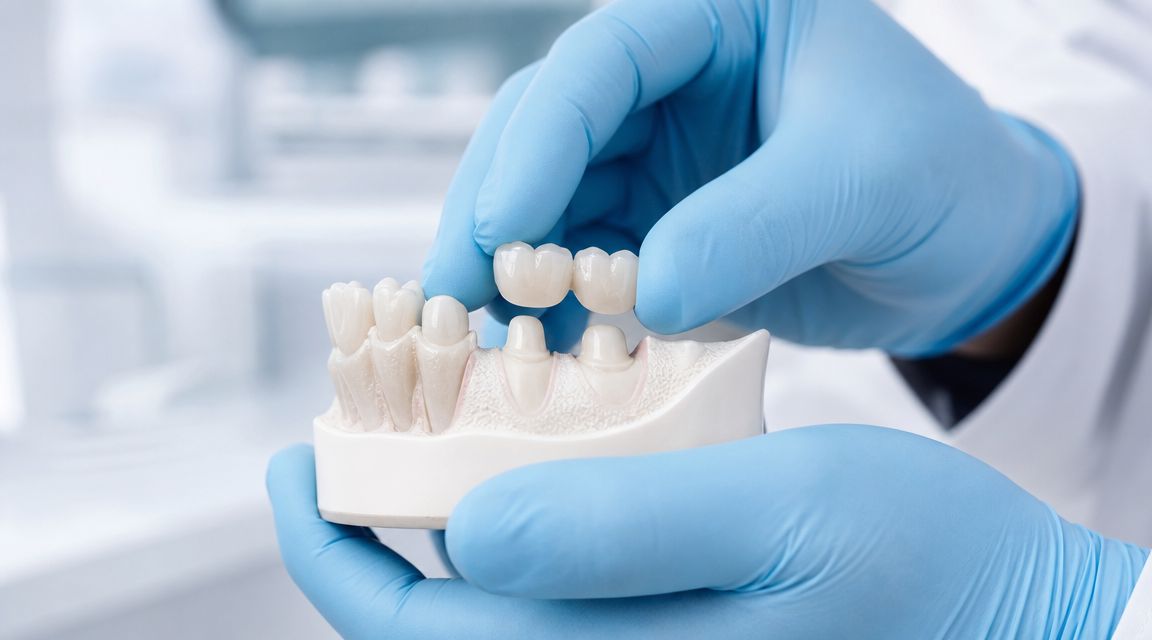
A dental bridge is a fixed prosthetic used to replace missing teeth. The name is literal. It bridges the open space left behind after a tooth is lost, using support from the teeth next to the gap or from implants, depending on the design. Cleveland Clinic's dental bridge overview notes that the most common design is the traditional bridge, which uses crowns on the teeth adjacent to the gap plus an artificial tooth, called a pontic, in between.

A simple way to picture it
A bridge works much like a small bridge over water. There are supports on each side, and the span in the middle fills the empty space. In dentistry, the supports are often the neighboring teeth, and the replacement tooth in the middle restores the gap.
For many patients, that simple analogy clears up the biggest point of confusion. A bridge is not removable in the way a partial denture is removable. It stays in place and is designed to feel like part of the smile.
What a bridge helps restore
A bridge does more than fill a hole in the smile. It can help with several practical concerns:
- Chewing: It restores contact where food was harder to bite or grind.
- Speech: It can help when a gap changes airflow or pronunciation.
- Smile shape: It fills in the visible space so the smile looks more complete.
- Tooth position: It can help prevent nearby teeth from drifting into the open area.
The same Cleveland Clinic reference explains that traditional bridges are most often used for a gap of one to three teeth in a row, and with good maintenance the average lifespan is about 5 to 15 years. That range helps explain why many patients choose a bridge. It's a mainstream restorative option that can often return function and appearance relatively quickly.
Practical rule: A bridge replaces the missing tooth area, but its success also depends on the health of the supporting teeth and gums.
That's why the question “what is a dental bridge” is only the starting point. The more useful question is whether a bridge fits the patient's bite, timeline, and long-term goals.
Types of Dental Bridges We Offer
Not all bridges are built the same way. The design depends on where the missing tooth is, how much support exists nearby, and how conservative the treatment should be. Patients often hear several terms during a consultation and assume they all mean the same thing. They don't.

Traditional bridge
This is the bridge typically described when dental bridge treatment is discussed. It uses crowns on the teeth on either side of the space, with a pontic between them. It's often chosen when the neighboring teeth already need significant restoration or can appropriately support the bridge.
Traditional bridges are commonly used when one to three teeth are missing in a row. They're familiar, predictable, and often a strong fit for patients who want a fixed replacement without implant surgery.
Cantilever bridge
A cantilever bridge is supported on only one side. That makes it more situation-specific.
It may be considered when there is only one suitable adjacent tooth next to the gap. Because the biting forces are different with this design, case selection matters. In the right place, it can work well. In the wrong place, it can place too much demand on the supporting tooth.
Maryland bridge
A Maryland bridge uses a framework bonded to the backs of adjacent teeth instead of full crowns on both sides. Patients often like this option because it can be more conservative in selected cases, especially in the front of the mouth where bite forces may allow it.
This design can be appealing when preserving natural tooth structure is a priority. It isn't right for every bite, but for the right front-tooth situation it can be elegant and efficient.
Implant-supported bridge
An implant-supported bridge is anchored to implants rather than natural teeth. This often makes it the most stable option for replacing multiple teeth, especially when a longer span needs support. Some sources note that implant-supported bridges may be used for three or more missing teeth in a row, which is one reason they're an important option in advanced restorative planning.
The choice here is less about labels and more about matching the design to the mouth. A patient with strong neighboring teeth, limited time, and a single missing tooth may need a different plan than someone replacing several teeth and wanting the most stable long-term chewing support.
| Bridge type | Best suited for | Main support |
|---|---|---|
| Traditional | One to three missing teeth with support on both sides | Adjacent teeth |
| Cantilever | A gap with support available on only one side | One adjacent tooth |
| Maryland | Select front-tooth cases where a conservative approach fits | Bonded retainers |
| Implant-supported | Multiple missing teeth needing strong support | Dental implants |
The Dental Bridge Process Step by Step
For many patients, the hardest part of bridge treatment is not the treatment itself. It's not knowing what will happen. Once the steps are clear, the process usually feels much more manageable.
A typical bridge case is often completed over two main visits, though timing can vary depending on the design and whether any other treatment is needed first.

Visit one preparation
At the first appointment, the dentist examines the teeth and bite, takes imaging as needed, and confirms that a bridge is the right option. If the bridge will be supported by neighboring teeth, those teeth are carefully shaped so the final restoration can fit properly.
A scan or impression is then taken so the custom bridge can be fabricated. During this stage, patients often receive a temporary bridge to protect the prepared teeth and keep the smile functional while the final restoration is being made.
For readers who want to understand how support teeth are restored in more detail, dental crowns at Prosth & Co. provide the foundation for many traditional bridge designs.
Temporary restorations matter. They protect the prepared teeth, help maintain comfort, and give patients a preview of how the final bridge will function.
A brief visual overview can also help patients picture the sequence more clearly.
Visit two placement
At the second visit, the temporary bridge is removed. The final bridge is tried in and checked carefully. The dentist evaluates how it fits against the teeth, how it meets the gums, and how the bite comes together when the patient closes and chews.
Small adjustments may be made before the bridge is cemented into place. The goal is for it to feel secure, balanced, and natural in the mouth.
What patients usually notice afterward
Most patients notice two things first. The gap is gone, and chewing feels more complete again. There may be a short adjustment period while the mouth gets used to the new shape, especially if the missing tooth has been absent for a while.
Clear instructions on cleaning, eating, and follow-up care help that transition go smoothly. When patients know what normal adaptation feels like, they're much less likely to worry unnecessarily.
Benefits Risks and Lifespan of a Dental Bridge
A dental bridge can be a very practical solution, but it's important to look at it realistically. Patients do better when they understand both the advantages and the trade-offs.

Benefits that matter in daily life
The biggest benefit is function. A bridge can restore a more even bite and make it easier to chew and speak comfortably. It also helps maintain the shape of the smile and may reduce the tendency of nearby teeth to shift toward the open space.
For many people, there's also a quality-of-life benefit that is hard to overstate. They stop thinking about the missing tooth every time they eat, talk, or smile.
Risks patients should understand
Traditional bridges usually require alteration of the teeth next to the gap because those teeth support the restoration. That's often appropriate, but it is still a real treatment decision. The bridge also relies on the ongoing health of those support teeth and the surrounding gums.
If plaque builds up around the bridge or under the pontic, problems can develop over time. That's why daily cleaning and routine dental care are not optional parts of bridge treatment. They are part of the treatment.
What lifespan really means
Long-term bridge performance is measurable, but it should be read as guidance, not a guarantee for any one person. The National Library of Medicine summary reports an estimated 5-year dental bridge survival rate of 89% to 91% and a 10-year survival rate of 79% to 82% in reviewed studies, with an overall 3.6% failure rate per year across 42 primary studies (NCBI Bookshelf summary on dental bridges).
That information matters because it gives patients a realistic picture. Bridges are durable, but they aren't maintenance-free and they aren't usually forever.
Good bridge care is simple in principle. Keep the gums healthy, clean around the restoration carefully, and don't skip regular checkups.
The right expectation is not permanence. The right expectation is a well-made restoration that can serve well for years when the design is appropriate and the maintenance is consistent.
Comparing Bridges with Implants and Partial Dentures
Most patients don't want a definition alone. They want help making a decision. A bridge is one option. A dental implant is another. A removable partial denture is another. Each has a different role.
One key trade-off, noted in Delta Dental's overview of dental bridges, is that implant-supported bridges are more stable and tend to last longer, while conventional bridges are often a medically simpler and faster choice. The same reference describes conventional bridges as typically lasting about 5 to 7 years with proper care.
Tooth Replacement Options at a Glance
| Feature | Dental Bridge | Dental Implant | Partial Denture |
|---|---|---|---|
| Feel in the mouth | Fixed | Fixed | Removable |
| Support source | Nearby teeth or implants | Implant in bone | Clasps and surrounding tissues |
| Effect on adjacent teeth | Traditional designs often involve those teeth | Usually avoids using adjacent teeth for support | Usually doesn't require crowning adjacent teeth |
| Treatment timeline | Often faster than implant treatment | Usually longer | Often relatively straightforward |
| Stability for chewing | Good | Often the most stable | Can feel less secure |
| Daily maintenance | Careful cleaning around bridge | Care around implant and crown | Remove and clean appliance |
When a bridge makes sense
A bridge can make sense when the neighboring teeth are already restored or need crowns, when a patient wants a fixed option without implant surgery, or when treatment speed matters. It can also be a reasonable option when medical or personal factors make implant treatment less appealing at the moment.
When an implant may be worth stronger consideration
An implant often deserves attention when the patient wants the most stable long-term chewing support and wants to avoid relying on neighboring natural teeth for support. For patients exploring that path, dental implants at Prosth & Co. are one restorative option used to replace missing teeth with implant-based support.
Where partial dentures fit
Partial dentures still have a place. They may be useful when several teeth are missing, when a removable option is preferred, or when a bridge or implant isn't the right immediate step. They can restore appearance and some function, though they typically feel different from a fixed restoration.
The best choice depends on what the patient values most. Some people prioritize speed. Some prioritize stability. Some want the least intervention on neighboring teeth. Good treatment planning keeps those priorities visible from the start.
Your Bridge Treatment at Prosth & Co on the UES
For Upper East Side patients, convenience matters, but so does precision. Bridge treatment works best when planning, tooth preparation, bite evaluation, and esthetics are handled with close attention to detail. Small decisions shape how natural the final result looks and how comfortably it functions.
Dr. Victoria Park's prosthodontic training at Columbia University and the Harvard School of Dental Medicine reflects a focus on complex restorative care, including the details that often matter most in bridges, crowns, implant restorations, and full-mouth rehabilitation. In a city where many patients want both efficiency and polish, that kind of focused restorative background can be especially valuable.
What the office experience is like
The practice is located at 47 E 77th St, Suite 207, New York, NY 10075, which makes care accessible for patients living or working in Manhattan. Modern imaging, intraoral photos, and clear explanations help patients understand what is happening in their own mouths instead of being told what they need.
An in-house lab also supports efficient workflows and close control over restorative details. That can be helpful when fit, shape, and shade need careful coordination.
What patients can expect
- Clear consultation: The condition of the missing area, neighboring teeth, bite, and gums is reviewed in straightforward language.
- Thoughtful planning: Bridge treatment is weighed against alternatives such as implants or other restorative options.
- Comfort-focused care: The team works to reduce anxiety and keep appointments calm and organized.
- Whole-smile perspective: Esthetics and chewing function are considered together, not as separate goals.
For Manhattan patients searching for a dentist near me, cosmetic dentistry, restorative dentistry, dental x-rays, cleaning and exams, tooth extraction follow-up, or help after an urgent dental problem, continuity matters. One office that can diagnose, explain, and restore the smile in a coordinated way tends to make the process easier.
Frequently Asked Questions About Dental Bridges
Is getting a dental bridge painful
Bridge treatment is usually performed with local anesthesia, so the teeth being prepared should be numb during the procedure. Afterward, some patients notice temporary sensitivity or mild soreness, especially around the supporting teeth or gums. That usually feels more manageable once they know what to expect.
What can someone eat with a dental bridge
Right after placement, softer foods are often easier while the bite and surrounding tissues settle in. Over time, most patients return to a normal diet, but it's wise to be careful with very hard or very sticky foods that can place extra stress on dental work.
If a new bridge feels high, catches oddly during chewing, or remains uncomfortable, the patient shouldn't wait and hope it resolves on its own. A bite adjustment may be needed.
How is a bridge kept clean
A bridge needs daily cleaning above, around, and beneath the replacement tooth area. Regular brushing still matters, but the area under the pontic often needs special attention with tools or techniques recommended by the dental team. Clean bridges tend to last longer because the support teeth and gums stay healthier.
Does dental insurance cover bridges
Coverage varies by plan, waiting periods, annual limits, and the reason treatment is needed. Many patients are surprised to learn that insurance questions can be as important as treatment questions. A dental office can usually help review benefits and explain what portions may or may not be covered before treatment begins.
When should someone call sooner rather than later
A patient shouldn't wait if a tooth breaks, an old bridge becomes loose, pain develops around a missing tooth site, or chewing becomes suddenly difficult. Those situations may call for prompt evaluation, especially if an emergency dentist visit is needed to stabilize the problem before a full restorative plan is made.
Patients in Manhattan who want a clear answer about bridge treatment, implants, crowns, or other restorative options can schedule a consultation with Prosth & Co.. The office helps Upper East Side patients understand what's happening, what their options are, and which treatment fits their smile, bite, and daily life.
Related topic: Learn more about Crowns, Bridges And Dentures.

Founder and lead prosthodontist of Prosth & Co. on Manhattan's Upper East Side. DDS, Columbia University; Prosthodontics certificate and MMSc in Oral Biology, Harvard School of Dental Medicine; Implantology fellowship, Columbia University.
Meet Victoria →