
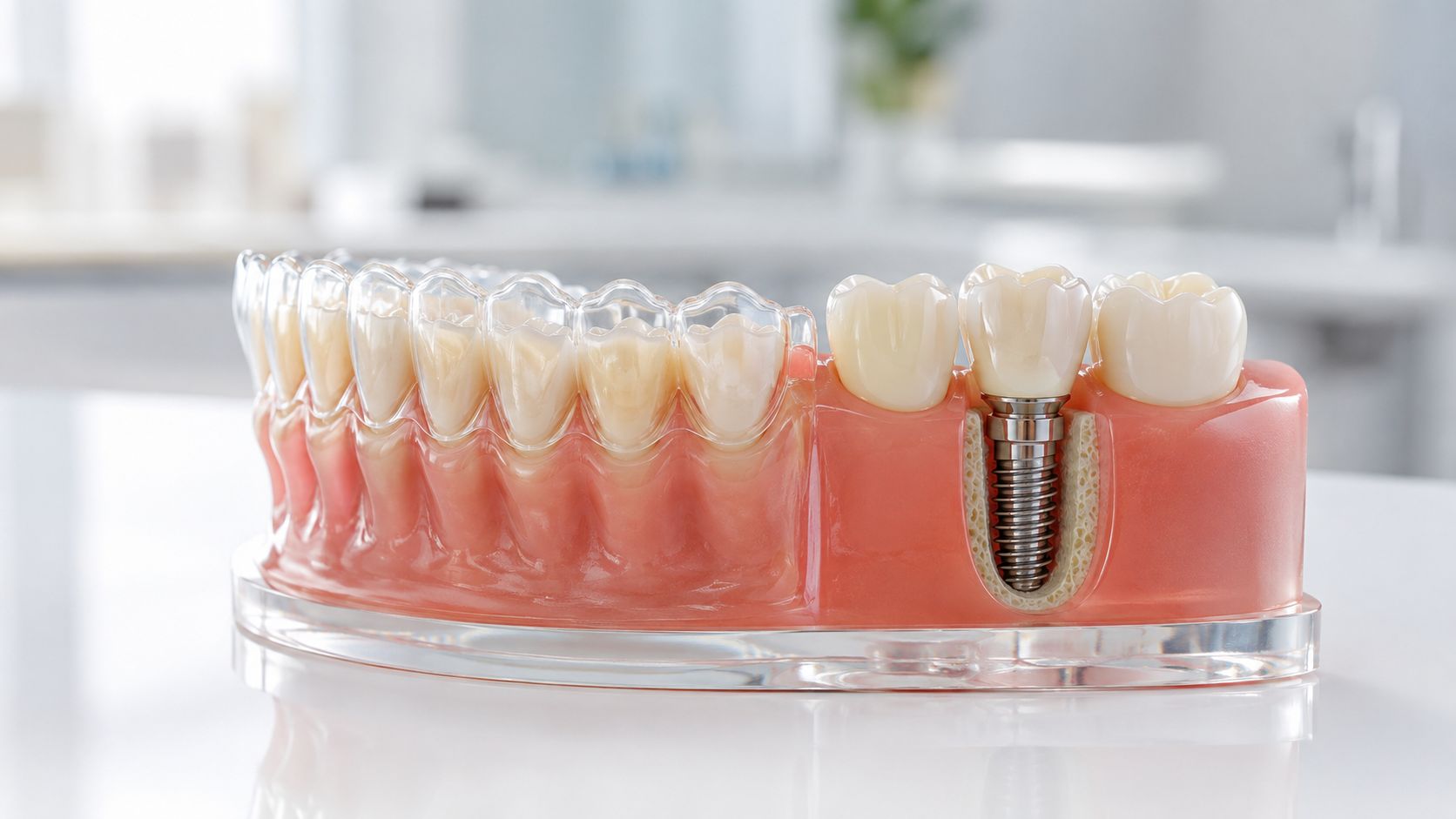
A common Upper East Side dental question sounds simple at first. A patient wants straighter teeth, but there's also a missing tooth, an older bridge that's failing, or a front tooth that may need to be replaced. The uncertainty usually isn't about whether modern dentistry can fix both problems. It's about where to begin without making the final result look forced or function poorly.
That's where combined planning matters. Clear aligners are now a mainstream treatment. By Q1 2025, over 18 million people worldwide had used Invisalign, according to this 2025 Invisalign statistics roundup. For adults in New York City who want a smile that looks polished and feels stable, the primary concern is rarely “Can Invisalign and dental implants work together?” Instead, it's “What sequence creates the best final smile?”
Table of Contents
- Planning Your Smile Makeover in New York City
- Why Implants and Aligners Behave Differently
- The Ideal Sequence Invisalign Before Your Dental Implant
- Invisalign With an Existing Dental Implant
- Your Combined Treatment Workflow at Prosth & Co.
- Expected Timeline Costs and Patient Commitment
- Schedule Your Consultation on the Upper East Side
Planning Your Smile Makeover in New York City
In Manhattan, many adults arrive with two goals that don't seem to fit together at first. They want a more even smile for work, photos, or daily confidence. At the same time, they're dealing with a missing tooth, a tooth that can't be saved, or an old restoration that no longer feels right.
That combination creates confusion fast. If the implant goes in first, will it block tooth movement later? If Invisalign starts first, will the space for the future tooth look awkward during treatment? Those are reasonable concerns, especially for busy patients searching for a dentist in New York, NY, a cosmetic dentist near me, or dental implants near me and hoping to find one office that can look at the full picture.

The concern behind the question
A patient may have crowding in the front teeth and a missing molar. Another may have spacing around a failing tooth and want a more refined smile before replacing it. Someone else may have postponed treatment for years because they assumed cosmetic dentistry and restorative dentistry had to be handled separately.
They don't. But they do need to be sequenced properly.
A straight smile and a complete smile are often built in phases, not in a single appointment.
What specialist planning changes
For combined Invisalign and dental implant cases, the treatment shouldn't begin with the first tray or the implant surgery. It should begin with the end result. The final tooth positions, the ideal implant site, the bite, and the shape of the future crown all need to be considered together.
That's the prosthodontic difference. Instead of treating alignment and tooth replacement as separate services, the planning starts with the final restoration and works backward. For patients looking for a dentist near me on the Upper East Side, that approach can prevent a result that looks acceptable in isolation but compromised when the whole smile is viewed together.
Why Implants and Aligners Behave Differently
Natural teeth and dental implants may look similar above the gums, but they do not respond to force the same way. That single fact explains why sequencing matters so much in combined cases.
A natural tooth has a support system that allows controlled movement. Under gentle pressure from aligners, the tooth can shift gradually within the jaw. That's how Invisalign works.
A dental implant is different by design. It's meant to stay fixed.

Think of movement versus anchorage
A useful way to picture it is this:
| Structure | How it behaves | What that means for treatment |
|---|---|---|
| Natural tooth | Can respond to controlled orthodontic force | Aligners can reposition it |
| Dental implant | Stays fixed in the bone | Aligners must work around it |
An implant functions more like a post set firmly in place. That stability is possible because of osseointegration, the biological fusion of bone to the implant. As explained in this clinical overview of implant failure and planning considerations, improper placement or poor bone quality can interfere with that fusion, which is why 3D imaging and precise planning are essential.
Why this matters in real treatment
Once an implant is integrated, it won't “follow along” with the rest of the smile. If nearby natural teeth need to move, they can move. The implant cannot. That means the implant either becomes a stable reference point or a limitation, depending on where it was placed and how the final smile was planned.
This affects several practical issues:
- Space for the future tooth: If neighboring teeth drifted into a missing tooth space, aligners may be needed to reopen or refine that space before a crown can look natural.
- Root position: The visible gap isn't the only concern. The roots of the adjacent teeth also need to be in favorable positions for an implant site.
- Bite balance: An implant crown should meet the opposing teeth in a controlled way. If the bite is off, the restoration may end up carrying force in the wrong pattern.
Practical rule: If one part of the smile can move and the other part cannot, planning has to begin with that limitation in mind.
What doesn't work well
What usually doesn't work is assuming the implant can be placed wherever the current gap happens to be, then expecting aligners to solve the rest later without compromise. In some mouths, that can leave the final crown too narrow, too wide, or slightly out of harmony with the arch.
For patients seeking cosmetic dentistry, restorative dentistry, or even treatment after a tooth extraction, this is the point that often changes the whole plan.
The Ideal Sequence Invisalign Before Your Dental Implant
For most patients, the most favorable sequence is to straighten the natural teeth first and place the implant afterward. That recommendation isn't based on convenience. It's based on control.
Research on combined cases highlights the central issue clearly: implants are fixed and cannot move orthodontically, so the key decision is whether to create the ideal implant site before placement or accept restorative compromise after placement, as discussed in this review on aligners and implant-adjacent planning. In everyday practice, that means the implant should usually come after the surrounding teeth and bite have been organized.
Creating the right space, not just any space
A missing tooth space can be misleading. From the front, it may look open enough. But once the neighboring teeth are measured carefully, the available room may be uneven, tilted, or not centered where the future crown should sit.
With Invisalign first, the natural teeth can be repositioned so the implant crown has the proportions it needs. That matters most in visible areas, where even a small discrepancy can make the replacement tooth look squeezed or oversized.
Patients exploring clear aligner treatment in New York often assume the trays are being used only to make the smile straighter. In combined cases, they're also being used to prepare the architecture for a restoration that hasn't been placed yet.
Correcting the bite before the permanent tooth goes in
The implant crown should not be an afterthought. It has to function within the bite every day. If the upper and lower teeth don't meet in a balanced way, the final restoration may be forced into a shape or position that is less than ideal.
Orthodontic setup first allows several improvements:
- Better alignment of neighboring teeth, so the implant crown emerges naturally from the smile
- Improved spacing between roots, which supports safer implant planning
- A more coordinated bite, so chewing forces are distributed more predictably
- Cleaner smile symmetry, especially when the missing tooth is in the visible zone
Why prosthodontic planning changes the outcome
A prosthodontist doesn't look only at whether the teeth can be moved. The focus is whether the final crown, bridge, veneer, or full restorative result will look right and function comfortably over time.
That distinction matters. A purely orthodontic win can still become a restorative compromise if the final tooth replacement doesn't fit the face, the bite, or the arch form. Planning backward from the final crown helps avoid that mismatch.
In many combined cases, the most important appliance isn't the aligner or the implant. It's the treatment plan.
When this sequence is especially valuable
This approach is often especially useful when:
- A front tooth is missing or failing and esthetics are very important.
- Adjacent teeth have drifted into the open space.
- There's crowding or spacing elsewhere that affects the bite.
- The patient wants both cosmetic improvement and a stable long-term restoration.
It also helps when a patient is trying to avoid repeating treatment later. If alignment and restoration are coordinated from the start, the final result is less likely to need aesthetic patchwork.
For someone searching dental implants near me, cosmetic dentist near me, or a dentist near me in Manhattan, that sequence often means fewer compromises and a cleaner finish.
Invisalign With an Existing Dental Implant
Some patients already have an implant and only later decide they want straighter teeth. Others had implant treatment years ago and now notice shifting, crowding, or unevenness in the surrounding natural teeth. That situation can still be treated, but the planning logic changes.
The implant is no longer a future part of the plan. It is now a fixed point inside the plan.

What can still move
The surrounding natural teeth can still be guided with aligners. The implant cannot. That means the trays and the digital setup must be designed around a tooth replacement that will stay exactly where it is.
In practical terms, the plan may involve moving teeth toward the implant, away from the implant, or reshaping the surrounding alignment so the whole smile looks more balanced. The implant effectively acts as a non-moving anchor.
Here's a helpful visual explanation of how that works in mixed cases:
What the evaluation needs to answer
Before treatment starts, several questions have to be settled:
- Is the implant in a favorable position? If it sits well in the arch, the surrounding teeth can often be aligned successfully.
- How much movement is being requested? Small to moderate improvements are usually easier to accommodate than a dramatic bite overhaul.
- Will the final esthetic result meet the patient's expectations? Sometimes alignment can improve significantly, but not perfectly, because the implant position sets a boundary.
A fixed implant doesn't make Invisalign impossible. It makes precision more important.
Where compromise may appear
An existing implant may limit how ideal the final tooth positions can be compared with an Invisalign-first sequence. That doesn't mean treatment isn't worthwhile. It means the goals should be realistic and carefully mapped.
For example, a patient may be able to improve crowding and smile symmetry while keeping a well-integrated implant exactly as it is. Another patient may need a more conservative alignment plan because pushing for a textbook finish would clash with the implant's location.
This is why mixed cases do better with detailed records, digital planning, and direct conversation about what's achievable. For adults in New York City looking for a new patient exam, dental x-rays, restorative dentistry, or cosmetic updates, that assessment is often the step that clarifies whether treatment will feel straightforward or constrained.
Your Combined Treatment Workflow at Prosth & Co.
Combined Invisalign and implant cases work best when every phase is connected to the final result. Instead of treating alignment, surgery, and restoration as isolated appointments, the process should function like one continuous treatment pathway.
At Prosth & Co. dental implants in New York, that workflow can include implant planning, restorative design, and cosmetic considerations within a single prosthodontic framework.

Step one starts with records, not assumptions
The first visit should answer more than whether a patient is a candidate for aligners or an implant. It should document the current bite, the quality of the existing space, the health of the surrounding teeth and gums, and the bone available in the implant site.
That commonly involves:
- A thorough exam, including the patient's concerns, goals, and dental history
- Digital x-rays and 3D imaging, when indicated for implant planning and site evaluation
- Photos and bite analysis, so the visible smile and chewing function are both considered
The smile is designed before treatment begins
Once records are collected, the treatment plan can be built in the correct order. Prosthodontic planning adds value at this stage. The final tooth replacement is considered early, before the first aligner is worn or the implant is placed.
A well-sequenced plan often follows this logic:
| Phase | What happens |
|---|---|
| Diagnosis | Teeth, bite, bone, and esthetic priorities are reviewed together |
| Orthodontic setup | Natural teeth are moved if the arch or implant space needs refinement |
| Implant placement | The implant is positioned for the planned restoration |
| Final restoration | A custom crown completes the space in harmony with the new alignment |
The final crown should look like it belonged there from the beginning, not like it was inserted into a space that happened to be available.
Why the restoration phase matters so much
Dental implants are a core part of modern restorative dentistry because of their long-term reliability. Studies cited in this national review of implant prevalence and outcomes report survival above 97%, and the same paper projected implant prevalence among adults missing at least one tooth could reach roughly 17% by 2026 under current trends. That success rate is one reason implants are so widely used in full-mouth rehabilitation and single-tooth replacement.
But reliability alone doesn't guarantee beauty. The crown on top of the implant still has to be shaped, shaded, and positioned to fit the smile around it. That's why the restoration phase deserves as much attention as the surgical one.
What patients usually notice during the process
Patients often say the most reassuring part of a combined plan is clarity. They know which phase comes first, what's being solved in each step, and how the temporary stage connects to the final one.
That matters for busy New Yorkers. Whether someone is coming in for a new patient exam, cosmetic dentistry consultation, restorative work, or treatment after a tooth extraction, confidence usually comes from understanding the sequence.
Expected Timeline Costs and Patient Commitment
A combined case involving Invisalign and dental implants takes planning, patience, and cooperation from the patient. It isn't a same-week cosmetic fix. It's a staged treatment designed to produce a result that looks natural and functions comfortably.
For aligners alone, a practical benchmark used in many protocols is tray changes every 1 to 2 weeks, with total treatment often around 12 to 18 months depending on complexity, according to this overview of Invisalign wear challenges and treatment timing. That same source notes aligners are typically prescribed for 20 to 22 hours per day, and inconsistent wear can weaken force delivery, disrupt tracking, and extend treatment.
What tends to shape the timeline
Some cases move efficiently because the missing tooth space is already close to ideal. Others take longer because the neighboring teeth have drifted, the bite needs more correction, or the implant site requires additional preparation before surgery.
A combined plan may include phases such as:
- Orthodontic preparation, when teeth need to be moved before the implant site is ready
- Extraction or site development, if a failing tooth must be removed or the ridge needs support
- Healing after implant placement, because the implant needs time to integrate before the final crown is attached
- Finishing and retention, so the aligned teeth stay where they belong after active treatment ends
What affects cost
There isn't one flat price for every combined case. The total investment depends on what the mouth needs to reach a stable final result.
Common factors include:
- The complexity of the tooth movement.
- Whether tooth extraction is needed before restorative treatment.
- Bone grafting or site development, when the implant area needs more support.
- The type and scope of the final restoration.
Planning note: The more coordinated the sequence is at the beginning, the fewer financial surprises tend to appear later.
The patient's role in staying on schedule
This is the part many people underestimate. Even a carefully designed plan can slow down if the aligners aren't worn consistently, if appointments are delayed, or if a temporary phase isn't protected properly.
For adults balancing work, travel, and family schedules in Manhattan, commitment matters just as much as technique. Daily wear discipline, regular follow-up, and honest communication about timing all help keep treatment moving.
Schedule Your Consultation on the Upper East Side
A patient doesn't have to choose between replacing a missing tooth and straightening a smile. In many cases, both goals can be achieved together. The difference is whether the case is approached as a sequence or as a collection of separate procedures.
That's why specialist planning matters. Invisalign and dental implants can work beautifully together when the final restoration, the bite, and the position of the natural teeth are all considered from the start. For some patients, that means aligners first. For others, it means working carefully around an existing implant. Either way, the right path comes from a full evaluation, not guesswork.
Patients searching for a dentist near me, dentist in New York, NY, dental implants near me, or a practice that can combine cosmetic dentistry with restorative dentistry often need more than a quick answer. They need a clear roadmap, thoughtful imaging, and a plan that respects both appearance and function.
If a missing tooth, shifting bite, old bridge, or uneven smile has been causing uncertainty, the next step is a consultation. A detailed exam, digital records, and a prosthodontic treatment plan can show what's possible and what sequence makes the most sense.
To discuss Invisalign and dental implants with a prosthodontic treatment plan designed for your smile, schedule a consultation with Prosth & Co.. The office serves the Upper East Side with a full range of restorative, cosmetic, and implant care designed around long-term function and natural-looking results.

Founder and lead prosthodontist of Prosth & Co. on Manhattan's Upper East Side. DDS, Columbia University; Prosthodontics certificate and MMSc in Oral Biology, Harvard School of Dental Medicine; Implantology fellowship, Columbia University.
Meet Victoria →