
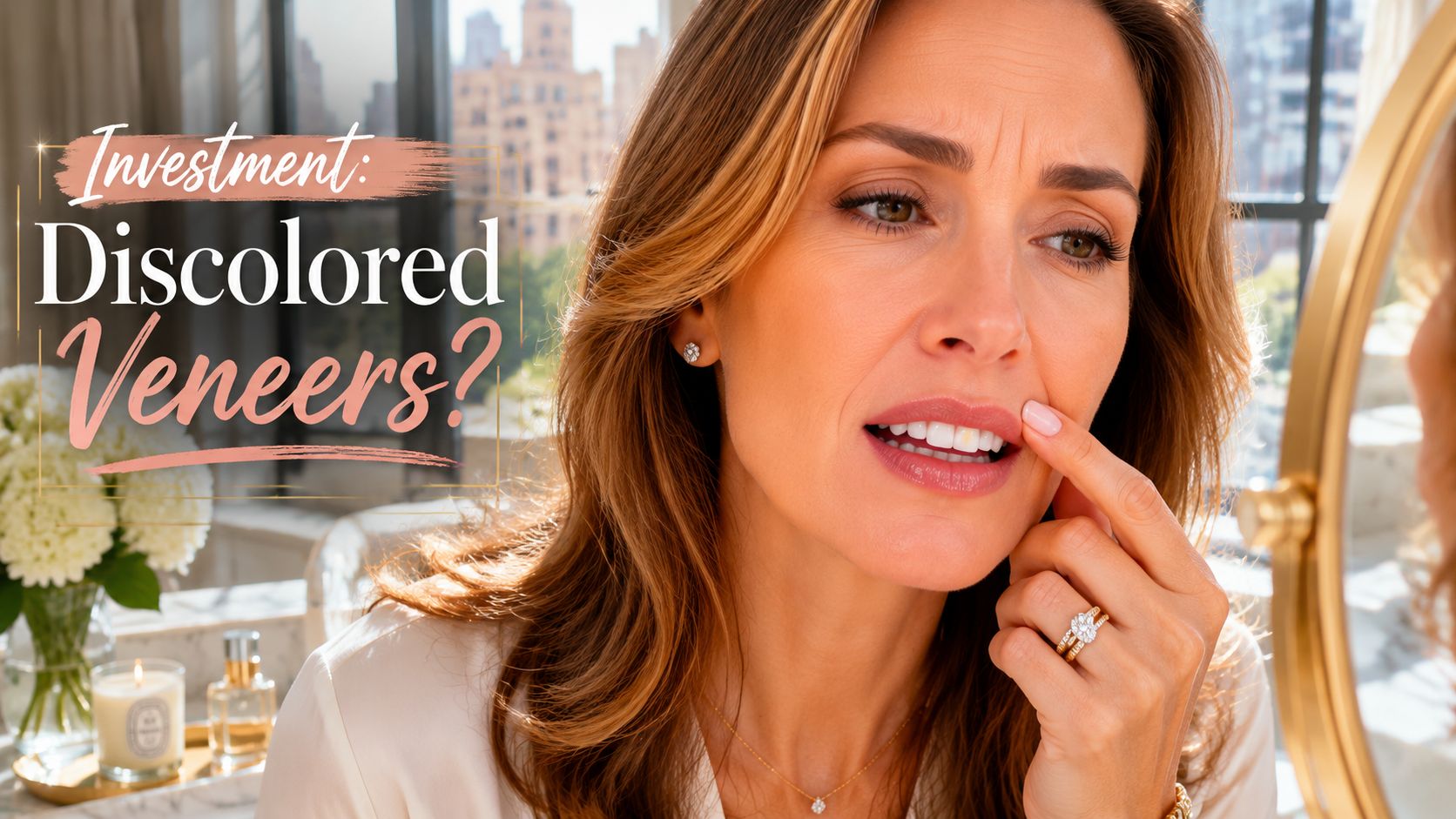
A patient usually notices veneer discoloration in a very specific way. The bathroom lighting is the same, the smile is the same, but something looks off. Veneers that once looked polished and bright now seem flat, slightly yellow, or darker than the surrounding teeth.
That moment can feel frustrating, especially when veneers were meant to be a long-term investment in confidence. The good news is that a dull-looking veneer doesn't always mean it has to be replaced. The right answer depends on why the change happened in the first place.
Table of Contents
- Your Trusted Cosmetic Dentist on the Upper East Side
- Understanding Why Your Veneers Have Changed Color
- The Clinical Reality of Whitening Dental Veneers
- Professional Pathways to Restore Your Veneers Brilliance
- What to Expect at Your Cosmetic Consultation in NYC
- A Proactive Guide to Maintaining Your Veneers
- Frequently Asked Questions About Veneer Brightness
Your Trusted Cosmetic Dentist on the Upper East Side
For many adults in Manhattan, veneer concerns start subtly. A patient may be getting ready for work, leaning toward the mirror, and noticing one front tooth that no longer reflects light the same way. Another may see that photos look different now than they did a few years ago. The smile isn't necessarily damaged, but it doesn't look as fresh.
That's often when people start searching for a cosmetic dentist near me or a dentist in NYC who can give a clear answer instead of a vague one. Veneers sit at the intersection of aesthetics, bite, material science, and long-term maintenance. A polished result depends on more than whitening. It depends on diagnosis.
Dr. Victoria Park and the team at an Upper East Side prosthodontic practice focus on exactly that type of evaluation. Prosthodontics is especially useful when a patient isn't just asking, “Can this be whitened?” but is really asking, “Why does this tooth look different, and what's the most conservative way to fix it?”
A veneer that looks darker isn't always stained. Sometimes the issue is on the surface. Sometimes it's beneath the veneer. Those are very different problems.
Patients in New York often want efficient, precise answers. They don't want trial and error with whitening strips, abrasive pastes, or internet advice that treats every veneer the same. They want to know what works, what doesn't, and what protects the investment they already made in their smile.
A careful cosmetic assessment can separate three very different situations:
- Surface discoloration: staining that may respond to professional cleaning and polishing.
- Material or glaze wear: a veneer that has lost some of its surface luster.
- Underlying tooth darkening: a change below the veneer that alters how the veneer looks from the front.
That distinction matters. It's the difference between a maintenance visit and a more involved restorative plan. For patients on the Upper East Side who want thoughtful cosmetic dentistry rather than guesswork, that's where the process begins.
Understanding Why Your Veneers Have Changed Color
Not every dull veneer is dull for the same reason. Many patients use the word “yellowing” to describe any change in brightness, but a prosthodontist looks at whether the problem is sitting on the veneer, within the restoration, or under it.
Surface stain and roughened glaze
Some veneers pick up external discoloration over time. Coffee, tea, red wine, tobacco, and daily plaque buildup can leave a film or stain on the surface, especially near the edges where veneer margins meet natural tooth structure. In other cases, the protective glaze has become slightly rough, which makes the veneer catch stain and lose its glossy finish.
That's why many articles oversimplify the issue. They say veneers can't be whitened, which is true in one sense, but they often fail to separate true discoloration from superficial stain that can sometimes be polished away. As noted in this discussion of veneer maintenance and polishing, professional cleaning and polishing may restore brightness when the issue is external stain rather than intrinsic color change.
Patients who are considering replacement often feel relieved when the issue turns out to be more conservative. For anyone comparing options for porcelain veneers in New York, this is one of the most important reasons to have veneers examined before assuming they've failed.
True color change and the tooth underneath
Other cases are more complex. A veneer may appear darker even when the surface is clean because the natural tooth behind it has changed over time. Veneers are not completely opaque. Their semi-translucent quality is one reason they can look so natural, but it also means the underlying tooth can influence the final appearance.
A veneer can also look different if its surface has worn unevenly, if the margins no longer blend as well, or if the surrounding natural teeth have changed color while the veneer stayed the same. What a patient sees as one cosmetic problem may be several small issues creating the same visual result.
A useful way to think about it is this:
| What the patient sees | What may actually be happening | Usual next step |
|---|---|---|
| Yellow or dull front tooth | Surface stain or plaque film | Professional cleaning and polishing |
| One veneer looks darker than the others | Underlying tooth shade may be showing through | Prosthodontic evaluation |
| Veneer looks flat, not shiny | Surface glaze may be worn | Re-polishing or restorative review |
The same color complaint can have very different causes. The solution only works when the diagnosis is correct.
The Clinical Reality of Whitening Dental Veneers
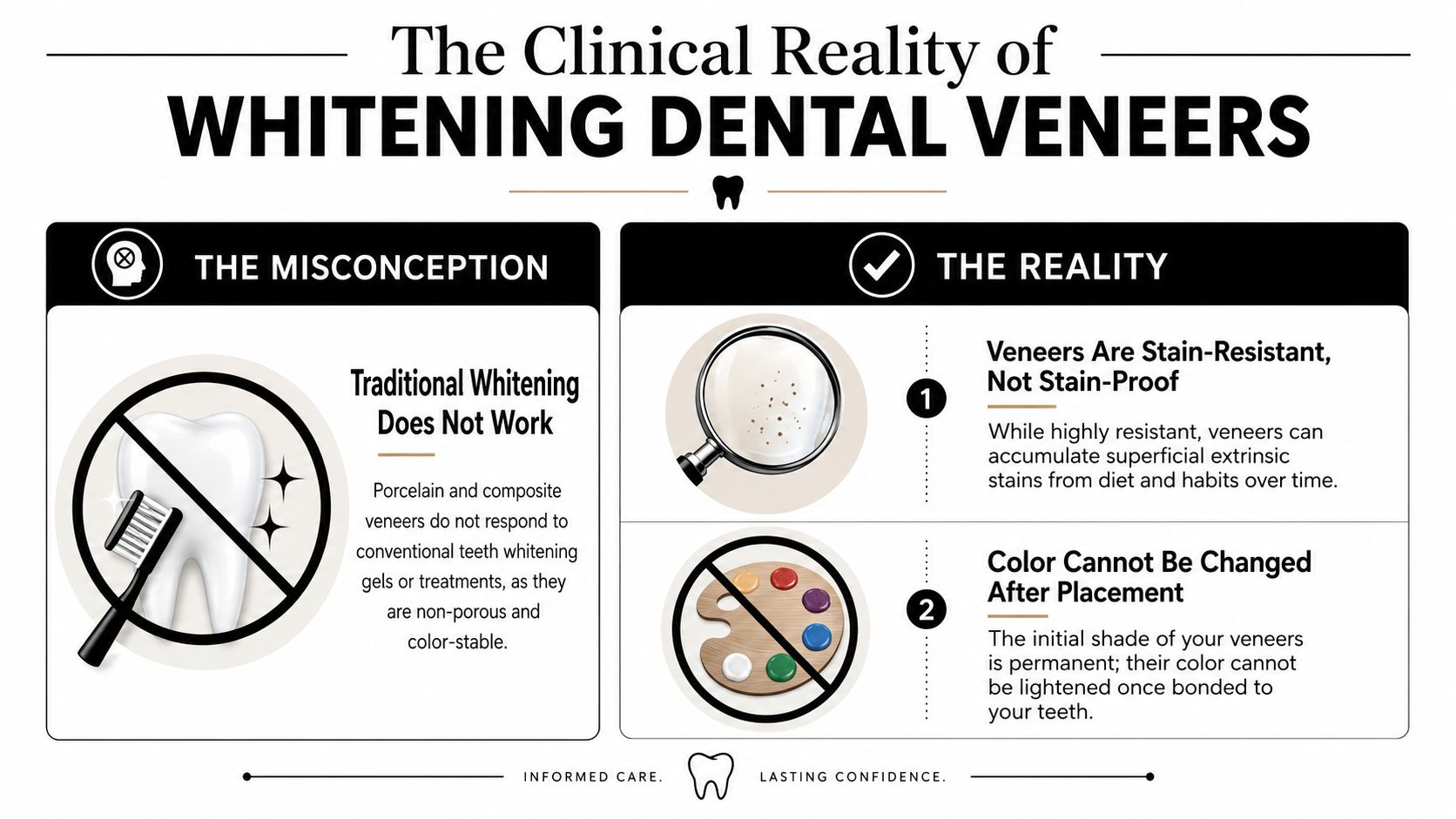
The direct answer to how to whiten veneers teeth is simpler than most patients expect. Traditional whitening products don't whiten veneer material.
Why whitening products fail on veneers
Whitening gels and strips are designed to work on natural enamel, not porcelain or bonded restorative material. That's why traditional whitening does not lighten veneers, crowns, or bonding materials, and why many clinicians advise whitening before veneer treatment, then waiting about two weeks for the natural tooth color to stabilize before matching the final shade, as explained in this review of whitening and veneer shade planning.
This point often surprises people because the packaging on whitening products makes them sound universal. They aren't. Veneers don't respond the way enamel does, so applying bleach to the front surface of a veneer won't give the kind of brightening patients expect.
That's also why patients who want a whiter overall smile should think in terms of cosmetic coordination, not just one product. If natural teeth are being brightened, the veneers need to be assessed as part of the same plan. Patients exploring professional teeth whitening in NYC often benefit from discussing that sequence before starting treatment.
Why surrounding teeth can create a mismatch
A veneer can look “more yellow” even when it hasn't changed much at all. Sometimes the surrounding natural teeth become brighter, and the veneer stands out by comparison. This is one of the most common reasons patients feel unhappy after whitening their non-veneered teeth without first checking how the shade will read across the full smile.
A few practical realities help:
- Whitening strips won't reset veneer shade. They may brighten adjacent enamel while leaving the veneer unchanged.
- A single darker tooth doesn't always need replacement. It may need polishing, reassessment, or a broader smile plan.
- Timing matters. Whitening before any new veneer work usually creates a more cohesive result than whitening afterward.
Practical rule: If a smile includes both natural teeth and veneers, shade changes should be planned across the whole smile, not one tooth at a time.
Professional Pathways to Restore Your Veneers Brilliance
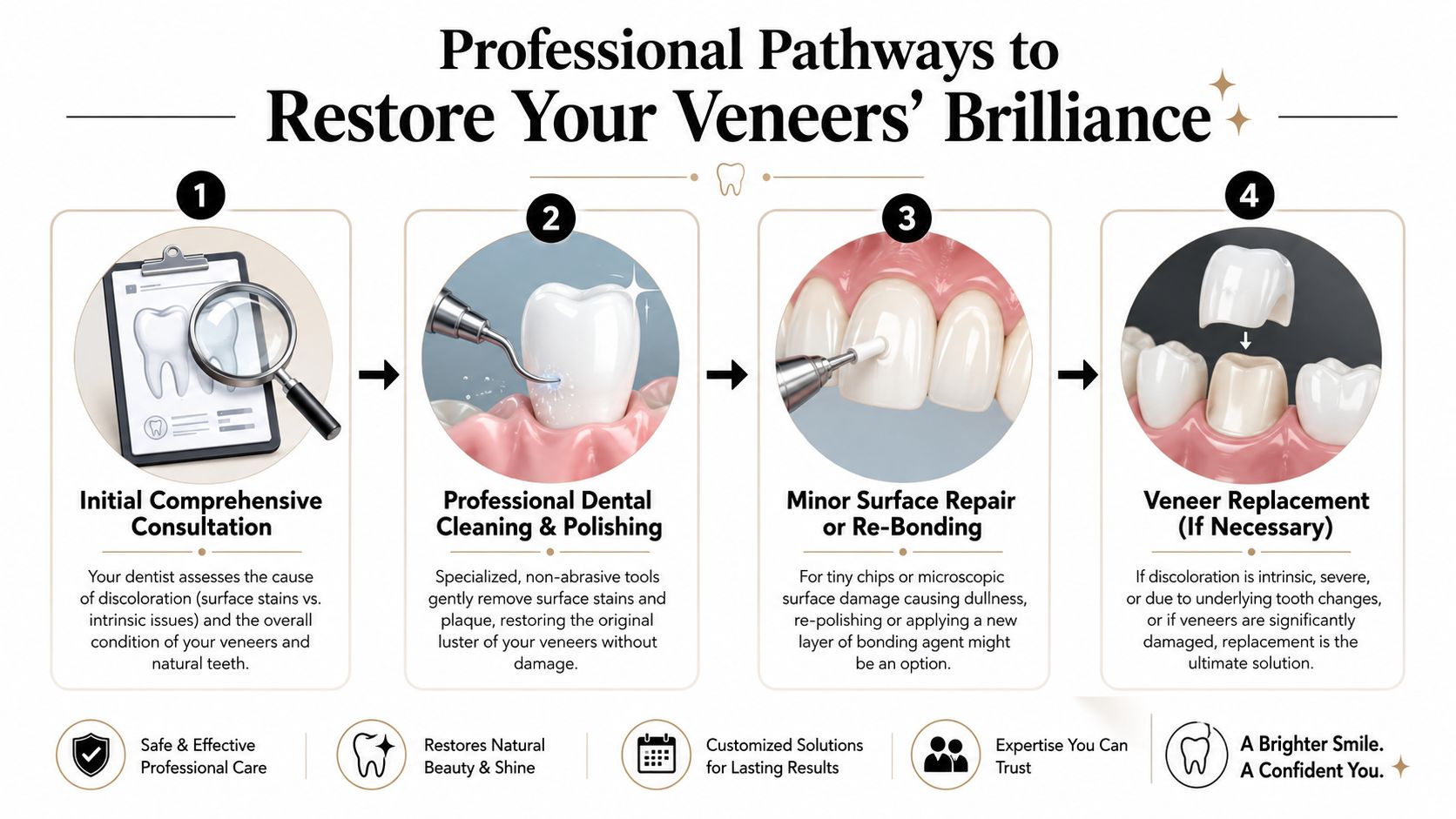
A patient often comes in saying, “My veneers look yellow. Can you whiten them?” The better question is why they look dull in the first place. In practice, the treatment choice depends on whether the change is sitting on the surface, developing at the margins, or showing through from the tooth underneath.
When polishing is the right fix
If the veneer is structurally sound and the loss of brightness is caused by external stain, professional polishing is usually the first step. For porcelain veneers, that means removing plaque, biofilm, and surface discoloration with instruments and polishing materials chosen to protect the ceramic finish, consistent with American Dental Association guidance on veneer polishing.
This is a conservative fix, and often the right one.
A visit may include:
- Careful cleaning around the veneer margins: to remove stain that collects where the restoration meets the tooth and gumline.
- Low-abrasion polishing: to restore gloss without roughening the surface.
- Magnified inspection: to check for glaze loss, small chips, open margins, or wear facets that change how light reflects off the veneer.
Home whitening products do not improve the intrinsic shade of a veneer. Some also leave the surface rougher if used too aggressively, which makes future staining more likely and can leave the restoration looking flatter and less reflective.
When the problem is not on the surface
Polishing helps only when the discoloration is superficial. If the veneer looks gray, opaque, or shadowed from within, the cause is often deeper. I look closely at three common culprits: breakdown of the surface finish, staining at the edges from aging cement or margins, and darkening of the natural tooth behind the veneer.
Those problems call for different solutions. A worn surface may respond to selective re-polishing. A compromised margin may require repair or replacement. A dark underlying tooth usually needs a more deliberate prosthodontic plan, because the veneer may be transmitting that color even if the ceramic itself is intact.
When repair or replacement is the predictable option
Composite veneers can sometimes be improved with recontouring and re-polishing if the issue is localized. Porcelain is less forgiving once the color problem is intrinsic or the restoration has lost its surface integrity. In those cases, replacement gives the highest level of control over shade, translucency, contour, and texture.
The sequence is straightforward:
- Treat the least invasive cause first. Remove stain and confirm what remains.
- Correct small defects if the veneer can still look natural. Minor surface issues may not require a full remake.
- Replace the veneer if the material, margin, or underlying color prevents a harmonious result. That is often the most efficient path when repeated maintenance will not solve the appearance problem.
At Prosth & Co., treatment planning starts with diagnosis, not assumptions. Some patients need advanced polishing and maintenance. Others need one carefully matched replacement rather than a full set of new veneers. The goal is a result that looks bright, balanced, and believable in real light.
The best cosmetic decision is usually the one that preserves what still works and replaces only what cannot be predictably restored.
What to Expect at Your Cosmetic Consultation in NYC
A veneer consultation should feel precise, not rushed. Patients often arrive worried that they'll hear only two options: live with it or replace everything. A proper prosthodontic evaluation is much more specific than that.
A close look before any treatment
The appointment begins with a detailed exam and a conversation about what the patient has noticed. Some people say a veneer looks darker in daylight. Others notice a contrast in photos or feel that the smile has lost uniformity. Those observations are useful because they help identify whether the issue is isolated or part of a broader change.
High-resolution intraoral images are especially helpful. They let the patient see whether discoloration sits near the edges, across the full surface, or appears to come from under the veneer. The gumline, surrounding enamel, bite contacts, and veneer condition all matter.
When the natural tooth behind a veneer darkens, that color can reflect through the restoration because of the veneer's semi-translucent nature. In selected cases, a prosthodontist may determine that targeted bleaching of the natural tooth from behind is appropriate, and that technique has shown an 85% success rate in specific situations according to the American College of Prosthodontists discussion of underlying tooth shadowing.
A plan built around appearance and function
Once the cause is identified, the next step is matching the treatment to the diagnosis. A patient with light surface staining needs a different plan than a patient with underlying tooth discoloration or a veneer that no longer blends with neighboring teeth.
The treatment discussion usually includes:
- What's causing the visual change
- Which option is most conservative
- Whether polishing, repair, or replacement is likely to help
- What the smile will look like in relation to nearby teeth
Patients also need practical guidance. If they're also considering teeth whitening, orthodontic alignment, a night guard for grinding, or other restorative work, the cosmetic sequence should be coordinated. That prevents one improvement from creating a new mismatch somewhere else.
For busy New Yorkers, clarity matters as much as aesthetics. A strong consultation leaves the patient understanding not just what can be done, but why that approach makes sense.
A Proactive Guide to Maintaining Your Veneers
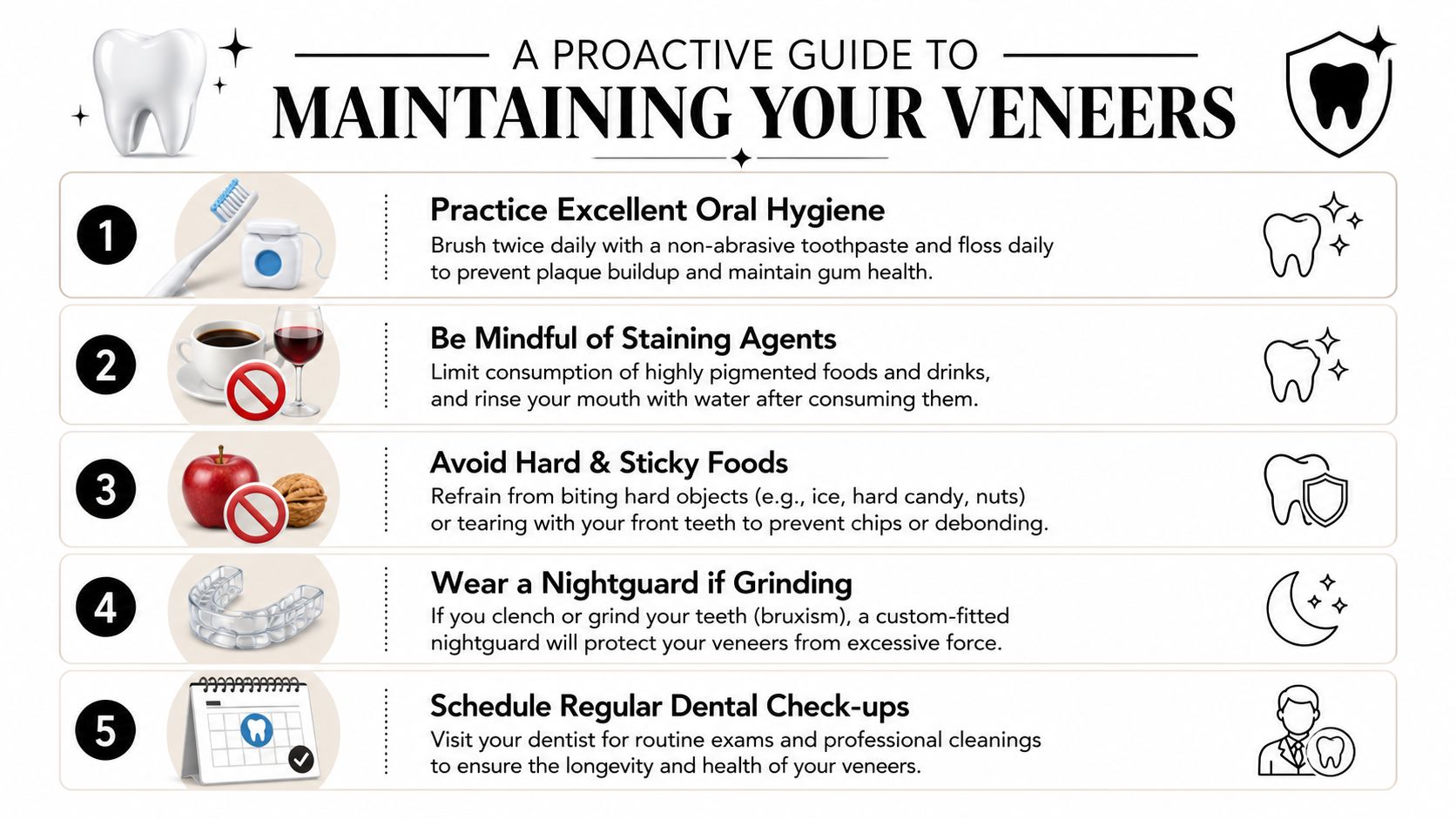
The best way to keep veneers looking bright is to protect the surface, preserve the margins, and plan any surrounding cosmetic changes carefully.
Simple habits that help
Daily care doesn't need to be complicated, but it should be deliberate.
- Use a soft toothbrush: harsh scrubbing can wear at the surface and margins over time.
- Choose non-abrasive toothpaste: the goal is to clean without scratching.
- Stay current with cleanings and exams: professional maintenance helps catch stain, roughness, or bite-related wear early.
- Be careful with hard foods: veneers are durable, but they shouldn't be used as tools for biting ice, opening packages, or tearing tough foods.
- Rinse after dark beverages: coffee, tea, and red wine can leave external staining on surrounding teeth and at veneer edges.
When to ask for a cosmetic plan
Many patients don't realize that maintenance includes planning. If natural teeth are being whitened, the timing should be coordinated with veneers so the smile still looks balanced.
Authoritative dental guidance emphasizes whitening surrounding natural teeth first, then matching new veneers or reassessing existing ones to avoid a mismatch, as explained in this discussion of veneer and whitening treatment sequencing.
A veneer can stay the same shade while everything around it changes. That's why cosmetic planning matters as much as home care.
Frequently Asked Questions About Veneer Brightness
What if the natural teeth look yellow but the veneers don't
That usually means the veneers have stayed stable while the natural enamel has darkened or picked up stain. In that situation, the answer may be selective whitening of the natural teeth rather than touching the veneers. A cosmetic consultation can determine whether the contrast should be corrected with whitening, polishing, or updated veneer work.
Is whitening toothpaste safe on veneers
That depends on the toothpaste. Some formulas are more abrasive than patients realize. A non-abrasive toothpaste is generally the safer choice because the goal is to clean the veneer without scratching the surface or dulling the finish. If a patient is unsure, it's worth bringing the product to a dental visit for review.
Can old veneers be made white again
Sometimes they can be made to look brighter with professional cleaning and polishing if the issue is superficial stain. If the color problem is intrinsic, related to wear, or caused by changes under the veneer, polishing may not be enough. In those cases, repair or replacement may be the more predictable option.
How much does it cost to fix stained veneers in NYC
The cost depends on what the veneer needs. A simple professional polishing visit is very different from replacing one veneer or redesigning several for a more even smile. The most useful next step is an in-person evaluation, where the patient can receive a clear diagnosis, options, timeline, and exact fee estimate.
Is this ever an emergency dentist issue
Not usually if the concern is only color. But if a veneer is loose, chipped, painful, or associated with trauma, the issue moves beyond appearance and should be assessed promptly. In that setting, an emergency evaluation may be appropriate to protect the tooth underneath.
A smile with dull or mismatched veneers usually has a solvable cause. Patients who want a precise answer about how to whiten veneers teeth, restore surface shine, or decide whether replacement is necessary can schedule a consultation with Prosth & Co. on the Upper East Side to receive a personalized cosmetic and prosthodontic evaluation.

Founder and lead prosthodontist of Prosth & Co. on Manhattan's Upper East Side. DDS, Columbia University; Prosthodontics certificate and MMSc in Oral Biology, Harvard School of Dental Medicine; Implantology fellowship, Columbia University.
Meet Victoria →