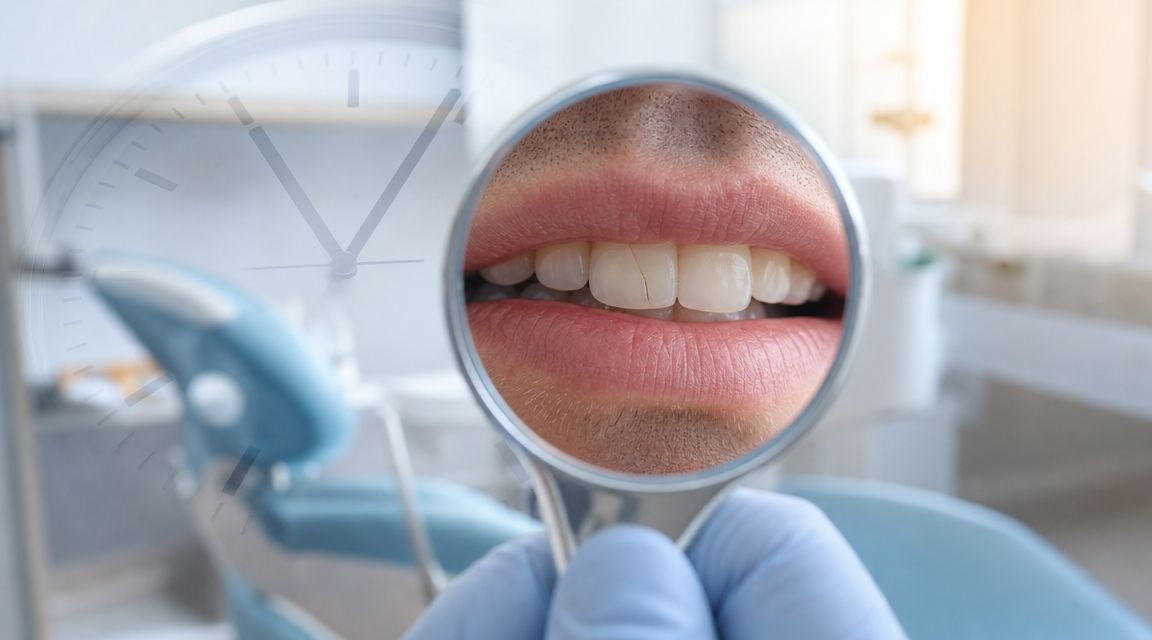
A broken tooth often happens at the worst possible time. A corner of a molar gives way during lunch. A front tooth chips before work. There may be no real pain yet, just roughness, sensitivity, and a growing question in the back of the mind: how long can a broken tooth go untreated?
For many busy adults in Manhattan, the first instinct is to wait and see. If the tooth isn't throbbing, it's easy to assume it can be handled next week. That assumption causes trouble. A broken tooth can stay quiet at first while damage continues below the surface, and the timing depends less on your calendar than on how deep the fracture goes.
Patients looking for a dentist in New York, NY or an emergency dentist near me usually don't need vague advice. They need a practical way to judge urgency, understand what's at stake, and know what treatment may involve. That's what this guide is for.
Table of Contents
- The Moment a Tooth Breaks Your First Question
- The Real Risks of Waiting A Timeline
- Urgency Levels How to Assess Your Broken Tooth
- When to Find an Emergency Dentist in NYC
- From Repair to Restoration Your Treatment Options at Prosth & Co.
- Your Next Steps for Expert Dental Care on the Upper East Side
The Moment a Tooth Breaks Your First Question
A broken tooth creates two problems at once. There's the visible problem you can feel with your tongue, and there's the uncertainty you can't see.
In New York, that uncertainty often gets pushed aside. The day is packed. Meetings are stacked. The tooth only hurts with cold water, or maybe it doesn't hurt at all. So the question becomes less “what happened?” and more “can this wait until things calm down?”
Sometimes a small chip is mostly cosmetic. Sometimes the break is shallow and the tooth can be protected before it becomes something bigger. But a calm tooth is not always a safe tooth. One patient may notice only a sharp edge. Another may have a crack that looks minor but opens a pathway into the tooth.
A broken tooth can be asymptomatic at first while still worsening underneath.
That concern isn't theoretical. Guidance on untreated broken teeth notes that infection may develop in days, weeks, or months depending on crack depth, and even minor chips can allow bacteria in within days, as described by guidance on untreated broken teeth.
What people often misjudge
Individuals typically don't underestimate the dramatic break. They underestimate the subtle one.
- A small chip with no pain: This may still need prompt evaluation if the edge is sharp, the tooth feels sensitive, or the chip changed the way the bite fits.
- A crack felt only on chewing: This can point to a structural problem that deepens under repeated biting pressure.
- A broken filling or old crown with exposed tooth: The opening may be small, but the tooth is less protected than it was yesterday.
The practical takeaway is simple. Don't judge urgency by pain alone. Judge it by change. If the tooth broke, cracked, started catching, became sensitive, or feels different when biting, it deserves an exam.
The right first move
The safest response is usually not panic. It's scheduling an evaluation quickly, then protecting the area until you're seen. Avoid chewing on that side. Stay away from hard or sticky foods. If there's a sharp edge, cover it with dental wax if available.
That approach works better than waiting for the tooth to “settle down.” Teeth don't heal the way skin does, and a delay can turn a straightforward restorative visit into a root canal, crown, tooth extraction, or dental implant discussion.
The Real Risks of Waiting A Timeline
The problem with waiting is that broken teeth rarely stay exactly as they are. Every meal, every clench, and every temperature change places force on a structure that's already compromised.
This visual summary helps show how risk changes over time.

What can happen in the first days
In the first day or two, a patient may notice roughness, mild sensitivity, or pain when biting. Some breaks stay quiet. Others announce themselves immediately.
The tooth is vulnerable from the start. A crack or missing piece changes how force travels through the tooth, and it may create an opening where bacteria can enter. That doesn't mean every chip becomes an emergency overnight, but it does mean the clock has started.
A practical response during this window is to protect the tooth and arrange care promptly. Soft foods help. Chewing on the opposite side helps. Ignoring the tooth because it “isn't that bad” doesn't.
A short explainer can make that progression easier to understand:
What changes after weeks and months
After the first week or two, the concern becomes less about discomfort and more about progression. The crack can spread deeper. Sensitivity may become sharper. Biting may start to trigger a distinct twinge. At that stage, treatment often becomes more involved because the tooth is less intact than it was when it first broke.
By the time a broken tooth has been left alone for weeks, the risk profile changes. Clinical and patient-education guidance notes that after 1 to 2 months without treatment, the tooth may become too damaged to fix as the crack extends under the gum or infection spreads, often making extraction necessary, according to this broken tooth timeline.
Practical rule: The longer a tooth is left fractured, the less conservative the treatment usually becomes.
That's the trade-off patients in Manhattan often face. Waiting may save a few days on the calendar, but it can cost tooth structure. Earlier care may mean smoothing, bonding, an inlay, or a crown. Delayed care may mean root canal therapy, extraction, or replacement with an implant.
A realistic way to think about timing
There isn't one universal “safe” deadline for everyone. A tiny enamel chip and a deep cusp fracture are not the same problem.
Still, a useful rule of thumb is this:
- If the tooth changed suddenly but you're comfortable: Schedule an exam within days.
- If chewing hurts or cold lingers: Move faster.
- If you have swelling, throbbing, or a bad taste: Treat it like an emergency.
That's the balance most patients need. Not every broken tooth is catastrophic. Very few improve by waiting.
Urgency Levels How to Assess Your Broken Tooth
The most important question isn't how large the break looks in the mirror. It's how deep the damage goes.
A small visible chip can be shallow and manageable. A less obvious crack can run inward toward the dentin or pulp and create a much more urgent problem. That's why some patients with very little visible damage have significant symptoms, while others with a larger-looking chip don't.
Why depth matters more than appearance
Clinical guidance from Cleveland Clinic makes the key point clearly. If a fracture reaches the pulp, it can lead to infection and may require root canal therapy. If the structural damage is deeper, the tooth can progress to extraction. Cracked teeth also don't heal on their own, as explained in Cleveland Clinic's cracked tooth guidance.
That helps explain the usual patterns patients notice:
- Pain on biting: Often suggests the crack is moving under pressure.
- Cold sensitivity: Can mean dentin is exposed.
- Lingering heat pain or spontaneous throbbing: Raises concern for pulp involvement.
- A visible split or mobile piece of tooth: Suggests a more serious structural failure.
If a tooth hurts when pressure is released after biting, that detail matters. It often tells the dentist more than “it kind of hurts.”
Broken Tooth Symptom & Urgency Guide
| Symptom | Potential Problem | Urgency Level (Call Prosth & Co.) |
|---|---|---|
| Sharp edge only, no pain | Small chip or lost enamel edge | Schedule soon |
| Mild cold sensitivity | Dentin exposure | Schedule within days |
| Pain when chewing | Structural crack or unstable cusp | Call promptly for near-term evaluation |
| Pain when releasing bite pressure | Crack affecting tooth structure | Call promptly for evaluation |
| Darkening or discoloration | Possible internal damage to the tooth | Schedule promptly |
| Broken filling or crown with exposed tooth | Loss of protection over weakened tooth | Call promptly |
| Constant throbbing | Possible pulp inflammation or infection | Same-day call |
| Swelling of gum or face | Infection spreading into surrounding tissue | Same-day emergency care |
| Bad taste, pus, or drainage | Abscess or active infection | Same-day emergency care |
| Loose tooth after break | Advanced structural damage or trauma | Same-day emergency care |
What usually can wait briefly, and what usually can't
Some situations can wait a short time for a scheduled restorative dentistry visit. A small chip with no bite pain, no sensitivity, and no visible crack line may fall into that category. Even then, the tooth should still be checked, especially if the break changed the way the teeth meet.
Other situations should move to the front of the line. A split cusp, recurring chewing pain, sudden sensitivity after biting something hard, or a fracture on a tooth with a large old filling often means the tooth needs support before more of it breaks away.
The goal of triage isn't self-treatment. It's smarter timing. The earlier the diagnosis, the more options remain on the table.
When to Find an Emergency Dentist in NYC
Some broken teeth are inconvenient. Others cross into emergency territory quickly. The difference usually comes down to signs of infection, instability, or severe inflammation.
Patients searching for an emergency dentist in NYC shouldn't wait for certainty if red-flag symptoms are already present. Those symptoms mean the problem has moved beyond a cosmetic chip or routine repair.

Signs that should not wait
Emergency guidance for broken teeth identifies swelling, persistent throbbing, fever, pus, or a loose tooth as red flags for same-day care. The same guidance notes that bacteria can enter a crack within days, and when pulp exposure is involved, the risk of tooth loss rises substantially if care is delayed beyond about one week, as noted in this emergency cracked tooth guidance.
That means same-day help is the right move if you notice any of the following:
- Facial or gum swelling: This may signal infection spreading beyond the tooth.
- Persistent throbbing pain: This often points to pulpal inflammation or infection, not simple sensitivity.
- Pus, drainage, or a bad taste: These are classic signs of infection.
- Fever with a broken tooth: This raises concern that the issue is affecting overall health.
- A loose tooth or large displaced fragment: Stability is compromised, and the situation can worsen quickly.
Patients looking for emergency dentist care in New York, NY should treat those symptoms as urgent, not optional.
Severe pain plus swelling is not a “watch it for the weekend” problem.
What to do before you're seen
Until the appointment, keep the area as calm as possible.
- Rinse gently with warm water: This helps clear debris without aggressive scrubbing.
- Avoid chewing on the area: Repeated force can extend the fracture.
- Use a cold compress on the cheek if swelling is present: Keep pressure light.
- Save any broken piece if you have it: Sometimes it helps with diagnosis.
- Don't place aspirin on the gum or tooth: It won't solve the problem and may irritate tissue.
For many New Yorkers, the temptation is to power through one more day. Emergency symptoms are the point where that approach stops making sense.
From Repair to Restoration Your Treatment Options at Prosth & Co.
Treatment depends on one thing above all else. Whether the tooth is still structurally and biologically savable in a predictable way.
That's where a proper exam matters. The same “broken tooth” complaint can lead to very different treatment plans. One patient needs smoothing and bonding. Another needs a ceramic crown. Another needs endodontic treatment before the tooth can be restored. If the damage goes too far below the gum or into the root, tooth extraction and replacement may be the healthier path.

Conservative care when the tooth is still stable
Not every crack needs aggressive treatment on day one. In a one-year clinical follow-up of untreated cracked teeth, researchers found that only 6% showed an increase in the number of cracks, and 32% of patients had pain changes overall, with decreases (23%) occurring more often than increases (10%). The authors concluded that untreated cracked teeth did not show meaningful progression over one year in increased symptoms or crack count, especially among teeth initially recommended for monitoring, according to this clinical cracked tooth follow-up study.
That finding matters because it supports a more nuanced approach. Some teeth can be monitored by a dentist rather than rushed into major treatment. Monitoring is not neglect. It's a clinical decision made after examination, imaging, and bite assessment.
Common conservative options include:
- Edge smoothing or polishing: Useful when the problem is a rough, superficial chip.
- Bonding: Helpful for smaller fractures where appearance and minor protection are the main goals.
- Ceramic inlay or onlay: A good choice when a portion of the chewing surface broke but the whole tooth doesn't need full coverage.
When deeper treatment is the right move
Once a break weakens more of the tooth, protection becomes the priority. A crown is often the most predictable way to hold the tooth together, restore biting function, and reduce the risk of further fracture. Patients considering this route can learn more about custom dental crowns in New York.
If the pulp has been affected, root canal therapy may be needed before the final restoration. That can sound intimidating, but in practical terms it's often the step that keeps the tooth in place rather than losing it.
If the tooth can't be predictably restored, replacement becomes part of the conversation. Options may include a bridge, denture, or dental implant. For adults seeking long-term restorative dentistry on the Upper East Side, that planning often focuses on bite stability, materials, and how the final result will look and function over time. In that setting, Prosth & Co. provides prosthodontic, restorative, and implant-based care under one roof.
The best treatment is the one that matches the real extent of damage, not the one that simply covers the symptom.
Your Next Steps for Expert Dental Care on the Upper East Side
Once a tooth breaks, the next step should be clarity. Patients don't need to guess whether they need a filling, crown, root canal, or extraction. They need a diagnosis they can trust.
For adults on the Upper East Side and across Manhattan, that usually starts with an exam, dental X-rays, and a close look at how the fracture affects both the tooth and the bite. A good evaluation doesn't just identify what broke. It shows what can still be preserved.
What a visit usually includes
A thorough visit for a broken tooth often involves:
- A visual and bite exam: The dentist checks crack lines, mobility, and where chewing pressure triggers symptoms.
- Dental X-rays or other imaging: This helps assess the root, surrounding bone, and any signs of deeper involvement.
- Intraoral photos: These make it easier for patients to see the fracture and understand the treatment choices.
- A treatment discussion in plain language: The decision may range from watchful monitoring to restorative or emergency care.
That process matters because broken teeth are rarely one-size-fits-all. A front tooth chip has different demands than a cracked molar. A cosmetic fix may be enough in one case, while another calls for restorative dentistry designed to withstand heavy chewing forces.
Why prompt diagnosis matters
The biggest benefit of being seen sooner is not just faster pain relief. It's preserving options.
A tooth that can be bonded or crowned today may become an extraction case if the crack travels further or infection reaches the wrong place. That's especially important for patients who care about maintaining their natural teeth, avoiding interruptions to work, and choosing treatment deliberately instead of under pressure.
The office is located at 47 E 77th St, Suite 207, New York, NY 10075, which makes it convenient for patients seeking a dentist near me in Manhattan, a cosmetic dentist near me, restorative dentistry, or emergency dental care after a sudden fracture.
If a tooth has chipped, cracked, or broken, the safest next step is a prompt evaluation with Prosth & Co.. The team provides exams, dental X-rays, restorative treatment planning, tooth extraction when necessary, and options such as crowns, root canal therapy, and dental implants for damaged teeth. Booking early can protect the tooth, reduce pain, and give patients a clearer path forward.

Founder and lead prosthodontist of Prosth & Co. on Manhattan's Upper East Side. DDS, Columbia University; Prosthodontics certificate and MMSc in Oral Biology, Harvard School of Dental Medicine; Implantology fellowship, Columbia University.
Meet Victoria →