A lot of adults on the Upper East Side reach the same point in private. They're on video calls all day, catching their reflection in a lobby mirror, or noticing that a worn edge, a crowded lower tooth, or a shifting bite no longer feels like a small issue. They want a straighter smile, but they also want a solution that fits Manhattan life.
That's where the actual question starts. In clear aligners vs braces, the right answer usually isn't about trends. It's about how the teeth need to move, how consistent the patient can be, and whether that orthodontic decision needs to support future veneers, crowns, or implants.
For busy adults looking for a dentist near me or a cosmetic dentist near me in Manhattan, that distinction matters. A treatment that looks convenient at the start can become limiting later if the bite, spacing, and restorative plan weren't considered together. On the other hand, a more visible option may be the better choice if it creates a stronger long-term foundation for restorative dentistry.
Table of Contents
- Your Smile Journey Starts Here on the Upper East Side
- Understanding Your Two Paths to a Straighter Smile
- Aesthetic, Lifestyle, and Comfort Comparison
- Clinical Effectiveness for Adult Orthodontic Cases
- Beyond Alignment A Prosthodontist's Perspective
- Your Orthodontic Journey at Prosth & Co in Manhattan
- Schedule Your Consultation with a Top NYC Dentist
Your Smile Journey Starts Here on the Upper East Side
A common Upper East Side scenario looks like this. An adult patient has been thinking about straightening teeth for years, but work kept getting in the way. Then a crown starts to feel slightly off in the bite, an old retainer no longer fits, or cosmetic work starts to feel premature because the teeth aren't in the right position yet.
That patient usually isn't asking for “straight teeth” in the abstract. Their actual goal is more practical. They want a smile that looks polished, functions well, and won't complicate future dental care.
For Manhattan professionals, the choice between aligners and braces often sits at the intersection of appearance, schedule, and long-term planning. Someone who spends the day in meetings may prioritize discretion. Someone with a more difficult bite may care less about visibility and more about getting the bite corrected predictably.
Clinical reality: The best appliance is the one that can move the right teeth, in the right sequence, without compromising the larger restorative plan.
That's especially important in a practice that sees more than simple cosmetic cases. Patients searching for a dentist in New York, NY, restorative dentistry, or even dental implants near me often need a broader conversation. Tooth position affects implant spacing. Bite position affects crown design. Tooth angulation can influence whether veneers look refined or bulky.
Adult orthodontics also overlaps with general dental care more than many people expect. A patient may need cleaning and exams, dental x-rays, replacement of worn restorations, or treatment for a cracked tooth before movement starts. Another may need orthodontic alignment first so later cosmetic dentistry can be more conservative.
That's why this decision should feel less like shopping for an appliance and more like planning a complete outcome.
Understanding Your Two Paths to a Straighter Smile
Clear aligners and braces both move teeth. They do it in different ways.
What each treatment actually is
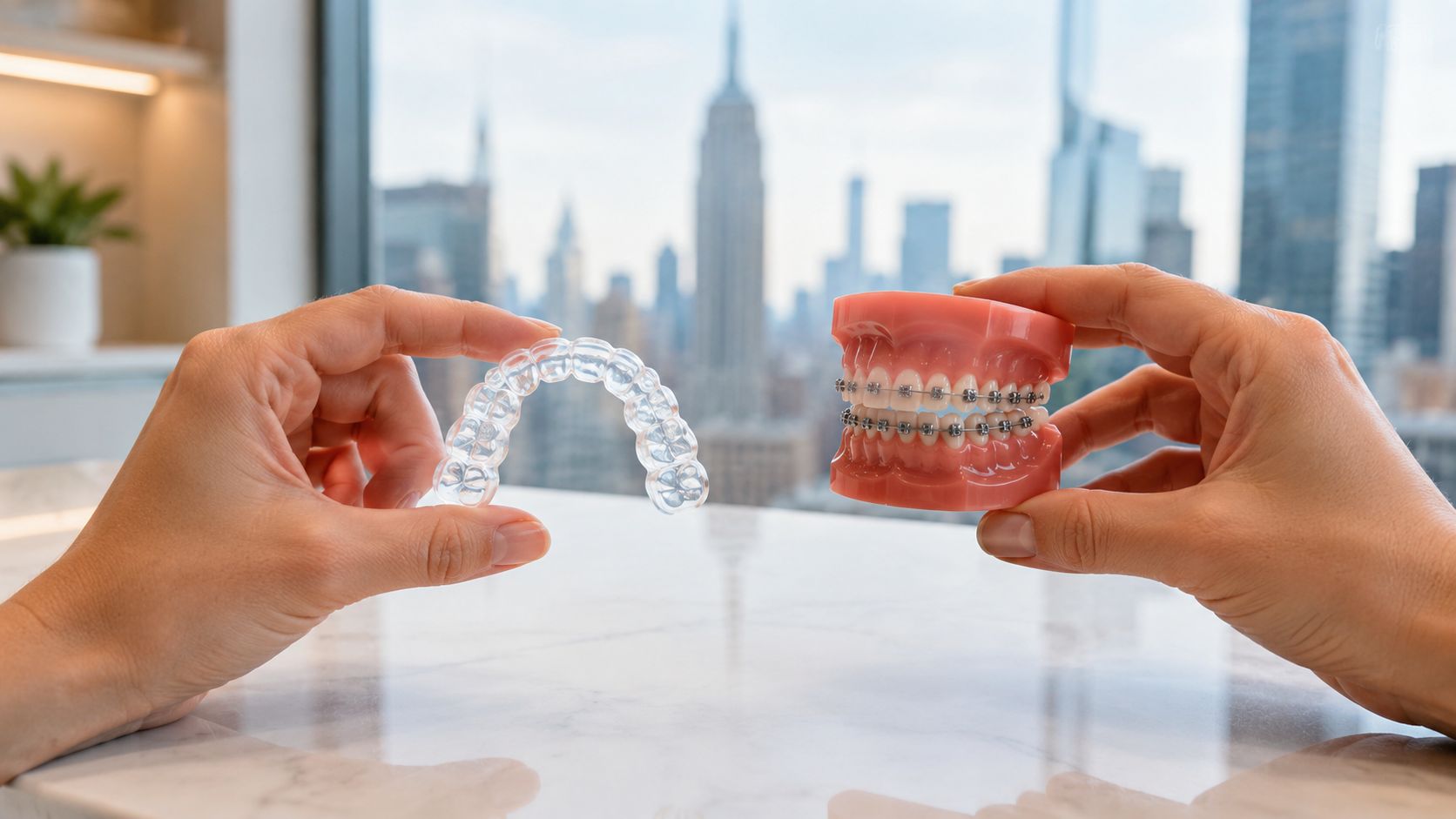
Clear aligners are removable, custom-made trays that fit closely over the teeth and are changed in sequence to guide movement. They're designed around digital planning and are especially appealing to adults who want a low-profile option during work and social life.
Traditional braces use brackets attached to the teeth with wires that deliver continuous force over time. Because the system is fixed in place, it gives the clinician strong control over certain movements that are harder to achieve with removable trays.
The popularity of aligners is no longer niche. The global adoption of clear aligner therapy rose from 5 million treated patients to 17 million by 2023, reflecting a major shift toward discreet, removable orthodontic treatment, according to industry adoption data summarized here.
Why both remain relevant
Patients sometimes assume aligners are the modern option and braces are the outdated one. That's too simplistic. Both are contemporary tools. The better question is whether the treatment matches the biology of the case and the patient's daily habits.
A useful way to frame it is this:
- Choose aligners for fit with lifestyle when the planned movements are within their strengths and the patient can wear them consistently.
- Choose braces for control when the bite is more demanding, the rotations are more stubborn, or continuous force will produce a more dependable result.
- Choose either only after diagnosis because crowding, wear, missing teeth, and existing restorations often change the decision.
Straightening teeth isn't just about appearance. It can improve how the bite distributes force, how restorations fit, and how easy the teeth are to clean.
For adults seeking a cosmetic dentist near me on the Upper East Side, this distinction matters. Cosmetic dentistry often looks better when orthodontic movement creates a more balanced starting point. For adults who may also need crowns, implant planning, or rehabilitation of worn teeth, the appliance choice becomes part of a much bigger blueprint.
Aesthetic, Lifestyle, and Comfort Comparison
Quick comparison at a glance
| Factor | Clear Aligners | Traditional Braces |
|---|---|---|
| Visibility | Nearly invisible in most daily settings | More noticeable on close conversation and photos |
| Eating | Removed for meals | Fixed on teeth during meals |
| Food limits | No appliance-related food restrictions while eating without trays | Certain foods are best avoided to protect brackets and wires |
| Cleaning | Teeth can be brushed and flossed more normally after removal | Cleaning around brackets and wires takes more effort |
| Comfort profile | Smoother surfaces and gentler day-to-day feel for many adults | Can create irritation and more noticeable adjustment soreness |
| Discipline required | High, because trays must be worn consistently | Lower, because the appliance stays on |

What daily life usually feels like
For aesthetics alone, aligners are the easier fit for many adults. They're discreet in meetings, photos, and social events. That matters to patients who are visible in client-facing roles or don't want their orthodontic treatment to be part of every conversation.
Braces ask for a different kind of confidence. Some adults don't mind that tradeoff at all, especially if the case calls for stronger mechanical control. Others are comfortable with braces once they understand that the treatment may be more predictable for the movements they need.
The comfort difference comes from how force is delivered. Clear aligners apply controlled, distributed pressure through removable trays exchanged every 1 to 2 weeks, which is associated with less discomfort than the higher initial pain peaks often felt after brace adjustments. Their removability also means no appliance-related food restrictions and easier oral hygiene, as described in this clinical overview of aligner mechanics and patient experience.
That's why lifestyle fit often sounds like this in practice:
- Workdays and social settings: Aligners are easier to keep visually subtle.
- Meals and coffee breaks: Aligners add a routine. They must come out before eating and go back in afterward.
- Home care: Brushing and flossing are more straightforward without brackets in the way.
- Consistency: Braces keep working whether the patient is busy, traveling, or distracted.
Patients comparing options can review the practice's clear aligners treatment page to understand how removable tray therapy is planned and delivered.
The tradeoff adults often underestimate
Aligners feel simpler. But they're only simpler if the patient is disciplined. A removable appliance creates freedom, and freedom creates responsibility.
A busy schedule can support aligners well if routines are strong. The same schedule can undermine aligners if trays stay out too long during meals, meetings, or evening events.
Braces are less flexible but more automatic. They don't ask the patient to remember the treatment. They keep applying force all day, every day. For some Manhattan patients, that reliability outweighs the inconvenience of food limitations and more detailed hygiene.
Clinical Effectiveness for Adult Orthodontic Cases

The clinical question isn't whether aligners “work.” They do. The main issue is how well they work for a specific adult bite, and what compromises come with each option.
For mild to moderate cases, the difference in overall success can be surprisingly small. Comparative research found that braces and clear aligners show similar effectiveness for mild to moderate malocclusion, with success rates ranging from 88% to 90%, while treatment time averaged about 18 months for Invisalign and 24 months for conventional braces. The same review reported that about 17% of aligner patients switched to braces to complete more difficult movements, according to this clinical comparison published in PubMed Central.
Where aligners perform well
Adults with spacing, mild crowding, relapse after earlier orthodontics, or straightforward bite refinement are often good aligner candidates. These cases usually benefit from what adults value most. Discretion, easier brushing and flossing, and less day-to-day friction.
That doesn't mean every adult case is simple. It means the treatment has to match the movement. If the plan asks for controlled, segmented correction and the patient is consistent with wear, aligners can be highly effective.
A separate adult-focused review framed the decision less as “better versus worse” and more as a question of acceptable tradeoffs. In that comparison, conventional braces achieved an 80% reduction in PAR index after 12 months versus 75% for aligners, while aligners had lower discomfort scores of 2.3 versus 5.6 and higher patient satisfaction of 85% versus 65% for adult patients. That analysis is discussed in this review of adult orthodontic tradeoffs.
When braces still have the edge
Braces remain stronger in certain movements. Severe crowding, significant bite discrepancies, difficult rotations, and cases that need more torque control or broader arch coordination often respond better to fixed appliances.
A patient may also be a poor aligner candidate even if the teeth look only moderately crowded. The issue might be compliance, not anatomy. If trays won't stay in for the required hours, the treatment loses precision quickly.
For patients considering fixed orthodontics, the practice also provides traditional braces treatment as part of complete care.
A short visual explanation can help make these mechanics easier to understand:
The strongest treatment plan is the one that respects both biology and behavior. A technically elegant aligner plan can still fail if wear is inconsistent. A visible brace case can still be the cleaner path to the final result.
Beyond Alignment A Prosthodontist's Perspective
Most articles on clear aligners vs braces stop once the teeth look straighter. That's often where the more important adult discussion begins.
Straight teeth are not the whole treatment plan
Adults frequently arrive with more than alignment concerns. They may already have crowns, worn edges, old bonding, missing teeth, gum recession, or a bite that has shifted over time. In that setting, orthodontics is often the first phase of a broader restorative plan.
The overlooked issue is sequencing. The American Association of Orthodontists notes that aligners must be worn at least 22 hours per day, and also emphasizes that treatment success depends heavily on compliance and overall planning in complete care, including cases that may later involve restorative work, as outlined in this AAO guidance on braces versus clear aligners.

Why sequencing matters in restorative dentistry
A prosthodontic perspective asks a different set of questions:
- Will tooth position create better room for veneers or make them look bulky?
- Will bite correction help a future crown last longer?
- Does an implant site need orthodontic space opening before placement?
- Are worn teeth being moved into positions that support function, not just appearance?
A patient planning veneers may benefit from orthodontic alignment first so less tooth structure has to be altered. A patient with a missing tooth may need roots and crowns positioned carefully before an implant is placed. Someone with a collapsing bite may need movement that supports full-mouth stability, not just cosmetic straightening.
In adult dentistry, the appliance is only one decision. The real decision is whether the whole treatment sequence supports long-term function and aesthetics.
That's especially relevant for patients searching for dental implants near me, cosmetic dentist near me, or restorative dentistry in Manhattan. The ideal orthodontic choice may not be the one that looks easiest today. It may be the one that makes the next phase more conservative, more stable, and easier to maintain.
Your Orthodontic Journey at Prosth & Co in Manhattan
Choosing treatment becomes much easier once the diagnosis is visual and specific. Adults rarely need more marketing around orthodontics. They need a clear explanation of what's happening in their own mouth.
What happens at the first visit
A detailed evaluation typically begins with an exam, imaging, and digital records. That may include intraoral photos, bite analysis, and digital scans that show crowding, spacing, wear patterns, and how current restorations relate to tooth position.

For adults on the Upper East Side, that process matters because it turns a vague concern into a plan. Instead of hearing broad statements about aligners or braces, patients can see where the teeth are now, what movements are realistic, and whether orthodontics should be coordinated with crowns, veneers, implants, or bite rehabilitation.
The visit may also identify non-orthodontic issues that should be addressed first, such as decay, periodontal concerns, fractured teeth, or the need for cleaning and exams. A patient searching for an emergency dentist, tooth extraction, or replacement of a failing restoration may need stabilization before tooth movement begins.
What patients can expect after planning
Once the records are reviewed, the treatment discussion usually focuses on fit. Not only fit on the teeth, but fit with the patient's schedule, goals, and larger dental needs.
That conversation often covers:
- Clinical suitability: Which appliance can deliver the required movements predictably.
- Daily demands: Whether the patient can realistically manage removable tray wear.
- Restorative timing: Whether future cosmetic or restorative work should be done after movement.
- Maintenance expectations: How retention and routine follow-up protect the result.
Patients tend to feel more confident once they can see how orthodontics connects to the rest of their care, rather than treating it as a separate project.
For adults looking for a dentist near me in Manhattan, that kind of planning is often what makes treatment finally feel manageable.
Schedule Your Consultation with a Top NYC Dentist
The decision between aligners and braces is personal, but it shouldn't be guesswork. Some adults are ideal candidates for removable trays and appreciate the cleaner appearance, easier hygiene, and smoother day-to-day experience. Others will get a more dependable result with braces because the bite, rotations, or restorative goals call for stronger control.
What matters most is choosing the appliance in the context of the whole mouth. That includes current function, future cosmetic goals, worn or missing teeth, and whether crowns, veneers, or implants may be part of the plan later. For many adults, that's the difference between a short-term cosmetic fix and a durable result.
A well-run dental office also makes the process easier for busy New Yorkers. Administrative systems, communication, and scheduling shape the patient experience more than generally understood. For readers interested in how practices improve responsiveness and continuity of care, this overview on how clinics reduce healthcare staff burnout with AI gives helpful context on why modern patient support matters.
Patients searching for a dentist in New York, NY, cosmetic dentist near me, or full restorative care on the Upper East Side can benefit from a consultation that looks beyond straightening alone and maps the full smile plan clearly.
Prosth & Co. provides full-service dental care at 47 E 77th St, Suite 207, New York, NY 10075. Patients considering clear aligners, traditional braces, veneers, crowns, implant treatment, or broader restorative dentistry can schedule a consultation to review their bite, smile goals, and long-term treatment options in one coordinated plan.

Founder and lead prosthodontist of Prosth & Co. on Manhattan's Upper East Side. DDS, Columbia University; Prosthodontics certificate and MMSc in Oral Biology, Harvard School of Dental Medicine; Implantology fellowship, Columbia University.
Meet Victoria →