

An adult often arrives with the same quiet concern. The front teeth seem to cover too much of the lower teeth in photos, the bite feels heavy or strained, and older dental work no longer feels quite right. Sometimes there's chipping. Sometimes there's wear from grinding. Sometimes the question is simple and urgent at the same time: can clear aligners fix this, or is it too late for that?
For many adults in Manhattan, that question isn't just cosmetic. A deep overbite can affect comfort, chewing, tooth wear, and the long-term success of crowns, bridgework, or other restorative dentistry. That's why overbite treatment needs more than a quick smile straightening plan. It needs a careful diagnosis, especially for patients searching for a dentist near me, a cosmetic dentist near me, or a dentist in Manhattan, NY who can look at the full picture.
Table of Contents
- Your Dentist in Manhattan for Overbite Correction
- Understanding Your Overbite and Its Effects
- How Clear Aligners Move Teeth to Fix an Overbite
- Determining Your Candidacy for Clear Aligner Treatment
- Your Aligner Treatment Timeline and Expected Results
- The Clear Aligner Journey at Our Upper East Side Practice
- Common Questions About Clear Aligners for Overbite
Your Dentist in Manhattan for Overbite Correction
A patient may spend years thinking the problem is only crooked teeth. Then one day the signs become harder to ignore. The lower front teeth feel hidden. The upper teeth look dominant in conversation. A back tooth fractures, or a crown starts taking more force than it should. That's often when the search begins for a dentist in Manhattan, NY who can connect appearance, bite function, and restorative needs.
On the Upper East Side, that concern is common among adults with busy schedules and very different dental histories. Some have had braces years ago and notice relapse. Others have never had orthodontic care but now see the effect of wear, clenching, or shifting teeth. Many already have crowns, fillings, or implant dentistry and want to know whether clear aligners for overbite can still fit into a safe treatment plan.
A local concern with a practical solution
In Manhattan, convenience matters, but expertise matters more. A patient who needs routine cleaning and exams may also need a deeper evaluation of tooth wear, bite balance, and whether cosmetic changes will hold up over time. Overbite correction sits right in that intersection.
A straighter smile only helps if the bite underneath it works well.
That's why an overbite evaluation should include more than a quick glance at the front teeth. It should consider jaw relationship, tooth position, existing dental work, and whether the case is mainly dental or more structural.
What patients are usually hoping to fix
Adults seeking clear aligners for overbite often want help with more than one issue at once:
- Appearance concerns that show up in photos, work meetings, or social settings
- Worn or chipped teeth caused by an imbalanced bite
- Jaw tension or chewing discomfort that worsens as the day progresses
- Restorative concerns when crowns, bridges, or veneers need protection from excess force
For patients looking for a cosmetic dentist near me, an emergency dentist, or complete restorative dentistry in Manhattan, overbite treatment can be part of a broader plan to restore comfort and confidence, not just alignment.
Understanding Your Overbite and Its Effects
An overbite sounds simple. In reality, it can mean very different things depending on what's causing it. That distinction matters because the treatment that works for one patient may be the wrong fit for another.
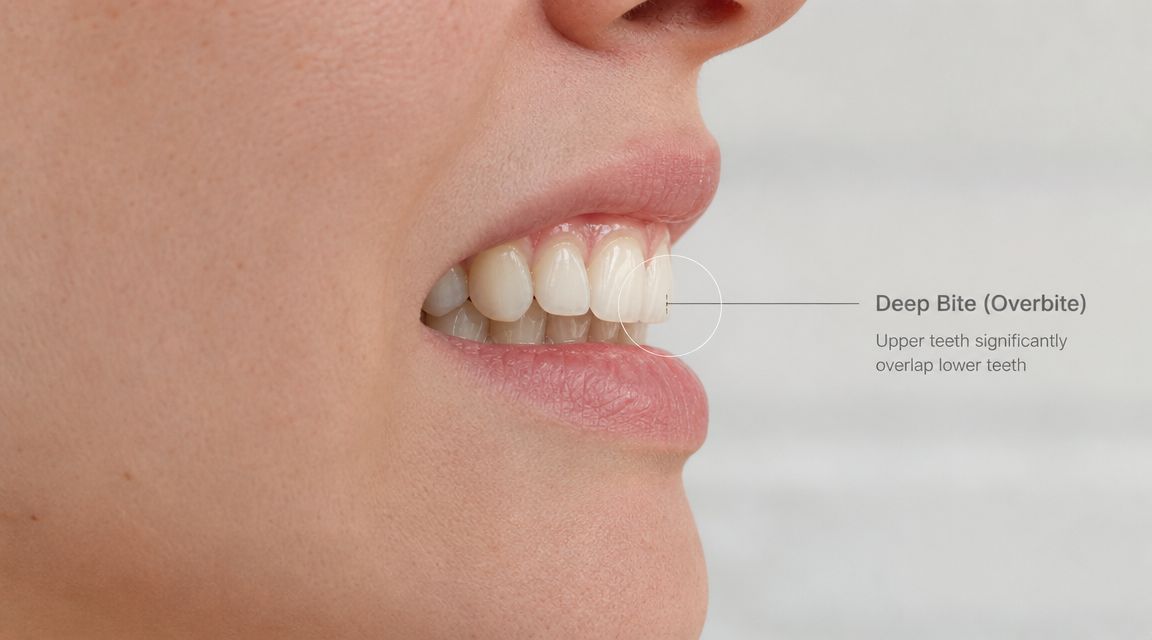
What an overbite actually means
An overbite describes how much the upper front teeth vertically overlap the lower front teeth. A small overlap can be normal. A deep bite means that overlap is excessive.
One useful way to think about it is as two gears that are supposed to meet smoothly. If one set sits too far over the other, the system still moves, but it doesn't move evenly. Certain teeth absorb more force. Some surfaces wear down faster. The jaw muscles may start compensating.
There are two broad categories that patients often confuse:
| Type | What drives it | Why it matters |
|---|---|---|
| Dental overbite | Tooth position | Teeth can often be repositioned with aligner therapy |
| Skeletal overbite | Jaw structure or jaw discrepancy | May need a different approach for lasting correction |
A key clinical point is that clear aligners work primarily by moving teeth, not by reliably changing adult jaw structure. A summary of this distinction appears in guidance on dental versus skeletal overbites and aligner suitability.
Why adults often notice it later
Some adults have had the same bite pattern for years, but the effects become more visible with time. The bite may deepen as teeth wear down or drift. A patient with crowns or bridgework may notice that one area keeps taking too much pressure. Someone else may feel that the smile has become shorter or more closed.
Common effects include:
- Tooth wear on front or back teeth
- Chipping or fractures in vulnerable teeth or restorations
- Jaw fatigue during chewing or clenching
- Smile concerns when too little lower tooth shows
Clinical perspective: The overbite itself isn't always the whole problem. Often, it's part of a broader pattern involving wear, grinding, broken edges, or older restorative work.
That's why a new patient exam for overbite concerns should be diagnostic, not rushed. Dental x-rays, photographs, and bite analysis help identify whether the issue is cosmetic, functional, restorative, or all three at once.
How Clear Aligners Move Teeth to Fix an Overbite
Clear aligners don't fix an overbite by merely “pushing everything straight.” They work through a planned sequence of very specific tooth movements. For patients, that's often the missing piece. They understand how aligners can tidy spacing, but they don't always realize that vertical bite correction is part of the plan too.
A visual overview helps make that process easier to follow.
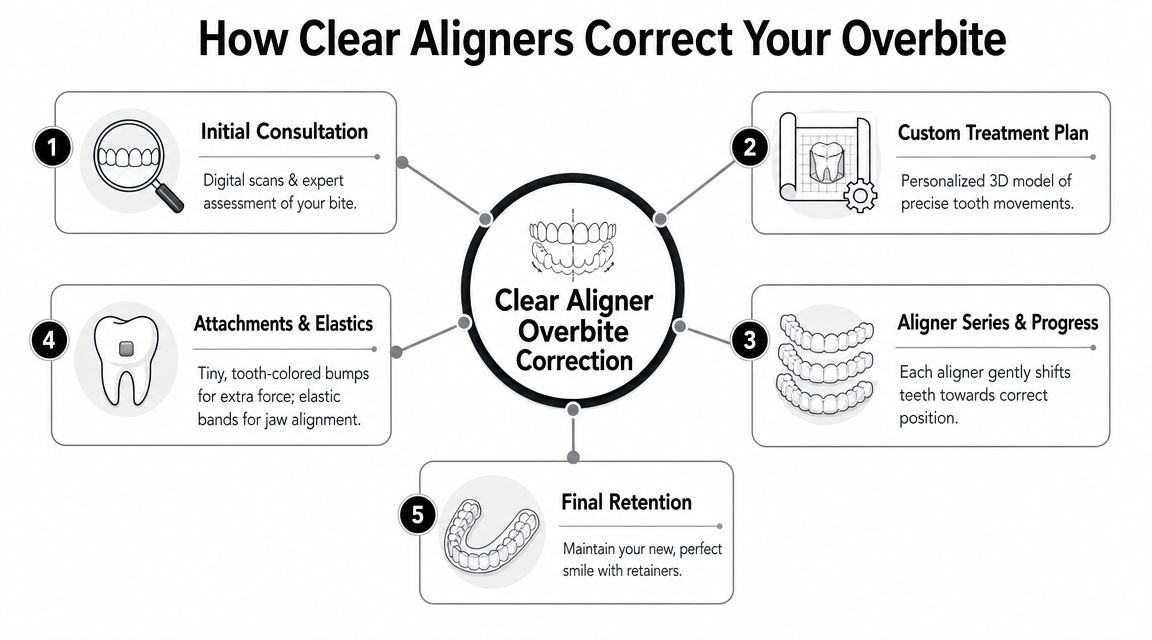
The movement is precise, not random
For a dental deep bite, one important concept is intrusion. That means gently moving certain front teeth upward into a more favorable position so the upper and lower teeth don't overlap so heavily.
This is controlled movement. The aligners are shaped so each tray encourages small changes from the position before it. In many cases, the goal isn't one dramatic motion. It's a coordinated series of smaller ones that improve how the front teeth meet while preserving support in the back.
Patients often understand it better in simple terms:
- Intrusion is like easing a front tooth slightly upward so it doesn't dominate the bite
- Anchorage means other teeth help stabilize the movement
- Sequencing means not every tooth moves the same way at the same time
Later in treatment, bite refinement matters just as much as initial movement. A good result should feel balanced, not merely look straighter.
A short demonstration can make the mechanics more concrete.
Why attachments and elastics matter
Some overbite cases need additional tools built into aligner therapy.
Attachments are small tooth-colored shapes bonded to selected teeth. They act like handles. Without them, the aligner may not grip a tooth well enough to create the intended force.
Elastics may also be used in certain cases to help guide how the upper and lower arches relate during treatment. Patients sometimes worry that using these means the case is going badly. It usually means the plan requires more control.
Practical rule: If a bite problem is three-dimensional, the treatment has to be three-dimensional too.
That's one reason professionally planned aligner treatment differs from simplified cosmetic alignment. Overbite correction often depends on controlling vertical overlap, torque, anchorage, and contact points together.
What the research shows
Clinical evidence supports the idea that aligners can make measurable vertical changes in deep-bite treatment. In a Pacific University analysis of Invisalign cases, the average overbite correction across the sample was −1.95 mm, with subgroup reductions of −1.84 mm and −2.05 mm. The same study reported about 0.77 mm of lower incisor intrusion and 0.21 mm of lower molar extrusion, showing that correction can come from a combination of tooth movements rather than one single mechanism, as detailed in the Pacific University cephalometric analysis of overbite correction.
That matters for patients because it confirms something important. Clear aligners for overbite can do more than align crowded front teeth. In the right case, they can change the vertical relationship in a meaningful, measured way.
Determining Your Candidacy for Clear Aligner Treatment
Not every overbite should be treated with clear aligners. That's not bad news. It's honest planning. A patient gets the best outcome when the appliance matches the cause of the problem.
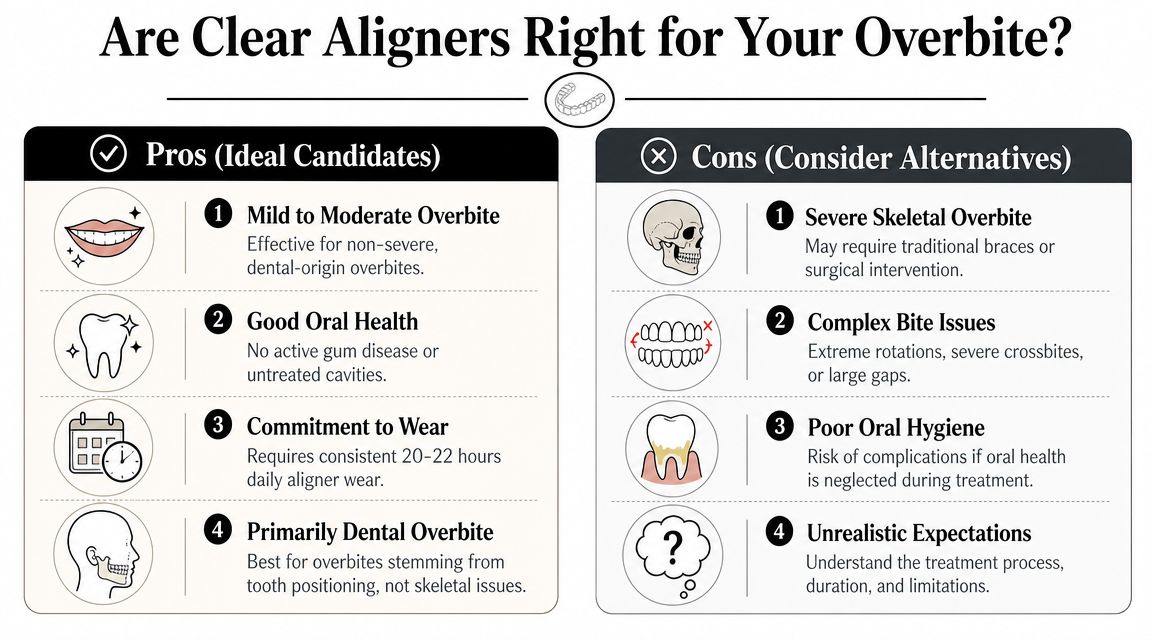
Who is often a strong candidate
Clear aligners are generally best suited to dental overbites, where tooth position is the main issue. In those cases, the treatment can focus on moving teeth into a healthier bite relationship.
A strong candidate often has several of these features:
- The bite problem is mainly dental rather than caused by a major jaw discrepancy
- Oral health is stable, with no untreated decay or active gum problems
- The patient is consistent, because treatment depends on daily wear
- Goals are realistic, with the understanding that bite correction takes planning and follow-through
For patients who also need restorative care, candidacy includes another question. Can the tooth movement be coordinated safely with crowns, worn edges, implant planning, or existing bridgework? That's especially relevant in adult cases.
When another approach may be more appropriate
Some overbites are more skeletal in nature. Others involve more complex bite relationships that may need a different approach, sometimes including braces or broader orthodontic planning. Patients who need that type of care can learn more about traditional braces as an orthodontic treatment option.
A consultation usually looks at:
| Finding during exam | What it may suggest |
|---|---|
| Teeth are tipped or overerupted | Aligner therapy may be a reasonable option |
| Jaw discrepancy is a major driver | Alternative treatment may be more stable |
| Existing restorations need protection | Planning must integrate orthodontics and restorative goals |
The central clinical point remains straightforward. Clear aligners are best for tooth-position problems. More severe skeletal overbites may require a different path, as explained in the earlier guidance on aligner suitability.
Some adults are excellent aligner candidates, but not for the reason they assume. The visible overlap is only part of the diagnosis.
That's why candidacy isn't decided from a selfie or a quick visual impression. It comes from a full exam, digital scans, and a detailed review of the bite.
Your Aligner Treatment Timeline and Expected Results
Adults usually want two honest answers before starting. How long will this take, and what kind of result is realistic?
For overbite correction, the answer is rarely “fast.” It's usually “predictable, if the diagnosis is right and the wear is consistent.”
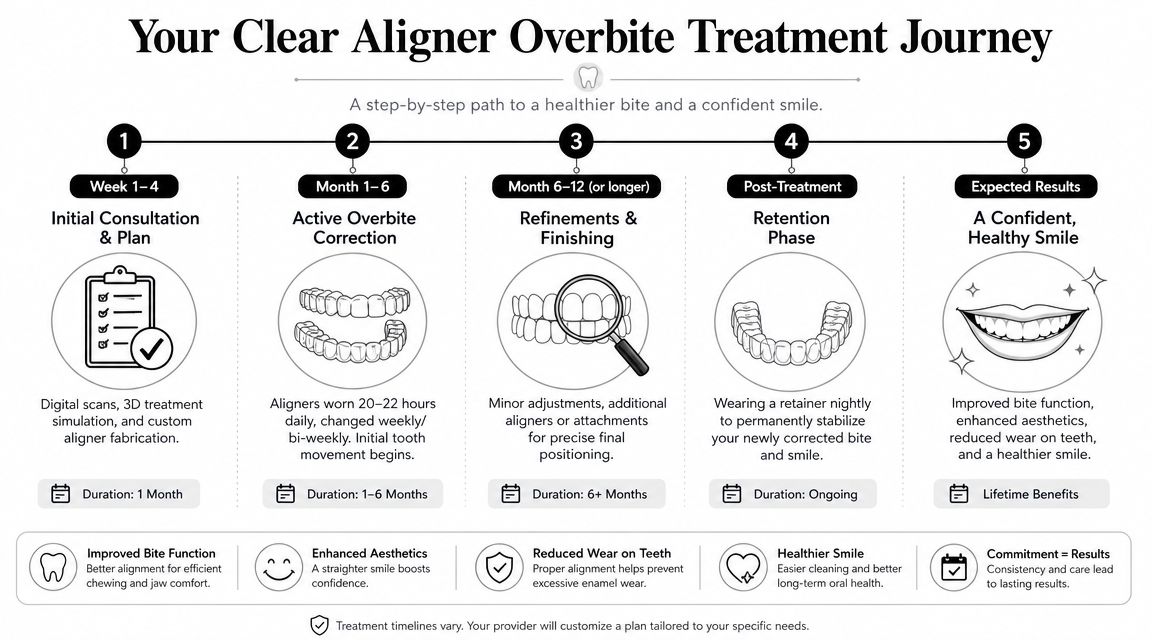
What the treatment schedule usually looks like
A more recent study of aligner treatment reported that mean overbite improved from −3.5 mm before treatment to +1.5 mm after treatment, with treatment lasting an average of 18 months and using about 24 sets of aligners per patient. The pre-treatment to post-treatment change was statistically significant, and 90% of participants reported improved aesthetics and comfort, according to the 2024 open-bite and overbite study on aligner outcomes.
That timing fits with broader clinical expectations. Aligners for overbite commonly require 20 to 22 hours per day of wear, and treatment often falls in the 12 to 24 month range depending on complexity and compliance, as described in manufacturer guidance on overbite treatment with aligners.
Patients are often told that treatment unfolds in phases:
- Early phase with initial tooth movement and adaptation to wearing trays
- Active correction phase when the bite begins to open or rebalance
- Refinement phase if additional detail is needed before finishing
- Retention phase after active treatment ends
What patients can realistically expect
A successful outcome isn't just a cosmetic one. In adult treatment, the target is usually a bite that looks better, functions better, and places less stress on vulnerable teeth.
That may mean improvements such as:
- Less excessive overlap of the front teeth
- A more even chewing pattern
- Reduced force concentration on worn or restored teeth
- A smile that appears more balanced
The trays only work when they're in the mouth. Compliance isn't a minor detail. It's one of the main drivers of success.
A patient who wears aligners inconsistently may still see some change, but treatment can take longer and the result may be less precise. This is one reason adults who do well with aligners are often highly organized and motivated. They understand that the removability is a benefit, but also a responsibility.
The Clear Aligner Journey at Our Upper East Side Practice
The process usually starts with a patient sitting down not because they want “straight teeth,” but because something feels off. A crown keeps chipping. The bite doesn't settle comfortably. The lower teeth are getting shorter from wear. In that setting, aligner treatment becomes part of a larger restorative conversation.
A first visit focused on answers
At an Upper East Side consultation, the first goal is clarity. Digital scans replace messy impressions. Photos and imaging help map out how the teeth meet, where force is concentrated, and whether the overbite is part of a wider wear pattern.
For adults who have been putting off care, this often changes the conversation. Instead of guessing, they can see the bite. They can understand why one tooth is overloaded or why a cosmetic fix alone wouldn't last. If clear aligners are appropriate, patients can review how a series of custom trays may fit into the broader plan through clear aligner treatment at Prosth & Co..
Why complex restorative cases need a different level of planning
Prosthodontic training holds particular significance in situations involving complex adult orthodontics. Adults with crowns, bridges, implants, or heavy grinding don't present like textbook orthodontic cases. A tooth may need movement while a neighboring implant cannot move at all. A worn bite may need orthodontic correction before final restorations are placed. Existing crowns may need to be protected while the bite is being reorganized.
A key concern in these cases is whether aligners can be integrated safely into a full-mouth plan. Guidance on this point notes that prosthodontic expertise is especially relevant when aligners must work around existing crowns, bridges, or dental implants in overbite correction and rehabilitation planning, as discussed in this clinical discussion of aligners for severe bite problems and restorative cases.
That's why the journey often includes coordination across services, not just orthodontic trays alone:
- Preventive care, such as cleaning and exams before treatment starts
- Restorative dentistry, when worn or damaged teeth need protection
- Cosmetic planning, if veneers or other esthetic work are part of the long-term goal
- Night guards or retention, when grinding risk remains after alignment
Adult overbite treatment often succeeds because the bite plan and the restorative plan are built together.
For someone looking for a dentist near me on the Upper East Side, that integrated approach can matter more than the aligners themselves.
Common Questions About Clear Aligners for Overbite
Will treatment hurt
Most patients describe pressure rather than sharp pain, especially when switching to a new set of trays. That pressure is expected. It usually reflects active tooth movement. Attachments may also feel unfamiliar at first, but patients typically adapt.
How should aligners be cleaned
Aligners should be removed for meals and cleaned gently every day. Teeth should also be brushed and flossed carefully before the trays go back in. Good hygiene matters because aligners sit closely against the teeth for most of the day.
What happens after treatment ends
Retention is part of treatment, not an optional extra. Once teeth have moved into a healthier bite, retainers help hold that result. Without retention, teeth can shift, especially in adults with a history of grinding or crowding.
Does insurance help
Coverage varies widely by plan. Some policies offer orthodontic benefits, while others don't. The only reliable way to understand cost is with an individual consultation, a diagnosis, and a written treatment plan based on the patient's bite, restorative needs, and treatment goals.
Patients who are also searching for dental implants near me, restorative dentistry, tooth extraction, emergency dentist care, or cosmetic dentistry often benefit from reviewing the full mouth thoroughly, because overbite correction may be only one part of what the smile needs.
Patients who want a clearer answer about clear aligners for overbite can schedule a consultation with Prosth & Co.. At 47 E 77th St, Suite 207 on Manhattan's Upper East Side, the practice provides thorough evaluation for bite concerns, worn teeth, crowns, bridges, implant planning, and full-mouth rehabilitation so treatment can be designed around both function and appearance.

Founder and lead prosthodontist of Prosth & Co. on Manhattan's Upper East Side. DDS, Columbia University; Prosthodontics certificate and MMSc in Oral Biology, Harvard School of Dental Medicine; Implantology fellowship, Columbia University.
Meet Victoria →