
A reader on the Upper East Side might be noticing something small that suddenly feels hard to ignore. A front tooth looks more crowded in photos. A child's teeth don't seem to be coming in evenly. A longtime crown or bridge no longer feels aligned with the bite. For many Manhattan patients, the question isn't just whether teeth can be straightened. It's whether orthodontic treatment still makes sense at this stage of life.
That's where the conversation becomes more useful. Braces aren't only about appearance, and they aren't only for teenagers. In many cases, they're part of a larger plan to improve bite function, protect teeth from uneven wear, and create better conditions for restorative dentistry. That matters in a practice on the Upper East Side, where many adults are balancing smile goals with existing dental work, busy schedules, and long-term oral health decisions.
Table of Contents
- Straighten Your Smile at Any Age in Manhattan
- Understanding the Need for Orthodontic Treatment
- Braces for Children Teens and Adults
- Exploring Your Treatment Options at Prosth & Co
- What to Expect at Your Upper East Side Dentist
- Maintaining Your Smile During and After Treatment
- Start Your Journey to a Straighter Smile in NYC
Straighten Your Smile at Any Age in Manhattan
A common Manhattan scenario goes like this. A professional catches a reflection in an office elevator and notices that the lower front teeth have shifted. A parent sees a child chewing unevenly and wonders whether it's too early to ask about braces. Another adult searching for a dentist near me on the Upper East Side is already thinking about a crown, implant, or cosmetic update and realizes the teeth may need to be moved first.
That hesitation is understandable. Many people still connect braces with middle school yearbooks and teenage milestones. But adult orthodontics is no longer unusual. The American Association of Orthodontists has reported that as many as one in three orthodontic patients are adults, and U.S. estimates suggest roughly one million Americans over age 18 were wearing braces by 2022, as summarized in this review of adult orthodontic statistics.

Why this question comes up so often in New York
Upper East Side patients often arrive with layered concerns, not one simple issue. They may want straighter teeth, but they also want a healthier bite, a more stable foundation for restorative dentistry, or a cleaner smile that feels easier to maintain. That's why braces for all ages is less of a slogan and more of a treatment philosophy.
A prosthodontic perspective changes the discussion. Instead of asking only, “What kind of braces looks best?” the better question is often, “What kind of tooth movement helps this person chew comfortably, protect existing dental work, and support the next step in care?”
Adult orthodontic treatment often starts with a practical concern, not a cosmetic one. A shifting bite, worn teeth, or planned restorative work can be the real reason treatment makes sense.
For patients looking for a cosmetic dentist near me or a dentist in New York, NY, that distinction matters. Straightening teeth can be a cosmetic improvement, but it can also be part of careful restorative planning. In Manhattan, where patients often want efficient, coordinated care, that kind of planning can make the entire process feel clearer and more worthwhile.
Understanding the Need for Orthodontic Treatment
Orthodontic treatment begins with one basic idea. Teeth should fit together in a way that supports comfortable chewing, healthy cleaning habits, and even force across the smile. When that doesn't happen, the issue isn't only visual.
A bite problem is often called a malocclusion. In plain language, that means the teeth or jaws don't line up the way they should. Some people have crowding, where teeth overlap and trap plaque. Others have spacing, where gaps affect appearance or make certain teeth drift. Some have overbites, underbites, crossbites, or deeper bite problems that place extra pressure on a few teeth.
Problems that seem small can create bigger issues
Patients often assume crooked teeth are mainly a cosmetic concern. Sometimes they are. But many alignment problems affect day-to-day oral health in ways that are easy to miss at first.
- Cleaning becomes harder. Tight overlaps and rotations create spots that are tougher to brush and floss well.
- Teeth can wear unevenly. If the bite lands too heavily in one area, enamel and restorations may take more stress than they should.
- Chewing may feel inefficient. Some patients compensate without realizing it, shifting food to one side or avoiding certain textures.
- Jaw strain can build up. An unbalanced bite can contribute to muscle fatigue or discomfort around the jaw.
Age matters less than oral health
This is the part that surprises many adults. Teeth can often be moved later in life. What matters most is whether the gums and supporting bone are healthy enough to handle that movement safely.
A 2023 NIH and PMC profile of orthodontic use notes that 67.6% of surveyed people who reported orthodontic use were under age 18, which shows children and teens still make up the majority. It also supports an important clinical point. Orthodontic candidacy depends on oral health, not a strict age cutoff.
Practical rule: The real question usually isn't whether someone is too old for braces. It's whether the teeth, gums, and bone are stable enough to move predictably.
That's why an adult with healthy gums may be a strong candidate, while a teenager with untreated decay or gum inflammation may need other care first. The same principle applies to older adults considering crowns, bridges, or dental implants near me. If the bite is off, orthodontic treatment may be part of creating a better foundation before restorative work moves forward.
What patients usually need to know first
The most useful early questions are often these:
- Is the bite causing wear or instability?
- Are the gums healthy enough for tooth movement?
- Will straightening improve function, appearance, or both?
- Does any restorative work need to happen before, during, or after orthodontics?
Those questions help turn a broad concern into a treatment plan that fits the person sitting in the chair.
Braces for Children Teens and Adults
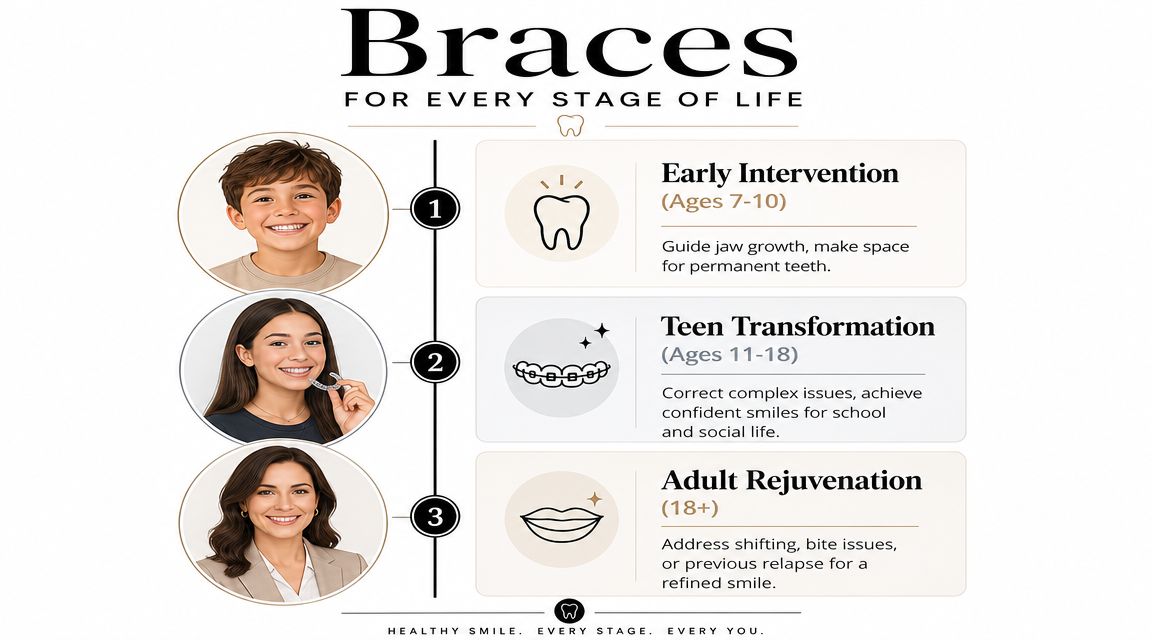
Different ages bring different goals. A child may need guidance while the jaws are still developing. A teenager may need full correction once the permanent teeth are in. An adult may need tooth movement that supports crowns, bridges, implants, or a worn bite. The appliance may look similar from the outside, but the reason for treatment often changes a lot.
Children and early guidance
For children, the goal isn't always full braces right away. Sometimes the most important step is an early orthodontic evaluation. The American Association of Orthodontists recommends an initial evaluation around age 7, because some bite and growth issues are easier to spot early, as noted in this discussion of age and treatment timing.
That doesn't mean every child starts treatment at that age. It means a clinician can look for patterns such as crowding, crossbite, or jaw development concerns and decide whether monitoring or early intervention makes sense.
Parents looking for family care on the Upper East Side may also want age-specific support through a pediatric dentist near me in Manhattan.
Teen treatment and full correction
Teen orthodontics is what many people picture first. By this stage, the permanent teeth are usually present, and treatment often focuses on full alignment and bite correction. This can include straightening crowded teeth, closing spaces, improving how the upper and lower arches fit together, and helping the smile function better long term.
Teenagers also tend to be managing school, activities, social life, and growing confidence. That means treatment planning has to be realistic. Some patients do well with fixed braces because there's less room for inconsistency. Others may be interested in more discreet options if the case allows.
Adults and restorative planning
Adults usually bring a more complicated dental history. They may already have fillings, crowns, missing teeth, implants under consideration, or years of wear from grinding. For that reason, the adult orthodontic conversation needs to go beyond appearance.
For many adults, the key question is not “am I too old?” but “is my mouth healthy enough for tooth movement, and do I need coordinated restorative planning first?” That same source explains that many adult patients need a specific sequence, with orthodontics creating the proper foundation for future crowns, bridges, or implants.
A simple example helps. If an adult has a tilted tooth next to a space where an implant is planned, straightening may be used to open or refine that space before implant placement. If the front teeth are flared because the bite has collapsed from wear, braces or aligners may be used to reposition teeth before veneers or crowns are designed. If an older bridge no longer fits the bite well, movement may improve the long-term outlook of the entire restoration plan.
Adults often aren't seeking braces for the same reason teens do. Many want a treatment plan that solves a functional problem first and improves appearance along the way.
That's one reason a prosthodontic-led setting can be useful for braces for all ages. The team isn't only asking how to straighten teeth. They're also asking how those teeth will support future restorative dentistry, comfort, and durability.
Exploring Your Treatment Options at Prosth & Co
Orthodontic appliances all move teeth, but they don't all do the same job equally well. Some offer maximum control. Some offer more discretion. Some fit better when the case is straightforward and the patient wants something removable.
How fixed braces work
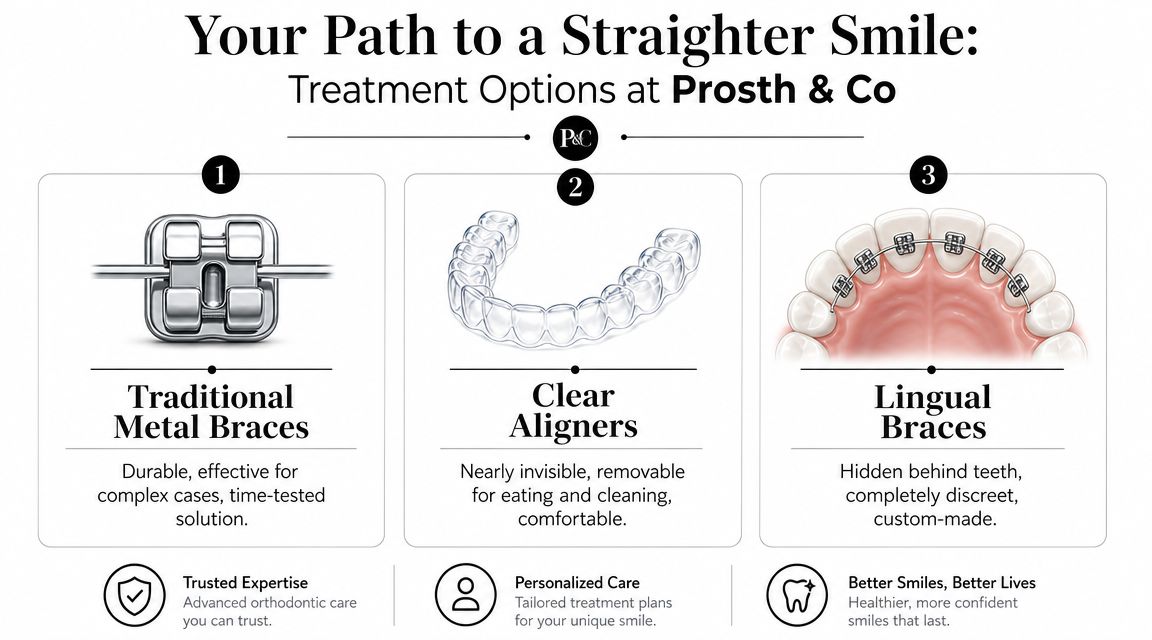
Traditional fixed braces use brackets and archwires to apply steady pressure that moves teeth gradually. They can also work with elastics or other attachments when bite correction needs more control. According to the American Association of Orthodontists, fixed braces can address a broader range of malocclusions than clear aligners, including severe crowding and jaw-alignment problems, and active treatment often runs about 12 to 24 months according to AAO guidance on braces.
That broader range matters. If a patient has a deep overbite, a crossbite, significant crowding, or a more complex restorative setup, fixed braces often give the clinician more precision.
Some adults prefer ceramic braces because they blend in more with the teeth. The mechanics are still in the fixed-braces family, so they can be useful when a patient needs the control of brackets but wants a less noticeable appearance.
When clear aligners make sense
Clear aligners appeal to many adults because they're removable and visually subtle. They can be a strong option for mild to moderate alignment issues when the patient is likely to wear them as directed. They also allow easier brushing and flossing because the trays come out for meals and hygiene.
For patients exploring clear aligners on the Upper East Side, the main question isn't whether aligners are popular. It's whether they can deliver the kind of movement the case needs.
A practical comparison
| Option | Often a good fit for | Main tradeoff |
|---|---|---|
| Metal braces | More complex tooth and bite movement | More visible |
| Ceramic braces | Patients who want fixed control with a softer appearance | Still fixed, may require careful maintenance |
| Clear aligners | Light to moderate alignment with strong patient compliance | Not ideal for every complex bite problem |
| Lingual braces | Patients seeking a hidden fixed option | Custom design and adaptation can be more involved |
One option offered in Manhattan is Prosth & Co., which provides both traditional braces and clear aligner treatment within a broader restorative and prosthodontic setting. That can be helpful when straightening teeth is only one part of the overall treatment plan.
A practical way to decide is to ask three things:
- How complex is the bite problem? If the answer is “very,” fixed braces often deserve serious consideration.
- How important is removability? Some adults value the ability to take aligners out for meals and meetings.
- Will restorative work follow? If crowns, bridges, veneers, or implants are part of the plan, appliance choice should support those next steps.
The right choice usually isn't the least noticeable appliance. It's the one that moves teeth predictably for the outcome the patient needs.
What to Expect at Your Upper East Side Dentist
Starting orthodontic care feels easier when the process is concrete. Most patients want to know what happens first, how often they'll come in, and whether treatment can fit around work, school, or family routines in Manhattan.
The first visit and records
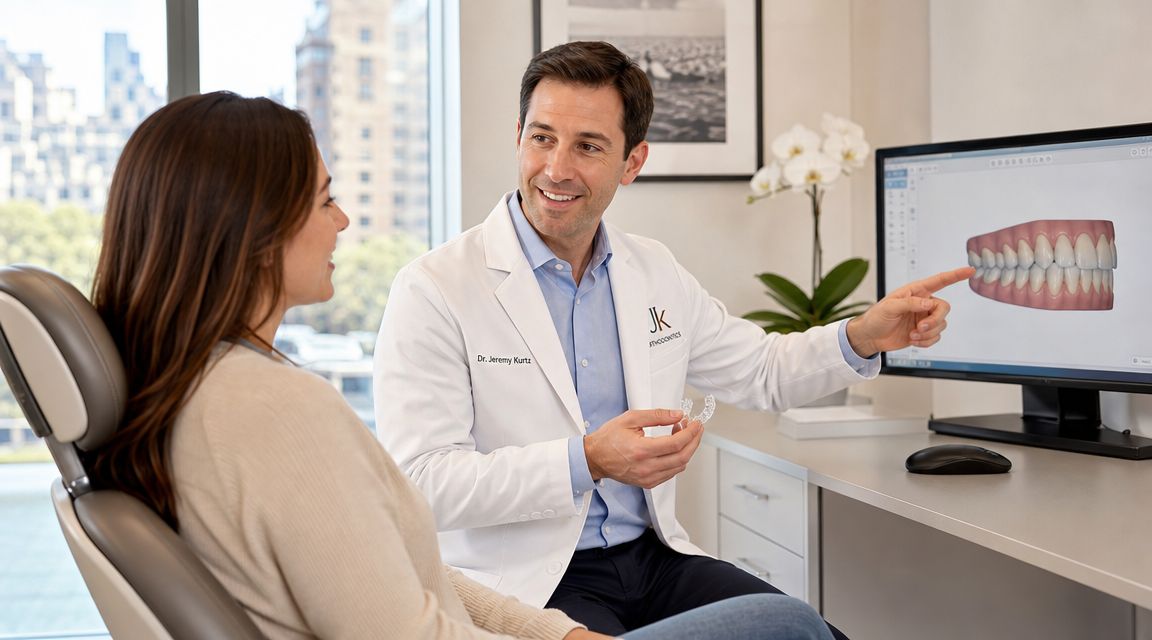
The initial visit usually starts with a conversation. The clinician reviews the patient's concerns, whether that's crowding, shifting teeth, cosmetic goals, chewing discomfort, or planning around existing restorative dentistry. The exam may include photos, digital imaging, and a close look at the bite from multiple angles.
This first visit is also where patterns become clearer. A patient who thought the issue was one crooked front tooth may have a bite imbalance. Another patient looking for a cosmetic dentist near me may learn that alignment changes could make future veneers or crowns more conservative and stable.
The most reassuring consultation is often the one that explains not just what can be done, but why the sequence matters.
Planning treatment around real life
Once records are reviewed, the treatment plan is customized for the person, not just the teeth. That includes discussing appliance options, likely timing, oral health priorities, and whether any restorative or periodontal steps should happen before movement begins.
Cost and insurance discussions should also happen early, in plain language. Patients deserve to understand the scope of care before they commit. In a busy New York practice, that kind of clarity matters almost as much as the treatment itself.
This overview helps many patients understand the process visually:
Visits during active treatment
After planning comes placement of the appliance or delivery of aligners. For fixed braces, patients return for periodic adjustments. For aligners, visits often focus on tracking progress and refining movement as needed.
A typical care sequence often includes:
- Initial consultation and records
- Custom treatment planning
- Appliance placement or first aligner delivery
- Regular follow-up visits
- Retention after active movement
For Upper East Side patients coming to 47 E 77th St, Suite 207, those visits are easier to keep up with when the office is close to home, work, or school. That convenience can make a real difference over the life of treatment.
Maintaining Your Smile During and After Treatment
Orthodontic treatment works best when the patient and the dental team do their parts consistently. The appliance creates the movement. Daily habits protect the teeth, gums, and final result.
Daily habits that protect progress
Braces and aligners both require more attention to cleaning. Food and plaque collect more easily around brackets, wires, and attachment points. If hygiene slips, the patient may finish treatment with straighter teeth but less healthy enamel or irritated gums.
A few habits make the process smoother:
- Brush carefully around every appliance edge. Small circular motions matter more than quick scrubbing.
- Clean between teeth daily. Floss threaders, interdental brushes, or a water flosser can help where a regular brush can't reach.
- Be selective with food choices. Hard, sticky, or crunchy foods can damage fixed appliances or create unnecessary delays.
- Keep scheduled visits. Small issues are easier to correct when they're caught early.
Why retainers matter
When active treatment ends, the work isn't over. Teeth naturally tend to drift if nothing holds them in their new position. That's why retainers are not optional. They protect the alignment that took months to create.
Patients sometimes think the braces did the hard part, so the retainer phase should be easy to skip. That's a mistake. Retainers are what help preserve the result while the teeth settle into long-term stability.
Straightening teeth changes position. Retention helps protect that position.
This is especially important for adults who have invested in cosmetic or restorative dentistry. If a patient has coordinated orthodontics with crowns, bridgework, or implant planning, maintaining alignment becomes part of protecting the whole treatment investment, not just the appearance of the smile.
Start Your Journey to a Straighter Smile in NYC
A question many adults ask at the end of a consultation is simple. Are clear aligners always the best option?
Not always. For some patients, aligners are an excellent fit because they're discreet, removable, and effective for the right level of correction. For others, especially those with more complicated bite problems or restorative needs, fixed braces may offer better control and a more predictable result. The most attractive option on paper isn't always the one that supports long-term function.
That decision matters because adult orthodontic care is no longer unusual. With about 1 in 4 orthodontic patients now being an adult, the demand is mainstream, and the choice between braces and aligners often comes down to function, not appearance alone, as noted by the American Association of Orthodontists blog on adult orthodontic demand.
For Manhattan patients, the most useful next step is a consultation that looks at the whole picture. That includes the bite, gum health, existing restorations, future plans for crowns or implants, and the patient's day-to-day priorities. A child may need guidance. A teen may need full correction. An adult may need a carefully staged plan that supports restorative dentistry.
A healthier, more stable smile can be built at many different life stages. The key is matching treatment to the person, not forcing every patient into the same path.
Patients searching for a dentist near me, dentist in New York, NY, cosmetic dentist near me, or support for restorative planning on the Upper East Side can schedule a consultation with Prosth & Co. to discuss whether braces, clear aligners, or coordinated restorative treatment makes the most sense for their smile.

Founder and lead prosthodontist of Prosth & Co. on Manhattan's Upper East Side. DDS, Columbia University; Prosthodontics certificate and MMSc in Oral Biology, Harvard School of Dental Medicine; Implantology fellowship, Columbia University.
Meet Victoria →