A front tooth chips on a coffee cup before a morning meeting. A lower molar shows a dark edge in a video call. An older silver filling still works, but it catches the eye every time a patient laughs. For a patient searching for a dentist near me or a dentist in Manhattan after one of those moments, the useful question isn't only whether a filling can match the tooth. It's whether that specific tooth, under that specific bite, should receive a direct tooth color filling, a ceramic inlay or onlay, or something stronger.
Table of Contents
- Why Manhattan Patients Ask About Tooth Color Fillings
- What a Tooth Color Filling Actually Is
- Composite Resin Versus Traditional Silver Fillings
- How the Filling Appointment Unfolds
- How Long a Tooth Colored Filling Is Likely to Last
- Caring for a Tooth Color Filling After Treatment
- What to Expect at Prosth & Co. on the Upper East Side
Why Manhattan Patients Ask About Tooth Color Fillings
The lunch scenario is familiar across New York, NY. A patient bites into something firm, feels a rough corner with the tongue, and checks a phone camera between appointments. The damage may look small, yet the concern is immediate because front teeth show in every conversation, photo, and presentation.
Back teeth prompt a different worry. A molar may not hurt, but an old amalgam filling looks dark against the enamel, or food starts catching where an edge has worn. Patients often ask whether replacing it with a tooth-colored restoration is cosmetic, restorative, or both. The answer depends on cracks, decay, remaining enamel, and how hard that tooth works during chewing.
Different Teeth, Different Conversations
A small chip on a front tooth is primarily an esthetic and bonding problem. Shade, translucency, and edge shape matter, and conservative composite can often restore the contour without covering the whole tooth. A large molar filling is a structural problem first. Cusps flex under load, old restorations may undermine the walls, and grinding can turn a neat repair into a fracture risk.
That's why a search for a cosmetic dentist near me can lead to very different treatment plans. One patient needs a polished bonding repair. Another needs an onlay that protects weakened cusps. Both can look natural, but they aren't interchangeable.
Practical rule: Material choice follows the condition of the remaining tooth, not the other way around.
At Prosth & Co. on the Upper East Side, care is led by a prosthodontist, a specialist focused on restoring damaged teeth, bite function, and complex esthetic cases. Routine fillings sit alongside crowns, dental implants, full mouth rehabilitation, and coordinated specialty care when a tooth also needs an endodontist or surgical input. That range matters because a patient doesn't benefit from a practice forcing every defect into the same solution.
Manhattan patients also tend to ask practical questions early. How many visits? Will the shade still match after teeth whitening? Can a broken tooth be seen quickly by an emergency dentist? Those questions deserve direct answers during a consultation, along with photographs and dental x-rays that show what the mirror can't.
The goal is a confident smile that also chews comfortably. For a patient seeking a dentist in New York for restorative dentistry, the best starting point is an individualized examination, not a promise that one white material fits every cavity.
What a Tooth Color Filling Actually Is
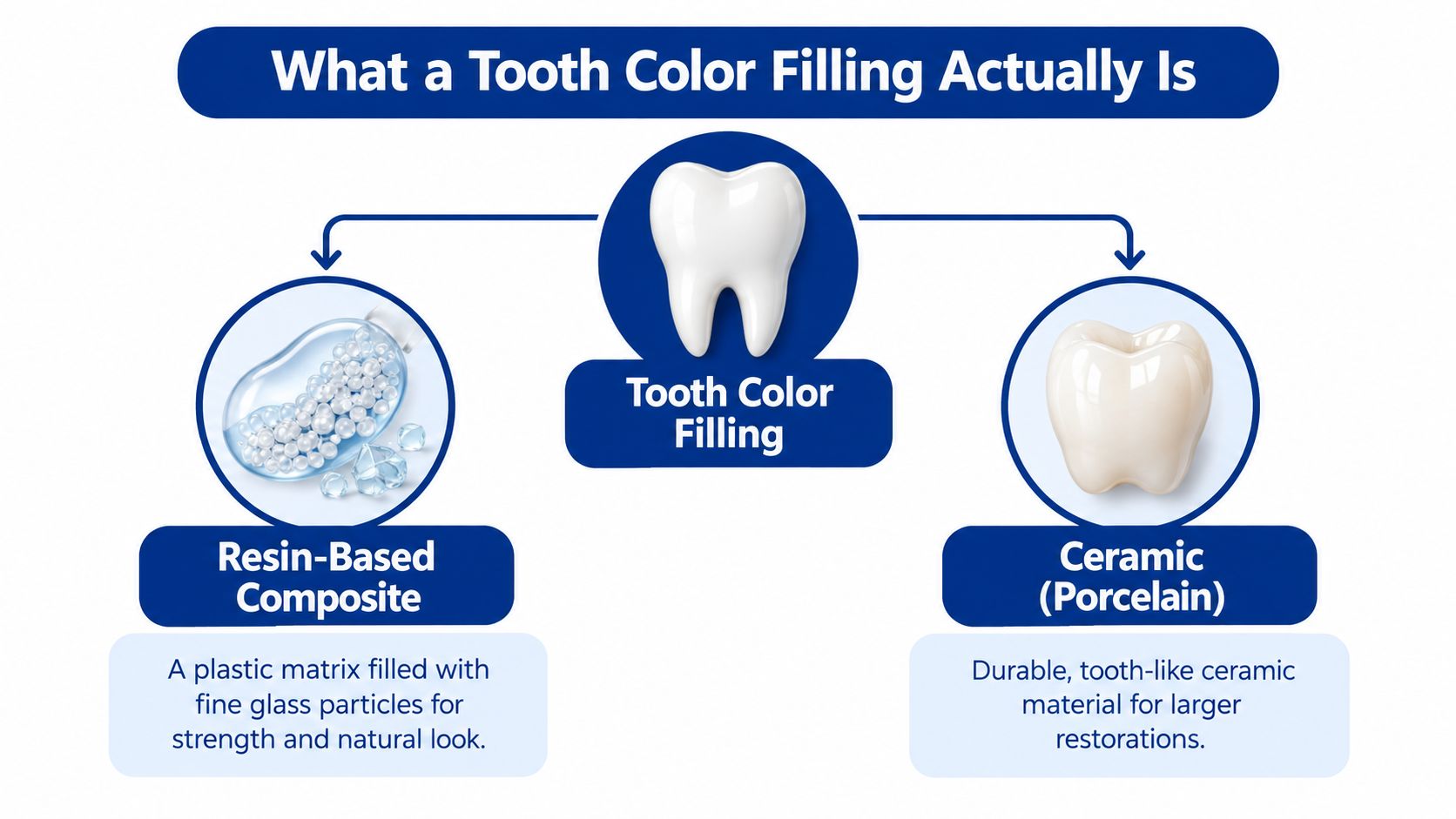
A tooth color filling usually means a direct restoration made from resin-based composite. Tooth-colored fillings are primarily resin-based composite materials made from plastic resin combined with powdered glass and can be color-matched to surrounding tooth structure, while generally requiring removal of less healthy tooth tissue than amalgam during placement, as explained in the National Institute of Dental and Craniofacial Research guidance on silver fillings. The dentist places the material directly into the prepared tooth, shapes it, and hardens it with a curing light.
Think of composite as a carefully hand-shaped patch. It's bonded to enamel and dentin, layered to rebuild missing anatomy, and polished so the surface blends with neighboring teeth. Because it bonds, preparation can stay focused on decayed or broken tissue rather than cutting extra shape for mechanical retention.
Direct Composite and Indirect Ceramic
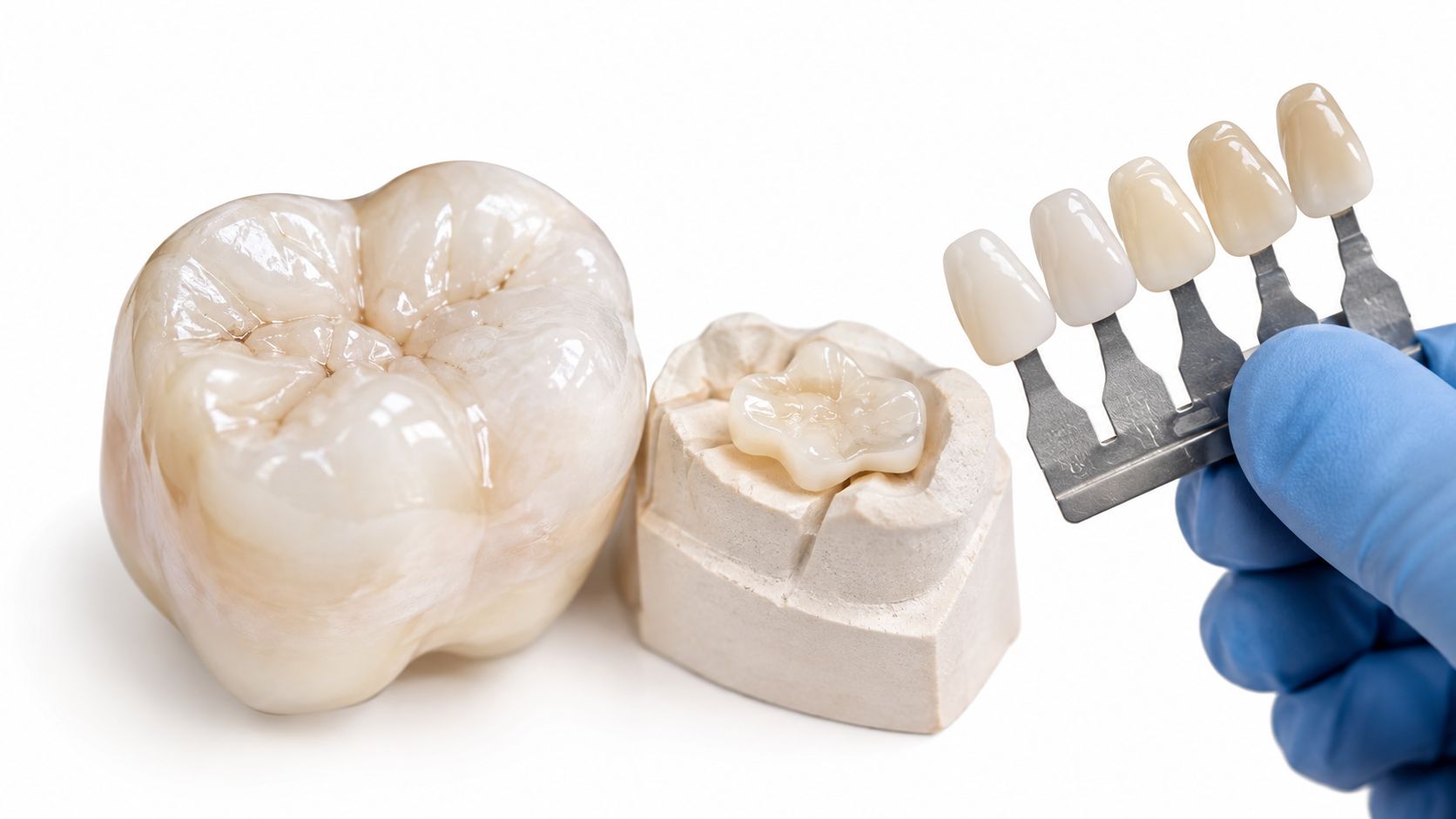
Ceramic inlays and onlays belong to the same tooth-colored family, but they're made outside the mouth. An inlay fits within the cusps of a back tooth. An onlay covers one or more cusps when those points are weak and need protection. A ceramic piece works more like a precisely milled puzzle piece, fabricated to the prepared shape and then bonded into place.
- Direct composite: Best suited to small or moderate cavities, front tooth chips, and areas where isolation and bonding can be controlled well.
- Ceramic inlay: Useful when a posterior defect is too large for a predictable direct filling but enough healthy structure remains.
- Ceramic onlay: Considered when cusps are thin, cracked, or heavily loaded and need coverage without a full crown.
Newer labels can confuse the decision. Terms such as bulk-fill, bioactive, or low-shrinkage describe handling or formulation features, not automatic superiority for every tooth. A mapping of 801 publications on bulk-fill techniques included 692 laboratory studies, which shows heavy research activity but a smaller base of direct clinical evidence, a distinction noted in a 2025 review of newer composite materials and bulk-fill evidence. Faster placement doesn't guarantee a longer-lasting result in an individual molar.
A prosthodontist weighs cavity depth, remaining walls, bite contacts, moisture control, decay risk, allergies, and future repairability before recommending a material. The right choice restores function, protects what's left of the tooth, and matches the smile without overselling novelty.
Composite Resin Versus Traditional Silver Fillings
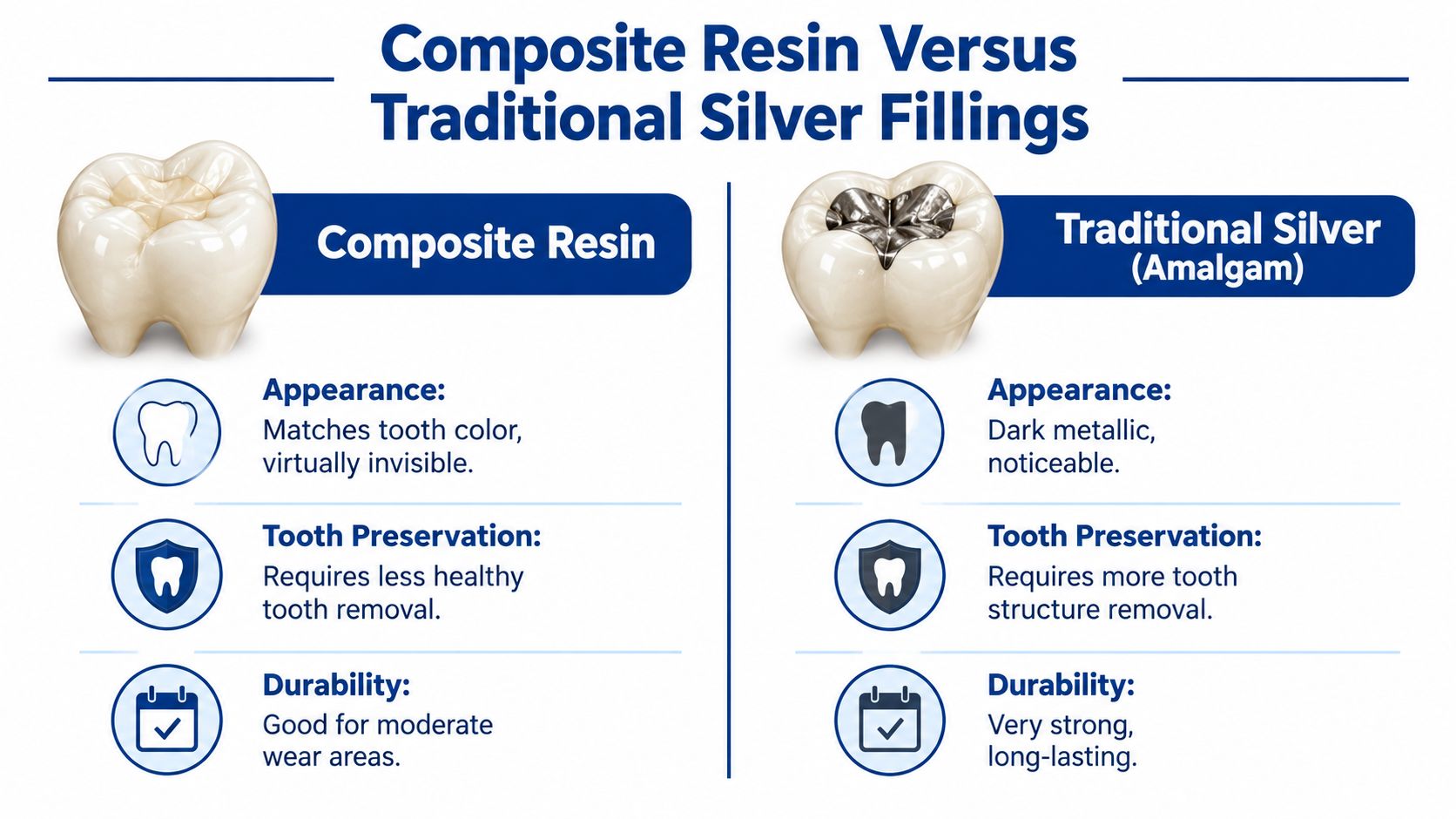
Patients comparing options usually start with appearance. Composite can be shade-matched and polished so a restoration is difficult to spot, especially on front teeth and premolars. Amalgam is called a silver filling because of its metallic appearance, and it can make a tooth look gray even when the restoration remains serviceable.
Appearance is only the first trade-off. Composite bonds to tooth structure, so preparation can preserve more healthy tissue and future repairs may stay more conservative. Amalgam doesn't bond in the same way and traditionally requires a preparation shape that helps hold it in place. Preserving structure matters, because every replacement cycle risks leaving the tooth weaker than before.
Where Each Material Has Limits
Composite is technique sensitive. Saliva contamination can interfere with bonding, so isolation with a rubber dam or careful moisture control isn't a detail, it's part of the restoration. Deep areas near the gumline, heavy bleeding, or limited access can make a direct bonded filling harder to place predictably. Amalgam historically earned its reputation partly because it tolerated difficult field conditions better in high-load back teeth.
Durability also needs context. Research involving more than 700,000 tooth-colored fillings found that 16% failed within five years, with 53% of failures attributed to recurrent or new cavities and 23% to tooth breakage or fracture, figures already introduced through the NIDCR guidance cited earlier. Those numbers don't mean composite is a poor material. They show that decay control and remaining tooth strength drive outcomes as much as the filling itself.
A filling can retain a good color match while the tooth around it is failing from decay or fracture.
The U.S. Food and Drug Administration notes that resin-based composites may be less durable than amalgam in high-stress posterior teeth and may be more vulnerable to fracture and replacement, according to FDA information for patients about dental amalgam fillings. That's a useful caution for large molars, clenchers, and teeth with thin cusps. It isn't a reason to reject composite for a small front tooth repair where esthetics and conservation matter most.
For patients searching for restorative dentistry or a cosmetic dentist near me in Manhattan, the practical answer is case selection. Composite offers natural appearance and conservative preparation. Large, heavily loaded defects may need ceramic coverage or a crown instead of a bigger direct filling. The ranking changes with the tooth.
How the Filling Appointment Unfolds
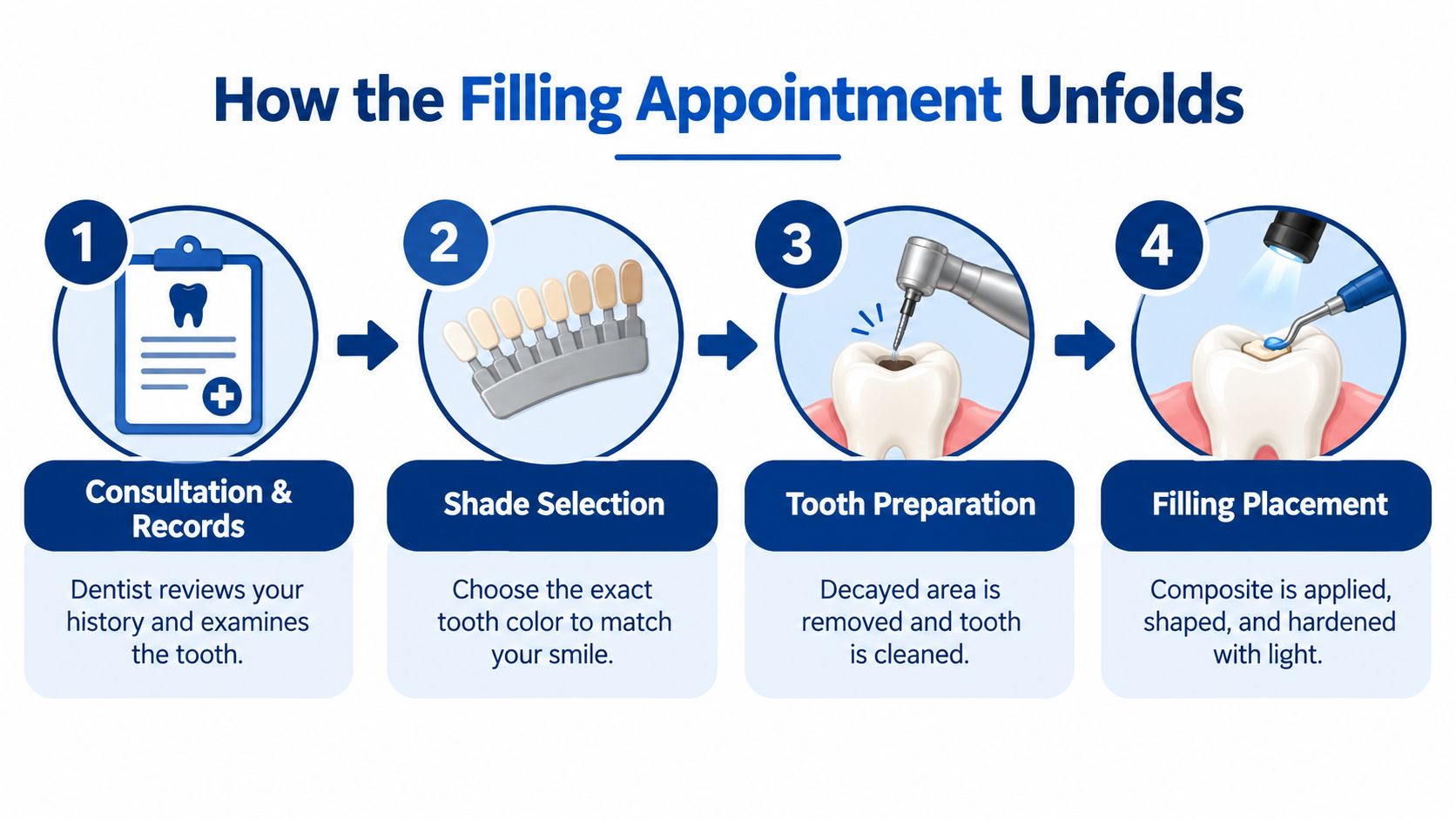
Treatment starts before any material is mixed. The dentist examines the tooth, reviews symptoms, checks the bite, and uses records such as radiographs and intraoral photographs to judge decay depth and cracks. Shade selection happens early, while teeth are hydrated and under neutral light, because a dry tooth can look lighter than it will later.
Local anesthesia keeps the area comfortable. Isolation follows, often with a rubber dam, because adhesive dentistry needs a clean, dry surface. Decayed or weakened tissue is removed conservatively, then the tooth is conditioned and bonded so composite can attach to enamel and dentin.
Why Layering and Curing Matter
Composite shrinks slightly as it hardens. Reported polymerization shrinkage commonly falls around 2 to 4%, with broader literature ranges of approximately 2.6 to 7.1% depending on formulation, as summarized in a review of composite polymerization shrinkage and clinical technique. If shrinkage stress pulls at the bond, patients can develop sensitivity, marginal gaps, or microleakage that raises the risk of recurrent decay.
- Incremental placement: Thin layers reduce the bonded mass cured at one time and help control stress.
- Light curing: Each layer receives the correct exposure so the material hardens fully and resists wear.
- Contouring: The dentist rebuilds contact with the neighboring tooth so floss passes with a snap and food doesn't pack.
- Bite adjustment and polish: High spots are removed, anatomy is refined, and the surface is polished to resist plaque and staining.
Bulk-fill composite can be appropriate in selected deeper cavities, but depth and curing instructions still govern its use. A patient shouldn't judge quality by speed. Proper isolation and curing take time, and that time protects the margin where filling meets tooth.
For a larger defect, the appointment may shift to an indirect plan. The tooth is prepared and scanned or impressed, a ceramic inlay or onlay is fabricated with lab support, and the restoration is bonded after shade and fit are checked. The process is longer, but cusp protection can make it the more durable answer for a molar that has already lost substantial structure.
How Long a Tooth Colored Filling Is Likely to Last
Longevity is a range, not a warranty stamped onto the material. The American Dental Association summarizes a 2012 study reporting an overall composite restoration success rate of approximately 90% after 10 years, with no significant difference from amalgam in that analysis, in its ADA overview of materials for direct restorations. That sounds reassuring, and it should. Modern composite can perform very well when case selection and adhesive technique are sound.
Posterior results show why follow-up length matters. The same ADA summary reports posterior composite cumulative survival of 91.7% at six years, 81.6% at 12 years, and 71.4% at 29 years. A restoration can serve for many years, yet the chance of repair or replacement rises as the tooth ages, the bite changes, and margins face repeated bacterial and chewing challenges.
Typical Composite Restoration Survival at a Glance
| Follow-up window | Composite survival estimate | What it usually reflects |
|---|---|---|
| 6 years | 91.7% | Strong medium-term performance for posterior composite in the ADA summary |
| 12 years | 81.6% | More repairs and replacements as size, load, and decay risk accumulate |
| 29 years | 71.4% | Long-term service remains possible, but monitoring becomes essential |
Annual risk tells another part of the story. A meta-analysis of 12 longitudinal clinical studies reported mean annual failure rates of 1.8% at 5 years and 2.4% at 10 years for posterior composite, according to a meta-analysis of posterior composite longevity. Caries risk and the number of restored surfaces significantly predicted survival. In plain terms, a one-surface filling in a low-risk patient has a better outlook than a multi-surface molar restoration in a mouth with frequent sugar exposure or dryness.
Secondary decay and fracture remain the principal failure mechanisms. When decay starts at a margin, polishing won't fix it. When a small edge chips but the seal stays sound, repair may be reasonable. When cusps crack or the restoration occupies much of the chewing surface, an onlay or crown may protect the tooth better than replacing composite with more composite.
Bruxism, acidic drinks, diet, saliva flow, bonding quality, and home care shift the estimate up or down. Patients asking a dentist in Manhattan for a single number should expect a more useful answer instead: a prognosis tied to that tooth, plus a monitoring plan during routine cleaning and exams.
Caring for a Tooth Color Filling After Treatment
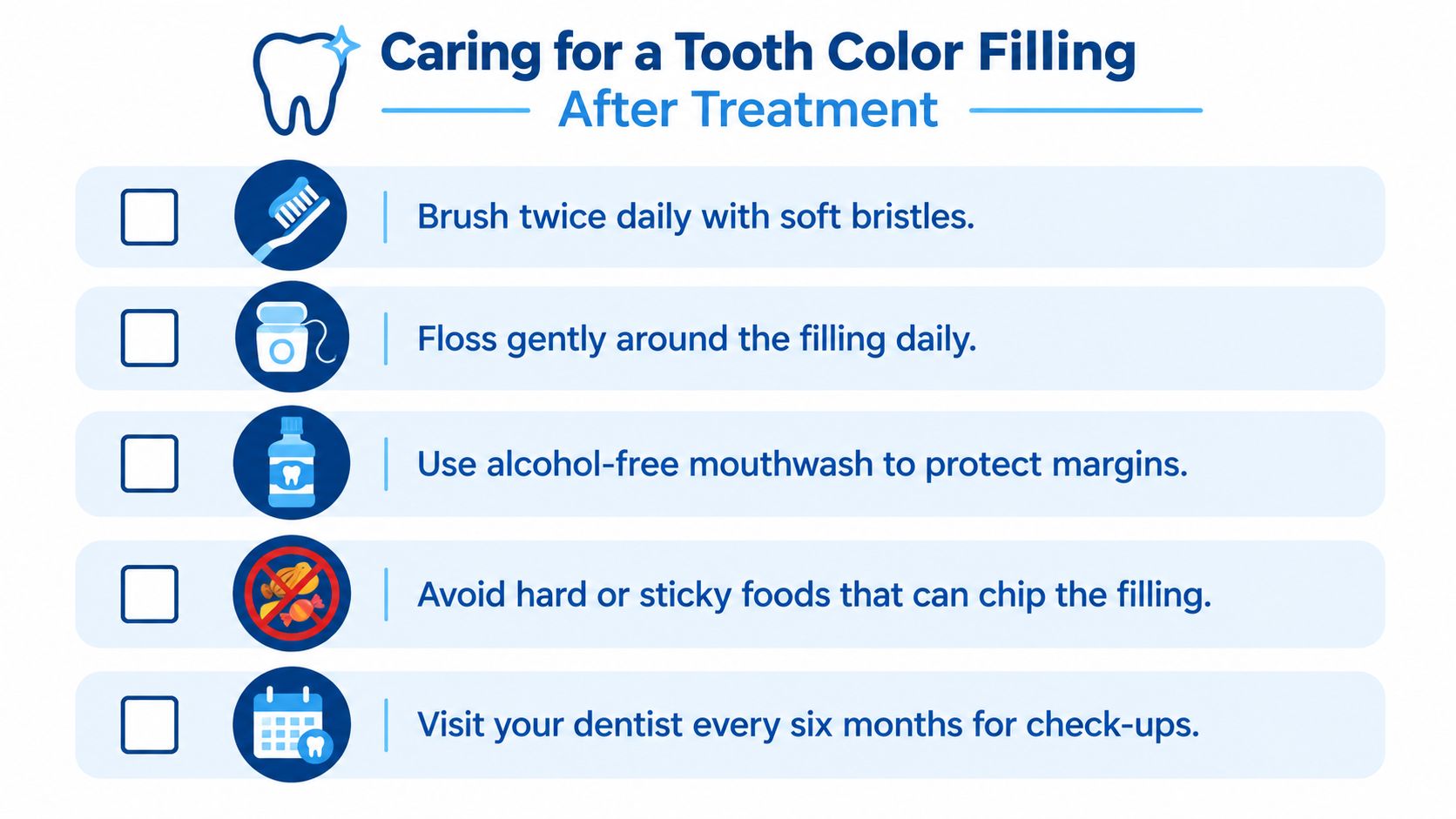
A new filling isn't maintenance-free. Composite and ceramic don't decay, but the natural tooth at the edge of the restoration still can. Daily plaque control protects that margin, which is where many future problems begin.
Patients should brush gently with a soft brush and clean between teeth with floss or interdental brushes. Frequent sugar exposure matters more than a single dessert, because repeated acid attacks give bacteria more chances to damage the margin. Sipping sweetened or acidic drinks over a long workday is harder on restorations than drinking with a meal and then returning to water.
Protecting the Restoration From Load
Grinding changes the equation. Many Manhattan professionals clench during deadlines or sleep, often without knowing it until edges chip or morning jaw soreness appears. A custom night guard can reduce destructive contacts on new posterior work, especially when several teeth have large restorations.
- Sharp pain on biting: This can signal a high spot, crack, or inflamed nerve and shouldn't wait for the next recall.
- Rough or ledged edge: A margin that suddenly catches floss may indicate chipping or wear.
- Dark line at the border: Stain can be harmless, but a soft or shadowed margin may point to recurrent decay.
- Food packing: A lost contact can trap plaque between teeth and irritate the gum.
Aftercare point: Sensitivity that steadily improves is common after treatment. Pain that spikes on release after biting deserves prompt evaluation.
Routine dental care visits allow the dentist to check margins, polish minor surface roughness, review radiographs, and catch decay while a repair is still small. Some fillings can be resurfaced or patched. Others need replacement because decay has undermined the seal. A heavily restored tooth may move to an onlay or crown when repeated filling replacement keeps removing structure.
Anyone with swelling, a broken tooth, or pain that wakes them at night should contact an emergency dentist rather than testing the tooth on hard food. Early care preserves options, including whether a root canal, crown, tooth extraction, or later dental implants near me search becomes part of the conversation.
What to Expect at Prosth & Co. on the Upper East Side
A consultation begins with the patient's concern in plain language. Is the problem pain, a visible chip, an old filling, or a tooth that feels high? The clinical team then examines the tooth, takes intraoral photographs, reviews digital records, and explains findings on screen so the patient can see cracks, margins, wear facets, and shade differences directly.
Treatment planning balances health, function, bite, esthetics, and long-term maintainability. A small cavity may need only a direct tooth color filling. A molar with undermined cusps may be better served by a ceramic onlay. A tooth with nerve symptoms may need evaluation for a root canal before any final restoration makes sense.
Specialty Care Under One Roof
The practice brings together prosthodontics, endodontics, periodontics, oral surgery, orthodontics, implant care, and services from a pediatric dentist, also searched as a kids dentist, for families seeking coordinated care. That structure helps when a simple filling request reveals gum inflammation, bite collapse, a missing tooth, or a child who also needs a new patient exam. Referrals don't automatically send the patient across town.
An in-house dental laboratory supports custom shade matching and ceramic work with direct clinical oversight. Patients considering broader cosmetic dentistry, porcelain veneers, crowns, or implant restorations can review options through the practice page for cosmetic and restorative dentistry services. Shade decisions can also be coordinated with teeth whitening, since composite doesn't bleach after placement.
The Upper East Side office at 47 E 77th St is near the 77th Street 6 train, with weekday hours and urgent care availability for sudden breaks or pain. Communication stays specific: what was found, what happens if treatment is delayed, which restoration fits the tooth, and how it will be maintained. Nervous patients benefit from that clarity because the unknown usually feels worse than the procedure.
For readers looking for a dentist in New York who can handle both a conservative filling and the larger bite question behind it, the next step is an examination with photographs and a plan built around the tooth that remains. Esthetics matter. Structure decides.
Patients ready to discuss a chipped tooth, worn molar, or natural-looking replacement for an older filling can schedule a consultation for tooth-colored composite, bonding, ceramic inlays and onlays, crowns, and coordinated restorative care on Manhattan's Upper East Side. Visit Prosth & Co. to request an appointment and get a plan matched to the tooth, the bite, and the smile.

Founder and lead prosthodontist of Prosth & Co. on Manhattan's Upper East Side. DDS, Columbia University; Prosthodontics certificate and MMSc in Oral Biology, Harvard School of Dental Medicine; Implantology fellowship, Columbia University.
Meet Victoria →