A chipped front tooth can make a Manhattan morning feel longer than it should, especially when a meeting, a dinner reservation, or a simple subway ride puts the smile back in focus. If the back teeth are also worn down or sensitive, chewing starts to feel uneven, and the problem stops being cosmetic. It becomes a bite issue, a comfort issue, and often a confidence issue at the same time.
That overlap is why cosmetic and restorative dentistry work best as a single plan, not as separate fixes. A veneer that looks great but doesn't respect the bite can fail early, while a strong crown that ignores appearance can leave a patient unhappy every time they look in the mirror. In Manhattan, where patients often want one treatment path that protects both function and appearance, a coordinated approach is usually the most reliable one.
Table of Contents
- Why Manhattan Patients Need an Integrated Dental Approach
- Understanding Cosmetic Versus Restorative Dentistry
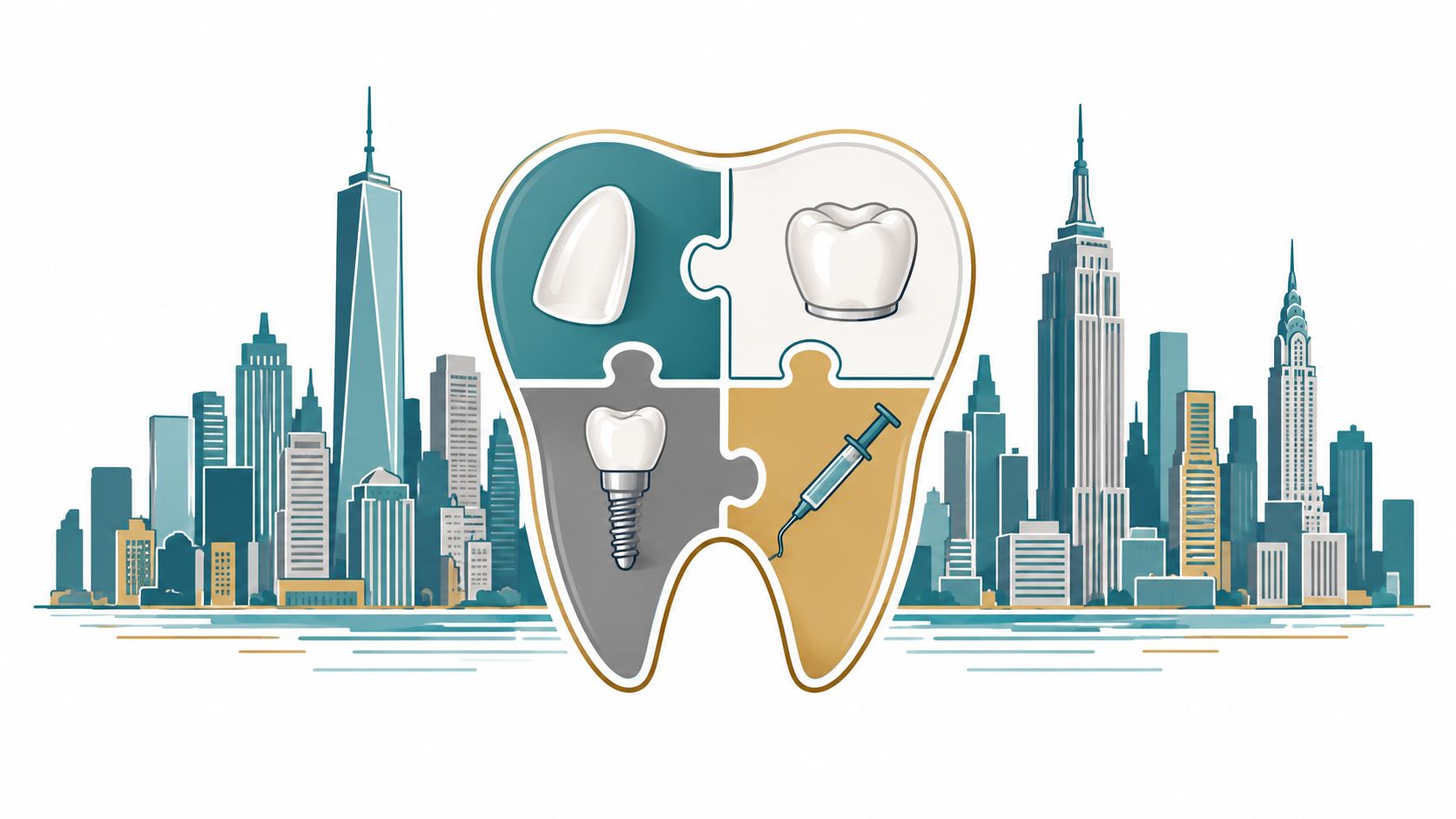
- Comparing Veneers Crowns Implants and Bonding Options
- How Case Planning Bridges Esthetics and Function
- Esthetic Principles That Transform Your Smile Design
- Long-Term Maintenance Strategies for Lasting Results
Why Manhattan Patients Need an Integrated Dental Approach
A busy professional on the Upper East Side may notice the problem in stages. First it's a chipped front edge on a tooth that catches the light in photos. Then the back molars feel flattened, chewing takes more effort, and one side of the mouth starts doing more work than the other.

When one part of the bite gives way
Teeth don't work in isolation. A worn or damaged tooth changes how force is distributed, and the surrounding teeth, gums, and jaw muscles start compensating. That's why a patient may come in asking for a cosmetic fix but also report jaw fatigue, uneven wear, or trouble biting into firmer foods.
A smile plan has to respect the bite first. If function is unstable, appearance won't stay stable for long.
The practical lesson is simple. The front tooth and the back teeth are connected through the same system, so repairing only the visible problem can leave the underlying mechanics untouched. Integrated care helps avoid that mismatch by looking at the whole mouth, not just the most obvious tooth.
For patients trying to sort through calls, scheduling, and urgent questions, a good guide to dentist call handling can be useful because the first conversation often determines how quickly the right appointment gets scheduled.
Why coordinated care fits Manhattan patients
Many Manhattan patients want efficient treatment, but efficiency shouldn't mean shortcuts. A multi-specialty office can coordinate exams, imaging, and treatment sequencing so that cosmetic goals and structural repair happen in the right order. That matters when a smile needs more than a quick polish.
A coordinated plan also helps patients make better decisions about timing. Some teeth need to be stabilized before esthetic work begins, while others can be refined once the bite is balanced. That sequence is what turns fragmented care into a plan that actually lasts.
Understanding Cosmetic Versus Restorative Dentistry
Cosmetic dentistry and restorative dentistry often overlap, but they're not the same thing. Cosmetic care focuses on appearance, things like color, shape, spacing, and symmetry. Restorative care focuses on rebuilding teeth that are damaged, missing, or no longer functioning the way they should.
Different goals, same mouth
A veneer can improve the look of a chipped or discolored front tooth, while a crown can protect a tooth that has lost too much structure to hold up on its own. Dental implants replace teeth that are missing, and root canal treatment addresses infection inside a tooth before the tooth is restored. Those treatments can absolutely work together, because the mouth doesn't separate “beauty” from “function.”
The best way to think about it is this:
- Cosmetic treatment changes how teeth look.
- Restorative treatment changes how teeth perform.
- Integrated treatment changes both, so the result is more durable and more natural.
The overlap matters because many patients don't fit neatly into one category. A tooth can be structurally compromised and still need to blend with the surrounding smile. A replacement tooth can restore chewing and still need to match shade, contour, and proportion.
The broader market reflects that overlap. The global restorative dentistry market was estimated at USD 22.4 billion in 2024 and is projected to reach USD 34.8 billion by 2030 at a 7.7% CAGR from 2025 to 2030 (academyofprosthodontics.org). Cosmetic dentistry is also a major category, with estimates ranging from USD 32.36 billion in 2025 to USD 98.31 billion by 2034 at a 13.5% CAGR and Europe accounting for 41.43% of the market in 2025 (Grand View Research). Those figures show why appearance and function are increasingly planned together rather than treated as separate worlds.
What falls into each category
A patient with staining, minor spacing, or worn edges may be a candidate for cosmetic refinement. A patient with decay, fractures, missing teeth, or a failing root canal restoration usually needs structural repair first. In real practice, many treatment plans include both because the same tooth can have both problems at once.
If the tooth can't tolerate the forces of daily chewing, a cosmetic result may only be temporary.
That's why the distinction matters, but the separation doesn't. The goal isn't to choose one category and ignore the other. It's to solve the problem in front of the patient.
Comparing Veneers Crowns Implants and Bonding Options
A patient in Manhattan usually wants to know which treatment fits the problem, the timeline, and the level of tooth preservation. That's the right question. Veneers, crowns, implants, and bonding all improve smiles, but they do so in different ways and for different reasons.
Treatment Comparison at a Glance
| Treatment | Best For | Typical Longevity |
|---|---|---|
| Porcelain veneers | Front teeth with discoloration, worn edges, small gaps, or shape concerns | Long-lasting when enamel is preserved and maintenance is good |
| Dental crowns | Teeth with major fracture, large fillings, root canal history, or severe wear | Long-lasting with proper fit and ongoing care |
| Dental implants | Missing teeth that need a fixed root replacement | Long-term, and NIH-hosted literature reports success above 97% over 10 years (NCBI Bookshelf) |
| Composite bonding | Small chips, minor contour changes, localized discoloration, or conservative cosmetic repair | Useful and conservative, though it often needs more maintenance than ceramic options |
Porcelain veneers are often chosen when the visible front teeth need a refined shape and color. A crown is more appropriate when the tooth needs coverage and protection, not just esthetic improvement. Composite bonding is useful when the goal is to preserve as much tooth structure as possible, especially for smaller changes.
Internal planning matters here too. A patient comparing conservative cosmetic options can review the practice's porcelain veneers page for a deeper look at when veneers make sense and when they don't.
Dental implants serve a different role. They replace missing teeth at the root level and support fixed or removable prostheses. For patients who care about both function and appearance, implants can anchor a restoration that looks natural and chews naturally, which is why they're often part of more complex plans.
The choice isn't always one treatment. Sometimes the right answer is bonding on one tooth, a crown on another, and an implant where a tooth is missing. That's why a side-by-side evaluation beats a one-size-fits-all cosmetic pitch every time.
A practice also has to communicate clearly, especially when patients are comparing options and trying to coordinate appointments. Teams that need stronger systems for intake and follow-up often look for the right marketing team to improve how those conversations are handled, but the clinical decision still has to start with the patient's mouth, not the message.
How Case Planning Bridges Esthetics and Function
The strongest results usually come from a careful sequence, not a fast fix. A prosthodontist-led team starts with a full exam, then uses imaging, photos, and bite analysis to map out how the mouth works now and how it needs to work after treatment.
What thorough planning actually includes
The first step is diagnosis. That means looking at the teeth, gums, bite contacts, wear patterns, missing areas, and old dentistry that may be failing. In many Manhattan cases, intraoral photography and digital smile design help the patient see what the dentist sees, which makes the conversation more concrete and less abstract.
Then the bite gets analyzed. If the bite is off, cosmetic changes can be placed under stress immediately. That's how a beautiful restoration becomes a repair appointment down the road.
A practical planning sequence often looks like this:
- Examine the foundation. Check for decay, fractures, gum issues, and old restorations that are no longer stable.
- Map the bite. Identify premature contacts, wear, and how the jaws move together.
- Plan the esthetics. Decide on shape, shade, symmetry, and proportion.
- Coordinate specialties. Bring in endodontics, periodontics, or oral surgery when the case needs it.
- Sequence treatment. Stabilize health first, then restore appearance and function.
- Review maintenance. Plan cleanings, follow-up, and future repair needs before treatment begins.
The interdisciplinary part matters in complicated cases. An endodontist may need to save a tooth before a crown is placed, a periodontist may need to address gum support, and an oral surgeon may be needed for extraction or implant placement. That teamwork keeps the final plan coherent instead of piecemeal.
The NIH-hosted literature on root canal outcomes shows why sequencing matters, since 18% of teeth in one practice-based study were eventually extracted even after root canal treatment (PMC). That doesn't mean root canals fail by default. It means the tooth still needs the right restoration, the right follow-up, and the right case selection.
Esthetic Principles That Transform Your Smile Design
A smile looks natural when the parts of it work together. Tooth proportion, color harmony, gum symmetry, and facial balance all matter, and none of them should be chosen in isolation. The goal is to make the restoration belong to the face, not look pasted onto it.
Why conservative esthetics usually age better
Ceramic veneers are a good example. A systematic review found enamel-bonded veneers had about 99% survival and 99% success, while veneers bonded to composite or teeth with minimal dentin exposure had lower survival, about 94%, and composite-substrate cases had markedly lower success, about 70% (PMC). The message is clear, preserve enamel whenever possible, because the bond is stronger and the prognosis is better.
That same logic supports today's preference for minimally invasive smile design. Conservative options such as composite bonding, ultra-thin veneers, and gum-framing procedures can create attractive results while preserving more natural tooth structure. A recent market report noted that demand for these approaches is growing, while the veneer market itself is projected to grow from USD 3.11 billion in 2026 to USD 4.29 billion by 2031 (Forbes).
What matters clinically is judgment. Not every tooth needs aggressive preparation, and not every smile should be rebuilt with the same material. A disciplined plan weighs how much structure is already present, how much esthetic change is needed, and how much maintenance a patient is realistically willing to take on.
The most attractive result is usually the one that looks inevitable, not forced.
That approach also fits the broader shift in patient expectations. People want smiles that look fresh, but they also want treatment that respects healthy tooth structure. The best esthetic dentistry does both.
Long-Term Maintenance Strategies for Lasting Results
A finished case is not the end of the story. Restorations need cleanings, periodic checks, and realistic maintenance over time, especially in a city where schedules are tight and patients sometimes stretch visits longer than they should. The better the initial plan, the easier that maintenance becomes.
What stays stable and what needs refreshment
Porcelain veneers are custom-made, natural-looking coverings that improve teeth that are chipped, broken, stained, crooked, misshapen, or gapped. They cover only the front surface of the tooth rather than the whole tooth, and the treatment is irreversible because enamel must be removed first (MouthHealthy). That makes the decision important up front, because veneer maintenance is about preservation, not reversal.
Implants follow a different pattern. They can be a very durable structural solution, but they still need professional care to keep the surrounding tissues healthy. Crowns, bridges, and dentures also benefit from routine checks because wear, loosening, and tissue changes can develop gradually.
Practical maintenance is usually straightforward:
- Keep routine exams and cleanings: Small issues are easier to manage before they affect the restoration.
- Use a night guard if clenching is present: Heavy bite forces shorten the life of cosmetic and restorative work.
- Report chips or looseness early: Repair is simpler when caught early.
- Clean around implant and bridge areas carefully: Food and plaque collect where patients least expect them.
- Don't stretch recall intervals too far: Long gaps make problems harder to catch in time.
A trusted local dentist becomes the long-term partner in that process. The best care plan isn't just about making teeth look good on day one, it's about keeping them serviceable, comfortable, and repairable for years afterward. That's where integrated cosmetic and restorative dentistry earns its value.
Schedule a consultation with Prosth & Co. if a chipped tooth, worn bite, missing tooth, or aging dental work is getting in the way of daily life. Prosth & Co. on Manhattan's Upper East Side plans cosmetic and restorative treatment together, so patients can discuss veneers, crowns, implants, bonding, and full-mouth rehabilitation in one coordinated visit.

Founder and lead prosthodontist of Prosth & Co. on Manhattan's Upper East Side. DDS, Columbia University; Prosthodontics certificate and MMSc in Oral Biology, Harvard School of Dental Medicine; Implantology fellowship, Columbia University.
Meet Victoria →