If a toothbrush still leaves pink in the sink, the next thought is usually a hard one. A Manhattan patient can be brushing twice a day, flossing on schedule, and still notice bleeding at the gumline, a metallic taste with morning coffee, or tenderness around one back tooth when chewing.
Those signs can feel like a hygiene issue, but they often point to something deeper. When plaque hardens below the gumline, a regular cleaning can't always reach it, and that's when a deep clean dental visit becomes the practical next step.
Table of Contents
- When Bleeding Gums Stop Being Normal
- What a Deep Clean Actually Means
- How Dentists Decide You Need One
- What Happens During the Visit
- What the Research Says About Results
- Recovery and How to Tell It Worked
- Deep Clean Dental Care on the Upper East Side
When Bleeding Gums Stop Being Normal
A small spot of blood once in a while can happen. Bleeding that keeps showing up after brushing, swelling along the gumline, persistent bad breath, or tissue that looks like it's pulling away from the tooth is a different pattern.
What a patient usually notices first
The first clue is often ordinary, not dramatic. A person in Manhattan may notice that plaque feels sticky again only hours after brushing, or that one tooth feels tender when biting into something firm. The tooth itself may not hurt, which is why gum disease can sneak up.
Practical rule: bleeding that keeps recurring, especially with swelling or bad breath, deserves a periodontal exam rather than another round of “brush harder.”
These changes don't mean someone failed at home care. They usually mean biofilm has moved into places a toothbrush can't reach, especially below the gumline where tartar can harden and sit against the root.
Why the surface clean isn't enough
A routine cleaning is built for the visible parts of the tooth. Once the infection process moves under the gum edge, the dentist starts thinking in terms of subgingival calculus, pocketing, and inflammation rather than just surface stain. Deep cleaning is the clinical response to that shift.
Periodontitis is common enough that it can't be treated like a rare problem. Large population data have reported chronic periodontitis in 47.2% of U.S. adults age 30 and older, with moderate and severe disease estimated at 30% and 8.5% of adults, respectively, and severe periodontitis affecting about 796 million people worldwide, or roughly 10% to 20% of dentate persons in 2010. Source data on periodontitis prevalence and global burden
What a Deep Clean Actually Means
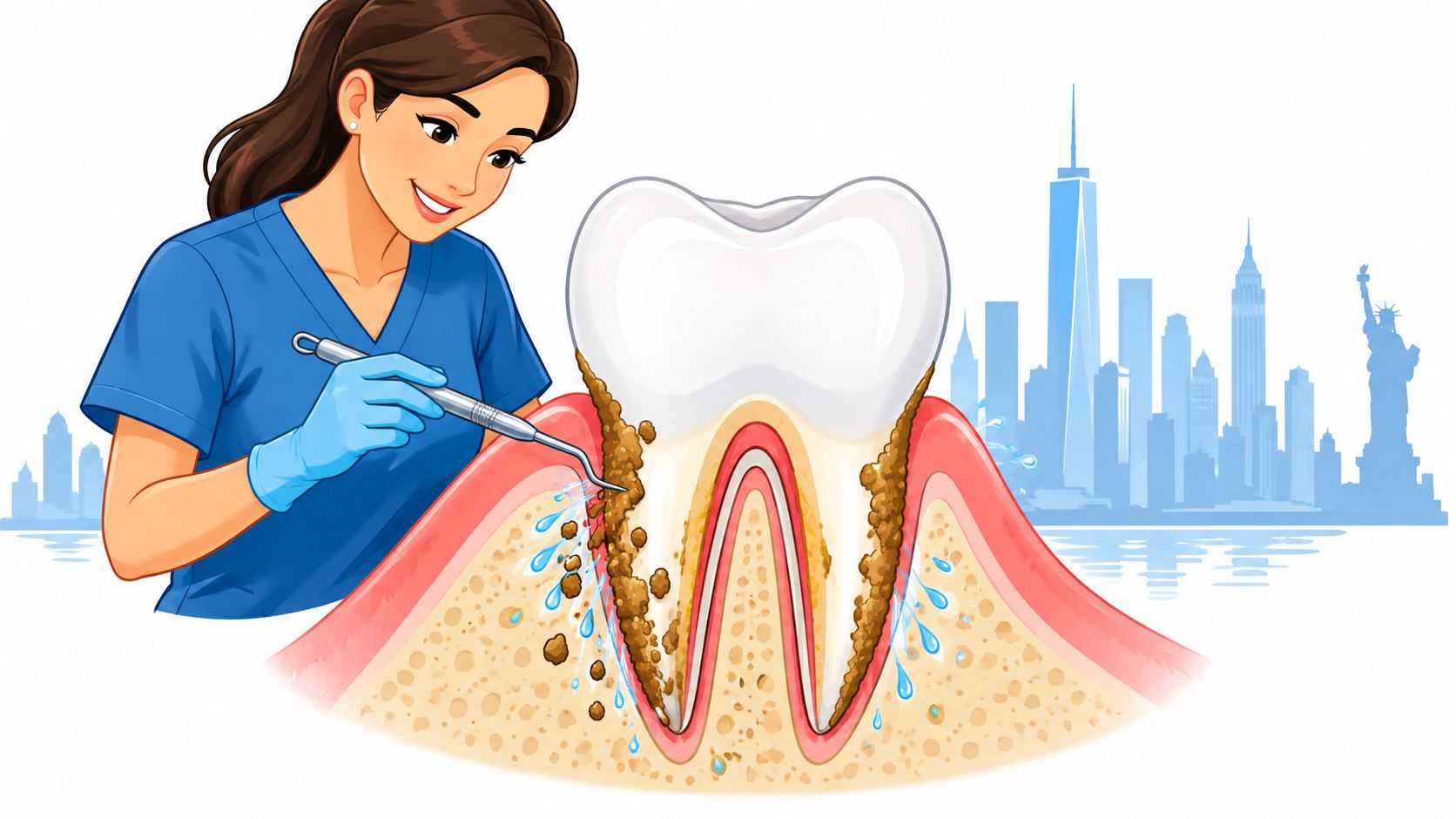
A deep cleaning is scaling and root planing, the standard non-surgical periodontal therapy. Think of a wooden deck where grime has settled between the boards, ordinary sweeping handles the surface, but the dirt between the cracks needs a tool that reaches down into the gaps.
The two parts, in plain language
Scaling removes plaque and tartar from above and below the gumline. Root planing smooths the root surface so bacteria have a harder time sticking again, and so the gum tissue has a cleaner surface to reattach to as it heals. That distinction matters because the treatment is aimed at infection control, not just polishing.

How it differs from a routine cleaning
A standard cleaning focuses on the exposed tooth structure and the easy-to-reach edges of the gums. A deep clean reaches below the gumline, often with local anesthesia, because the work is happening where ordinary instruments and brushing can't fully access the root surface.
The language can be confusing, but the terms usually mean the same thing in everyday use. Deep cleaning is the patient-facing phrase, and scaling and root planing is the clinical name for the periodontal procedure.
How Dentists Decide You Need One
The recommendation usually starts with measurements, not guesswork. A periodontal probe, which is a thin ruler marked in millimeters, is placed gently around each tooth to map pocket depth and bleeding.
The numbers that matter in the chair
A review in the NIH literature states that scaling and root planing should be performed at sites with periodontal probing depths of 5 mm or greater after adequate home care or biofilm control is achieved. NIH review on scaling and root planing indications
The American Academy of Periodontology's clinical case definition of periodontitis includes detectable interdental clinical attachment loss at at least 2 non-adjacent teeth, or buccal or oral attachment loss of 3 mm or more with pocketing greater than 3 mm at at least 2 teeth. ADA summary of periodontitis case definition
What the chart tells the dentist
A single bleeding site is handled differently from widespread bleeding across several teeth. The full picture also includes radiographs, bone levels, recession, and mobility, because a pocket number by itself doesn't tell the whole story.
| Pocket Depth | Likely Diagnosis | Recommended Cleaning |
|---|---|---|
| 1 to 3 mm | Usually healthy or near-healthy tissue | Routine cleaning |
| 4 to 6 mm | Early to moderate periodontal disease | Deep cleaning |
| 7 mm or more | More advanced disease, often with deeper infection burden | Deep cleaning, then possible surgical follow-up |
The threshold for treatment can be lower when other risks are present, such as smoking, diabetes, hormonal change, or family history. In a Manhattan dental office, that diagnosis is based on measured disease activity, not convenience or insurance timing.
The pocket chart is often the point where a dentist may discuss whether a surgical step could be needed later, which is why some patients are also referred for procedures such as osseous surgery when bone defects are present. Osseous surgery overview
What Happens During the Visit
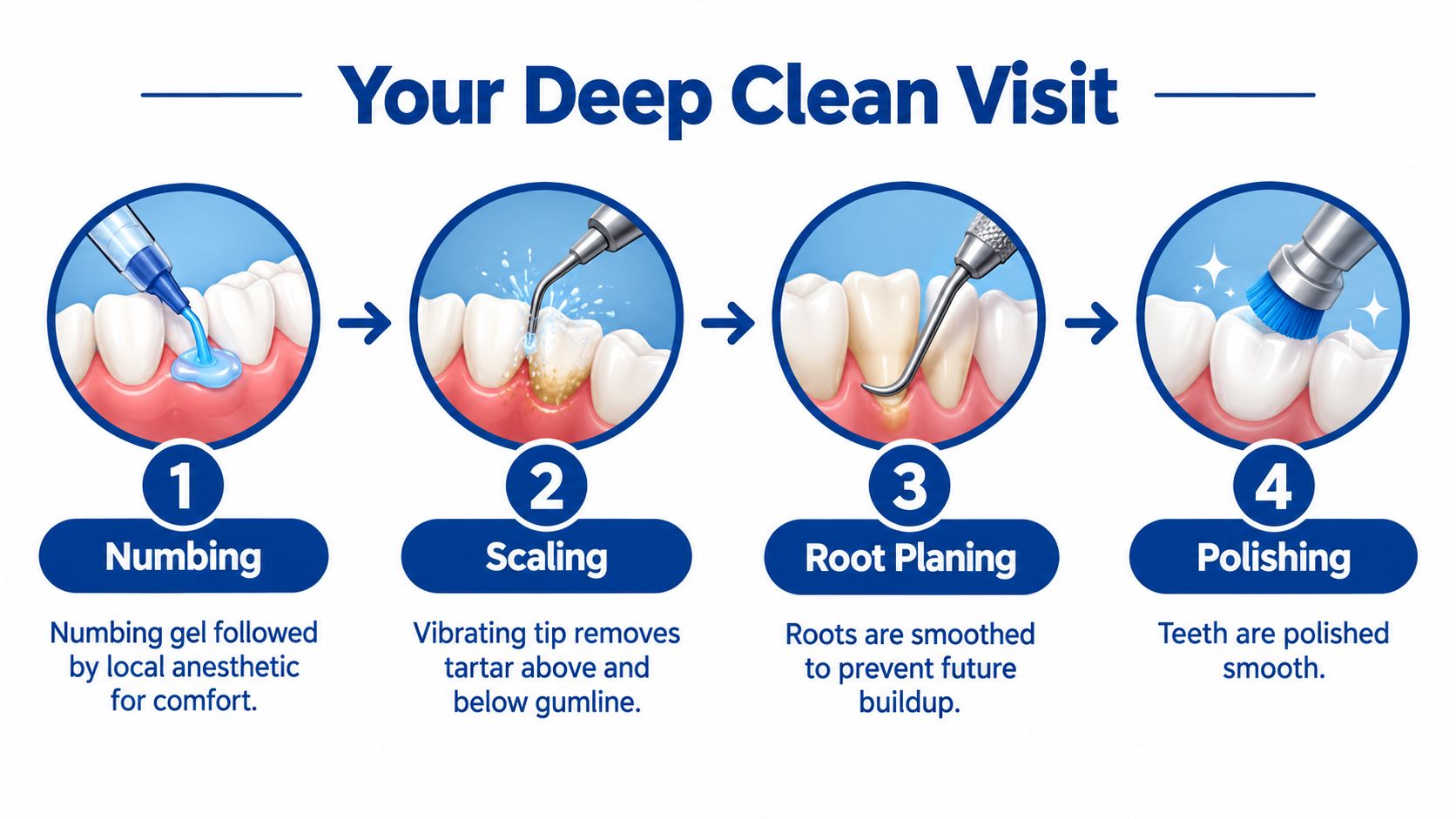
A deep cleaning visit is usually more comfortable than people expect because numbing comes first. The team typically starts with topical gel, then local anesthetic, so the deeper work stays manageable.
The sequence a patient actually feels
The hygienist or dentist usually treats the mouth in quadrants, often one or two at a visit, so the tissue doesn't get overworked. An ultrasonic scaler then vibrates through hardened calculus while water flushes debris away, followed by hand instruments that smooth the root surface below the gumline.
The goal isn't to “scrape harder.” The goal is to remove the deposits that are feeding inflammation and leave the root surface smooth enough for healing.
At the end, teeth are polished with a gritty paste, and stubborn pockets may sometimes get an antibiotic placed locally if the clinician thinks it's appropriate. A visit can take about 45 to 90 minutes per quadrant, depending on how much buildup is present and how deep the pockets are.
What the sensations are like
Most patients feel pressure and vibration more than pain. Cold sensitivity can show up afterward, and the sound of instruments against tooth structure can seem strange the first time, but it's harmless.
What the Research Says About Results
A deep cleaning is a reset, not a cure. The published evidence shows that scaling and root planing can produce measurable periodontal improvement, but the size of that change depends on how deep the pockets were to begin with and how well the patient maintains the result.
What improvement usually looks like
Research summaries report that sites with probing depths of 4 to 6 mm typically improve by about 1 mm in probing depth and gain about 0.5 mm in clinical attachment. Sites of 7 mm or more average about a 2 mm probing-depth reduction and about a 1 mm attachment gain. SRP outcome summary
Clinical evidence also shows that SRP reduces probing depth and bleeding on probing, and adjuncts can help in certain pockets, although the added benefit is often modest and site-specific. Clinical trial summary of SRP outcomes
Why some cases need more than one visit
Deeper pockets are harder to clean thoroughly in one pass, and that is one reason treatment is sometimes staged. Ongoing studies are still comparing full-mouth and quadrant-based approaches, which shows there's still nuance in how dentists choose the protocol for different cases. ClinicalTrials.gov study on SRP approaches
Key takeaway: the procedure often lowers inflammation enough to stabilize the gums, but it works best when the patient keeps up with home care and periodontal maintenance.
In the long term, the true value is stability. One clinical study reported that at 12 months, 71.2% of teeth with initial Class 1 mobility and 42.2% with Class 2 mobility became clinically stable after non-surgical periodontal therapy. Clinical stability after non-surgical periodontal therapy
| Baseline Pocket Depth | Disease Stage | Avg. Depth Reduction | Typical Bleeding Reduction |
|---|---|---|---|
| 4 to 6 mm | Moderate periodontal disease | About 1 mm | Bleeding usually decreases as inflammation settles |
| 7 mm or more | More advanced periodontal disease | About 2 mm | Bleeding often improves, but deeper sites may remain active |
| Sites with ongoing plaque retention | Active disease risk | Variable | Improvement depends heavily on maintenance |
Recovery and How to Tell It Worked
The first few days usually feel like a healing period, not a setback. Mild tenderness, slight bleeding, and gum swelling can show up after the visit, with swelling often peaking around day two before it starts to fade.
What to do at home
A soft diet for 24 to 48 hours helps the tissue calm down. Gentle brushing with a soft-bristle brush is still important, and over-the-counter ibuprofen can help with soreness if it's safe for the patient to take it.
- Brush gently: Clean the teeth without scrubbing the gums.
- Choose softer foods: Give the tissue a short break from hard chewing.
- Skip forceful rinsing: Let the area settle instead of disturbing the clotting and healing surface.
- Avoid straws: Strong suction can irritate sensitive tissue.
Severe throbbing pain, fever, a bad taste that suggests infection, or bleeding that keeps going beyond three days should trigger a call to the office. That kind of follow-up is different from the normal tenderness that comes with healing.
How to tell the treatment worked
Success starts showing up in the mirror and at the follow-up visit. Gums often look pinker and firmer within two weeks, bleeding during brushing usually drops by week four, and the 6 to 8 week recheck should show whether pocket depths have shrunk from baseline.
Deep Clean Dental Care on the Upper East Side
At Prosth & Co. on Manhattan's Upper East Side, periodontal care fits into a broader treatment plan, not a one-off cleaning. A typical path starts with a full periodontal exam, charting, and radiographic review, then moves to staged treatment, often one quadrant at a time under local anesthesia, with a re-evaluation appointment about six to eight weeks later to compare pocket depths against the starting chart.
What that visit can connect with
Periodontal care often overlaps with other needs, especially for patients managing diabetes or cardiovascular risk, so coordination matters. The practice also works alongside referring general dentists in Manhattan and can fold deep cleaning into longer-term maintenance, restorative planning, or oral surgery timing when that makes sense.
Prosth & Co. offers deep cleaning as part of its periodontic services, and it also supports related needs such as implants, endodontics, pediatric care, and oral surgery when the case calls for a broader team. For a patient who is already thinking about cleaning and exams, new patient visits, x-rays, or a future restorative plan, that kind of coordination can keep the next step clear.
What to bring and how to book
Recent x-rays and a current medication list help the team plan safely, and insurance pre-authorization may be needed for procedure code D4341. New patients should ask about consultation timing, payment options, and whether the office has a wait list for earlier periodontal evaluation.
An early visit matters more than many realize, because pocketing and bleeding tend to develop gradually before becoming painful. For Manhattan patients searching for a dentist near me, a dentist in Manhattan, or a trusted option for family and specialty care, a periodontal consultation can be the point where the problem is caught before it becomes a bigger restorative issue.
If bleeding gums, bad breath, or deep pockets are getting in the way of daily comfort, Prosth & Co. can evaluate the gums, explain whether a deep cleaning is appropriate, and plan the next steps around healing and maintenance. Visit Prosth & Co. to request a periodontal consultation on Manhattan's Upper East Side.

Founder and lead prosthodontist of Prosth & Co. on Manhattan's Upper East Side. DDS, Columbia University; Prosthodontics certificate and MMSc in Oral Biology, Harvard School of Dental Medicine; Implantology fellowship, Columbia University.
Meet Victoria →