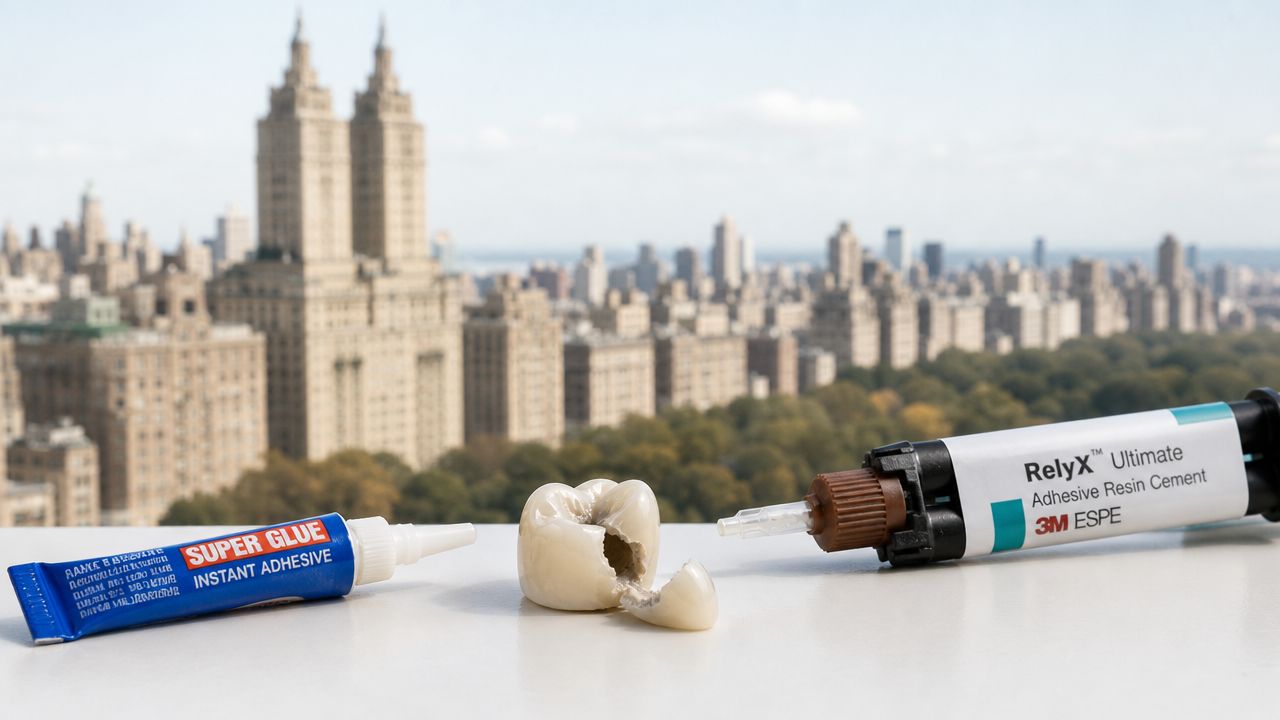
A crown comes off on the way to work. A veneer shifts before dinner. A back tooth chips the morning of an important meeting in Manhattan. In that moment, many people do the same thing. They search for non toxic super glue for teeth and hope there's a fast, harmless way to hold everything together until they can be seen.
That search usually starts from panic, not bad judgment. The problem is that the question points in the wrong direction. The key issue isn't whether a glue sounds “non-toxic.” It's whether the material was made and cleared for use inside the mouth, where saliva, heat, pressure, and chewing create a completely different environment from a broken mug or household repair.
Table of Contents
- A Dental Emergency on the Upper East Side
- Why Household Super Glue Is a Danger to Your Teeth
- Professional Dental Adhesives vs Store-Bought Glue
- What to Do Right Now for Your Broken Tooth
- Lasting Solutions from Your NYC Prosthodontist
- Schedule Your Visit at Prosth & Co. on the Upper East Side
A Dental Emergency on the Upper East Side
A dental emergency rarely happens at a convenient time. It happens while getting ready for an event, eating lunch between meetings, or trying to make it through a normal day in New York City without adding one more problem to the list. When a crown falls off or a front tooth chips, the first instinct is often to fix the appearance fast and ask questions later.

That's why the search for non toxic super glue for teeth is so common. But as discussed in this review of why “non-toxic” misses the real question, what matters is whether the product is engineered and cleared for intraoral use. The mouth is a high-moisture, high-friction setting. Consumer adhesive isn't built for that.
For patients on the Upper East Side looking for an emergency dentist near me in Manhattan, the most useful first step is to slow down before trying a home repair. A loose crown, denture problem, broken veneer, or chipped tooth may feel cosmetic at first, but the wrong temporary fix can turn a manageable visit into a more complicated restorative case.
Most same-day dental panic comes from uncertainty. The tooth may look worse than it feels, but the safe response is still professional evaluation, not a hardware-store solution.
Adults searching for a dentist near me, a cosmetic dentist near me, or an emergency dentist in Manhattan usually want the same thing. They want to protect how the tooth looks, avoid pain, and keep the situation from getting worse before they can get to the office. That's a reasonable goal, and it's exactly why a calm, clinically sound plan matters.
Why Household Super Glue Is a Danger to Your Teeth
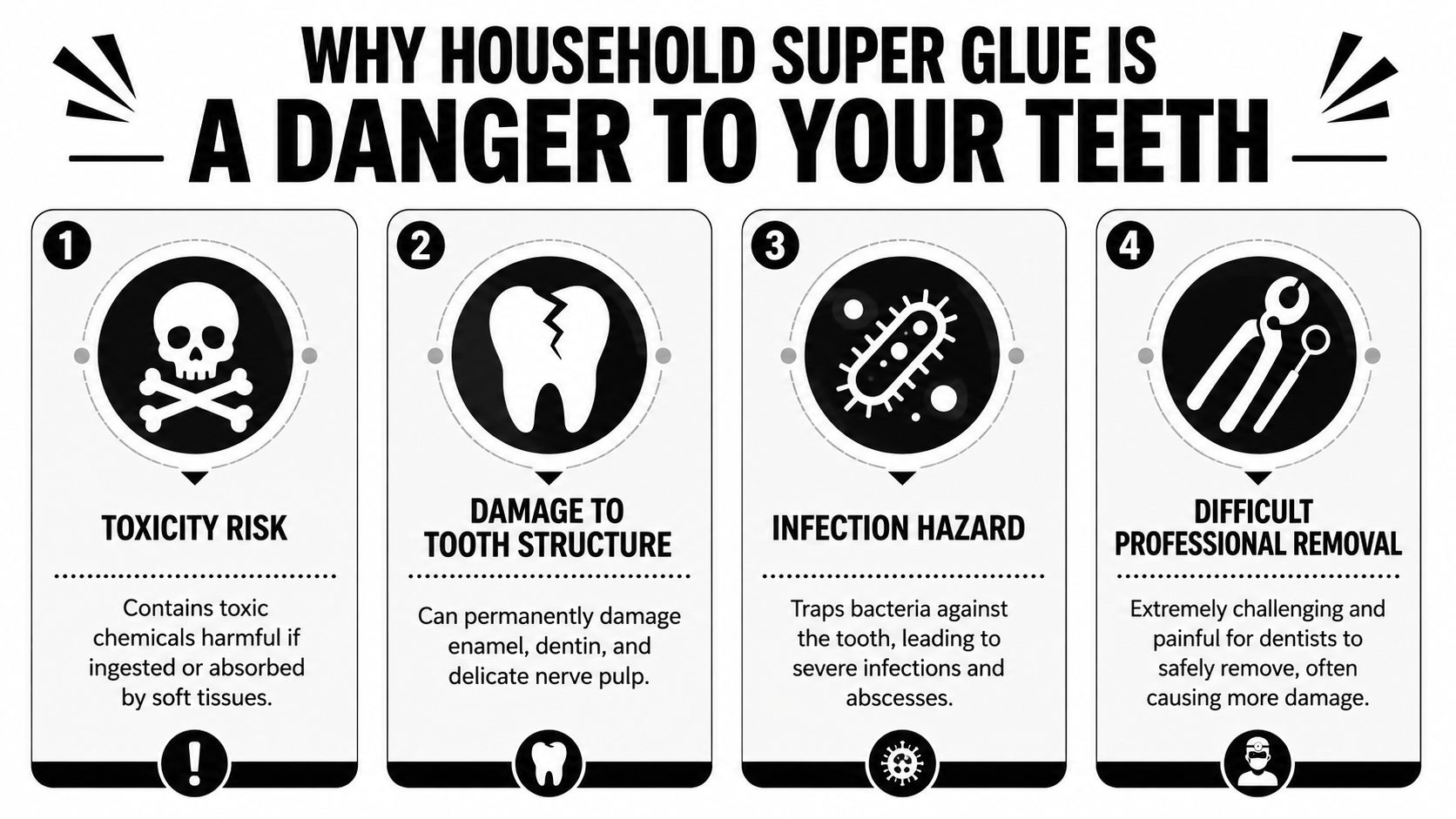
Patients often ask whether super glue is "non-toxic." That question points in the wrong direction. Super glue is cyanoacrylate, and Poison Control notes that it is generally not poisonous once dry. In a dental emergency, the larger concern is whether it can place a broken tooth, crown, or veneer accurately, protect the tooth underneath, and hold up safely in a wet, high-pressure environment. It cannot.
What actually makes it dangerous
The mouth is difficult on materials. Saliva, tongue movement, temperature changes, and chewing forces all work against a quick home repair. Poison Control also warns that saliva can loosen super glue from teeth or gums within a short period, so a patient may create a new problem only to have the bond fail soon after.
Fit matters just as much as sticking power. If a crown or broken fragment goes back even slightly off position, it can change the bite, press into the gumline, trap food and bacteria, or place extra force on an already damaged tooth. I see this after do-it-yourself repairs. What felt stable at home often arrives inflamed, misaligned, and harder to restore cleanly.
The risks patients usually discover later
Some problems happen right away. Others show up after the tooth starts hurting or the restoration comes loose.
- Accidental bonding to soft tissue can stick the lips, cheek, or gums to a tooth or restoration.
- An incomplete or distorted seal can leave openings where saliva and bacteria collect.
- A brittle repair under normal chewing can fracture and expose the tooth again.
- Residue on the tooth or restoration can make professional recementation or repair more difficult.
Practical rule: If a product was not made for oral tissues, saliva, and bite pressure, it should not go in your mouth.
There is another issue patients do not always consider in the moment. Super glue can lock a damaged piece into the wrong position, which may hide the problem briefly while irritation and contamination continue underneath. A case that might have been managed with a straightforward office repair can turn into a more involved restoration, including professional dental bonding for a chipped or damaged tooth or replacement of the original work.
For patients searching for a tooth extraction, restorative dentistry, or an emergency dentist in New York City, the takeaway is simple. Household super glue is dangerous to teeth because it is the wrong material for the biology, fit, and forces inside the mouth.
Professional Dental Adhesives vs Store-Bought Glue
The question shouldn't be “Is there a non toxic super glue for teeth?” The better question is “What makes a dental adhesive safe and usable in the mouth?” That answer is where professional materials and household glues separate completely.
Why the materials are not interchangeable
Medical and dental literature on cyanoacrylate use in oral procedures shows that medical-grade cyanoacrylate adhesives can be used intraorally by professionals because they are formulated for biocompatibility and polymerize rapidly in the presence of saliva or blood to form a hard barrier with hemostatic and bacteriostatic effects. That does not make household super glue acceptable. Household versions are not formulated for oral biocompatibility and can cause adverse tissue reactions.
That distinction matters in restorative dentistry. A dental professional isn't just trying to make something stick. The material has to work with the tooth, the gum tissue, the bite, and the long-term treatment plan. It must allow accurate seating and support a restoration rather than compromise it.
Patients who need repair of a chipped edge or restoration often end up needing clinically appropriate materials such as those used in dental bonding for damaged teeth, not a consumer adhesive that hardens unpredictably in the mouth.
Household Glue vs Professional Dental Cement
| Feature | Household Super Glue | Professional Dental Cement |
|---|---|---|
| Intended use | General household bonding | Dental use by trained clinicians |
| Oral biocompatibility | Not formulated for oral tissues | Chosen for intraoral use |
| Fit and seating | Can lock a restoration in the wrong position | Supports precise placement |
| Behavior in moisture | Reacts quickly but unreliably for dental repair | Selected for the oral environment |
| Effect on future treatment | May complicate removal and repair | Used within a planned restorative process |
A useful comparison is a temporary patch on a leaking pipe. It may hold briefly, but it doesn't restore the system it was never designed to serve. The same is true here. A proper dental adhesive is part of treatment. Household glue is just adhesion without control.
What to Do Right Now for Your Broken Tooth
A broken tooth, lost crown, or loose veneer needs a calm first response. The priority is preserving the tooth and any restoration, keeping the area clean, and preventing a bad temporary fix from making the final repair harder.
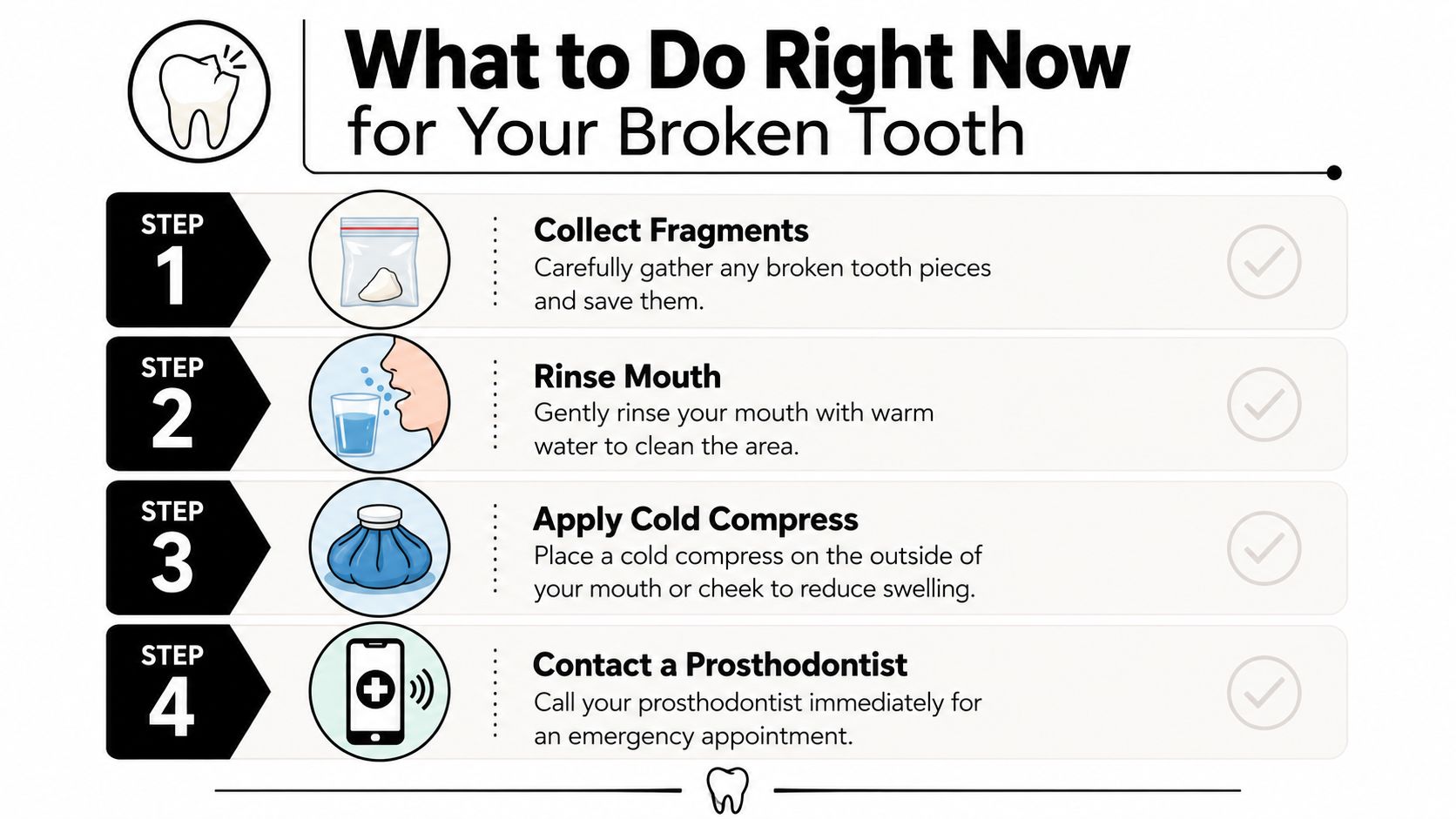
The first visual guide patients often find helpful is below.
Safe first steps
Guidance for loose crowns and veneers notes that the best immediate action is not finding an adhesive, but preserving the restoration, keeping the area clean, and contacting an emergency dentist. Household glues can prevent a dentist from being able to properly re-cement the original restoration.
For a patient in Manhattan dealing with this right now, the safest sequence is:
- Call a dentist promptly. If the tooth is painful, visibly cracked, or the bite feels wrong, ask for an emergency visit.
- Rinse gently with warm water. Clean the mouth without scrubbing the area aggressively.
- Save the crown, veneer, or tooth fragment. Keep it in a clean container and bring it to the appointment.
- Skip super glue completely. A fast bond is not the same thing as a safe one.
- Use only products intended for temporary oral use if absolutely necessary. A pharmacy temporary dental cement or denture adhesive may serve as a brief stopgap until the appointment.
- Eat carefully. Choose soft foods and chew on the other side.
- Manage discomfort with standard over-the-counter pain relief if appropriate for that patient.
This short video may help patients understand the difference between a temporary problem and one that needs urgent treatment.
When the situation is urgent
Some situations shouldn't wait.
- Significant pain that doesn't settle may mean the tooth or nerve needs attention.
- Swelling or drainage can point to infection and needs prompt care.
- Sharp edges cutting the tongue or cheek should be assessed quickly.
- A restoration that won't stay out of the bite can place damaging force on the tooth.
Keep the piece. Keep the area clean. Keep glue out of the mouth. Then get the tooth assessed.
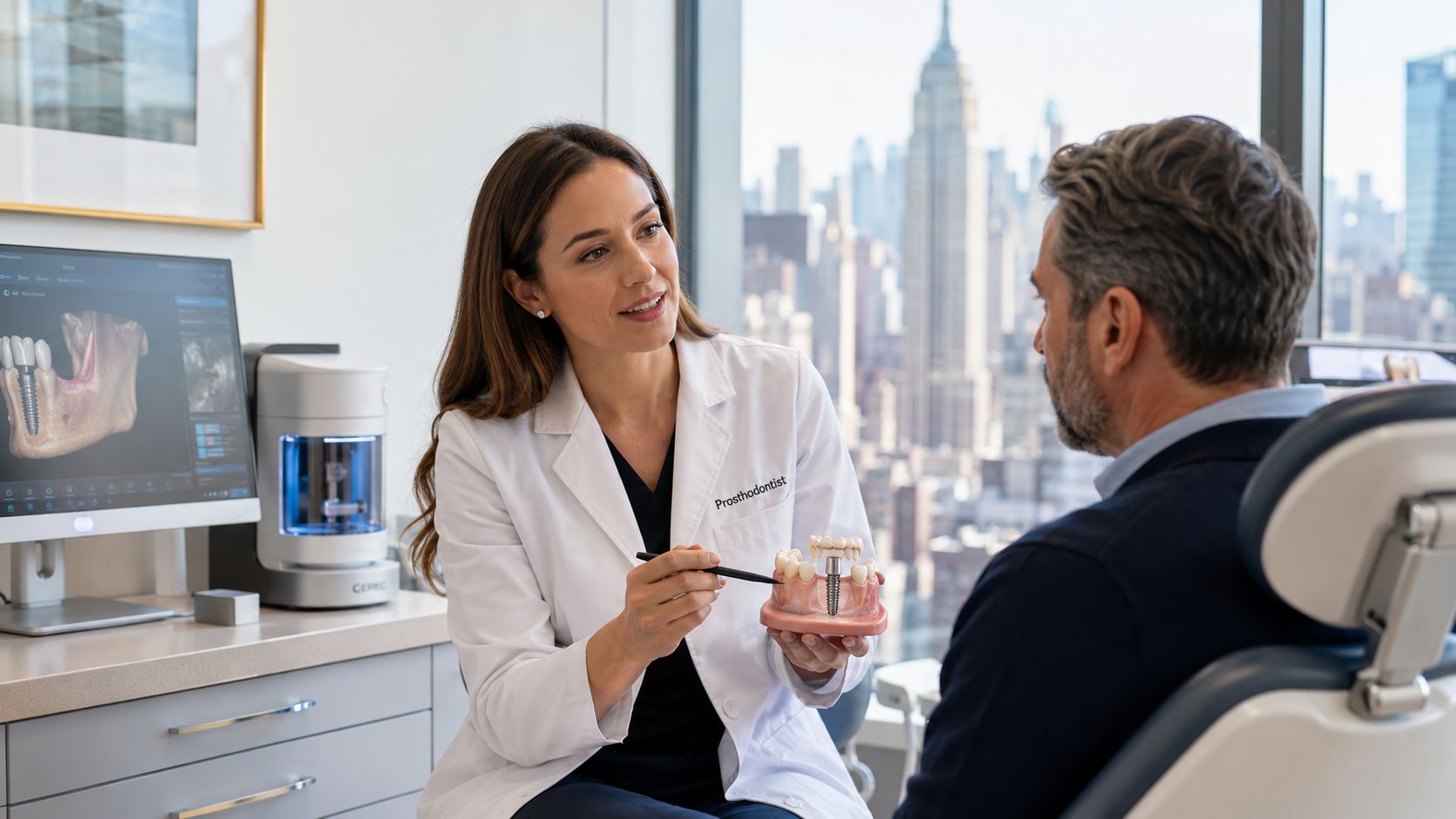
Lasting Solutions from Your NYC Prosthodontist
The right long-term fix depends on what failed. A crown can come off because the cement gave way, because decay formed underneath, because the tooth cracked, or because the bite has been overloading that area for months. Those situations do not get the same treatment, and they should not.
Repair when the tooth can be saved
If the restoration is intact and the tooth structure is still sound, re-cementation may be possible. That only works after the area is cleaned, the fit is checked carefully, and the bite is adjusted if needed. A crown that is pushed back on without that evaluation can trap bacteria, sit high, or place damaging force on the tooth every time you close.
Small chips can often be repaired with conservative treatment. In other cases, a worn or weakened restoration is better replaced than patched. The trade-off is straightforward. Preserving more natural tooth is always preferable when it is predictable, but a short-term repair is not a good bargain if it leaves the tooth vulnerable to another fracture.
Patients who search for cosmetic dentist near me or restorative dentistry often expect the main question to be how the tooth looks. In practice, fit and function usually decide whether that result will hold up.
Replacement when the damage is more serious
Some teeth need more than a reattachment. A fractured crown may need to be remade. A tooth with deep structural loss may need a new crown, build-up, or another form of restoration that gives it proper support. If the tooth cannot be saved, treatment may include tooth extraction followed by replacement with an implant, bridge, or denture, depending on the condition of the tooth, the surrounding bone, and the bite.
Household super glue makes these cases harder, not easier. As noted earlier, DIY glue repairs can contribute to tissue injury and complicate proper treatment. I often have to remove residue, assess whether the tooth was seated incorrectly, and check whether the gum has been irritated or sealed over debris before we can even start the actual repair.
At Prosth & Co., the plan may involve crowns and bridgework, ceramic restorations, veneers, implant crowns, dentures, or a broader reconstruction when several teeth are involved. The goal is a restoration that fits correctly, protects the tooth or implant, and feels natural when you eat and speak.
Schedule Your Visit at Prosth & Co. on the Upper East Side
A patient who comes in after a broken tooth or lost crown is usually carrying two concerns at once. One is clinical. The other is emotional. They want to know whether the tooth can be saved, and they want the situation to stop feeling urgent.
What an emergency or new patient visit looks like
At 47 E 77th St, Suite 207, New York, NY 10075, the visit begins with a careful assessment of what failed and why. That may include modern imaging, close evaluation of the tooth and restoration, and a review of symptoms such as pain, pressure, looseness, or sensitivity. Patients are then walked through the options in plain language.
That process matters for people searching online for a dentist in New York, NY, dental implants near me, or a local office for cleaning and exams, dental x-rays, new patient exams, and emergency care. Even when the concern starts with one loose crown, the appointment often reveals the larger issue that needs attention, such as bite stress, decay under a restoration, or fracture patterns from grinding.
A calm next step in Manhattan
The office experience should reduce stress, not add to it. Patients can expect a modern setting, a supportive team, and a treatment discussion that explains what can be done right away and what should be planned next. Some people need a simple recementation. Others need a replacement crown, cosmetic repair, implant evaluation, or broader restorative dentistry.
For adults on the Upper East Side who have been searching for dentist near me after a dental surprise, the key message is simple. Don't risk the tooth with a household fix that wasn't meant for the mouth. Get the restoration and the tooth evaluated properly, then move forward with a treatment plan that protects both health and appearance.
If a crown has come off, a tooth has chipped, or a temporary fix is starting to feel risky, contact Prosth & Co. to schedule care at the Upper East Side office. Patients can call (646) 874-1877 or request an appointment through the practice's online booking options for emergency dentistry, restorative care, cosmetic treatment, and prosthodontic evaluation in Manhattan.
Related topic: Learn more about Preventive And General Dentistry.

Founder and lead prosthodontist of Prosth & Co. on Manhattan's Upper East Side. DDS, Columbia University; Prosthodontics certificate and MMSc in Oral Biology, Harvard School of Dental Medicine; Implantology fellowship, Columbia University.
Meet Victoria →